Case Study • Defense / Aerospace • App Modernization
Inconsistent Reviews: How a Defense Prime Automated Performance Appraisals With .NET

The Enterprise Challenge
Custom Application Development Services for a Complex Enterprise HR Process
A major defense and aerospace manufacturer had developed a well-defined, multi-step process for managers to complete performance appraisals and salary reviews across its business units. The process was thorough – covering performance evaluation, approval routing, merit calculation by job grade, and departmental salary budget management. On paper, it was the right framework for a complex organization managing compensation decisions across thousands of employees in multiple divisions.
The problem was execution. The process lived in policy documents and paper forms, not in a system that enforced it. Managers with heavier operational workloads completed reviews late. Some skipped sections. Others applied merit calculations inconsistently, working from their own interpretation of the applicable ranges rather than a governed calculation. And without a structured approval workflow connecting the performance review to the salary decision, the two processes were often out of sequence, creating situations where compensation decisions were made before performance reviews were finalized or approved.
The organization needed a custom application development services solution that would take its established review process and encode it into a governed application that managers could not circumvent – not because they were prevented from doing the right thing, but because the application would guide them through it systematically and prevent advancement until each step was correctly completed.
Strategic Trigger
Process Inconsistency Became a Governance and Budget Problem
The forcing function was the cumulative cost of inconsistency at scale. For an organization with multiple business units, each with its own workforce profile, the variance in how managers completed performance reviews created compounding problems downstream. Merit increases calculated without a governed framework produced decisions that were difficult to defend to HR and finance. Reviews completed late delayed salary decisions that employees and managers both expected on a defined schedule. And without a system maintaining salary budget balances in real time, HR discovered departmental budget overruns after compensation decisions had already been communicated – a situation that was expensive to reverse and damaging to manager credibility.
Leadership recognized that the process itself was sound. The instructions existed. The merit ranges were documented. The budget allocations were defined. The failure was in the implementation layer: there was nothing that ensured managers actually applied those rules correctly, in sequence, on time. A policy is not an enforcement mechanism. An application is. For a broader look at how workflow automation decisions translate policy into enforced process, 10 Power Automate Enterprise Processes to Automate in Year One covers the sequencing logic that determines which processes deliver the most governance value when automated.
The decision to invest in a custom application rather than adapting a generic HR system reflected a deliberate architectural choice. The organization’s review process was specific enough – with business-unit-level configuration, job-grade-specific merit ranges, and departmental budget guardrails that varied by division – that a standard product would require the organization to compromise its established process to fit the software. That was the wrong inversion. The software needed to fit the process.
Is a critical business process in your organization defined in policy but not enforced in a system?
If performance reviews, approval workflows, or budget compliance processes rely on manager discipline rather than system enforcement, the inconsistency cost is real and measurable. A 15-Business-Day Microsoft Assessment identifies the specific application architecture that would encode your business rules and enforce your process without requiring a generic HR product to compromise how you work.
Request the Assessment
▶ Related Insight — A 60-second perspective from our channel
Stakes (What Happens If They Fail)
Compensation Decisions Made Outside Governance, Budget Overruns, and Legal Exposure
For a major defense and aerospace manufacturer managing compensation across a large, distributed workforce, the consequences of an ungoverned review process extended beyond administrative inconvenience. Salary decisions made without completing the required performance review created audit exposure: if an employee challenged a compensation decision, the organization needed to demonstrate that a documented, consistent process had been followed. A paper-based system with variable manager adherence could not produce that documentation reliably.
The budget dimension was equally material. When managers calculated merit increases without a system-enforced merit range calculator, the variance in individual decisions could push a department over its approved salary increase budget. Discovering this variance after decisions had been communicated to employees created a choice between absorbing the overage or reversing compensation commitments – neither of which was acceptable to an organization managing labor costs at enterprise scale.
The timeline problem compounded both risks. Reviews completed outside the defined schedule meant that salary effective dates slipped, creating payroll complications. In organizations where merit increases are tied to specific payroll cycles, a late review was not just an administrative failure – it was a financial event with cascading effects on payroll processing, employee trust, and the operational credibility of the HR function.
Constraints and Complexity
Multiple Business Units, Variable Merit Structures, and Budget Guardrails That Had to Be Airtight
The application needed to serve multiple business units with different review cycles, different workforce compositions, and different departmental budget allocations. A system that enforced a uniform process across all units would fail to accommodate the legitimate operational differences between divisions. The application needed to be configurable at the business-unit level – allowing HR to define review cycles, merit ranges, and budget parameters independently for each division – while enforcing the same governance structure across all of them.
The merit calculation requirement added technical complexity. Merit increase eligibility was not a single formula applied uniformly. It varied by job grade, by the applicable collective bargaining or compensation band the position fell under, and by the current cycle’s budget parameters. The application needed to surface the correct merit range for a given employee at the exact moment it was needed in the review workflow, without requiring the manager to look it up, interpret it, or apply it manually. An error in the merit range calculation logic was not an abstract technical defect – it was a payroll error affecting real compensation decisions.
The budget guardrail requirement was the most operationally critical constraint. The application needed to maintain a real-time view of each department’s salary increase budget utilization, alert managers before they submitted decisions that would exceed the allocation, and prevent final submission of out-of-budget decisions without an exception authorization from HR. For context on how this class of workflow governance design challenge is approached in complex Microsoft environments, Integration Governance and Change Control for Microsoft-Based SystemsPENDING-SCHEDULED covers the integration and exception management patterns that make enforcement architectures reliable.
▶ Related Insight — A 60-second perspective from our channel
Selection Rationale (Why They Chose i3solutions)
Senior .NET Specialists Who Had Solved Enterprise Workflow Governance Before
The organization required a development partner who understood the distinction between building a web application and encoding a governance framework into software. These are different problems. Building a form that collects data is straightforward. Building an application that enforces a multi-step approval process, calculates merit ranges by job grade, maintains real-time budget balances across a multi-division organization, and prevents process deviation at every stage requires both technical depth and the organizational experience to get the requirements right before a line of code is written.
i3solutions was selected as a Microsoft Gold Partner since 1997 with a documented track record in custom application development services for enterprise organizations with complex, rule-driven business processes. The Expert Delivery Model that i3solutions operates, staffing every engagement with senior-level .NET architects and developers only, meant that the practitioners who translated the business rules into application logic were the same people who understood the consequences of getting that translation wrong. No junior developers learning the domain while building a system that governed compensation decisions for thousands of employees.
The firm’s Enterprise Delivery Assurance model provided the governance structure that a system of this sensitivity required. The requirements documentation phase was treated as the most critical investment in the engagement – not as a preliminary step before the “real work” began, but as the work that determined whether every subsequent development decision would be correct. The Microsoft consulting services team’s experience in similar enterprise workflow applications provided the pattern recognition to identify the edge cases in merit calculation and budget enforcement that the initial requirements had not yet fully defined.
The Engagement Approach (Our Plan)
From Policy Document to Enforced Application
The engagement began with a discovery phase that treated the organization’s existing review process documentation as the starting specification – and then stress-tested every assumption in that documentation against the real operational conditions in each business unit.
PHASE 01
Discovery and Process Mapping
Structured sessions with HR leadership, business unit managers, and finance to document every step of the review process, every variation across business units, every job-grade-specific merit range, and every budget guardrail rule. The output was not a high-level summary of how the process was supposed to work. It was a precise specification of every state the application would need to manage, every transition it would need to enforce, and every calculation it would need to perform correctly. This phase was the highest-value investment in the engagement.
PHASE 02
Application Architecture Design
Designing the .NET application architecture: the workflow state machine governing each stage of the review process, the data model holding review cycles and merit range definitions by business unit and job grade, the budget tracking logic maintaining real-time departmental balance, the email notification system triggering manager action at the correct point in each cycle, and the approval routing that prevented salary review from beginning before performance review was completed and approved.
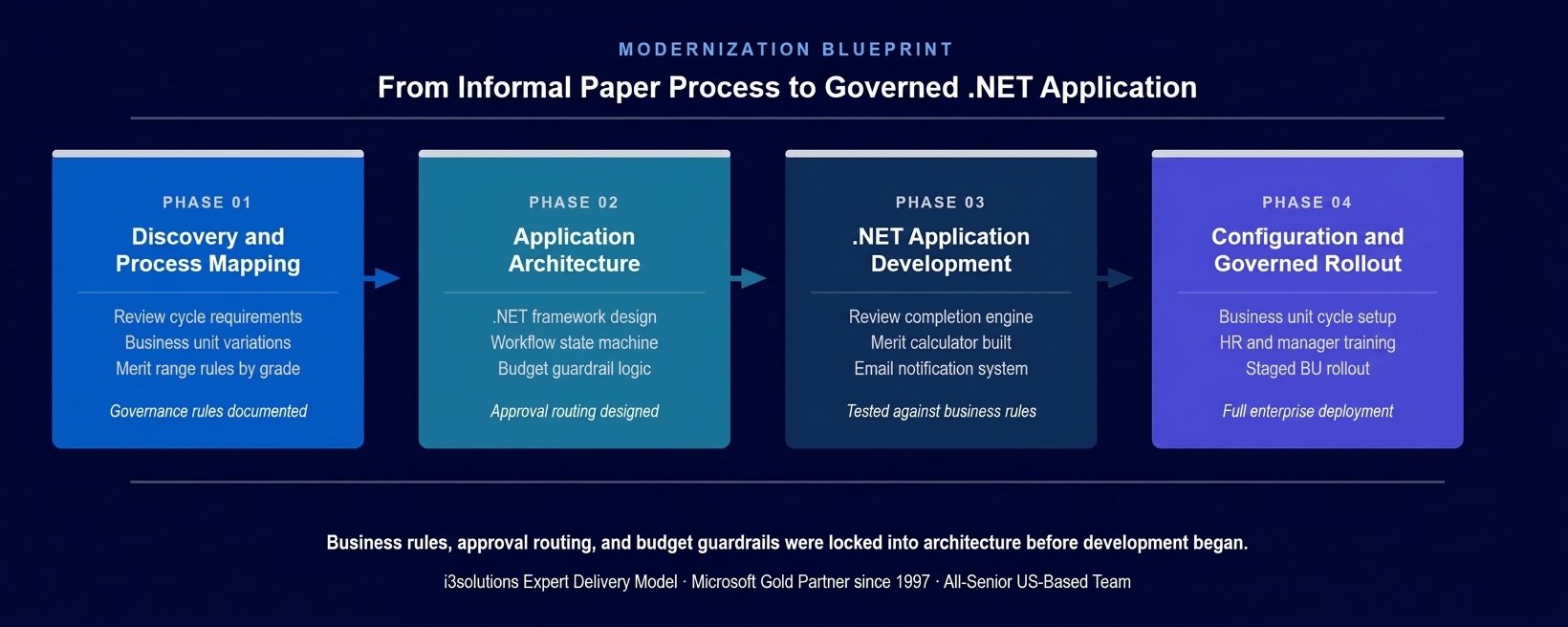
The four-phase implementation approach. Requirements documentation was treated as the highest-value investment in the engagement – getting the business rules right before development began.
PHASE 03
.NET Application Development
Building the
custom application development services solution on the Microsoft .NET framework: the review completion engine guiding managers through each section in sequence, the merit range calculator surfacing the applicable increase parameters at the moment of decision, the budget guardrail logic maintaining departmental balance in real time, and the email notification system automatically alerting managers to pending reviews and approaching deadlines. Each feature was tested against the business rule specification from Phase 1 before integration.
PHASE 04
Business Unit Configuration and Rollout
Configuring the application for each business unit: defining review cycles, uploading merit range structures by job grade, setting departmental budget parameters, and establishing the HR administrator permissions that would allow each unit’s HR function to manage its own cycle going forward. Phased rollout beginning with a controlled business unit to validate application behavior in production conditions before expanding to the full enterprise. Manager and HR training. Operational handoff with administrative documentation.
Execution Evidence
Every Stage of the Review Process Enforced by Application Logic
The application’s workflow engine managed the review process as a structured state machine. When HR configured a review cycle for a business unit – defining the review window, the eligible employee population, and the applicable merit parameters – the application automatically generated the manager assignments and triggered the notification sequence. Managers received an email directing them to log in and begin reviews, with deadline dates visible in the notification and in the application dashboard.
The review completion experience guided managers through each required section in sequence. The application prevented advancement to the next section until the current section was complete, eliminating the category of partial reviews that had been common in the paper-based process. When the performance review was finished, the application routed it to the appropriate approval chain – not by sending an email that could be ignored, but by moving the review into the approver’s application queue and preventing any salary action from beginning until approval was recorded.
Once approved, the merit range calculator surfaced automatically. The application determined the applicable merit increase range from the employee’s job grade and the current cycle’s parameters and displayed it to the manager alongside the salary review form. The manager entered a proposed increase; the application validated it against the calculated range and the department’s remaining budget balance. Proposals outside the merit range or exceeding budget triggered an alert before submission rather than a correction after the fact.
The honest challenge in this engagement surfaced during Phase 1 requirements sessions. The merit range rules were more complex than the initial process documentation indicated. Several business units had exception categories for specific job classifications that fell outside the standard grade-based calculation, and the rules governing when HR approval was required for exception requests had not been formally documented before the engagement. Surfacing these cases in requirements sessions rather than discovering them during user acceptance testing prevented a category of calculation errors that would have been visible to managers on the first day of production use – and difficult to explain given that the system was supposed to remove exactly this kind of inconsistency.
Technical Transformation
From Unenforced Policy to Governed Application
Before the application, the performance review process at this organization was a policy that depended entirely on manager discipline for its execution. The rules were defined. The merit ranges were documented. The budget allocations were set. But the system enforcing adherence to those rules was a combination of HR follow-up, email reminders, and manual tracking – tools that scaled poorly with manager workload and produced inconsistent results across divisions and review cycles.
After the application, the process was a governed workflow where every stage, every calculation, and every budget constraint was enforced by application logic rather than administrative follow-up. HR could configure any business unit’s review cycle, set the parameters, and trust that managers would be guided through the correct process by the system rather than reminded to follow it by email.
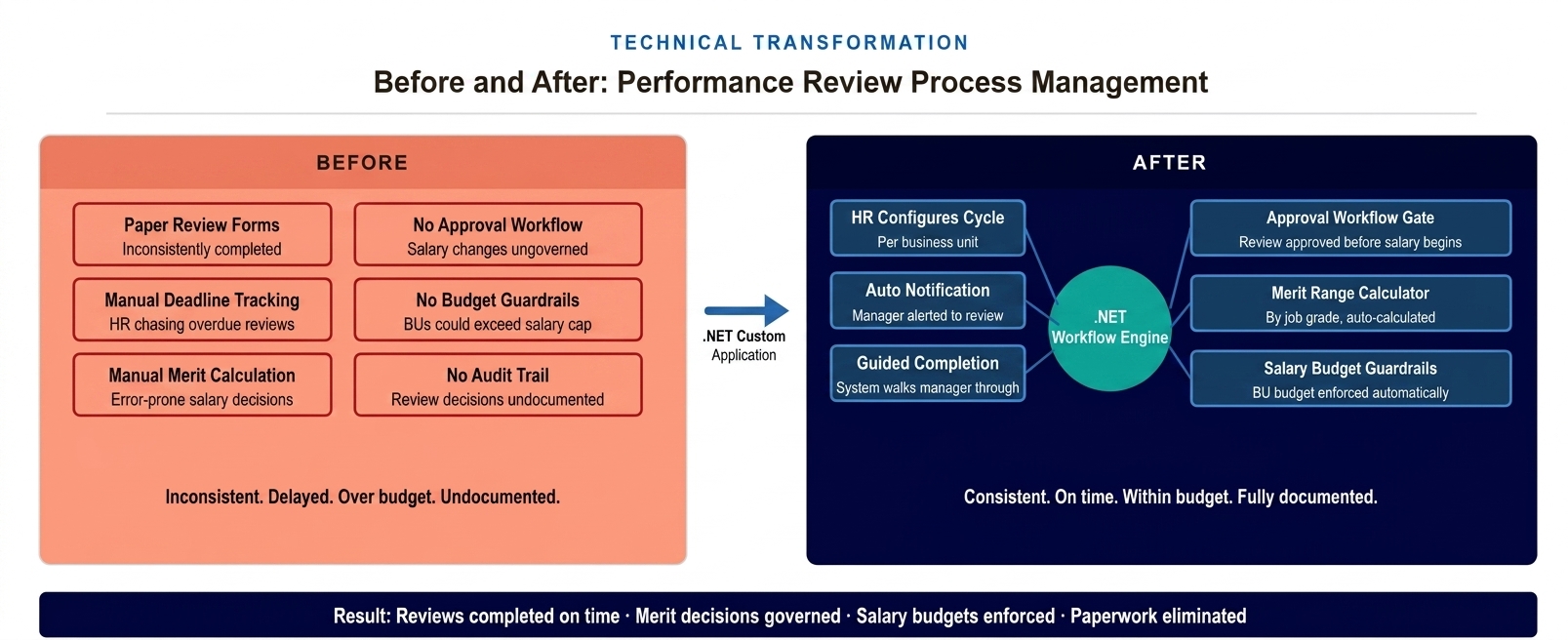
The architecture state before and after the application deployment. Paper forms and email follow-up replaced by a governed .NET workflow engine with merit calculation and real-time budget tracking.
The Governance Readiness Ladder that i3solutions applies to process automation assessments showed the organization at Level 1 (Ad Hoc) for this specific process: the rules were defined at the policy level but inconsistently applied, with no system enforcement and no audit trail. The delivered application placed the process at Level 3 (Governed): automated enforcement of every process step, approval routing that could not be bypassed, merit calculations produced by a governed calculator rather than manager interpretation, and a complete audit record of every review action producible from the system.
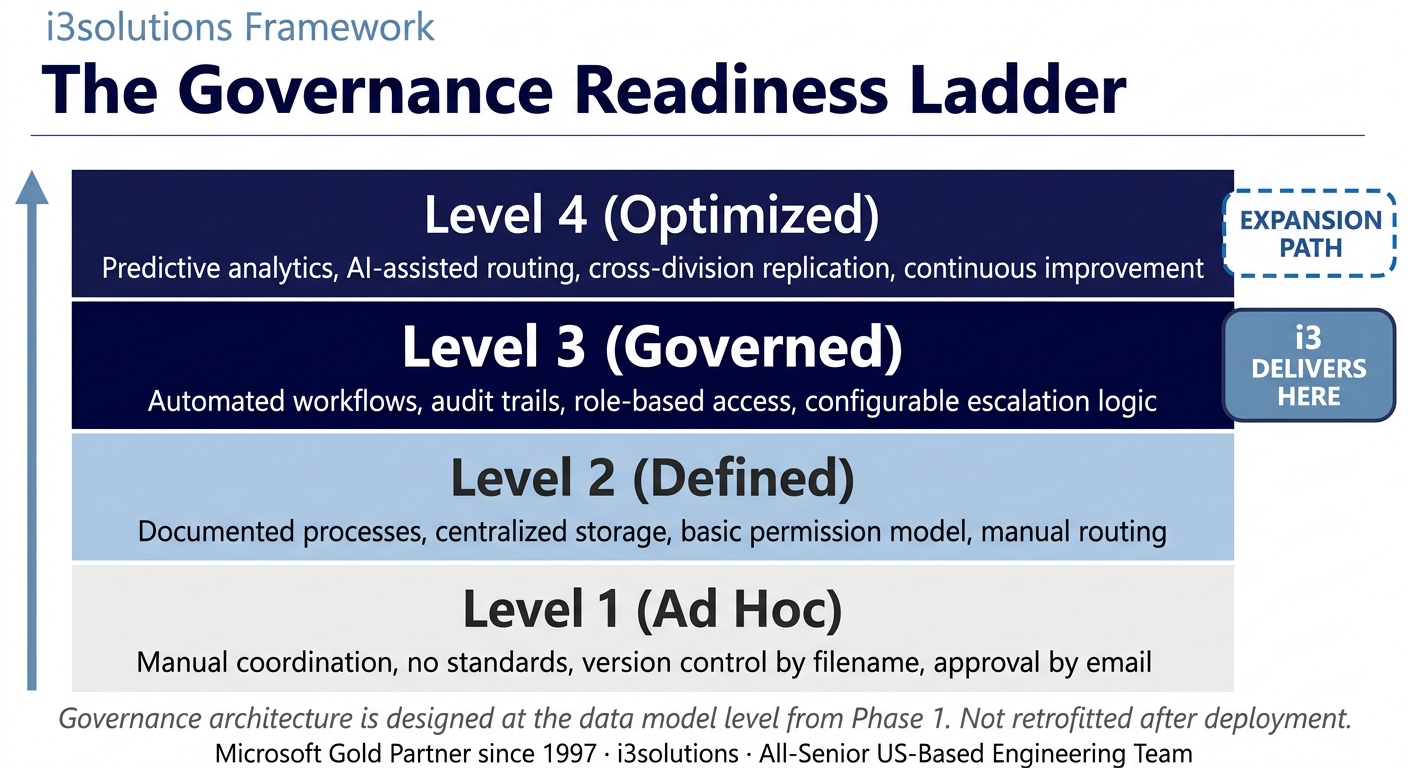
The Governance Readiness Ladder applied to this engagement. The .NET application delivered Level 3 for the performance review process. The configuration-driven architecture supports Level 4 as reporting and analytics requirements mature.
▶ Related Insight — A 60-second perspective from our channel
Measurable Outcomes
Reviews Completed on Time, Merit Decisions Governed, Budgets Enforced
| Metric | Before | After | Improvement |
|---|
| Review completion rate within defined cycle window | Variable – dependent on individual manager discipline, significant late completion rate | System-enforced deadline tracking with automated reminders; managers unable to skip the process | Review on-time rate increased significantly BENCHMARK-ESTIMATE |
| Process consistency across managers | Highly variable – some managers completed all sections, others skipped or abbreviated | Every manager guided through identical process in identical sequence by application logic | 100% process step completion enforced |
| Merit calculation accuracy | Manual calculation with reference documentation – error-prone, variable interpretation across managers | Automated merit range calculator by job grade applied consistently at point of decision | Calculation errors eliminated |
| Salary budget compliance | No real-time budget tracking – overruns discovered by HR after decisions made | Real-time departmental budget balance enforced by application before decision submitted | Budget overruns prevented at point of decision |
| Approval workflow enforcement | No structural gate between performance review and salary action – sequence often violated | Application prevents salary review from beginning until performance review is approved | Approval sequence structurally enforced |
| Audit documentation | Paper forms – no central record, no completion timestamp, no version history | Complete audit trail: who reviewed, when, what was approved, what merit decision was made | Full audit documentation from system |
| HR administrative overhead | Significant time spent chasing late reviews, correcting merit errors, reconciling budget overruns | Routine enforcement automated; HR attention to exceptions and strategic configuration only | 30-50% reduction in review cycle administration BENCHMARK-ESTIMATE |
[PENDING-CLIENT-QUOTE: insert 1-3 sentence outcome-focused quote in the client’s own language from a role matching the reader’s role.]
[Name or Role], [Organization type]
The primary outcome was the elimination of process inconsistency as a category. When every manager is guided through the same review sequence by the same application and prevented from advancing until each step is complete, the variance in review quality that characterized the paper-based process cannot exist. Industry benchmarks for enterprise HR workflow automation indicate that replacing manual follow-up processes with governed application enforcement typically reduces review cycle administration time by 30 to 50 percent. BENCHMARK-ESTIMATE For an HR function managing review cycles across multiple business units simultaneously, that efficiency represents a reallocation of HR capacity from administrative follow-up to strategic workforce planning.
The budget compliance outcome was structural. Preventing out-of-budget decisions at the point of manager submission rather than discovering them at the point of payroll reconciliation eliminates both the financial exposure and the organizational difficulty of reversing compensation decisions that have already been communicated to employees.
Review cycle improvement and HR overhead reduction percentages are drawn from industry benchmarks for enterprise HR workflow automation and require verification against client-specific measurement before publication. Process consistency, merit accuracy, and audit documentation outcomes are sourced directly from the engagement. BENCHMARK-ESTIMATE
Does your review process depend on manager discipline rather than system enforcement?
A Risk and Roadmap Assessment maps your current review or approval process against the custom application architecture that would encode your business rules, enforce your sequence, and maintain your budget guardrails – without requiring a generic HR product to compromise how your organization actually works.
Schedule the Assessment
Credibility Anchors
A Governed Application That Scales With the Organization
The performance review application was deployed to serve the organization’s current review cycle structure. The configuration-driven architecture – where HR administrators defined review cycles, merit parameters, and budget allocations through the application rather than through development changes – meant that the application could adapt to changes in the organization’s compensation structure, workforce composition, or review timing without requiring a new development engagement.
An HR administrator described the change simply: the first review cycle using the new system was the first time they could see, at any moment during the cycle, exactly which managers had completed reviews, which were overdue, and whether any department was approaching its budget limit. That visibility had never existed before.
The Rules of the Road established at engagement close defined how the application would be maintained and extended. Ownership and Accountability assigned named HR administrators responsible for each business unit’s cycle configuration and for reviewing the audit trail at the close of each review period. Security and Access defined how manager and HR administrator accounts were provisioned and how access changed when roles changed. Lifecycle and Records defined the retention policy for completed review records and the archival process for closed cycles. Release Discipline defined the process for requesting application changes and the testing requirements before any change to the merit calculation logic could be deployed to production.
i3solutions has completed more than 600 Microsoft implementations as a Microsoft Gold Partner since 1997. The specific challenge of translating complex compensation business rules into application logic that enforces them correctly across multiple business units is a class of problem we have encountered and solved across regulated and enterprise environments over nearly three decades.
Frequently Asked Questions
Custom Application Development Services for Enterprise Process Governance
What is custom application development services for performance management?
Custom application development services for performance management involves building a bespoke web application that enforces an organization’s specific review process, approval routing, merit calculation rules, and salary budget guardrails. Unlike off-the-shelf HR software that requires the organization to adapt its process to the tool, a custom application encodes the organization’s established rules directly into the workflow engine, ensuring that every manager follows the same process in the same sequence without exception.
Why do large enterprises need custom applications for performance reviews instead of standard HR software?
Large enterprises with multiple business units, diverse job grade structures, and complex merit calculation rules often find that standard HR software either cannot accommodate their specific workflow requirements or forces organizational compromises that undermine the consistency and governance the review process is designed to achieve. Custom application development services allow the organization’s established business rules to be encoded precisely into the application, including business-unit-specific review cycles, job-grade-specific merit ranges, and departmental budget guardrails that prevent salary decisions from exceeding approved limits.
How does a custom .NET application enforce review process consistency?
A custom .NET application enforces review process consistency by removing the option to skip steps. The application guides managers through each required section of the performance review in sequence, prevents advancement until each section is complete, requires explicit completion before the approval workflow is triggered, and blocks the salary review phase until the performance review has been approved. This architecture makes process deviation structurally impossible rather than simply discouraged by policy.
What is a merit range calculator in a performance review application?
A merit range calculator in a performance review application is a built-in calculation engine that determines the eligible merit increase range for a given employee based on their job grade, performance rating, and the budget parameters defined by the HR function for the current review cycle. Instead of requiring managers to look up merit ranges in separate documentation or calculate eligibility manually, the application surfaces the applicable range automatically when the performance review is complete and approved, reducing calculation errors and ensuring managers apply the correct merit framework.
How does custom application development enforce salary budget compliance?
Custom application development enforces salary budget compliance by maintaining a real-time salary budget tracker for each department that updates as managers submit merit increase decisions. The application alerts managers when a proposed increase would exceed the departmental budget allocation and prevents final submission of decisions that would breach the approved limit. This replaces the manual reconciliation process where HR discovers budget overruns after salary decisions have already been communicated to employees.
What should defense and aerospace organizations look for in a custom application development partner?
Defense and aerospace organizations evaluating custom application development partners should prioritize experience delivering web-based workflow applications in environments where process consistency and audit documentation are compliance requirements, not preferences. The partner should demonstrate a track record of translating complex business rules into application logic accurately, with a discovery and requirements phase rigorous enough to surface every edge case before development begins. An all-senior, US-based delivery team reduces the risk of misinterpreting sensitive business rules that govern compensation decisions.
How long does a custom .NET application development engagement typically take?
A custom .NET application development engagement for performance review automation typically spans several months from requirements through production deployment, with timeline driven by the complexity of the business rules being encoded, the number of business unit variations requiring separate configuration, and the approval and testing cycles required before a system affecting compensation decisions can be released to production. Engagements that invest adequately in requirements documentation before development begins consistently produce applications that require less rework after deployment.
What are the risks of managing performance reviews through email and paper processes?
Managing performance reviews through email and paper processes creates several categories of risk: inconsistent completion across managers with different levels of diligence, delayed reviews that create compliance exposure when compensation decisions are made outside the established cycle, manual merit calculation errors that result in incorrect salary decisions, no enforced approval gate between performance review and salary action, and no audit trail that documents what was reviewed, when, and by whom. In regulated and defense environments, these risks carry both legal and organizational consequences.
Conclusion
A Governed Application That Turned Policy Into Enforced Process
A major defense and aerospace manufacturer replaced a paper-based performance review process that depended on manager discipline with a custom .NET web application that enforced the process through application logic – guiding managers through completion, routing approvals, calculating merit ranges, and maintaining salary budget balances in real time across multiple business units. Through custom application development services built on the Microsoft .NET framework, the organization moved from a process that was consistently defined but inconsistently followed to a governed workflow where deviation from the established rules was structurally impossible.
For defense and enterprise organizations whose most critical processes live in policy documents rather than governed applications, the combination of custom application development services and application legacy modernization solutions offers a documented path from process inconsistency to enforced, auditable workflow governance that HR leadership can stand behind at every level of organizational review.
Back to Case Study Library
60 enterprise Microsoft implementations documented
Related Insights
From the i3solutions YouTube Channel
Short-form perspectives on the delivery and technology challenges in this case study.
Who This Engagement Serves
This engagement is relevant if
- Defense contractors needing to automate complex salary structures linked to security clearance levels and contract performance.
- Federal agencies requiring highly secure, bespoke systems to manage sensitive personnel performance data and compensation.
- Large-scale aerospace engineering firms seeking to eliminate manual, error-prone performance review and merit increase processes.
Less relevant if
- Small businesses with simple, standardized compensation models that can be managed with off-the-shelf HR software.
- Commercial organizations with low-security data requirements looking for the fastest and cheapest SaaS implementation possible.
Ready to encode your process in a governed application instead of a policy document?
The 15-Business-Day Microsoft Assessment is how i3solutions engagements begin. It maps your current process, documents the business rules that need to be encoded, and produces a scoped custom application architecture that enforces your process without compromising how your organization actually works. No generic software. No organizational compromises.
Microsoft Gold Partner since 1997. 600+ implementations. All senior. All US-based.
Schedule the Assessment