Case Study • Global Nonprofit • Knowledge Management
Disconnected Across 40 Countries: How a Global Humanitarian Nonprofit Built a SharePoint Intranet

The Enterprise Challenge
Microsoft SharePoint Consulting for a Global Knowledge Management Challenge
A global humanitarian organization dedicated to helping people affected by conflict and disaster operates across more than 40 countries, with staff ranging from headquarters-based program directors to field workers in active conflict and disaster zones. The organization’s effectiveness depends on its ability to share knowledge, coordinate programs, and move critical information from headquarters to the field and back – quickly, reliably, and without the friction of disconnected systems that force staff to search in multiple places for information they need to do their work.
The organization’s information environment before the SharePoint implementation was a collection of siloed systems, department-specific file repositories, and informal knowledge sharing practices that had accumulated over years of organizational growth. Staff spent significant time searching for information that existed somewhere in the organization but was not centrally accessible. Teams in different program areas duplicated work because they did not know that other teams had already produced relevant analysis or documentation. Field staff in remote locations operated with limited visibility into the organizational knowledge base that headquarters staff could access more readily.
The microsoft sharepoint consulting solution required was an organization-wide SharePoint intranet that would centralize the knowledge base, eliminate redundant systems, create a governed home for every program’s content, and be accessible to staff across all forty-plus countries whether working from a headquarters office or a remote field location. The complexity of the requirement matched the scale and geographic diversity of the organization itself.
Strategic Trigger
Information Fragmentation Was Costing the Organization’s Mission Delivery Capacity
The trigger was the recognition that staff time spent searching for information was not a minor administrative inefficiency – it was mission capacity being consumed by preventable coordination failure. In an organization whose work involves time-sensitive humanitarian response, every hour that a program officer spent searching across systems for a policy document, a previous assessment, or a field report was an hour not spent on the substantive work of helping affected populations. At scale across thousands of staff in 40 countries, the aggregate cost of information fragmentation was significant.
The redundant systems problem compounded the capacity cost. When different departments and country offices maintained separate content repositories with overlapping subject matter, the organization was investing resources in creating and maintaining multiple versions of information that could have existed once in a governed central location. Teams were also making decisions without awareness of relevant knowledge that existed in another department’s siloed system – a problem that was invisible to individual staff but visible in aggregate patterns of duplicated effort and inconsistent approaches.
Leadership recognized that the organization already had Microsoft SharePoint available as part of its enterprise environment. The intranet was not a new platform acquisition – it was the application of Microsoft consulting services expertise to build a governed, user-centric knowledge platform on infrastructure the organization already operated. For context on how SharePoint intranet architecture translates existing platform investment into operational knowledge infrastructure, SharePoint and Power Platform Integration covers the integration and governance patterns that determine whether a SharePoint intranet becomes the authoritative knowledge source or another system to maintain in parallel.
Is knowledge fragmentation consuming your staff’s mission delivery capacity?
If your staff spends significant time searching across systems for information that exists somewhere in the organization, the capacity cost is measurable and the solution is architectural. A 15-Business-Day Microsoft Assessment maps the specific SharePoint intranet architecture that would centralize your knowledge base and make critical information accessible to every staff member regardless of location.
Request the Assessment
▶ Related Insight — A 60-second perspective from our channel
Stakes (What Happens If They Fail)
Mission Capacity Lost to Administrative Friction, Field Staff Disadvantaged, Redundancy Unchecked
For a humanitarian organization, the stakes of information fragmentation are not abstract. When a field team responding to a crisis cannot quickly locate the organization’s established protocols, relevant country assessments, or lessons learned from previous responses in similar contexts, the quality of the humanitarian response is directly affected. The knowledge exists. The failure is in the system that makes it accessible – or doesn’t. A well-functioning intranet is not a productivity tool for a humanitarian organization. It is part of the operational infrastructure that enables mission delivery.
The redundancy cost was also a sustainability concern. Nonprofit organizations operate under resource constraints that make wasted effort particularly consequential. When teams produce content that duplicates work already done elsewhere because there is no discoverable central repository of existing knowledge, the organization is paying for the same work twice. In an environment where every resource dollar is accounted for against programs and outcomes, administrative waste of this kind is a governance concern as well as an operational one.
The field access gap created inequity in organizational effectiveness. Staff at headquarters with easier access to the organization’s information environment could leverage institutional knowledge in ways that field staff could not. This asymmetry disadvantaged the staff whose work was most directly connected to the organization’s mission and most dependent on rapid access to relevant protocols, assessments, and organizational guidance.
Constraints and Complexity
40 Countries, Diverse Connectivity, Multiple Programs, and a Platform That Had to Serve the Field as Well as Headquarters
The geographic diversity of the organization’s operations presented the most fundamental architectural challenge. A SharePoint intranet designed for high-bandwidth headquarters users would fail field staff operating in locations with limited connectivity. The content architecture, document storage approach, and navigation design had to accommodate the reality that staff in active response environments were accessing the platform on variable connections, sometimes from mobile devices, sometimes from environments where page load time was a material constraint.
The organizational complexity added information architecture complexity. The organization operated across multiple program areas – emergency response, economic recovery, health, education, protection – each with distinct content types, distinct audiences, and distinct knowledge management requirements. The intranet architecture had to create coherent, governed homes for each program area’s content while maintaining the cross-organizational discoverability that made the unified platform more valuable than the siloed systems it was replacing.
The change management dimension was significant. Staff across 40 countries had established information practices – informal as many of them were – that the intranet would need to replace. An intranet that was technically correct but organizationally foreign would not achieve the adoption needed to consolidate the knowledge base and eliminate the redundant systems. User-centric design, validated with actual staff across multiple regions during requirements, was not optional – it was the adoption prerequisite. For a look at how information governance decisions made during intranet implementation determine whether knowledge consolidation is sustained over time, Integration Governance for MicrosoftPENDING-SCHEDULED covers the change control architecture that keeps a governed knowledge platform from reverting to siloed behavior.
▶ Related Insight — A 60-second perspective from our channel
Selection Rationale (Why They Chose i3solutions)
SharePoint Intranet Specialists With Global Organization Experience
The organization needed a partner who had built SharePoint intranets for organizations with the combination of geographic scale, organizational complexity, and user diversity that a 40-country humanitarian operation presented. A partner experienced only in corporate intranet implementations for single-location enterprises would not have encountered the connectivity constraints, the multi-language considerations, or the field-staff usability requirements that shaped this engagement’s architecture.
i3solutions was selected as a Microsoft Gold Partner since 1997 with a documented track record in microsoft sharepoint consulting for organizations managing complex, multi-stakeholder knowledge environments. The Expert Delivery Model that i3solutions operates, staffing every engagement with senior-level SharePoint architects and developers only, meant that the practitioners who designed the information architecture were the same people who built and validated it against the organization’s actual operational conditions.
The firm’s Enterprise Delivery Assurance model provided the governance structure that an organization-wide knowledge platform required. Requirements sessions were conducted with stakeholders from multiple program areas and country offices – not just headquarters – to ensure the intranet architecture served the field as well as the center. The Microsoft consulting services engagement model’s emphasis on working closely with decision-makers throughout the project lifecycle was particularly critical in an organization where adoption across 40 countries depended on field staff feeling that the platform had been built for them, not just for headquarters.
The Engagement Approach (Our Plan)
From Siloed Systems to a Unified Global Knowledge Platform
PHASE 01
Discovery and Global Requirements
Requirements sessions with stakeholders from headquarters and multiple country offices across the organization’s primary program areas. Content inventory across existing siloed systems identifying what existed, where it lived, who needed it, and how often it was being sought unsuccessfully. User journey mapping from the perspective of both headquarters program staff and field staff in low-connectivity environments. Output: an information architecture specification that reflected the actual knowledge needs of the organization’s full global workforce.
PHASE 02
Information Architecture Design
Designing the SharePoint site structure that would serve as the intranet’s foundation: the top-level navigation organizing content by program area and organizational function, the permission model governing content access by role and country office, the document library taxonomy enabling consistent content organization across all departments, and the search configuration that would make content discoverable across the full intranet regardless of where it was published. Architecture decisions in this phase determined whether the unified platform would actually replace the siloed systems or become another system to maintain alongside them.
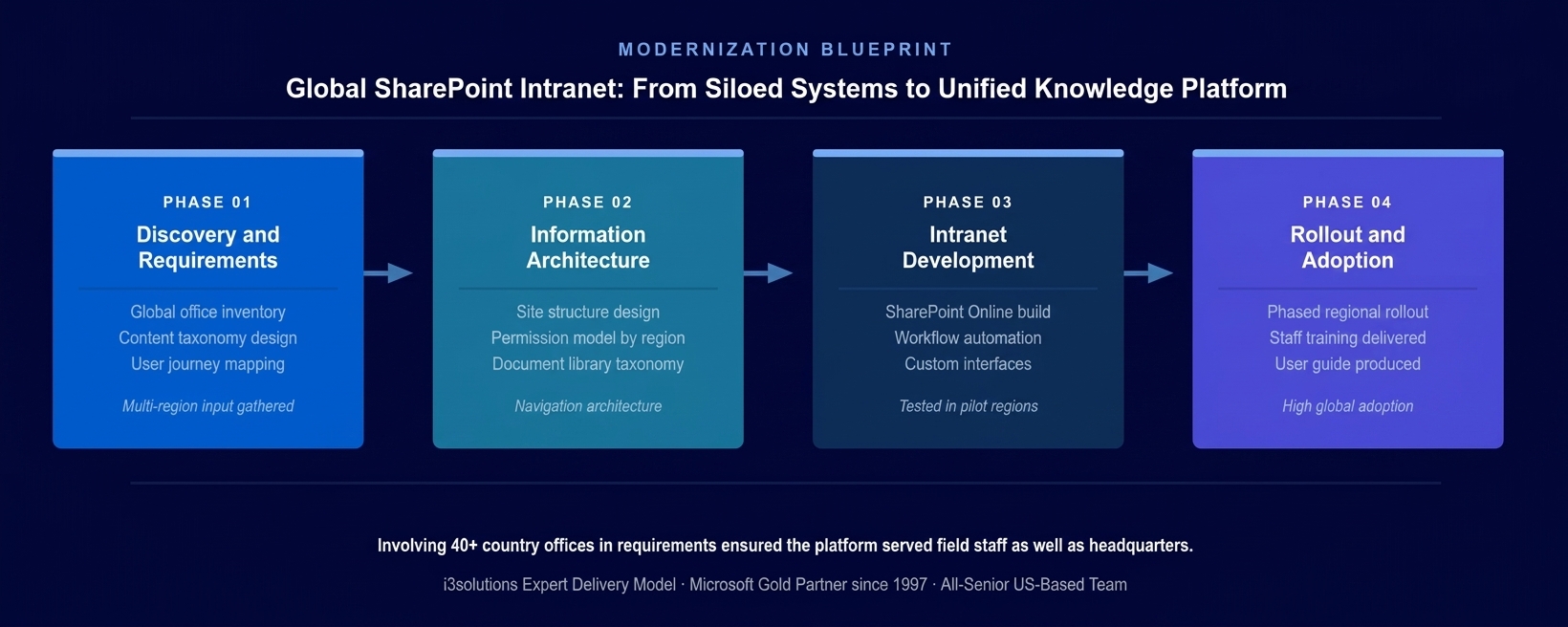
The four-phase implementation approach. Requirements input from multiple country offices shaped the information architecture in Phase 2 – field staff usability was a design constraint from the beginning, not a retrofit.
PHASE 03
Intranet Development and Workflow Automation
Building the SharePoint intranet: department and program sites with governed document libraries, user-friendly interfaces designed for accessibility on variable connections, workflow automation supporting content approval and publication processes, and the organizational knowledge base structure that connected people across program areas to relevant expertise. The platform leveraged SharePoint’s document management, collaboration, and workflow capabilities to deliver a system that improved both information access and team coordination.
PHASE 04
Phased Global Rollout and Adoption
Phased rollout beginning with headquarters and primary program areas before expanding to country offices. Staff training adapted to the different usage contexts of headquarters and field staff. User guides produced in formats accessible to staff with limited connectivity. Adoption monitoring and content migration support helping teams transition their existing content from siloed systems to the unified platform. Post-deployment engagement with country offices to validate that the platform was serving field staff as intended.
Execution Evidence
A Unified Knowledge Base Accessible from Headquarters to the Field
The SharePoint intranet gave every program area a governed home for its content – a structured site with consistent document library organization, clear ownership, and a publication workflow that maintained content quality without creating bottlenecks for routine publishing. Staff publishing a field assessment, a program protocol update, or a lessons-learned document had a defined process for getting that content into the intranet where it would be discoverable to colleagues across the organization.
The search capability transformed how staff located information. Rather than knowing which siloed system might contain a relevant document and having access to that system’s specific navigation, staff could search across the full intranet from a single interface and surface content from any program area, any country office, or any organizational function. The time that had previously been spent navigating multiple systems and asking colleagues where to find specific information was replaced by a search interaction that returned relevant results from the unified knowledge base.
The workflow automation connected content publication to review processes in a way that the siloed systems had not supported. Documents requiring approval before organizational distribution went through a defined review workflow rather than an informal email chain. This improved content quality and created an audit trail of the review process that the informal system could not provide.
The honest challenge in this engagement surfaced during the information architecture phase. The organization’s existing content was more fragmented than the initial inventory suggested – there were significant volumes of content in personal drives and email attachments that were not in any of the formal siloed systems and would need to be captured and organized as part of the migration. Identifying this during the architecture phase rather than after the platform was deployed allowed the migration plan to account for the full content scope rather than discovering the gap when field staff asked for content that had not made it into the new platform.
Technical Transformation
From 40+ Country Silos to One Governed Global Knowledge Platform
Before the intranet, the organization’s knowledge environment consisted of department-specific file systems, country-office local repositories, email attachments, and personal drives – a collection of information stores with no unified navigation, no cross-organizational search, and no governed publication process. Staff who needed information from outside their immediate team faced a multi-system search problem every time.
After the intranet, the organization operated a single SharePoint-based knowledge platform where content from all program areas and all country offices was published, organized, and discoverable through a unified interface accessible to staff regardless of their location or the connectivity constraints of their operational environment. The microsoft sharepoint consulting investment converted the organization’s existing Microsoft platform investment into an operational knowledge infrastructure that supported the mission rather than competing with it for staff attention.
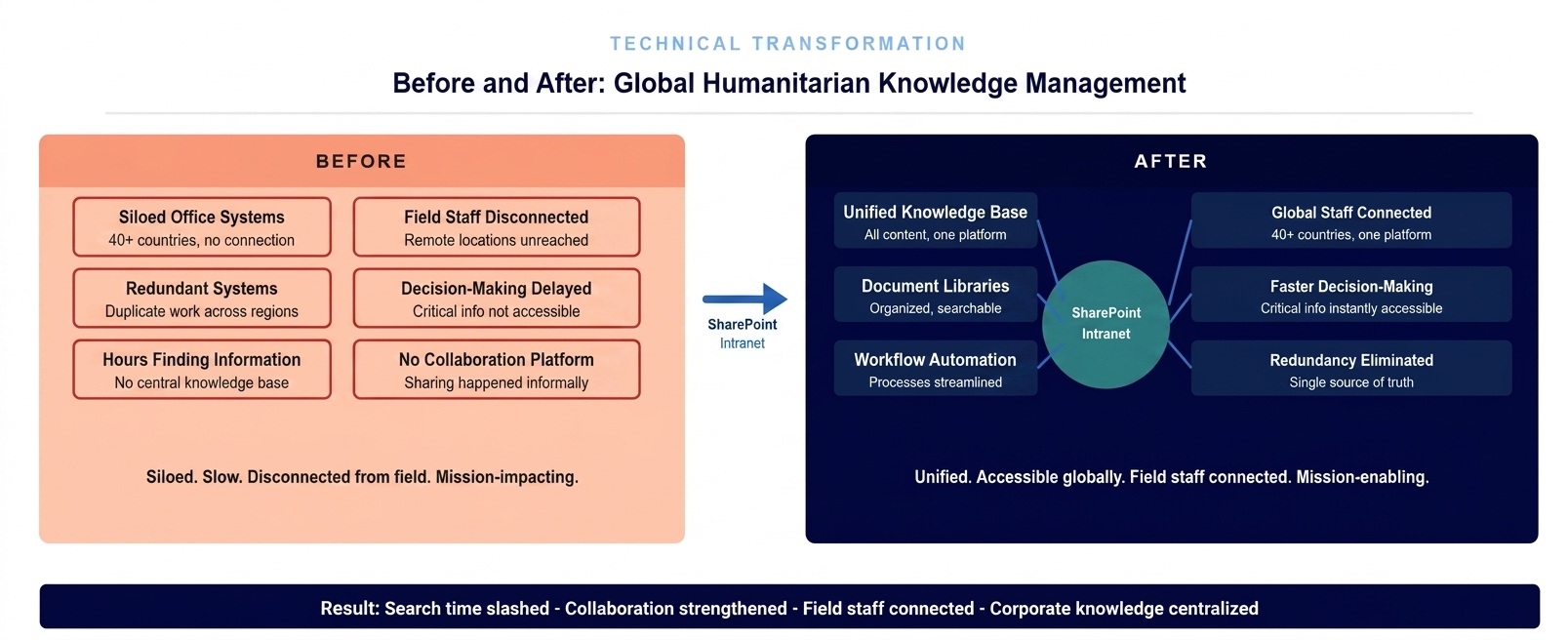
The architecture state before and after the intranet deployment. Multiple siloed country and department systems replaced by one governed global knowledge platform accessible from headquarters to field locations.
The Governance Readiness Ladder applied to this engagement showed the organization’s knowledge management at Level 1 (Ad Hoc): no central platform, content living in personal drives and departmental silos, no governed publication process, search impossible across organizational boundaries. The delivered intranet placed knowledge management at Level 3 (Governed): centralized publication with review workflows, unified search across the full knowledge base, permission-governed access by role and location, and content organization that enabled both program-specific depth and cross-organizational discoverability.
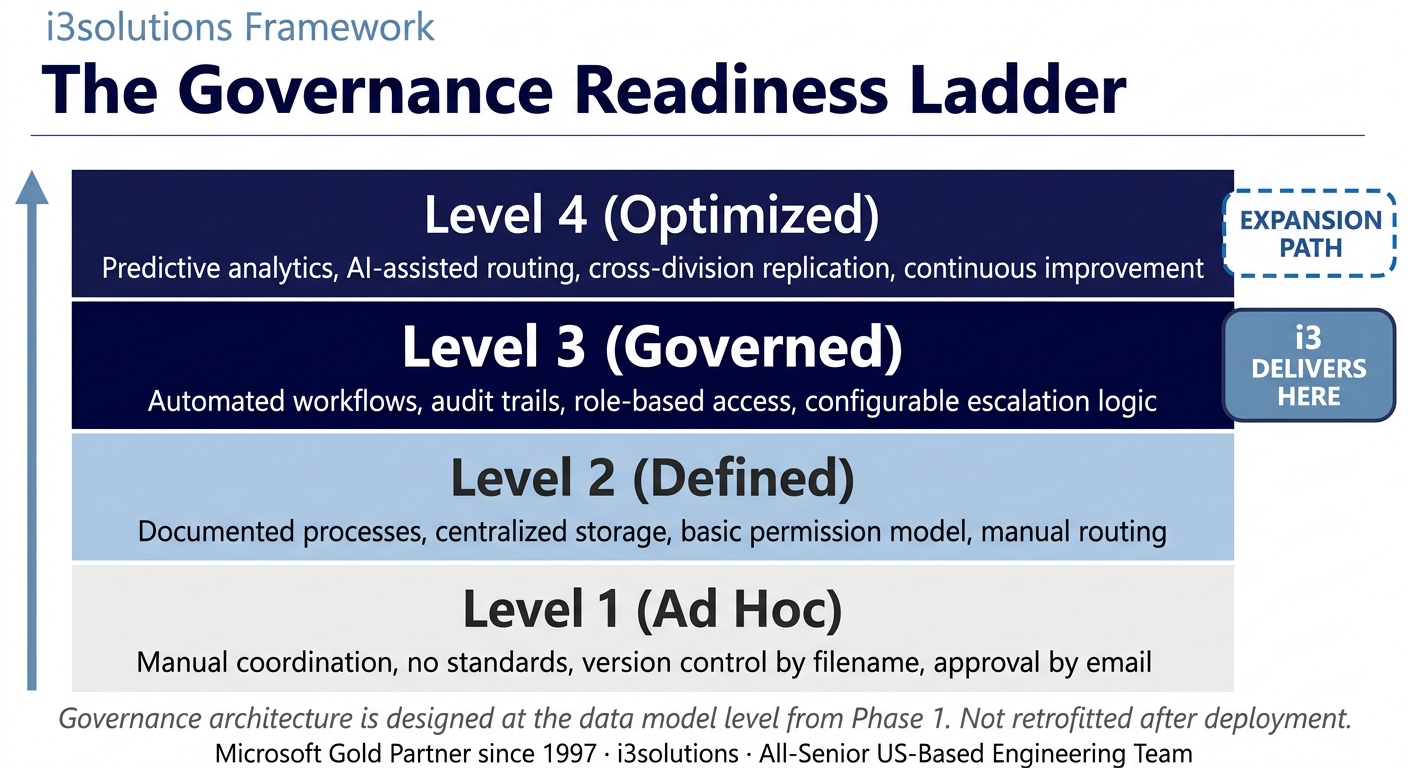
The Governance Readiness Ladder applied to this engagement. The SharePoint intranet delivered Level 3 knowledge governance across 40+ countries. The platform architecture supports Level 4 as analytics and intelligent content surfacing capabilities mature.
▶ Related Insight — A 60-second perspective from our channel
Measurable Outcomes
Search Time Reduced, Collaboration Strengthened, Redundant Systems Eliminated
| Metric | Before | After | Improvement |
|---|
| Time staff spend searching for information | Significant – multi-system search required for most cross-organizational queries | Significantly reduced – unified search surfaces content from all program areas | Information search time significantly reduced BENCHMARK-ESTIMATE |
| Cross-organizational content discoverability | Not possible without knowing which system held the content and having access | Full-intranet search from single interface, accessible to all staff | Universal discoverability established |
| Redundant systems and duplicate work | Multiple parallel systems with overlapping content, duplicated effort common | Unified platform replaces siloed systems, single source of truth for organizational knowledge | Redundant systems eliminated |
| Field staff access to organizational knowledge | Limited – field staff lacked access to systems maintained at headquarters | Platform accessible globally with design accommodating variable connectivity | Full global access established |
| Content publication governance | Informal – email chains and personal drive sharing with no review process | Workflow-governed publication with defined review and approval for distributed content | Governed publication process established |
| Decision-making information access | Delayed – relevant knowledge often not found or found late | Critical information accessible from unified interface at point of need | Decision-making information access improved |
| Collaboration across program areas | Informal and inconsistent – cross-program knowledge sharing depended on personal connections | Platform-enabled collaboration with shared workspaces and accessible content across all programs | Cross-program collaboration strengthened |
[PENDING-CLIENT-QUOTE: insert 1-3 sentence outcome-focused quote in the client’s own language from a role matching the reader’s role.]
[Name or Role], [Organization type]
The primary mission impact was the reduction in time staff spent searching for information that existed in the organization but was not centrally accessible. Knowledge management benchmarks for large nonprofits indicate that staff in fragmented information environments spend between 15 and 25 percent of their working time searching for information – time that in a mission-driven organization represents direct reduction in program delivery capacity. BENCHMARK-ESTIMATE The SharePoint intranet does not eliminate all search time, but it dramatically reduces the portion attributable to system fragmentation rather than content complexity.
The field access improvement addressed both the operational and equity dimensions of the information challenge. When field staff have the same access to the organization’s knowledge base as headquarters staff, the quality of decision-making in remote and challenging environments improves and the organizational inequity between center and field is reduced.
Is your organization’s knowledge scattered across systems that don’t connect?
A Risk and Roadmap Assessment maps the specific SharePoint intranet architecture that would centralize your knowledge base, make it accessible to all staff regardless of location, and eliminate the redundant systems consuming staff time and resources on your existing Microsoft platform.
Schedule the Assessment
Credibility Anchors
A Platform That Scaled With the Organization’s Global Mission
The SharePoint intranet architecture delivered for this organization was designed to accommodate the organization’s continued growth in both program scale and geographic footprint. Adding a new country office to the platform, creating a new program area site, or expanding content governance to additional departments were all achievable through configuration by designated administrators rather than requiring development engagement for each extension.
A program director described the change in how their team worked: before the intranet, finding anything produced by a different program required knowing the right person to ask. After it went live, the search just worked. Field staff in country offices started citing documents they had found in the intranet that they would never have known existed before.
The Rules of the Road established at engagement close defined the governance model for the platform’s ongoing operation. Ownership and Accountability assigned content owners for each program area site with defined responsibilities for maintaining content currency and managing publishing rights. Security and Access defined how new staff were provisioned into the platform and how access was adjusted when staff changed roles or country assignments. Lifecycle and Records defined the content review cycle that ensured outdated documents were archived rather than remaining discoverable alongside current versions. Release Discipline defined how changes to the platform’s structure or governance were reviewed and approved before deployment.
i3solutions has completed more than 600 Microsoft implementations as a Microsoft Gold Partner since 1997. The specific challenge of building a SharePoint intranet that serves as the operational knowledge infrastructure for a global organization spanning 40 countries, multiple program areas, and staff operating in some of the world’s most challenging environments reflects both platform depth and organizational complexity experience that only decades of enterprise implementation work can provide.
Frequently Asked Questions
Microsoft SharePoint Consulting for Global Nonprofit Knowledge Management
What is microsoft sharepoint consulting for global nonprofits?
Microsoft SharePoint consulting for global nonprofits involves designing and implementing a unified intranet platform that centralizes the organization’s knowledge base, makes content accessible to staff across all locations regardless of connectivity constraints, and eliminates the redundant siloed systems that fragment information and consume staff time. For humanitarian and international development organizations with dispersed workforces, SharePoint consulting delivers the information infrastructure that enables staff to access organizational knowledge at the point they need it rather than searching across incompatible systems.
How does a SharePoint intranet reduce information search time for global organizations?
A SharePoint intranet reduces information search time for global organizations by replacing multi-system navigation with a unified search interface that surfaces content from all program areas, all country offices, and all organizational functions from a single query. Rather than knowing which of several siloed systems might contain relevant information and having access to that system’s specific navigation, staff can search the full organizational knowledge base from one place and receive results regardless of which part of the organization published the content.
Can SharePoint serve field staff in low-connectivity humanitarian environments?
SharePoint can serve field staff in low-connectivity environments when the intranet is architected with connectivity constraints as a design requirement rather than a post-deployment accommodation. This means making content architecture decisions that minimize page-load complexity for field users, ensuring that the most frequently needed content is accessible through simple navigation rather than complex search, and configuring SharePoint’s offline capabilities where appropriate for field contexts. Organizations that design intranets only for headquarters users and assume field staff will adapt consistently find that field adoption fails – which is why the requirements process must include field staff perspectives from the beginning.
How does a SharePoint intranet eliminate redundant systems in large nonprofits?
A SharePoint intranet eliminates redundant systems in large nonprofits by providing a governed, centrally accessible alternative to the department-specific file systems, local drives, and informal sharing practices that develop in organizations without a unified knowledge platform. When the intranet’s search, navigation, and content organization genuinely serve staff’s information needs better than the siloed systems did, adoption follows organically and the siloed systems fall out of use. Organizations that migrate content systematically from siloed systems to the intranet during deployment accelerate this transition and prevent the parallel-system period from becoming permanent.
What information architecture decisions are most important for a global nonprofit intranet?
The most important information architecture decisions for a global nonprofit intranet are the top-level navigation structure that makes content discoverable to staff who do not know exactly where to look, the permission model that gives each country office and program area appropriate control over its own content without fragmenting the cross-organizational search, the document taxonomy that ensures content published from any part of the organization follows a consistent structure that supports both program-specific access and cross-organizational discoverability, and the content governance model that keeps the knowledge base current rather than accumulating outdated documents that undermine trust in the platform.
How long does a global SharePoint intranet implementation take?
A global SharePoint intranet implementation for an organization operating across multiple countries and program areas typically spans several months from requirements through initial deployment, with full global rollout extending over a longer period as content migration, regional training, and adoption support are completed in waves. Organizations that invest adequately in requirements gathering across multiple regions and stakeholder groups before beginning architecture design consistently deliver intranets with higher field adoption and less post-deployment restructuring than those that design from headquarters perspectives alone.
What governance model supports a sustainable global SharePoint intranet?
A sustainable global SharePoint intranet requires a governance model that assigns content ownership to named program area owners responsible for keeping their content current, defines the publication review process that maintains content quality without creating bottlenecks, establishes the content lifecycle policy that archives outdated documents on a defined schedule, and creates a change control process for structural updates to the intranet that prevents ad-hoc modification from eroding the architecture over time. Without this governance model, SharePoint intranets accumulate outdated content and informal workarounds that progressively undermine the platform’s value as the organizational knowledge source.
How does SharePoint workflow automation support content management in a global nonprofit?
SharePoint workflow automation supports content management in a global nonprofit by governing the publication process for organizational documents – routing draft content to the appropriate reviewers, tracking approval status, and publishing approved content to the intranet without requiring manual coordination of the review chain. This is particularly valuable in organizations where content requires sign-off from subject matter experts in different locations or program areas, as the workflow handles the routing and notification automatically rather than depending on the publishing staff to know and contact the right reviewers manually.
Conclusion
A Unified Knowledge Platform That Connects 40+ Countries Behind One Mission
A global humanitarian relief organization replaced a fragmented collection of siloed systems, department repositories, and informal sharing practices with a unified SharePoint intranet that made the organization’s full knowledge base accessible to staff from headquarters to field locations across more than 40 countries. Through microsoft sharepoint consulting that centralized content, eliminated redundant systems, and established governed publication workflows, the organization moved from a knowledge environment that consumed staff time on administrative search to one where critical information was accessible at the point of need – and the capacity that had been spent searching was returned to mission delivery.
For global nonprofits and mission-driven organizations whose knowledge fragmentation is costing staff capacity and field effectiveness, microsoft sharepoint consulting and SharePoint development services offer a documented path from siloed information environments to a unified, governed knowledge platform built on Microsoft infrastructure the organization already operates.
Back to Case Study Library
60 enterprise Microsoft implementations documented
Related Insights
From the i3solutions YouTube Channel
Short-form perspectives on the delivery and technology challenges in this case study.
Who This Engagement Serves
This engagement is relevant if
- A global NGO with thousands of field staff operating in diverse, low-bandwidth environments needs centralized coordination.
- A large humanitarian organization struggling to provide consistent operational and compliance resources across multiple country offices.
- An international non-profit requiring a single, secure platform to manage critical knowledge for decentralized disaster response.
Less relevant if
- A domestic single-site organization with a small staff that relies primarily on email and in-person communication.
- A corporation needing a highly customized e-commerce platform or customer-facing portal rather than an internal intranet.
Ready to give every staff member access to your organization’s full knowledge base?
The 15-Business-Day Microsoft Assessment maps the specific SharePoint intranet architecture that would centralize your knowledge base, eliminate redundant systems, and make organizational knowledge accessible to staff across all locations – on your existing Microsoft infrastructure. No new platform procurement. No information left in silos.
Microsoft Gold Partner since 1997. 600+ implementations. All senior. All US-based.
Schedule the Assessment