Case Study • Defense Intelligence • Digital Transformation
10,000 Personnel, 180 Locations, No SDLC: How a Defense Intelligence Command Modernized Its Microsoft Platform
The Enterprise Challenge
Power Platform Governance and Digital Transformation for Defense Intelligence Operations
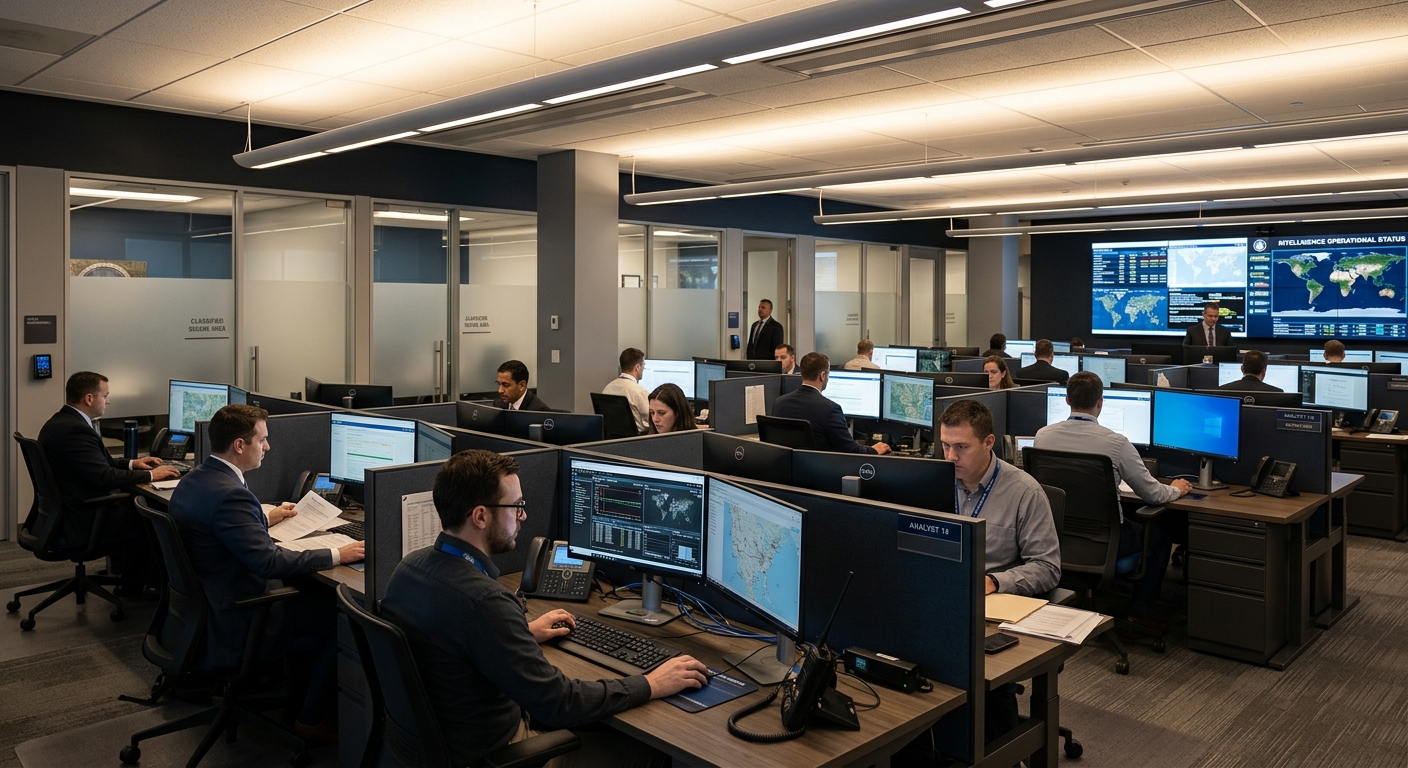
A major defense intelligence command serves as a critical partner in intelligence, security, and information operations. With more than 10,000 personnel distributed across 180 locations worldwide and dozens of major subordinate commands overseeing a diverse range of operational units, the command’s internal technology infrastructure is not an administrative function – it is operational capability. The systems that support personnel management, security vetting, deployment and leave tracking, contracts management, and communications directly affect the command’s ability to execute its mission.
The command’s technology environment at the start of the engagement was characterized by three compounding problems. First, the internal processes were largely manual – paper-based workflows, informal coordination practices, and spreadsheet tracking that scaled poorly across an organization of this size and geographic distribution. Second, the existing technology solutions were outmoded, with legacy systems that did not integrate with each other and could not support the automation the operational scale demanded. Third, the organization had no formal Software Development Lifecycle methodology – requirements were gathered informally, changes were implemented without documentation standards, and the development work being done across the command’s various units followed inconsistent practices with no governance framework.
The command selected i3solutions as its digital transformation partner to address all three problems simultaneously: modernize the workflows, replace the legacy systems, and establish the formal SDLC and power platform governance framework that would govern all future SharePoint and custom application development across the command’s operations.
Strategic Trigger
Scale Made Manual Processes a Mission Risk, Not Just an Administrative Problem
At 10,000 personnel across 180 locations and 50 major subordinate commands, the inadequacy of manual processes was not a theoretical efficiency concern – it was a daily operational reality that affected the command’s ability to track personnel status, manage security and vetting requirements, coordinate deployments, and maintain the contracts and obligations data that supported its operations. Manual systems that were marginally acceptable at smaller scale became sources of systemic inaccuracy at the command’s operational size.
The absence of a formal SDLC compounded the technology problem in a specific way: without documented requirements standards and change management practices, the development work being done across the command was producing systems that could not be maintained, extended, or audited with confidence. Each system was built on the individual knowledge of whoever had built it, making the organization vulnerable to capability loss when those individuals moved on and making it impossible to govern the development portfolio consistently across 50 subordinate commands operating in parallel.
The IL4 and IL6 compliance requirement – operating on certified government cloud environments that met the impact level requirements for controlled unclassified and classified information – added a layer of complexity that general-purpose Microsoft development partners could not navigate. Building Power Apps and Power Automate flows on GovCloud environments certified to IL4 and IL6 standards requires specific platform knowledge and compliance experience that is distinct from standard commercial Microsoft development. For context on how Power Platform governance on certified government cloud environments is architected, SharePoint and Power Platform Integration covers the integration and compliance design patterns that determine whether a GovCloud implementation is audit-ready from day one.
Is a large defense or government organization running critical processes without a formal SDLC?
If requirements are gathered informally, changes are implemented without documentation standards, and development work varies across organizational units without governance, the risk accumulates with every system built. A 15-Business-Day Microsoft Assessment identifies the specific SDLC framework and Power Platform governance architecture that would bring consistency and auditability to your development portfolio.
Request the Assessment
▶ Related Insight — A 60-second perspective from our channel
Stakes (What Happens If They Fail)
Mission Capability at Risk, Compliance Exposure, and Development Debt Accumulating Across 50 Commands
For a defense intelligence command, the stakes of technology failure are not measured in productivity loss – they are measured in mission capability degradation. When the systems supporting personnel status tracking, security vetting, and deployment coordination are manual and error-prone, the command’s ability to place the right personnel in the right roles with the right clearances at the right time is directly impaired. Intelligence operations that depend on rapid personnel coordination cannot afford the systematic inaccuracy that manual processes introduce at scale.
The SDLC absence created a specific category of institutional risk: the command’s technology systems were increasingly dependent on undocumented knowledge held by individual staff. When those staff members transferred, retired, or were deployed, the systems they had built became effectively unmaintainable – functional as long as nothing changed, but incapable of being extended or modified without significant reverse engineering. Across 50 subordinate commands operating independently, this problem was multiplying faster than it was being recognized.
The IL4/IL6 compliance dimension carried audit and accreditation risk. Government cloud environments at these impact levels are subject to continuous monitoring and periodic accreditation reviews. Systems built without compliance as a foundational design constraint – and without the documentation standards that SDLC governance provides – are vulnerable to findings in those reviews that can affect the command’s ability to operate on the certified platforms that its mission requirements demand.
Constraints and Complexity
IL4/IL6 Classified Environments, 50 Subordinate Commands, and a Formal SDLC That Had to Stick
The IL4 and IL6 platform requirement was the most technically differentiating constraint. Power Apps and Power Automate on GovCloud environments certified to these impact levels are functionally similar to their commercial counterparts but operate in isolated cloud environments with specific licensing, feature availability, and integration pattern differences. Building workflows on IL4 and IL6 that perform correctly and maintain compliance with the information handling requirements of those environments requires hands-on experience with the platform at those certification levels – not theoretical familiarity with commercial Power Platform.
The 50-subordinate-command stakeholder environment made requirements gathering a substantial organizational challenge. Each major subordinate command had its own operational priorities, its own process variations, and its own technology situation. Getting alignment across this population on the requirements for shared systems and the standards that would apply to locally developed solutions required structured engagement that respected each command’s operational perspective while building consensus on the governance framework that would govern all of them.
The SDLC establishment goal was the most organizationally complex element of the engagement. Establishing a formal Software Development Lifecycle is not a technology implementation – it is an organizational change that affects how requirements are gathered, how changes are managed, how documentation is produced, and how development work is reviewed across every unit in a large and geographically distributed command. Getting a methodology to stick in an organization of this complexity requires both the quality of the framework and the credibility of the consultants who introduce and model it. For a look at how formal development governance transforms technology portfolio quality in complex organizations, Integration Governance for MicrosoftPENDING-SCHEDULED covers the change control patterns that make governance frameworks durable rather than aspirational.
▶ Related Insight — A 60-second perspective from our channel
Selection Rationale (Why They Chose i3solutions)
Defense Intelligence Experience, GovCloud Certification, and SDLC Consulting Depth
The command required a partner with the combination of capabilities that this engagement demanded: GovCloud Power Platform development experience at IL4 and IL6, defense intelligence organizational understanding, and formal SDLC consulting depth. These requirements significantly narrowed the field of qualified partners. A commercial Microsoft development partner without GovCloud experience could not navigate the platform constraints. A defense IT generalist without Power Platform depth could not build the workflow solutions. A systems integrator without SDLC consulting experience could not establish the methodology governance the command needed.
i3solutions was selected as a Microsoft Gold Partner since 1997 with a documented track record in power platform governance and custom application development for defense and government-classified environments. The Expert Delivery Model that i3solutions operates, staffing every engagement with senior-level consultants and developers, was specifically critical in this context: the consultants who would be establishing SDLC standards and modeling documentation practices for 50 subordinate commands had to be practitioners whose credibility as senior engineers was evident to the command’s own technical leadership.
The firm’s Enterprise Delivery Assurance model provided the governance structure that a digital transformation engagement of this scope required. The requirements gathering process was structured to accommodate input from stakeholders across all 50 major subordinate commands, producing documentation that reflected the full operational complexity of the command rather than the perspective of a single headquarters unit. The Microsoft consulting services engagement framework established the collaborative working model that sustained a multi-year transformation program across the command’s organizational complexity.
The Engagement Approach (Our Plan)
Formal SDLC, IL4/IL6 Platform, and 10+ Workflow Automations Across the Command
PHASE 01
Stakeholder Engagement and SDLC Establishment
Structured requirements sessions with stakeholders from all 50 major subordinate commands, capturing operational priorities, process pain points, and technology requirements across the full command portfolio. Concurrent establishment of the formal SDLC methodology that would govern all subsequent development work: requirements documentation standards, change request management processes, process mapping and wireframe diagram standards, and the review and approval workflow for system changes. This phase produced both the requirements that guided the workflow automation program and the governance framework that would sustain it beyond the initial engagement.
PHASE 02
IL4/IL6 GovCloud Architecture
Designing the SharePoint Online and Power Platform architecture on the IL4 and IL6 certified GovCloud environments: the SharePoint information architecture that would serve as the collaboration and document management foundation, the Power Platform governance model governing who could build solutions and what compliance standards applied, and the integration patterns connecting Power Apps forms to Power Automate workflows to SharePoint data stores within the compliance constraints of each environment’s certification level.
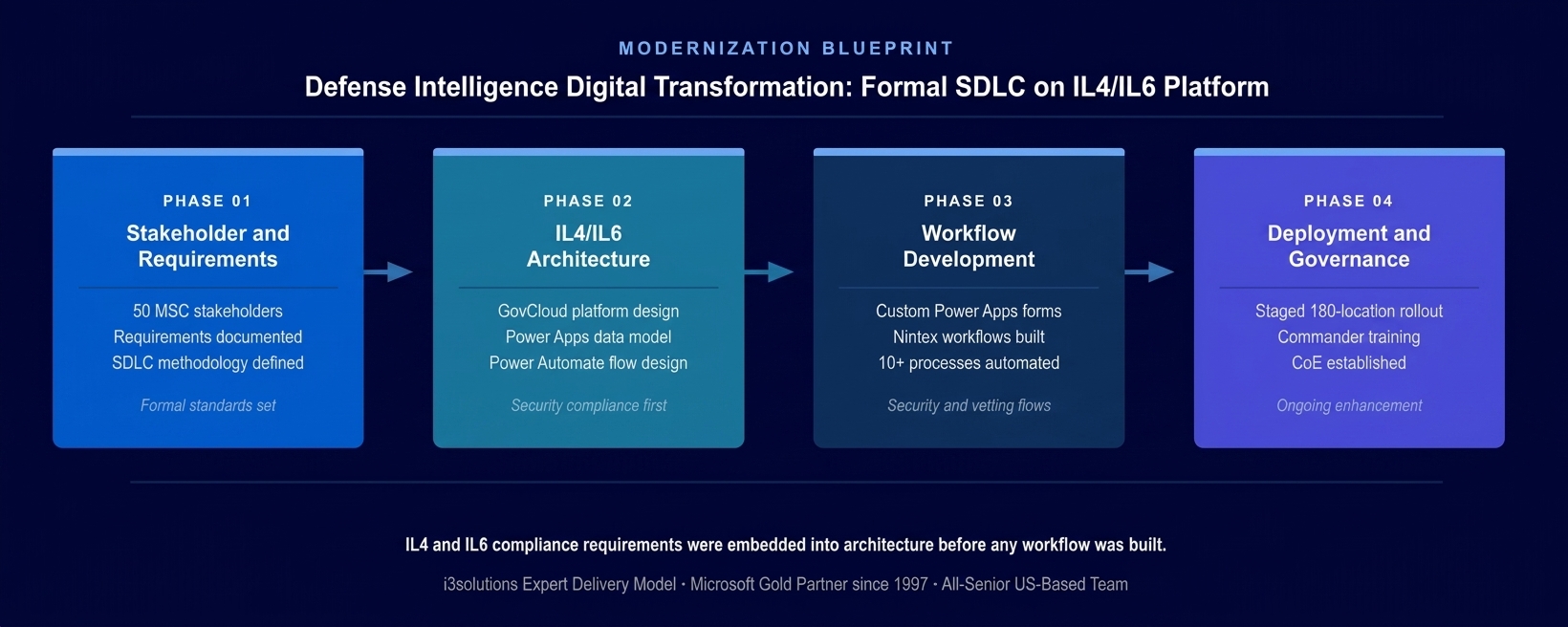
The four-phase implementation approach. SDLC establishment in Phase 1 was a parallel workstream to requirements gathering – the methodology that would govern all future development was established at the same time as the requirements for the first wave of workflows.
PHASE 03
Power Platform Workflow Development
Building the workflow automation solutions across the command’s prioritized process areas: Power Apps custom forms for data collection and process initiation, Nintex workflows and Power Automate flows for routing, approval, and notification automation, and SharePoint as the data layer connecting workflow submissions to organizational records. Workflows built across the initial deployment covered security and vetting processes, deployment and leave tracking, auditing functions, personnel hiring workflows, authorization management, contracts and task order management, and obligations and payment data processes.
PHASE 04
Staged Deployment and CoE Establishment
Staged deployment beginning with priority workflows and priority commands before expanding across the full 180-location, 50-command portfolio. Establishment of the Center of Excellence structure that would govern ongoing Power Platform development across the command, providing the governance framework, the development standards, and the review process that would apply to solutions built by command units independently. Commander and administrator training. Ongoing enhancement program supporting the command’s continued workflow modernization beyond the initial deployment.
Execution Evidence
Formal SDLC Embedded, IL4/IL6 Workflows in Production, CoE Operational
The SDLC methodology established in Phase 1 was not a document delivered at the end of the engagement – it was a working methodology modeled by i3solutions consultants throughout the project and embedded in the command’s development practices through direct mentorship of the command’s own technical staff. Every workflow built during the engagement was built to the documentation and requirements standards of the new SDLC, creating a library of reference implementations that demonstrated the methodology in practice rather than only describing it in theory.
The Power Apps and Power Automate workflows deployed on the IL4 and IL6 GovCloud environments covered the broadest set of operational processes the command had targeted. Security and vetting workflows automated the routing and approval chains that had previously required manual coordination across multiple organizational levels. Deployment and leave tracking replaced spreadsheet management with governed digital records connected to the command’s organizational hierarchy. Contracts management and task order workflows automated the documentation and approval routing for procurement actions that had previously relied on paper processes.
Nintex Forms provided the user-facing data collection interface for workflows where the Power Apps native forms did not meet the specific usability requirements of the process. The combination of Nintex Forms for structured data entry, Power Automate for workflow routing and automation, and SharePoint for centralized data management gave the command a governed, integrated platform for operational workflow management that operated within the compliance constraints of each environment’s IL certification level.
The honest challenge in this engagement was the requirements alignment across 50 subordinate commands. When the same process – leave tracking, for example – was managed differently by different commands with different operational rhythms and different organizational structures, establishing a common workflow that served all of them required significant deliberation among stakeholders who each had legitimate reasons for their existing approach. The resolution in most cases was a workflow architecture with configurable parameters that allowed command-specific variation within a governed framework rather than forcing uniformity that would not have been operationally appropriate.
Technical Transformation
From Manual Processes and No SDLC to Governed IL4/IL6 Platform With CoE
Before the engagement, the command’s internal process environment was characterized by manual workflows, outmoded legacy systems, and an absence of development governance that was producing unmaintainable technology at increasing scale. The 10,000-person, 180-location, 50-command operation was functioning on the organizational equivalent of spreadsheets and informal coordination – adequate for a smaller organization, inadequate for the command’s operational requirements.
After the engagement, the command operated a formal SDLC with documentation and requirements standards applied across all development work, a GovCloud Power Platform and SharePoint environment certified to IL4 and IL6 with 10-plus automated workflows in production across priority process areas, and a Center of Excellence governing ongoing Power Platform development across the command’s 50 subordinate commands.
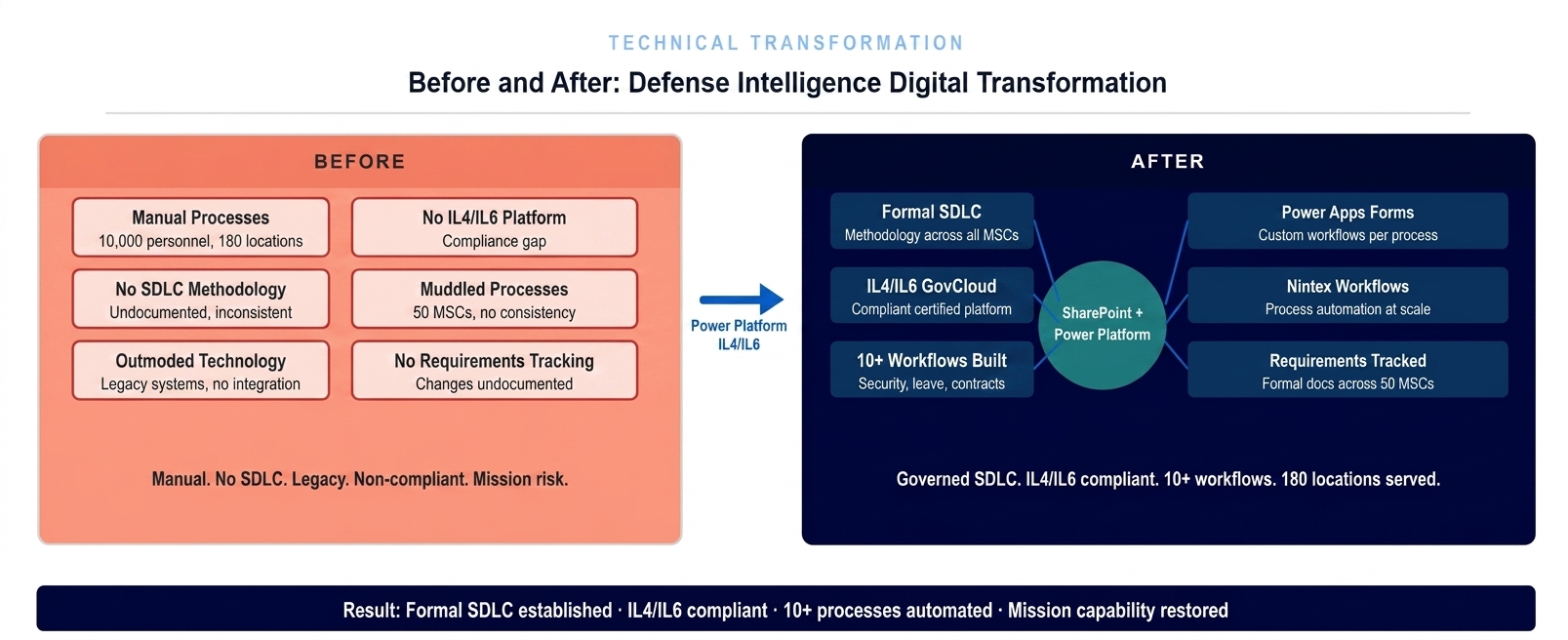
The architecture state before and after the digital transformation. Manual processes and undocumented development replaced by formal SDLC, IL4/IL6 compliant workflows, and a Center of Excellence governing all future Power Platform development.
The Governance Readiness Ladder applied to this engagement placed the command’s technology environment at Level 1 (Ad Hoc) at the start: manual processes, no formal SDLC, undocumented systems, and development work varying across 50 commands without governance. The delivered transformation placed the command at Level 3 (Governed): formal SDLC applied consistently across all development work, IL4/IL6 compliant workflows with audit-ready documentation, Center of Excellence governance framework active, and requirements tracking and change management operating as standard practice.
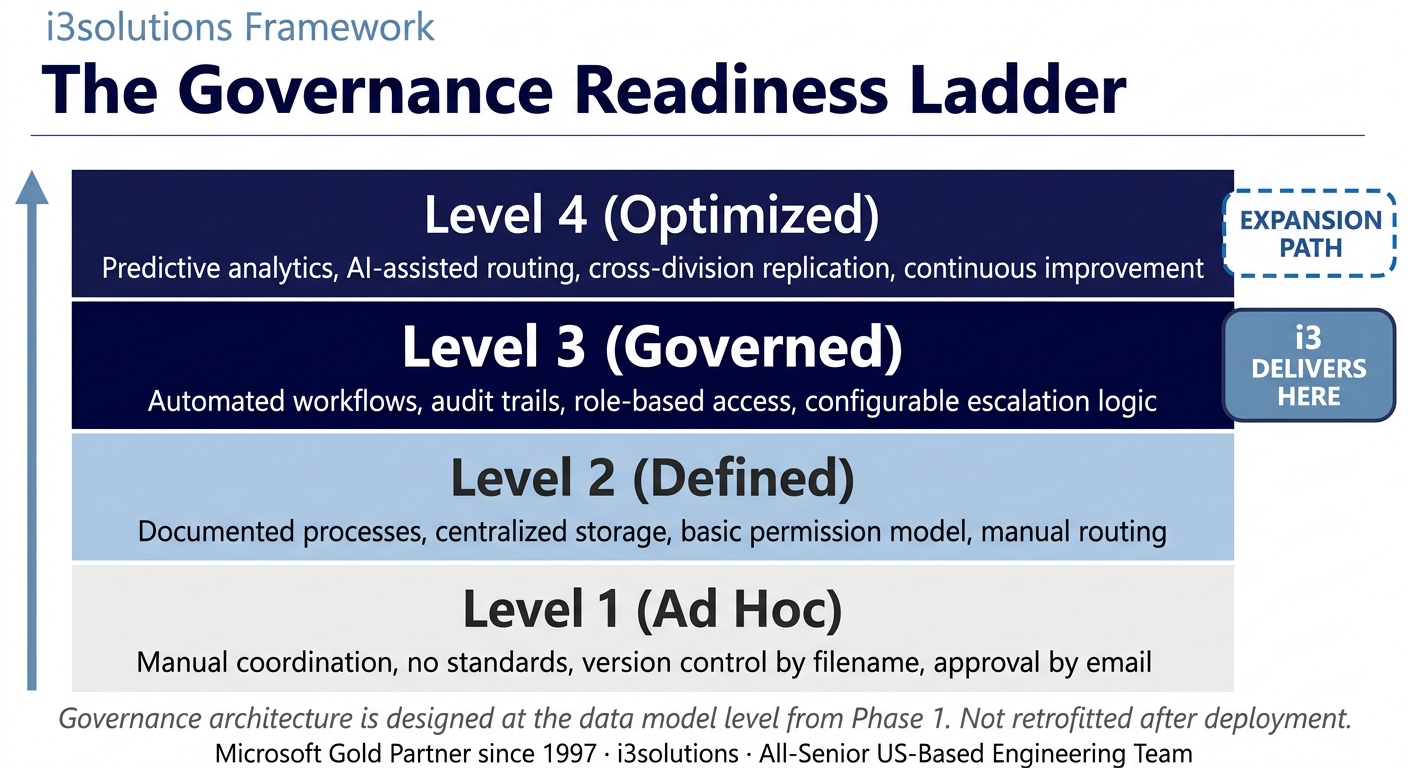
The Governance Readiness Ladder applied to this engagement. The digital transformation delivered Level 3 across the command’s technology portfolio. The CoE architecture supports continued progression toward Level 4 as the workflow automation program expands.
▶ Related Insight — A 60-second perspective from our channel
Measurable Outcomes
Formal SDLC Established, 10+ Workflows in Production, CoE Operational Across 180 Locations
| Metric | Before | After | Improvement |
|---|
| SDLC methodology | None – requirements gathered informally, no documentation standards, changes unmanaged | Formal SDLC with documented requirements, change management, and process mapping standards | Formal SDLC established organization-wide |
| IL4/IL6 compliant platform | Legacy systems not meeting GovCloud certification requirements | SharePoint Online and Power Platform deployed on IL4 and IL6 certified GovCloud environments | Full IL4/IL6 compliance achieved |
| Automated workflows in production | Zero – all processes manual across security, leave, contracts, personnel | 10+ workflows operational across priority process areas | 10+ processes automated |
| Power Platform governance | No governance – development varying across 50 commands without standards | Center of Excellence with development standards, review process, and compliance framework active | CoE operational across 180 locations |
| Process documentation | Absent – systems undocumented, knowledge held individually | Process maps and wireframe standards applied to all workflows, full documentation library | Full documentation portfolio established |
| Security and vetting coordination | Manual – paper-based routing across organizational levels | Automated routing and approval through Power Platform workflow on IL4/IL6 platform | Manual coordination eliminated |
| Deployment and leave tracking | Spreadsheet-based – no integration with organizational records | Governed digital tracking connected to command hierarchy and personnel records | Governed tracking operational |
[PENDING-CLIENT-QUOTE: insert 1-3 sentence outcome-focused quote in the client’s own language from a role matching the reader’s role.]
[Name or Role], [Organization type]
The most significant outcome of this engagement was not any individual workflow – it was the establishment of the SDLC and Power Platform governance framework that changed how the command builds and maintains technology going forward. Every workflow built after the engagement is built to documented requirements, follows the established methodology, and is reviewable by the CoE. The accumulation of undocumented, unmaintainable systems that had characterized the pre-engagement environment was interrupted and reversed by a governance framework that makes consistent, auditable development the institutional standard rather than an aspiration.
The IL4/IL6 platform achievement addressed the command’s compliance posture at its foundation. Operating critical workflows on GovCloud environments certified to the impact levels appropriate for the information being processed is a compliance requirement, not an optimization. The engagement delivered the platform compliance that the command’s operational information handling required.
Is a large defense organization operating critical processes without a formal SDLC or Power Platform governance?
A Risk and Roadmap Assessment maps the specific Power Platform governance framework, SDLC methodology, and GovCloud architecture that would bring consistency and auditability to your development portfolio – and identifies the highest-priority processes to automate first within a governance framework that will sustain the program beyond the initial engagement.
Schedule the Assessment
Credibility Anchors
A Transformation That Extended Beyond the Initial Engagement
The digital transformation program established in this engagement was designed as a sustainable, ongoing program rather than a bounded implementation project. The SDLC methodology, the CoE governance framework, and the IL4/IL6 platform were all architected to support continued workflow automation across the command’s full process portfolio as development capacity, funding, and operational priorities allowed. The initial 10-plus workflows were the foundation of a continuing program, not the conclusion of it.
A command technology leader described the SDLC establishment in direct terms: before the engagement, every system was built differently by whoever built it, and when that person left, the system became a black box. After the methodology was established and the first wave of workflows were built to it, there was documentation for the first time. Future teams could actually understand and maintain what had been built.
The Rules of the Road established at engagement close defined the governance model for the Center of Excellence and the ongoing development program. Ownership and Accountability defined the CoE leadership structure responsible for reviewing new solution proposals, maintaining the Power Platform governance framework, and overseeing the SDLC compliance of development work across all subordinate commands. Security and Access defined the platform access control model for IL4 and IL6 environments, including how new users were provisioned and how access reviews were conducted. Release Discipline defined the review and testing requirements before any workflow modification could be deployed to a production environment serving operational processes.
i3solutions has completed more than 600 Microsoft implementations as a Microsoft Gold Partner since 1997. The combination of IL4/IL6 GovCloud experience, formal SDLC consulting depth, and Power Platform governance architecture for organizations of this scale and complexity represents the most demanding class of defense technology engagement – and one where i3solutions’ senior-only delivery model and defense sector experience are directly reflected in outcomes.
Frequently Asked Questions
Power Platform Governance for Defense Intelligence Organizations
What is power platform governance for defense organizations?
Power Platform governance for defense organizations involves establishing the formal framework that controls how Power Apps, Power Automate, and related Microsoft tools are developed and deployed within classified and controlled environments. This includes the SDLC methodology governing requirements documentation and change management, the Center of Excellence structure overseeing development standards across organizational units, the IL4 and IL6 GovCloud compliance architecture ensuring solutions meet impact level certification requirements, and the review and approval process that prevents ungoverned shadow IT development from accumulating across subordinate commands.
What are IL4 and IL6 GovCloud environments for Microsoft Power Platform?
IL4 and IL6 GovCloud environments are Microsoft cloud environments certified to Impact Level 4 and Impact Level 6 under the Department of Defense Cloud Computing Security Requirements Guide. IL4 is certified for Controlled Unclassified Information and supports most defense organization operational workflows. IL6 is certified for classified information at the SECRET level. Power Apps and Power Automate deployed on these environments operate within isolated cloud infrastructure with specific security controls, compliance documentation, and monitoring requirements that distinguish them from commercial Microsoft cloud deployments.
What is a Power Platform Center of Excellence for defense organizations?
A Power Platform Center of Excellence for defense organizations is a governance body that establishes and enforces standards for how Power Platform solutions are developed, reviewed, and deployed across the organization’s subordinate units. The CoE defines the development standards that must be followed, reviews proposed solutions before they are built to ensure compliance with governance requirements, maintains the SDLC methodology applied to all development work, and provides guidance to unit-level developers building solutions within the governed framework. For an organization with 50 subordinate commands all capable of building Power Platform solutions independently, the CoE prevents the proliferation of ungoverned solutions that would recreate the pre-transformation technology problem at the unit level.
How does a formal SDLC improve technology outcomes in defense organizations?
A formal SDLC improves technology outcomes in defense organizations by ensuring that every system is built to documented requirements, every change is managed through a defined process, and every deployed solution can be understood, maintained, and modified by staff other than the original developer. Without a formal SDLC, technology in large organizations accumulates as undocumented systems whose maintenance depends on individual knowledge that leaves with the person when they transfer or retire. With a formal SDLC, the institutional knowledge is embedded in documentation that makes every system maintainable, auditable, and extensible by any qualified developer.
What processes benefit most from Power Platform automation in defense organizations?
Defense organizations typically see the highest value from Power Platform automation in processes where manual coordination across organizational levels creates delay, inconsistency, or audit risk: security and vetting workflows, personnel deployment and leave tracking, contracts management and task order processing, authorization management, and obligations and payment data. These processes involve structured data that can be captured through Power Apps forms, routing logic that Power Automate can automate, and approval chains that benefit from automated notification and tracking in ways that manual processes cannot provide at scale.
How does Power Platform governance prevent shadow IT in defense commands?
Power Platform governance prevents shadow IT in defense commands by establishing a governed path for unit-level solution development that is more accessible than ungoverned workarounds. When units have a clear process for requesting new Power Platform solutions, getting CoE review, and deploying to the compliant GovCloud environment, the motivation for building ungoverned solutions outside the framework is reduced. Governance that is purely restrictive without providing a functional development path typically increases shadow IT; governance combined with a supported development program typically reduces it.
What should defense organizations look for in a Power Platform governance partner?
Defense organizations evaluating Power Platform governance partners should assess GovCloud experience at the relevant IL certification levels, SDLC consulting depth in complex organizational environments, and a delivery model that staffs engagements with senior-level practitioners who can model the methodology they are establishing rather than only documenting it. An all-senior, US-based team with clearance capability appropriate to the engagement environment reduces both security risk and the credibility gap that junior consultants face when establishing governance standards in organizations with experienced technical leadership.
How long does a Power Platform digital transformation take for a large defense command?
A Power Platform digital transformation for a defense command with 10,000 or more personnel, multiple major subordinate commands, and IL4/IL6 compliance requirements is a multi-year engagement rather than a bounded implementation project. The initial phase covering SDLC establishment, platform architecture, and the first wave of priority workflows typically spans 12 to 24 months. Expansion to the full workflow portfolio, CoE maturation, and development program scaling across all subordinate commands continues beyond the initial engagement as an ongoing organizational capability rather than a project with a completion date.
Conclusion
Formal SDLC, IL4/IL6 Compliance, and CoE Governance Across 10,000 Personnel
A defense intelligence command with 10,000 personnel across 180 locations selected i3solutions as its digital transformation partner to address three simultaneous problems: manual processes at operational scale, legacy systems without integration, and an absence of development governance that was producing unmaintainable technology across 50 subordinate commands. Through power platform governance and SharePoint development services on IL4 and IL6 GovCloud environments, the engagement delivered a formal SDLC embedded across the command’s development portfolio, 10-plus automated workflows covering the command’s priority operational processes, and a Center of Excellence governing all future Power Platform development.
For defense and government organizations where technology governance has not kept pace with operational scale and where GovCloud compliance requirements add complexity that general-purpose Microsoft partners cannot navigate, power platform governance and Microsoft consulting services offer a documented path from undocumented development and manual processes to a governed, compliant, continuously improvable technology program.
Back to Case Study Library
60 enterprise Microsoft implementations documented
Related Insights
From the i3solutions YouTube Channel
Short-form perspectives on the delivery and technology challenges in this case study.
Who This Engagement Serves
This engagement is relevant if
- Defense organizations relying heavily on manual data entry across multiple disconnected legacy intelligence or operational systems.
- Intelligence agencies needing automated workflows to rapidly consolidate and visualize data from disparate security sources.
- Federal offices with high security compliance needs that must streamline operational processes using approved cloud platforms.
Less relevant if
- Small businesses with minimal operational complexity whose needs can be met by simple off-the-shelf software solutions.
- Organizations without Microsoft 365 or those unwilling to adopt low-code solutions on cloud based environments.
Ready to bring formal SDLC and Power Platform governance to a large defense technology program?
The 15-Business-Day Microsoft Assessment maps your current development portfolio against the governance framework it needs, identifies the IL4/IL6 platform architecture appropriate for your mission requirements, and produces a scoped transformation plan that establishes the methodology and the first wave of workflow automation simultaneously. No generic consulting. No ungoverned development.
Microsoft Gold Partner since 1997. 600+ implementations. All senior. All US-based.
Schedule the Assessment