Case Study • Professional Services / Consulting • Knowledge Management
Expertise Invisible, Knowledge Trapped in Email: How FTI Consulting Built a SharePoint Knowledge Management Intranet

Strategic Trigger
Global Practice Silos Freeze Critical Firmwide Collaboration
As FTI Consulting expanded globally, critical institutional knowledge became trapped in thousands of disconnected personal drives, local servers, and email inboxes. This fragmentation severely impacted operational efficiency. Consultants were spending up to 20% of their time recreating existing methodologies, leading to redundant efforts and inconsistent client deliverables across different regions. Leadership recognized that this “reinvention of the wheel” was not only draining profitability but also creating dangerous operational bottlenecks, as vital subject matter expertise often remained isolated within specific teams, inaccessible to the rest of the organization.
FTI’s executive leadership recognized that this localized approach to knowledge management was fundamentally unsustainable for a global consulting powerhouse. They understood that to maintain their competitive edge, the firm needed to transition from a culture of information hoarding to one of active knowledge sharing. Leadership committed to a comprehensive digital transformation centered around a centralized, searchable repository. This strategic imperative aimed to break down geographic and departmental silos, standardize methodologies, and ensure that every consultant could leverage the full collective expertise of the global firm.
Stakes
Inaccessible Knowledge Escalates Compliance and Liability Risks
The absence of a centralized repository posed severe financial risks and compromised regulatory compliance. Without standardized storage and retention policies, locating critical documents during litigation or internal audits was slow and sometimes impossible. This directly escalated legal spoliation risks, where failure to produce required documentation could lead to substantial court sanctions and adverse legal findings against the firm. Furthermore, the reliance on fragmented local drives made the firm increasingly vulnerable to data loss from hardware failure or unauthorized access, threatening intellectual property valuable to FTI and its clients.
The long-term reputational and strategic risks were equally severe. Failure to quickly access the firm’s deep expertise across its global network was eroding FTI’s reputation for rapid, authoritative response in complex, high-stakes situations. Clients hire FTI for their comprehensive global insights, yet the lack of a shared knowledge base meant clients often received localized expertise rather than the full might of the firm’s collective experience. This inability to leverage global capabilities consistently not only threatened long-standing client relationships but also limited the firm’s ability to win new complex, cross-border engagements.
Constraints and Complexity
Migrating Decades of Unstructured Data Without Disrupting Operations
The primary constraint was the sheer volume and complexity of the existing data environment. Over two decades of operation had yielded petabytes of unstructured data, spread across thousands of personal drives, local servers, and outdated SharePoint 2010 sites. This data included critical engagement reports, legal briefs, and client data, much of it holding significant regulatory or historical value. The organizational complexity was equally daunting; distinct practice groups had developed customized workflows and taxonomies over many years, making standardization across the firm a difficult and delicate internal alignment exercise.
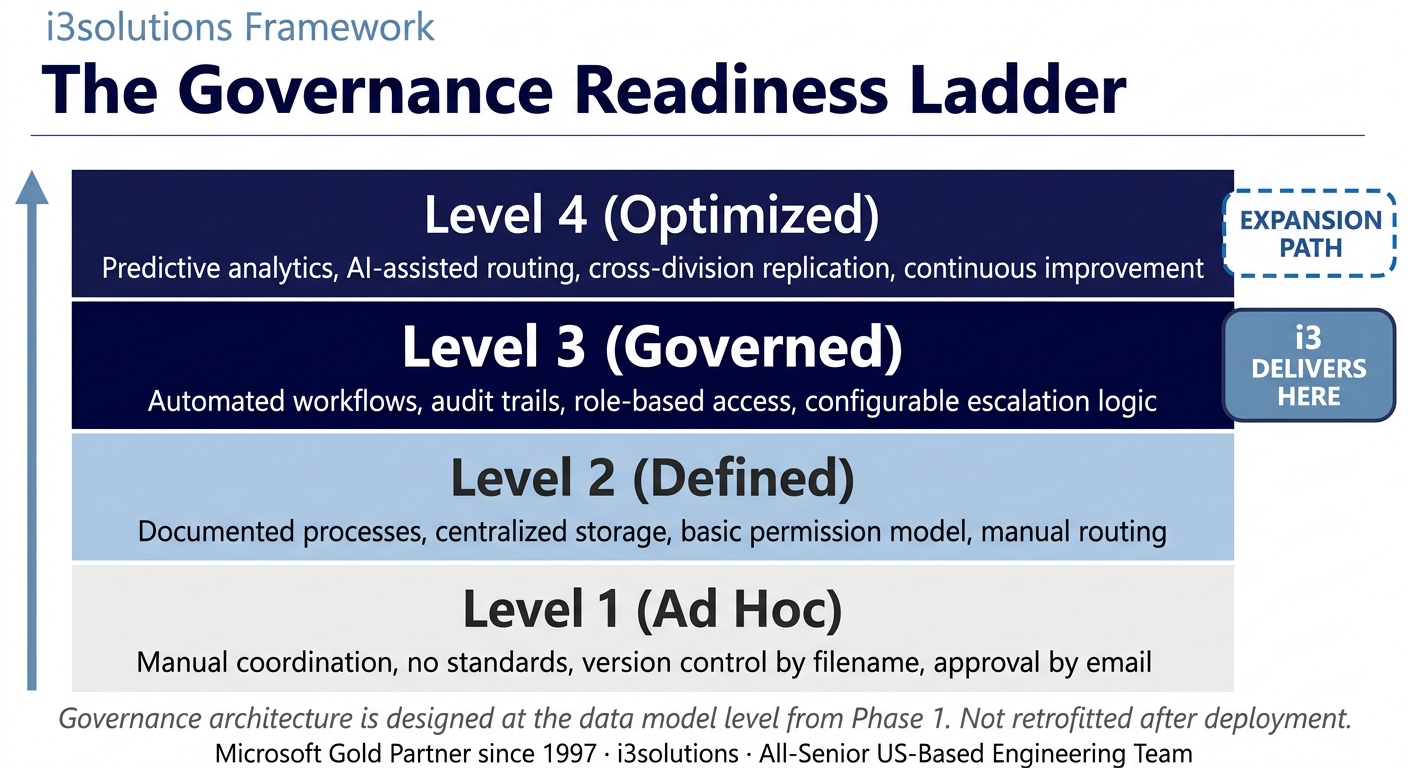
The data migration challenge was exceptionally complex. The migration required consolidating heterogeneous data structures and cleansing legacy information while maintaining strict security, metadata, and versioning protocols. FTI’s operations are highly sensitive to disruption; any system downtime during the cutover would directly impact billable client hours. The transition required migrating enormous datasets in phases while simultaneously implementing a new governance model and metadata schema to ensure the new SharePoint environment would not degrade back into an unmanageable repository over time.
Selection Rationale
Senior Microsoft Specialists with Proven Delivery Depth
FTI Consulting initially evaluated several generalist consulting firms and offshore outsourcing providers. These alternatives proved inadequate due to their shallow understanding of complex SharePoint migrations and their focus on ‘lift-and-shift’ approaches, which would have merely replicated FTI’s existing organizational problems in a new environment. FTI needed more than just technical expertise; they required a partner with deep strategic knowledge of modern information architecture, automated governance, and complex large-scale data cleansing to truly resolve the root causes of their information silos.
FTI chose i3solutions because they provided specialized Microsoft Gold Partner expertise, with an exclusive focus on complex content management solutions. As a senior-only team, entirely US-based with over 600 successful implementations since 1997, i3solutions delivered the specific depth and maturity FTI required. i3solutions went beyond simple file migration, developing custom automated tools for metadata extraction, deduplication, and automated governance. This ensured that FTI’s new SharePoint environment was not just a storage location, but a robust, searchable repository designed for long-term scalability and security.
The Enterprise Challenge
FTI Consulting is a multi-disciplined consulting firm with leading practices in financial restructuring, litigation support, engineering, and scientific investigation. As a growing organization, FTI recognized the critical need for seamless collaboration, real-time knowledge sharing, and leveraging existing intellectual property to maintain a competitive edge. Effective communication across divisions was essential to ensure employees had access to the right information at the right time.
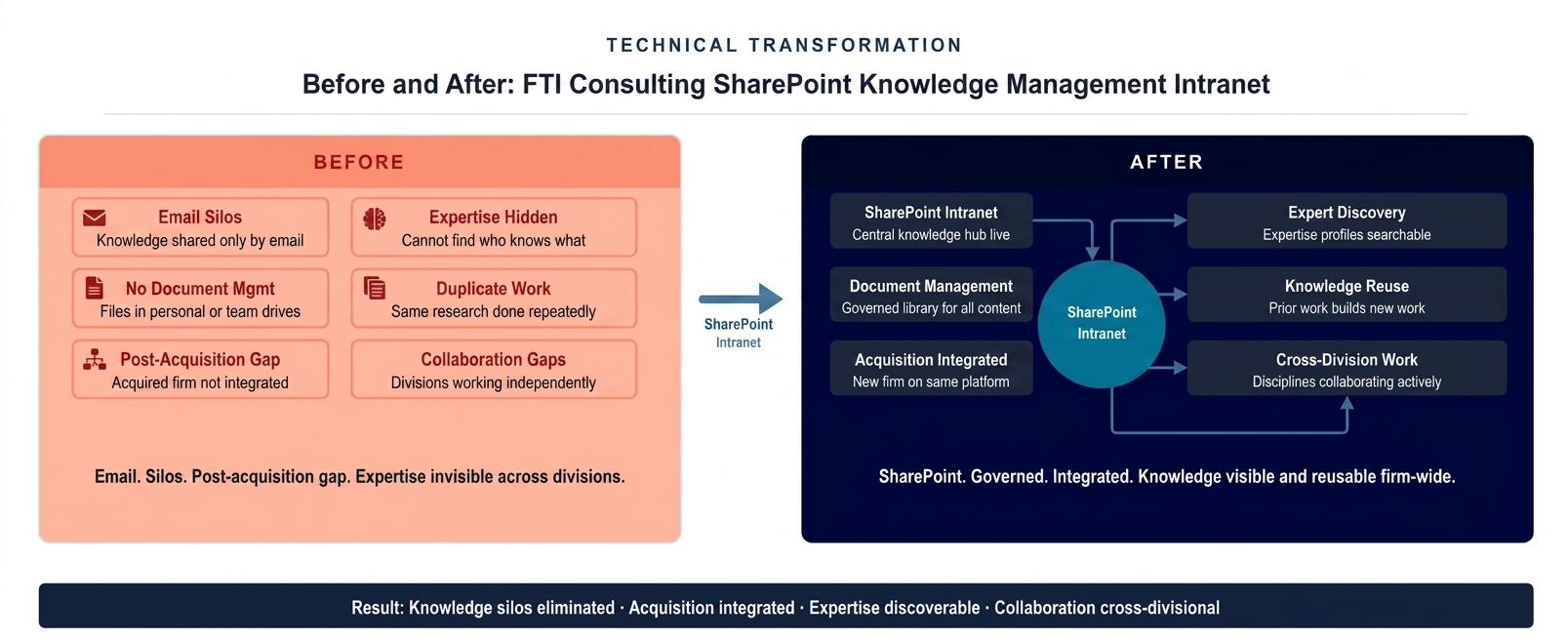
FTI’s existing infrastructure had not kept pace with the firm’s growth and increasingly complex knowledge-sharing requirements. Documents lived in personal and team drives. Expertise was invisible across divisions – finding who knew what required informal networks rather than a governed system. A company acquisition added an entirely new set of staff and content that had no clear integration path into the existing knowledge environment. i3solutions built a modern SharePoint-based intranet that centralized knowledge management, enabled cross-division collaboration, and integrated the acquired firm’s staff and content into a single governed platform.
The Engagement Approach
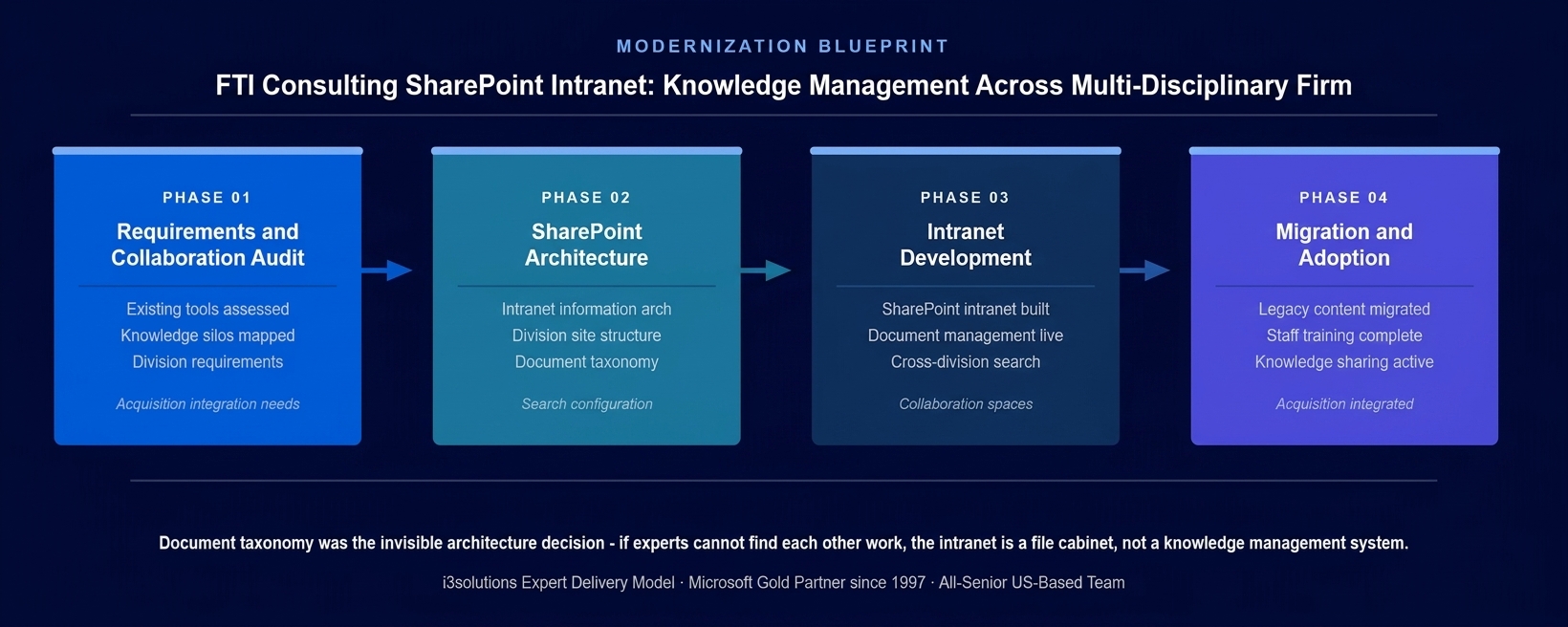
PHASE 01
Requirements and Collaboration Audit
Assessment of existing collaboration tools and content repositories. Knowledge silo mapping across FTI’s divisions. Division-specific requirements for document management and expertise discovery. Acquisition integration requirements for the newly joined firm and its staff.
PHASE 02
SharePoint Architecture
Intranet information architecture designed for FTI’s multi-disciplinary structure. Division site structure providing each practice area its own organized space within the unified intranet. Document taxonomy enabling cross-division content discovery. Search configuration indexing expertise profiles alongside documents.
PHASE 03
Intranet Development
SharePoint intranet built with document management library, division collaboration sites, and enterprise search. Expertise profiles enabling staff to discover colleagues with specific knowledge across the firm. Cross-division search confirmed indexing all content and profiles. Acquisition firm staff and content integrated into the platform.
PHASE 04
Migration and Adoption
Legacy content migrated from personal and team drives into the governed SharePoint library. Staff training across all divisions. Knowledge sharing patterns confirmed across previously siloed practice areas. Acquisition integration complete.
Technical Transformation
Measurable Outcomes
| Metric | Before | After | Improvement |
|---|
| Knowledge access | Personal and team drives – content not discoverable | SharePoint intranet with enterprise search across all content | Knowledge centralized and searchable |
| Expertise discovery | Informal networks – finding who knows what was hit-or-miss | Expertise profiles searchable across the full firm | Expertise discoverable firm-wide |
| Cross-division collaboration | Divisions working independently – silos across practice areas | Division collaboration sites enabling cross-practice work | Cross-division collaboration active |
| Document management | Ungoverned drives with inconsistent structure | Governed SharePoint library with unified document taxonomy | Governed document management |
| Acquisition integration | No path to integrate acquired firm staff and content | Acquired firm on same platform, fully searchable | Acquisition integrated |
| Knowledge reuse | Prior work inaccessible for new engagements | Prior work searchable and reusable across the firm | Knowledge reuse enabled |
[PENDING-CLIENT-QUOTE: insert 1-3 sentence outcome-focused quote in the client’s own language from a role matching the reader’s role.]
[Name or Role], [Organization type]
Frequently Asked Questions
SharePoint Knowledge Management for Consulting and Professional Services Firms
What is SharePoint knowledge management and why does it matter for consulting firms?
SharePoint knowledge management is the discipline of organizing a consulting firm’s accumulated intellectual property, engagement deliverables, methodologies, expertise profiles, and institutional knowledge, in a centralized platform that makes it searchable, accessible, and reusable across the firm. It matters for consulting firms because the competitive advantage of a consulting organization is knowledge: knowing what approaches work, which industries have which dynamics, which colleagues have which expertise, and what prior engagements can inform the current one. A firm whose knowledge is siloed in personal drives and email chains is a firm that rebuilds that knowledge from scratch on every new engagement, paying in consultant time for what it already earned on prior ones.
How does i3solutions build a SharePoint knowledge management intranet for a professional services firm?
i3solutions begins SharePoint knowledge management engagements with a collaboration audit that maps how knowledge currently flows across the firm, or fails to. This means understanding which practice areas collaborate regularly, which expertise is invisible across division lines, and what specific types of content consultants most often search for and fail to find. The intranet information architecture is then designed around those actual knowledge patterns rather than an organizational chart or a generic document library template. For FTI Consulting, this meant a cross-division search architecture, expertise profiles indexable alongside documents, and division sites structured for the multi-disciplinary nature of FTI’s practice areas, with acquisition integration built in from the start rather than added as an afterthought.
How does SharePoint enterprise search enable expertise discovery across a multi-disciplinary firm?
SharePoint enterprise search indexes user profile attributes, skills, prior engagement experience, industry focus, subject matter expertise, alongside documents and pages, making expertise discoverable through the same search interface used to find documents. When a consultant searches for expertise in a specific regulatory domain, the results include both relevant documents and the colleagues who have tagged expertise in that area or who authored the documents that come back. For a firm like FTI Consulting with leading practices across financial restructuring, litigation support, engineering, and scientific investigation, surfacing expertise across those divisions through a unified search is the capability that allows cross-disciplinary collaboration to happen systematically rather than only through personal networks.
How does a SharePoint intranet integration handle a company acquisition?
A SharePoint intranet that handles a company acquisition well is one whose architecture was designed with integration in mind from the start, with a document taxonomy flexible enough to absorb a new firm’s content structure, a user profile framework extensible to new expertise categories, and site architecture that can add new division sites without restructuring the existing ones. For FTI Consulting, integrating an acquired firm’s staff and content into the existing knowledge management intranet was a specific design requirement that i3solutions addressed in the architecture phase, not a scope addition discovered during implementation. The result was a single searchable platform that treated the acquired firm’s knowledge as a first-class part of FTI’s intellectual capital from day one.
Why choose i3solutions to build a knowledge management platform over a generic SharePoint consultant?
i3solutions brings pattern recognition from 600+ Microsoft platform implementations that a generic SharePoint consultant does not have, specifically including the failure modes that knowledge management intranets encounter when information architecture is built around convenience rather than how consultants actually search for and use knowledge. The difference between a SharePoint intranet that achieves adoption and one that becomes a dusty document repository is largely architectural: the document taxonomy, the search configuration, the expertise profile design, and the division site structure all determine whether the system becomes the place people go first to find knowledge or the place they uploaded something once and never returned to. i3solutions has been designing those architectures for Microsoft platforms since 1997.
Back to Case Study Library
60 enterprise Microsoft implementations documented
Related Insights
From the i3solutions YouTube Channel
Short-form perspectives on the delivery and technology challenges in this case study.
Who This Engagement Serves
This engagement is relevant if
- Consulting firms struggling with fragmented institutional knowledge across siloed personal drives and disconnected project folders.
- Organizations needing a secure, centralized SharePoint repository for critical data currently stored on individual desktops.
- Professional services teams requiring streamlined document collaboration and enhanced retrieval to leverage shared expertise effectively.
Less relevant if
- Companies requiring only basic document storage without complex collaboration or knowledge management workflows within a structured repository.
- Small businesses with highly agile teams who manage fine without formal, rigid knowledge centralization or retrieval systems.
Ready to make your firm’s knowledge discoverable and reusable across practice areas?
The 15-Business-Day Microsoft Assessment maps the SharePoint intranet architecture, document taxonomy, expertise profile design, and search configuration that would convert your firm’s accumulated knowledge from hidden assets into accessible competitive advantage.
Microsoft Gold Partner since 1997. 600+ implementations. All senior. All US-based.
Schedule the Assessment