Case Study · Business Advocacy
3 Million Businesses, Legacy Processes: How the the national business association Automated Operations with SharePoint
Client: the national business association

The Enterprise Challenge
The the national business association, headquartered in Washington D.C., is the largest business advocacy organization in the nation, representing the interests of more than 3 million businesses across every sector and every state. Behind that public-facing policy mission is a substantial internal operation: managing member relationships, coordinating legislative activities, processing business requests, and maintaining the data infrastructure that supports one of the most influential organizations in American economic policy.
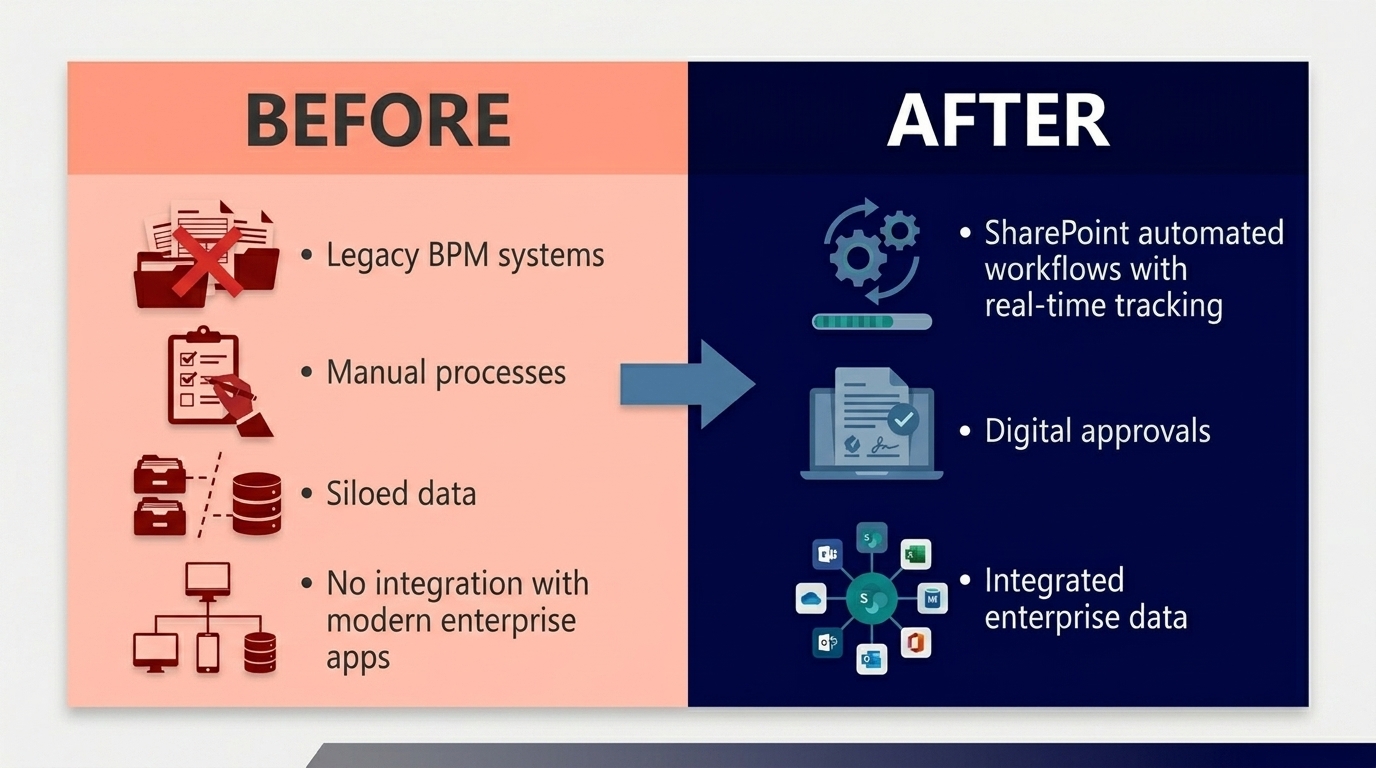
Much of that internal operation was running on legacy Business Process Management (BPM) systems that had been outpaced by the Chamber’s growth and the evolution of enterprise technology. These systems could not integrate cleanly with modern applications, could not scale to meet increasing processing demands, and required heavy manual intervention at every step. Data was siloed across systems with no automated connections. Staff spent significant time on low-value data entry and routing tasks that should have been automated.
The Strategic Trigger
The Chamber needed a modern workflow automation platform that could bridge its legacy systems with current enterprise applications, eliminate manual handoffs, and provide the scalability to support growing operational demands, all without disrupting the day-to-day operations of an organization whose work is time-sensitive and publicly visible.
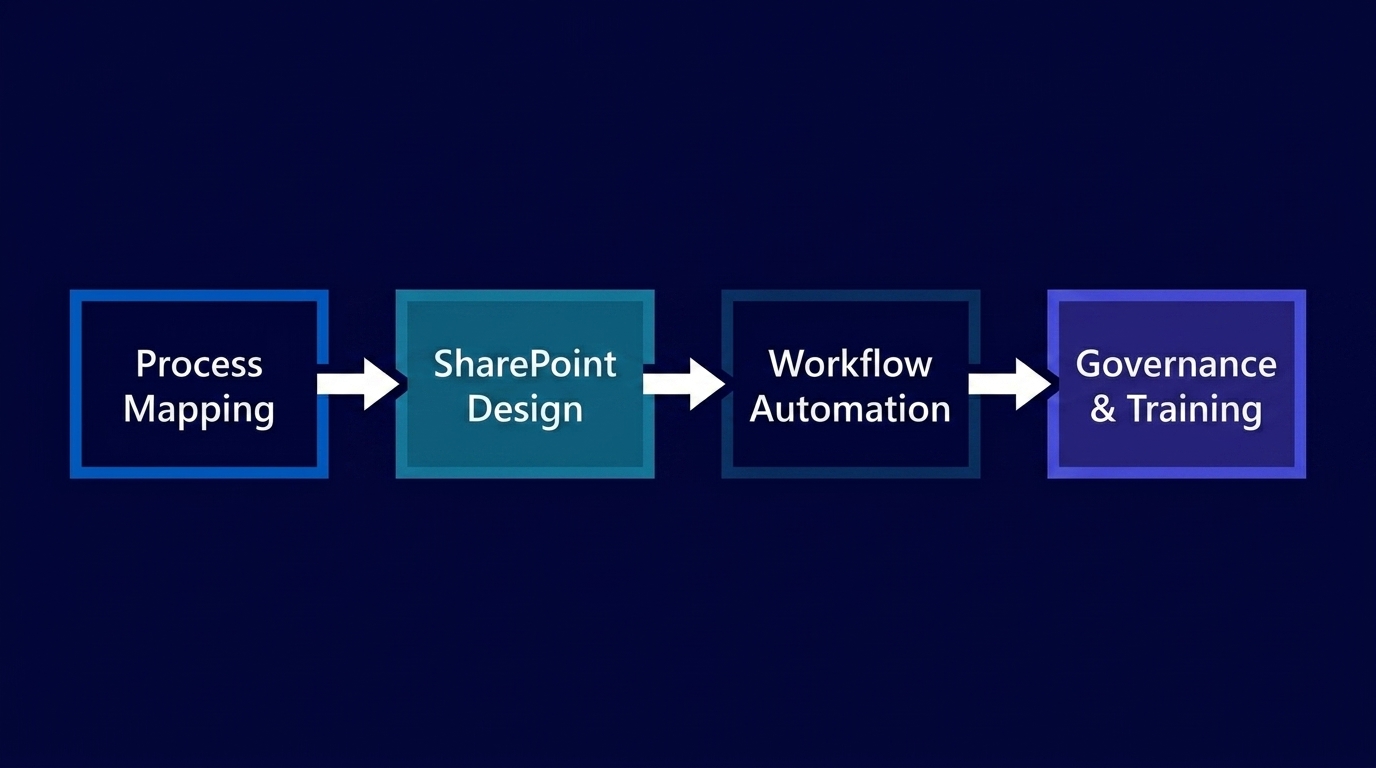
The Engagement Approach
Strategic Trigger
Undocumented Email Approvals Caused Audit Visibility Failure
The the national business association relied on a critical internal approval process managed entirely through email forwarding. As request volume increased, this ad-hoc method began breaking down, resulting in lost requests, significant delays, and inconsistent decision routing. The manual nature of the process meant there was absolutely no tracking of pending requests, making it impossible for leadership to identify bottlenecks or manage workloads. More critically, the absence of a central repository meant there was no historical visibility into past decisions, creating significant organizational risk during any review or inquiry.
Recognizing the escalating operational inefficiency and the severe data management gaps, executive leadership determined that the reliance on unstructured email approvals was unsustainable and posed an unacceptable risk to organization-wide transparency. They acknowledged that continued operational complexity demanded a standardized, automated, and secure system to handle complex internal workflows. The mandate was clear: implement a robust enterprise solution that would not only automate the routing and tracking of approvals but also create a comprehensive, centralized audit trail for every request to ensure long-term accountability.
Stakes
Absence of Audit Trail Creates Governance Risks
The primary risk of maintaining the status quo was a complete breakdown in compliance and corporate governance. The total lack of an immutable audit trail meant the Chamber could not definitively prove who authorized critical decisions, when they were approved, or what supporting documentation was reviewed at the time. This void exposed the organization to severe financial, legal, and regulatory consequences in the event of an internal audit or external investigation, as there was no centralized repository of approvals to validate operational adherence to internal controls or external mandates.
Beyond the immediate compliance risks, the unstructured approval process threatened the U.S. Chamber’s institutional credibility and operational strategic integrity. Continued failure to modernize these essential workflows resulted in persistent, avoidable operational delays and a pervasive lack of accountability that eroded internal trust. Externally, any high-profile governance failure stemming from the inability to track or document key approvals would cause lasting reputational damage to the organization’s standing as a leading advocate for American business, directly undermining its core mission and strategic effectiveness.
Constraints and Complexity
Mapping Intricate Approval Hierarchies Across Departments
The fundamental challenge lay in accurately digitizing the immensely complex and often implicit approval hierarchies that had evolved within the Chamber. The existing workflows were not standardized; they varied significantly by department, the specific type of request, and the dollar value or strategic impact involved. Translating these intricate, conditional routing rules from arbitrary email chains into a structured, reliable SharePoint-based automated system, without disrupting daily operations or introducing new bottlenecks, required an extraordinarily deep level of business process analysis and advanced workflow configuration expertise that was unique to this environment.
Successful implementation was contingent upon achieving universal adoption of the new digital process by a diverse user base accustomed to the informality of email. Resistance to change was a major organizational hurdle, as any complexity in the new interface would lead users back to non-compliant methods. The solution demanded an exceptional user experience designed within SharePoint that was intuitive, simplified the submission and approval actions, and provided clear visibility into request status, all while enforcing the strict technical and compliance requirements mandated by leadership for centralized tracking and reporting.
Selection Rationale
Senior Microsoft Specialists with Proven Delivery Depth
The the national business association considered multiple engagement models, including utilizing broad-market IT staffing agencies, large offshore outsourcing firms, and generalist integrators to develop the solution. These options were ultimately rejected because they couldn’t guarantee the sophisticated level of specialized Microsoft SharePoint workflow expertise required. The high potential for communications gaps, high staff turnover, and the shallow technical depth commonly associated with these cost-focused models posed an unacceptable risk to a project of such critical importance, which demanded precise business process engineering and immediate solution reliability.
The Chamber ultimately selected i3solutions due to their deep technical credentials as a specialized Microsoft Gold Partner since 1997, with over 600 successful implementations. The primary differentiator was the i3solutions model: an all-senior, all US-based team, where every member possessed extensive experience in direct-to-client requirement translation and complex process automation. This ensured that the team managing the integration had the necessary strategic consulting depth to synthesize the Chamber’s intricate approval rules into a robust, compliant, and user-friendly SharePoint application, guaranteeing the required audit visibility.
Phase 1
Process Mapping
Documented existing BPM workflows, identified manual handoff points, integration requirements, and data dependencies across the Chamber’s operational systems.
Phase 2
SharePoint Design
Architected a SharePoint-based process automation framework with workflow templates, approval routing, and data integration connectors.
Phase 3
Workflow Automation
Built and configured automated workflows for the Chamber’s core business processes, replacing manual routing with digital approvals and system-to-system data flows.
Phase 4
Governance & Training
Established process governance standards, trained operational staff, and delivered documentation for ongoing administration.
Technical Transformation
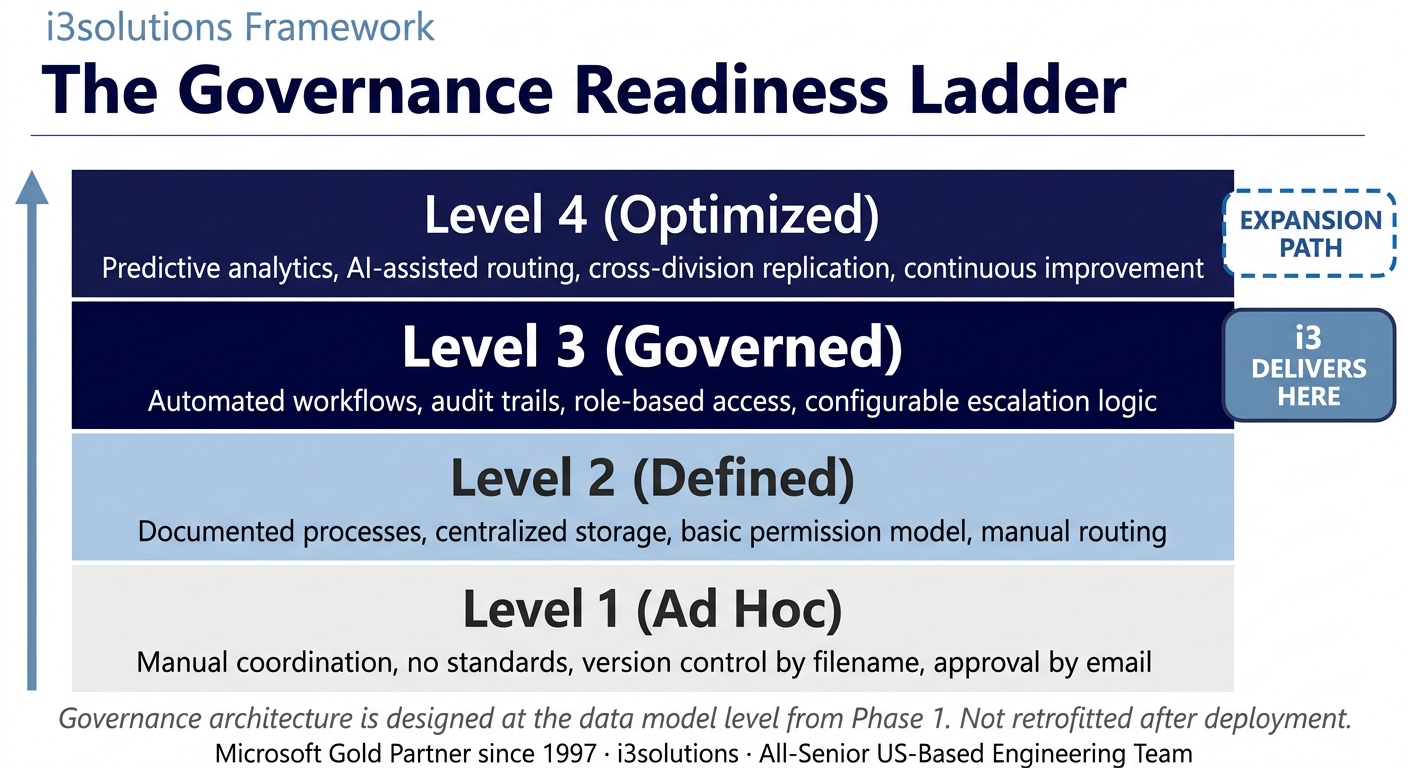
i3solutions replaced the Chamber’s legacy BPM infrastructure with a SharePoint-based automation platform that connects modern enterprise applications, eliminates manual workflow steps, and scales with organizational demand. Staff who previously spent time on manual data entry and physical routing now work in a system where approvals flow automatically, data moves between systems without intervention, and process status is visible in real time. The platform was designed with governance standards that allow the Chamber to manage and extend workflows as operational needs evolve.
Measurable Outcomes
| Metric |
Result |
| Manual Work Eliminated |
Automated digital workflows replaced manual routing and data entry across core operational processes |
| Integration Achieved |
SharePoint platform connects legacy systems with modern enterprise applications without manual synchronization |
| Scalability Delivered |
New architecture handles increasing processing demands without degradation or manual workarounds |
| Process Visibility |
Real-time workflow status tracking replaced opaque manual routing processes |
| Governance Established |
Standardized process templates and administration protocols support long-term self-sufficiency |
[PENDING-CLIENT-QUOTE: insert 1-3 sentence outcome-focused quote in the client’s own language from a role matching the reader’s role.]
[Name or Role], [Organization type]
Frequently Asked Questions
What is business process automation on SharePoint and how does it differ from legacy BPM?
SharePoint business process automation uses Microsoft’s workflow engine to digitize and automate manual process steps, routing approvals, transferring data between systems, and triggering actions based on business rules. Legacy BPM systems often require proprietary middleware and cannot connect to modern cloud applications. SharePoint-based automation integrates natively with Microsoft 365, Power Platform, and enterprise APIs, giving organizations a more flexible and maintainable automation foundation.
How does i3solutions approach workflow automation for large advocacy and membership organizations?
i3solutions begins with process mapping, documenting every workflow step, every manual handoff, and every system touch point. For organizations like the Chamber, the challenge is that processes cross multiple departments and involve data from multiple systems simultaneously. i3solutions designs automation that handles those cross-system dependencies cleanly, rather than automating individual process fragments that still require manual connection.
How does SharePoint integrate with legacy BPM systems during a modernization?
i3solutions uses a combination of SharePoint connectors, REST APIs, and Power Automate flows to bridge legacy BPM outputs with modern SharePoint workflows. This approach allows organizations to automate new processes immediately while legacy systems are decommissioned gradually, rather than requiring a simultaneous cutover that risks operational disruption.
What ROI should advocacy organizations expect from workflow automation?
Organizations that automate manual BPM workflows typically recover significant staff time, hours per week per process, that can be redirected to higher-value work. For the Chamber, eliminating manual routing and data entry across core processes represented a meaningful reduction in operational overhead. The secondary ROI is quality: automated workflows eliminate the human error inherent in manual data entry and routing.
Why choose i3solutions for SharePoint workflow automation at enterprise scale?
i3solutions has delivered workflow automation for organizations ranging from federal agencies to global nonprofits and enterprise defense contractors, always with an all-senior team, always on the Microsoft platform. Our 600+ implementations and 27-year Gold Partner track record give us pattern recognition that accelerates delivery. Our 15-Business-Day Microsoft Assessment gives advocacy organizations a clear implementation plan before committing to any automation work.
Who This Engagement Serves
This engagement is relevant if
- An association needing automated workflows to replace manual, ad-hoc email review processes within its advocacy department.
- A member-based organization requiring a centralized system for tracking and auditing content approvals for public release.
- A regulatory body needing to establish clear compliance trails for internal decision-making processes using existing Microsoft infrastructure.
Less relevant if
- A startup utilizing only third-party SaaS applications with no requirement for custom compliance documentation.
- A company that has already standardized all workflows on an enterprise-grade dedicated Business Process Management system.
Ready to establish a governed Microsoft environment?
i3solutions delivers enterprise digital transformation on-time, in-scope, in-production. Microsoft Gold Partner since 1997. 600+ implementations. All-senior, all US-based team.
Schedule a 15-Business-Day Microsoft Assessment