Case Study · Nonprofit / Humanitarian
National Mentors, No Central Hub: How SHARED HOPE Built a Collaboration Platform on SharePoint
Client: Samaritan Inn / SHARED HOPE® Mentoring Network

The Enterprise Challenge
Samaritan Inn operates the SHARED HOPE® mentoring partnership network across the United States, a faith-based and community organization program dedicated to addressing addiction and homelessness through structured mentoring relationships. The network connects individuals rebuilding their lives with partner organizations and trained volunteer mentors spread across the country. Managing that network requires reliable, accessible communication infrastructure that can reach participants regardless of location or technical sophistication.
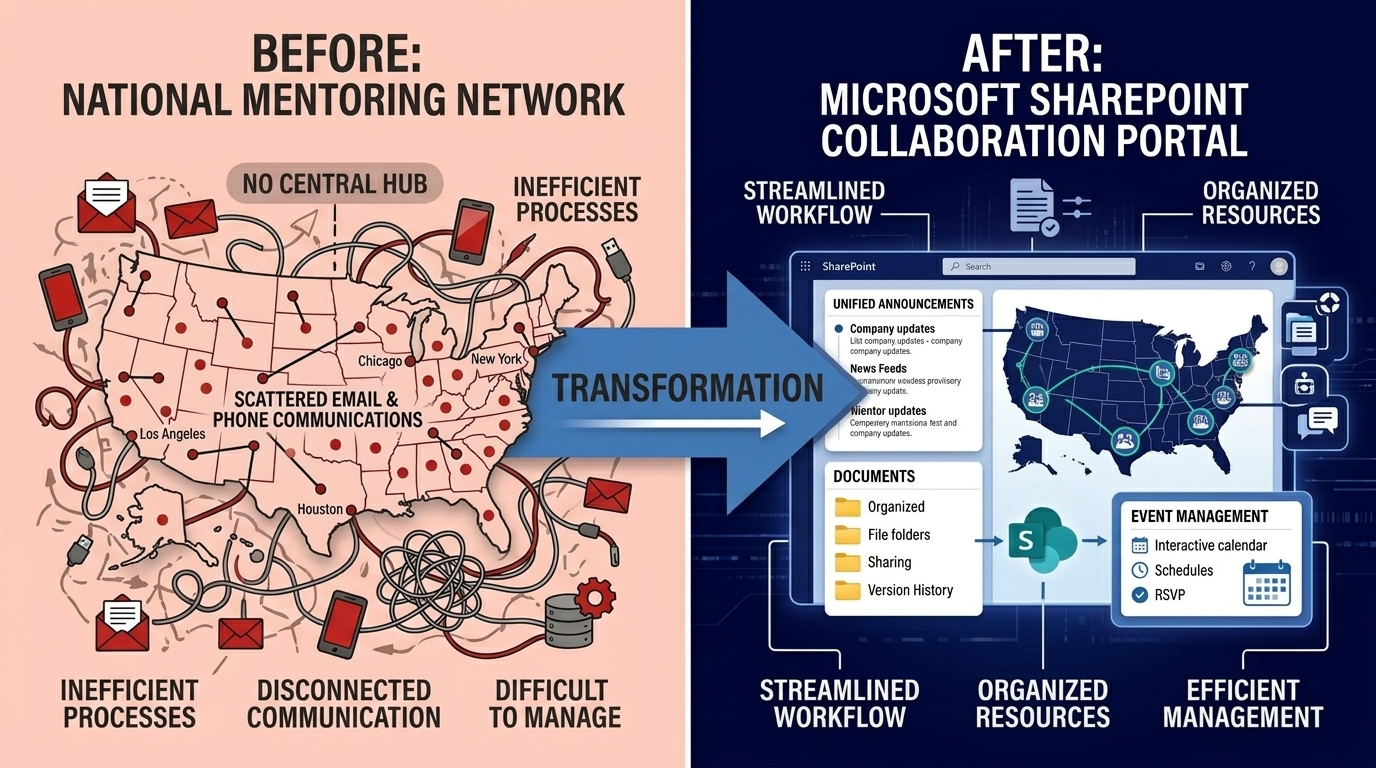
The existing communication infrastructure was not equal to that requirement. Partner organizations and mentors across the country received information through a mix of email, phone calls, and informal channels. There was no central location where the latest program announcements, training documents, event schedules, or best practice resources could be reliably found. When SHARED HOPE updated a program guide or scheduled a national training event, ensuring that every partner and mentor actually received and accessed the update was a manual, time-consuming process with no verification mechanism.
The Strategic Trigger
SHARED HOPE needed a centralized digital platform that could serve as the single source of truth for the entire national network, announcements, documents, events, and resources, accessible to all partners and mentors regardless of location, with enough simplicity that volunteers with varying technical comfort could use it effectively.
The Engagement Approach
Strategic Trigger
Fragmented communication channels threatened national program scaling efforts
As the SHARED HOPE national mentoring network expanded, Samaritan Inn faced a critical juncture where the lack of a central hub for partner and mentor communication was no longer sustainable. Regional coordinators were relying heavily on siloed email chains, disparate spreadsheets, and ad-hoc phone calls to manage mentor-mentee matches and share program resources. The accumulated near-misses in volunteer tracking and escalating failures in delivering standardized training materials across different chapters began to erode stakeholder confidence and slowed down the onboarding process. This communication fragmentation created significant inefficiencies and inconsistent program delivery, hindering their mission.
Recognizing these operational bottlenecks, SHARED HOPE leadership formally acknowledged that the current decentralized model posed a significant risk to the integrity and effectiveness of their national mentoring network. They realized that without a unified, central hub for collaboration and information dissemination, the program could not maintain quality standards or support continued growth. To secure the future of the initiative and enhance the experience for both partners and mentors, leadership committed to a comprehensive digital transformation focused on implementing a standardized, enterprise-grade communication platform to serve as the single source of truth.
Stakes
Inability to support growing demand risks major funding
The absence of a modernized, central hub for the national mentoring network presented substantial financial and operational risks. Samaritan Inn faced the direct financial operational consequence of losing critical grant funding if they could not accurately report on program outcomes, volunteer engagement levels, and mentee progress across all chapters. Furthermore, the operational inefficiencies stemming from redundant administrative tasks and manual data reconciliation drove up overhead costs and diverted precious resources away from core program activities, severely impacting the overall cost-effectiveness of the national initiative.
Beyond the immediate financial and operational implications, the continued reliance on disconnected communication systems posed severe reputational and strategic risks to Samaritan Inn and the SHARED HOPE program. Continued failure to provide a seamless, supportive environment for mentors and partners threatened to increase volunteer attrition rates and damage relationships with corporate sponsors. Strategically, the inability to collect and leverage consistent data across the national network prevented leadership from making informed decisions, ultimately limiting the long-term impact of the mentoring program.
Constraints and Complexity
Integrating highly diverse partners within rigorous data security
Implementing the new national hub on SharePoint introduced unique technical and organizational constraints, primarily due to the vast diversity of external partners and the sensitivity of the data involved. The system had to be accessible and user-friendly for stakeholders with varying levels of technical proficiency across hundreds of affiliate organizations, many operating with their own distinct IT policies. Striking the right balance between necessary security controls to protect the PII (Personally Identifiable Information) of minors and mentors while maintaining the required openness for collaboration across the national network was paramount.
The data migration and adoption complexity specific to the SHARED HOPE client was substantial. The new SharePoint platform needed to integrate or ingest a chaotic assortment of legacy data formats and documents from existing regional silos, which was a significant undertaking for the central team. More importantly, overcoming organizational resistance was essential, as success depended heavily on widespread adoption of the new solution. Ensuring that busy regional directors and volunteers fully embraced the standardized central hub over familiar, albeit inefficient, legacy communication methods required careful change management.
Selection Rationale
Senior Microsoft Specialists with Proven Delivery Depth
Samaritan Inn evaluated several consulting alternatives, including larger commodity staffing firms and offshore resources, but found them inadequate for this critical project. These alternatives often leverage junior-level talent and offshore pools where high turnover and language barriers can impede collaboration and solution quality for complex SharePoint implementations. For a project with high stakes and specific compliance needs, relying on firms that couldn’t guarantee consistent access to seasoned experts who understand the nuances of SharePoint for national-scale nonprofit collaboration was deemed unacceptably risky for SHARED HOPE.
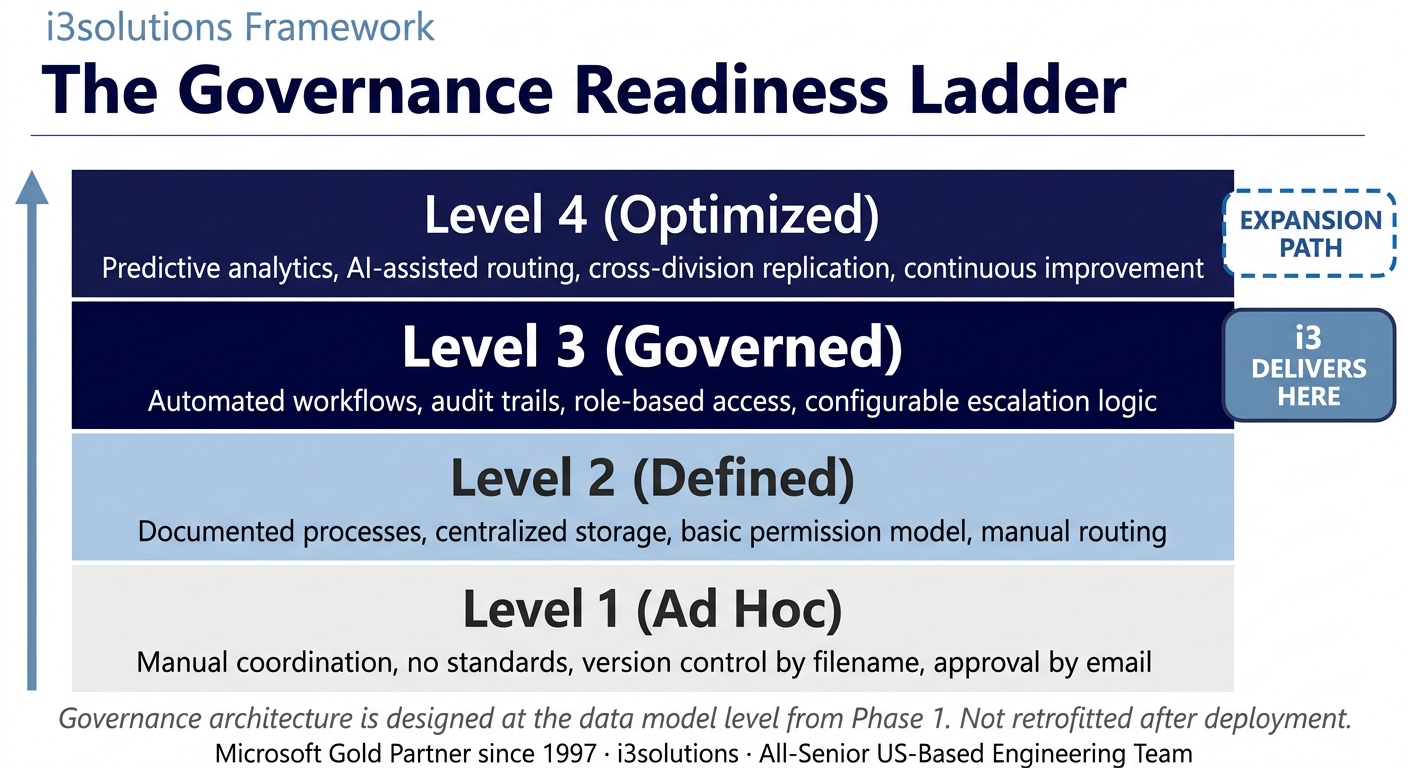
Conversely, i3solutions was chosen based on their deep expertise as a Microsoft Gold Partner since 1997, with a specific focus on complex collaboration solutions and over 600 successful implementations. Their unique staffing model, featuring an all-senior, all US-based team, directly addressed Samaritan Inn’s requirement for a highly skilled and reliable partner to build the central hub. This depth of experience ensured i3solutions could navigate the complex technical and security constraints, delivering a robust SharePoint solution tailored to the SHARED HOPE national mentoring network’s specific needs.
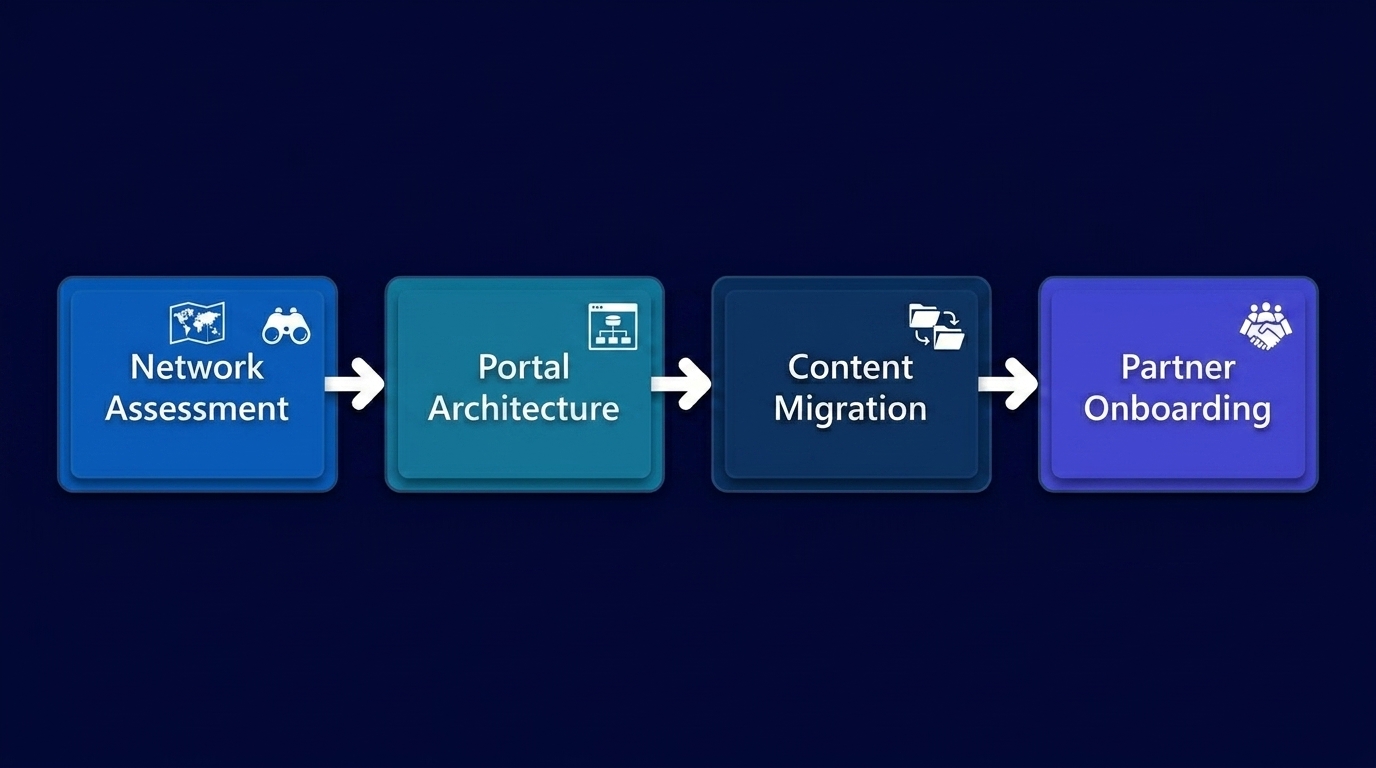
Phase 1
Network Assessment
Mapped the full SHARED HOPE partner and mentor network, identifying communication patterns, document types, and access requirements across all geographic regions.
Phase 2
Portal Architecture
Designed a SharePoint collaboration portal with an information structure organized around network roles, partner organizations, individual mentors, and program administrators.
Phase 3
Content Migration
Moved existing program documents, training materials, and resources into the new SharePoint portal with organized libraries and search capability.
Phase 4
Partner Onboarding
Conducted rollout training for partner organizations and mentors, establishing the portal as the official hub for all SHARED HOPE network communications.
Technical Transformation
i3solutions delivered a centralized SharePoint collaboration portal that gave SHARED HOPE’s national partner and mentor network a single, reliable destination for all program information. Announcements post once and reach the entire network simultaneously. Training documents, program guides, and event calendars are organized in searchable libraries accessible from any device. Program administrators can target communications to specific partner groups rather than broadcasting everything to everyone. The informal phone and email coordination system was replaced with a structured, scalable digital platform.
Measurable Outcomes
| Metric |
Result |
| Network Reach |
All partners and mentors across the country access the same current information through a single platform |
| Information Reliability |
Program announcements and document updates reach the network immediately without manual distribution effort |
| Document Findability |
Searchable SharePoint libraries replaced informal email archives for training materials and program guides |
| Event Coordination |
Centralized event calendar eliminated the confusion of managing national training schedules through email chains |
| Administrative Efficiency |
Program staff reduced time spent on manual communication management and distribution tracking |
[PENDING-CLIENT-QUOTE: insert 1-3 sentence outcome-focused quote in the client’s own language from a role matching the reader’s role.]
[Name or Role], [Organization type]
Frequently Asked Questions
What is a SharePoint collaboration portal for nonprofit mentoring networks?
A SharePoint collaboration portal is a centralized web platform where network members, in SHARED HOPE’s case, partner organizations and volunteer mentors, can access program information, documents, event schedules, and communications from a single authenticated location. It replaces the fragmented email-and-phone communication model with a structured digital hub that scales with network growth.
How does i3solutions approach SharePoint implementations for national nonprofit networks?
i3solutions begins with a network assessment that maps the different roles within the organization, administrators who publish content, partner organizations who consume and share it, and individual participants who need specific resources. For SHARED HOPE, the architecture had to serve users with widely varying technical comfort levels across many geographic locations. Simplicity was as important as functionality.
How does SharePoint handle role-based content targeting for a national network?
SharePoint’s audience targeting features allow administrators to tag content for specific groups, partner organization leaders, individual mentors, regional coordinators, so each user sees content relevant to their role when they visit the portal. i3solutions configures these targeting rules during the architecture phase to ensure the portal presents a curated experience rather than overwhelming users with all content.
What ROI should national nonprofit networks expect from a centralized collaboration platform?
Nonprofit networks that centralize communication on a SharePoint portal typically see measurable reduction in the administrative time spent on manual distribution, and improvement in network engagement as partners and mentors develop the habit of checking a single reliable source. The secondary benefit is organizational continuity, when information lives in a central platform rather than individuals’ email inboxes, the network retains knowledge through staff and volunteer transitions.
Why choose i3solutions for nonprofit collaboration platform development?
i3solutions has built collaboration platforms for nonprofits ranging from IRC’s global humanitarian network to the the nonprofit membership organization and SHARED HOPE. Our all-senior team understands that nonprofit implementations require simplicity and ease of adoption alongside functional capability. Our 15-Business-Day Microsoft Assessment gives nonprofits a clear implementation plan before any commitment.
Who This Engagement Serves
This engagement is relevant if
- National non-profits struggling to maintain cohesive communication across dozens of independent local mentoring chapters or affiliates.
- Organizations lacking a centralized knowledge hub for sharing critical program resources and best practices nationally.
- Networks requiring a secure, unified platform for remote staff collaboration and standardized data collection across regions.
Less relevant if
- Small, local non-profits operating from a single office with few staff and no external network.
- Organizations seeking a client-facing database rather than an internal tool for staff collaboration and information sharing.
Ready to establish a governed Microsoft environment?
i3solutions delivers enterprise digital transformation on-time, in-scope, in-production. Microsoft Gold Partner since 1997. 600+ implementations. All-senior, all US-based team.
Schedule a 15-Business-Day Microsoft Assessment