Case Study • Federal Government / Labor Relations • Case Management
900 Arbitrators, Zero Digital Tracking: How FMCS Digitized Its Arbitration Case Management System
The Enterprise Challenge
Digital Case Management for a Federal Labor Relations Agency
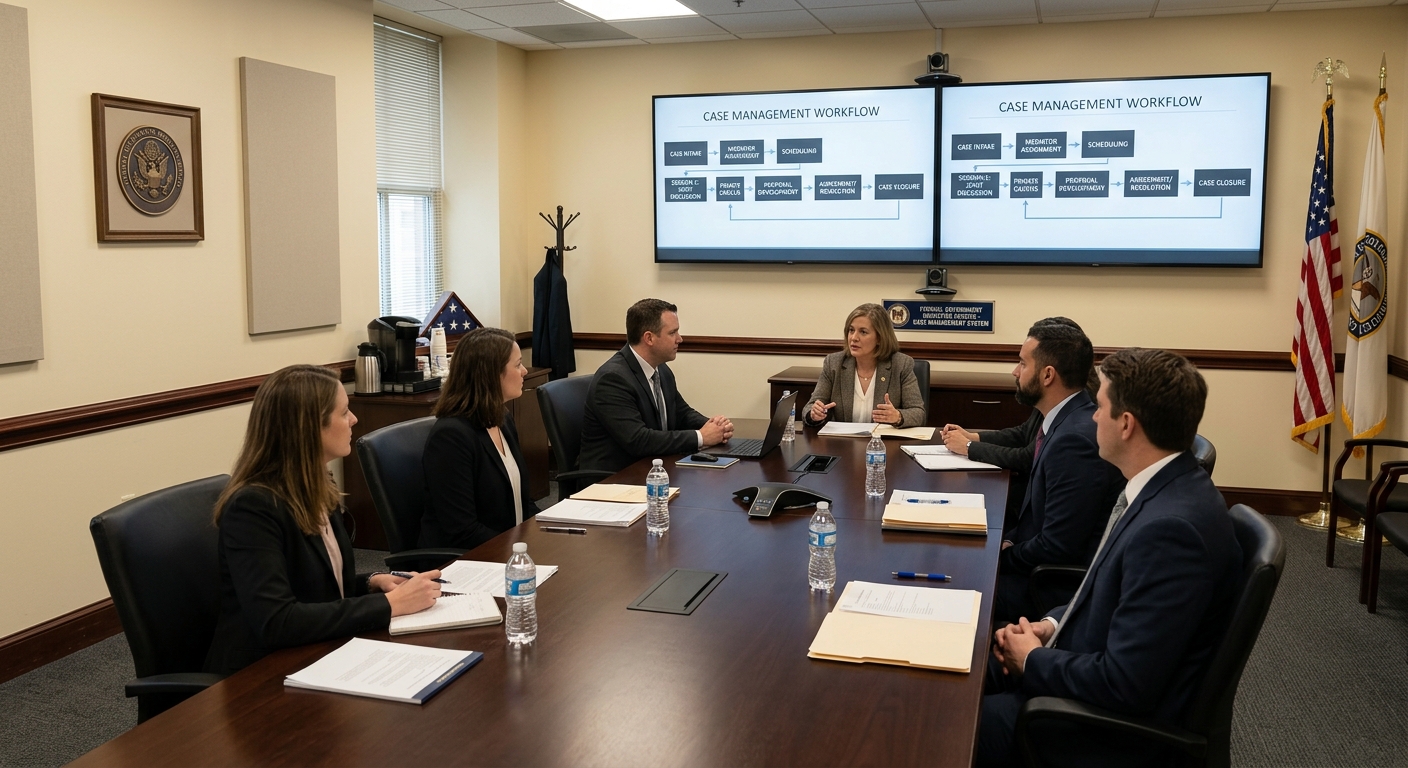
The Federal Mediation and Conciliation Service promotes peaceful labor-management relations, prevents and mitigates labor disputes, and facilitates the negotiation of collective bargaining agreements between employers and labor unions. FMCS provides mediation, conciliation, arbitration, and training services across industries, government agencies, and communities from its Washington DC headquarters and a network of regional and field offices.
FMCS managed more than 900 arbitrators, 3,800 requestors, and more than 10 administrators through a system that had no digital process for tracking, awarding, and compensating arbitrators. The entire arbitration process – assigning arbitrators to cases, managing requestor interactions, tracking case status, processing awards, and issuing compensation – relied on a paper-based approach that created inefficiencies at every stage. There was no digital record of case status, no self-service capability for the 3,800 requestors who needed to initiate arbitration requests, and no automated process for the compensation that arbitrators received for completed cases.
i3solutions designed and developed a new online arbitration system that modernized, simplified, and automated the arbitration process end-to-end – delivering self-service capability for both arbitrators and requestors, automated tracking and compensation, and a digital record of every case action that replaced the paper-based system with a governed, scalable digital platform.
Strategic Trigger
Scale Made the Paper System Untenable
The forcing function was the operational scale of the arbitration portfolio against the limitations of a paper-based tracking system. Managing 900 arbitrators and 3,800 requestors through manual processes required administrative time and effort that scaled linearly with caseload – every new case added to the paper system required manual processing at every stage. A digital system with self-service capability for both arbitrators and requestors would convert the linear administrative cost of caseload growth into a flat platform cost that served any volume the FMCS arbitration portfolio required.
The compensation accuracy risk was the second driver. Paper-based arbitrator compensation processing introduced the possibility of errors at every manual step: tracking which cases had been completed, calculating the correct compensation amount, issuing the correct payment, and maintaining an accurate record of compensation history. A digital system that automated compensation tracking and issuance would eliminate the error-prone manual calculation and payment process that the paper system required.
Is a federal agency managing case assignments and compensation through paper-based processes?
If case tracking, award management, and compensation processing depend on paper records and manual administration, the operational cost scales with caseload. A 15-Business-Day Microsoft Assessment maps the digital case management architecture that would deliver self-service, automated tracking, and electronic compensation to every participant.
Request the Assessment
Stakes
Operational inefficiencies threaten federal labor dispute resolution
Failure to modernize from a paper-based system could lead to significant financial losses and operational bottlenecks for the FMCS. Continued reliance on manual processes increases the risk of errors, delays in case processing, and inefficient resource allocation. Without visibility into case status and history, the agency would struggle to make data-driven decisions, impacting the timeliness of arbitrations. These delays directly contribute to increased administrative costs and reduced overall productivity, creating a financial burden that is unsustainable for a federal agency tasked with ensuring timely labor dispute resolution.
Downstream, the inability to effectively manage labor dispute resolutions poses a major reputational and strategic risk. The FMCS’s reputation hinges on its impartiality and efficiency. Persistent delays in case management could erode the trust that employers and unions place in the agency, ultimately compromising its core mission. Furthermore, a lack of data visibility hinders strategic planning, making it difficult for the agency to adapt to evolving labor-management landscapes. This could result in a diminished influence and relevance within the labor relations community, impacting the FMCS’s ability to fulfill its legislative mandate.
Constraints and Complexity
Securely managing sensitive labor data in real time
The FMCS operates under unique constraints, including strict regulatory requirements for data security and confidentiality. This makes implementing a cloud-based solution particularly challenging. Managing highly sensitive labor data while ensuring real-time accessibility and collaboration across various stakeholders required robust security protocols and access controls. Furthermore, the complexity of FMCS operations, which involve numerous participants in each case, meant that the solution had to facilitate seamless data exchange without compromising security. These technical and security requirements were paramount, ensuring that the new system met all federal mandates for data protection.
Data migration from the legacy paper-based system introduced additional layers of complexity. Hundreds of thousands of documents needed to be accurately and securely digitized and integrated into the new platform. Ensuring data integrity throughout this process was critical to the successful implementation. This required meticulous planning and execution to prevent data loss or corruption. Moreover, driving adoption of the new technology among FMCS staff required a carefully crafted change management strategy. Staff accustomed to traditional paper-based processes needed support and training to transition effectively, which was vital for achieving the expected gains in efficiency and productivity.
Selection Rationale
Senior Microsoft Specialists with Proven Delivery Depth
Before selecting i3solutions, the FMCS evaluated several large consulting firms and commodity offshore staffing options. Many of these alternatives lacked the deep technical expertise and personalized approach needed for such a complex federal project. Large firms often prioritize scale over specialization, leading to potential gaps in solution design and execution. Offshore commodity staffing, while cost-effective in some scenarios, presents unique challenges regarding data security and communication. Given the sensitivity of FMCS data and the strategic importance of the project, these options were deemed inadequate, emphasizing the need for a highly qualified and trustworthy partner.
i3solutions was selected for its proven track record and specialized expertise as a Microsoft Gold Certified Partner. With a long-standing history of successful Microsoft implementations, the firm demonstrated deep familiarity with the Power Platform and its capabilities. Their team of all-senior, all-US-based professionals provided the necessary assurance of data security and high-quality solution delivery. This onshore, expert-only staffing model ensured that the FMCS would receive the highest level of attention and support throughout the project. The firm’s experience with federal agencies further solidified their position as the ideal partner to navigate the complex regulatory landscape and successfully implement the new solution.
The Engagement Approach
PHASE 01
Process Mapping
Complete documentation of the paper-based arbitration process: every step in the requestor workflow from initial request through case assignment; every step in the arbitrator workflow from case receipt through completion and compensation; every administrative step in case management and award processing. Output: the complete process specification that the digital system would implement, and the specific points where self-service capability would eliminate administrative intervention.
PHASE 02
System Architecture
Online portal architecture supporting distinct requestor and arbitrator interfaces. Case assignment system connecting requestors to available arbitrators based on case requirements. Admin tracking dashboard providing FMCS administrators visibility into all active cases, pending assignments, and compensation processing. Electronic compensation system replacing manual payment calculation and paper check issuance. Database architecture maintaining the complete case record from initiation through compensation.
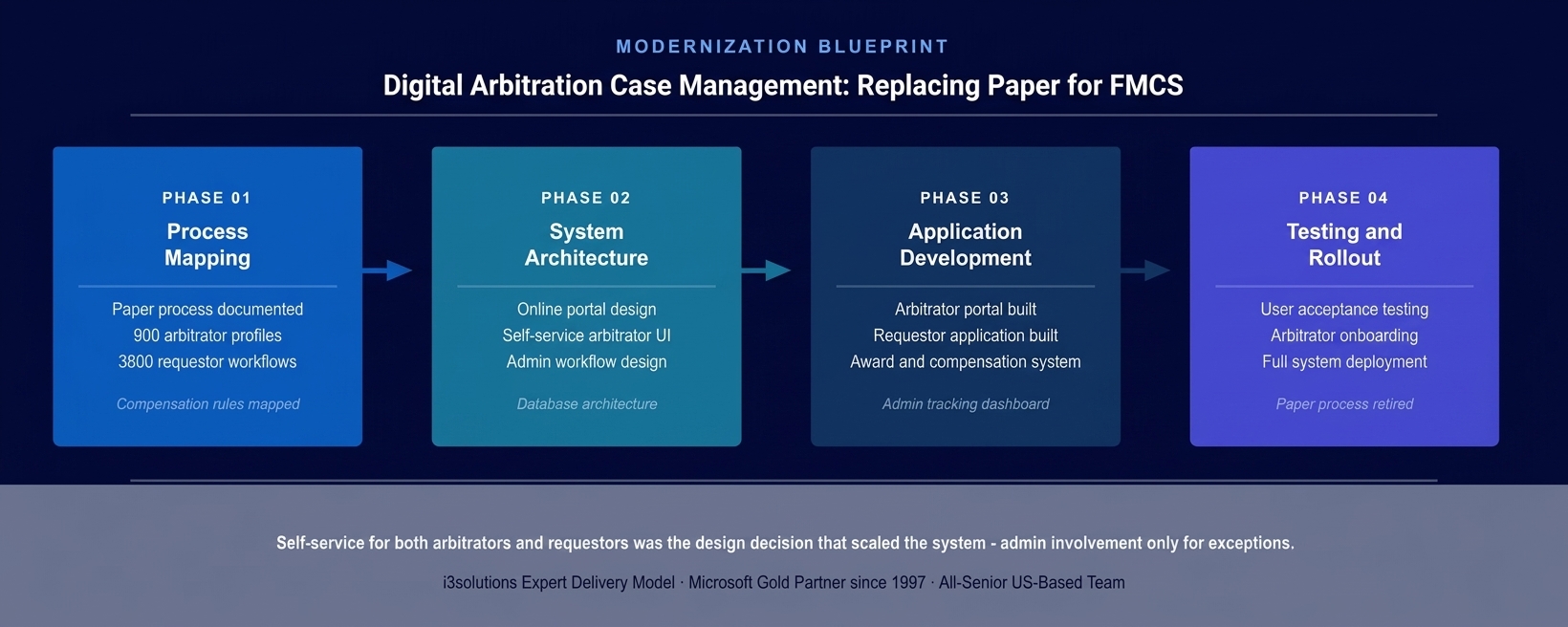
The four-phase approach. Building self-service for both arbitrators AND requestors was the design decision that scaled the system – if either group required admin involvement for routine interactions, the administrative savings would be only partial.
PHASE 03
Application Development
Arbitrator self-service portal enabling arbitrators to manage their availability, receive case assignments, submit case completion documentation, and track their compensation history. Requestor self-service application enabling the 3,800 requestors to initiate arbitration requests, select from qualified available arbitrators, track case status, and receive case outcomes. Award and compensation system automating the calculation and processing of arbitrator compensation. Admin dashboard providing complete case visibility across the full portfolio.
PHASE 04
Testing and Rollout
User acceptance testing with arbitrators, requestors, and FMCS administrators across the full case lifecycle. Arbitrator onboarding migrating all 900 arbitrators from paper records to digital profiles. Requestor portal launch for the 3,800 requestors. Paper process retired. Post-launch monitoring confirming system performance under the full operational load of the FMCS arbitration portfolio.
Technical Transformation
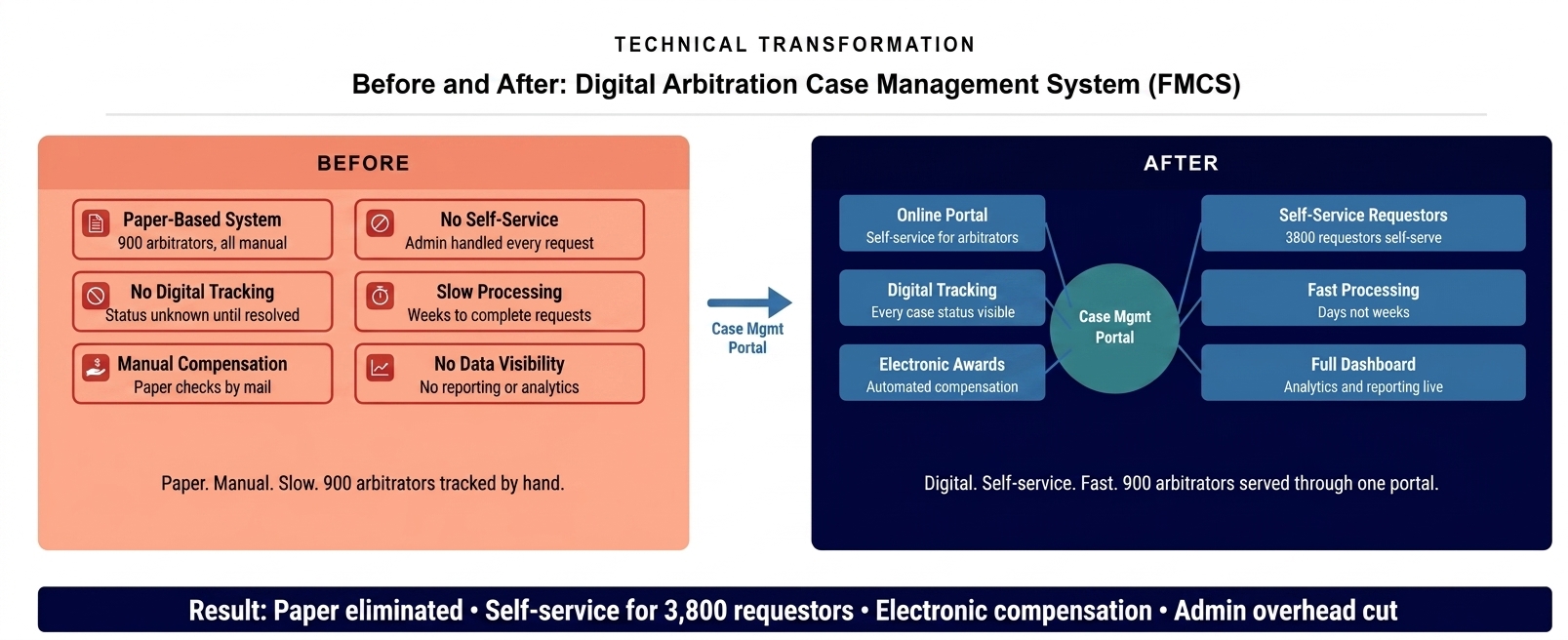
The arbitration management state before and after. A paper-based process serving 900 arbitrators and 3,800 requestors through manual administration replaced by a self-service digital platform with automated case assignment, tracking, and electronic compensation.
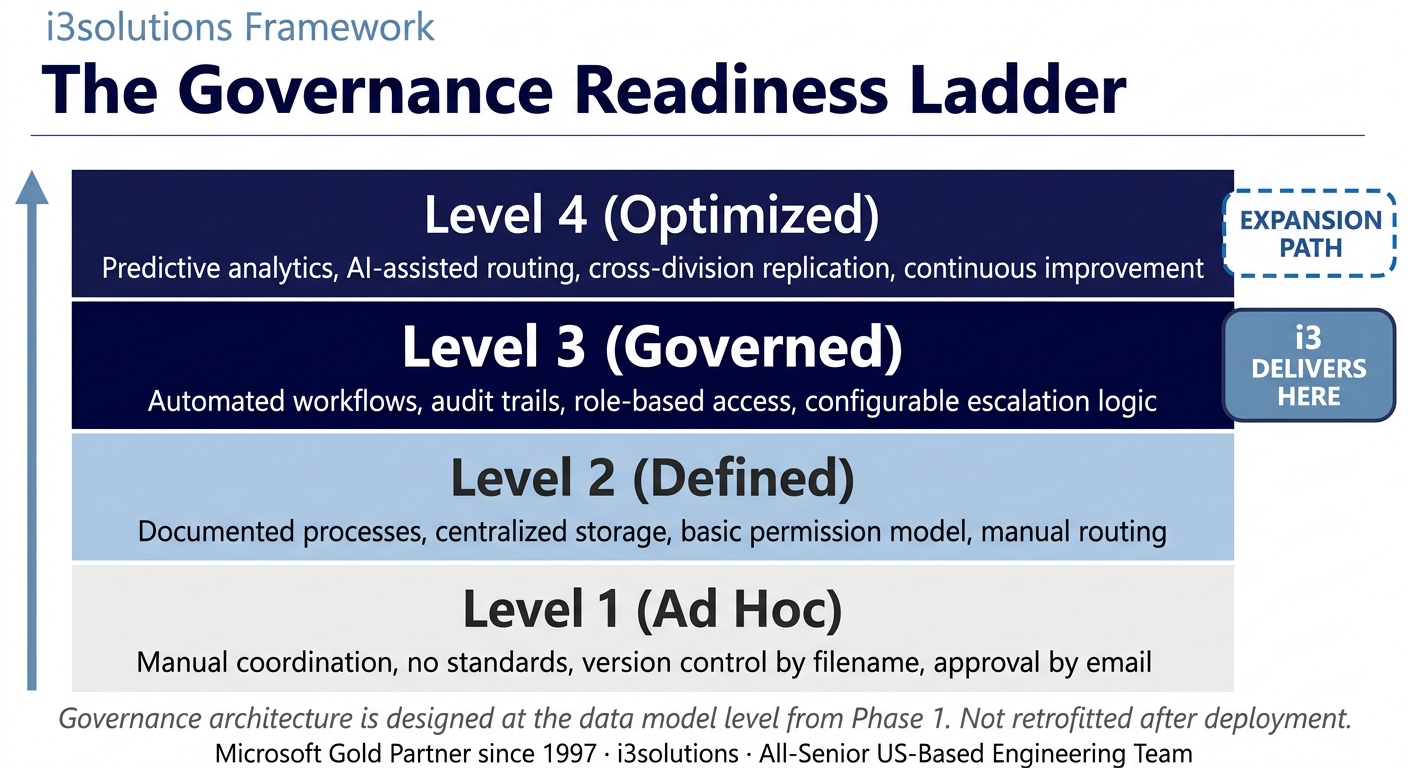
The Governance Readiness Ladder applied. The digital arbitration system delivered Level 3 case management governance. The platform architecture supports Level 4 as analytics and predictive case management capabilities are added.
Measurable Outcomes
| Metric | Before | After | Improvement |
|---|
| Arbitration process | Paper-based – manual tracking across 900 arbitrators and 3,800 requestors | Digital – end-to-end case lifecycle managed in system | Paper process fully digitized |
| Requestor self-service | Not available – all requests required admin processing | 3,800 requestors self-service from initiation through outcome | Self-service for 3,800 requestors |
| Arbitrator self-service | Not available – availability and case management required admin coordination | 900 arbitrators self-manage availability, cases, and compensation history | Self-service for 900 arbitrators |
| Case status visibility | None – paper records with no real-time status | Complete – admin dashboard shows all active cases in real time | Full case portfolio visibility |
| Compensation processing | Manual – paper calculation, paper check issuance | Electronic – automated calculation, electronic payment | Electronic compensation active |
| Administrative overhead | Significant – every case interaction required admin involvement | Minimal – admin handles exceptions only | Admin overhead reduced to exceptions |
[PENDING-CLIENT-QUOTE: insert 1-3 sentence outcome-focused quote in the client’s own language from a role matching the reader’s role.]
[Name or Role], [Organization type]
Frequently Asked Questions
Digital Case Management for Federal Labor Relations and Arbitration Programs
What is case management system development for federal labor agencies?
Case management system development for federal labor agencies involves designing and building custom digital platforms that replace manual, paper-based processes for managing arbitration, mediation, or other case-based workflows. A custom case management system for a federal labor agency provides self-service interfaces for all participant types, automated case assignment and tracking, electronic compensation or payment processing, administrative oversight dashboards, and a complete audit trail of every case action, eliminating the administrative overhead and accuracy risk of paper-based case management at scale. For FMCS managing 900 arbitrators and 3,800 requestors, the paper process had reached the limit of what manual administration could support.
How does i3solutions design self-service portals for arbitration management systems?
i3solutions designs self-service portals by beginning with the specific workflows of each participant type, in FMCS’s case, arbitrators and requestors have fundamentally different interactions with the arbitration system and needed fundamentally different portal experiences. Arbitrators needed to manage their availability, receive and accept case assignments, submit case completion documentation, and track compensation history. Requestors needed to initiate requests, select from qualified available arbitrators, track case status, and receive case outcomes. Building true self-service for both groups, where neither required admin involvement for routine interactions, was the design decision that scaled the system. If either group had required admin involvement for common tasks, the administrative savings would have been only partial.
How does electronic compensation processing improve arbitration management for federal agencies?
Electronic compensation processing improves arbitration management by eliminating the paper check calculation and postal delivery cycle that paper-based compensation systems require. Manual compensation processing involves tracking case completions, calculating the correct compensation amount per case type, generating check issuance requests, and mailing checks, a cycle that takes weeks and introduces calculation errors at each manual step. Electronic processing calculates compensation automatically from case completion records, processes payment electronically, and gives arbitrators real-time visibility into their compensation history through the portal. For an agency managing compensation across 900 arbitrators with varying case types and compensation structures, automation eliminates both the processing time and the accuracy risk.
What audit trail requirements should a federal arbitration system satisfy?
A federal arbitration system should maintain a complete audit trail covering every action taken in the system: case creation and status changes with timestamps and actor identity, arbitrator availability updates, case assignment records, requestor interactions, case outcome documentation, and every compensation transaction from calculation through payment confirmation. The audit trail should be immutable, actions recorded at the time they occur cannot be modified retroactively, and should be searchable for compliance review and dispute resolution. FMCS’s prior paper-based system produced a physical paper trail that was only as complete as the filing was consistent, and only findable if the papers were correctly stored. The digital system’s audit trail is automatically complete, consistently formatted, and instantly searchable.
Why choose i3solutions to build a federal arbitration management platform?
i3solutions brings specific experience building digital case management platforms for federal labor and mediation agencies, combined with the .NET and SharePoint development depth that the custom workflow requirements of arbitration management demand. Federal arbitration systems have both complexity and consequence, the system manages legal process events where accuracy and completeness are not optional. i3solutions’ all-senior delivery model ensures that the architects who design the system are the same practitioners who build and test it, maintaining design intent through every phase of delivery. Our federal client track record includes FMCS, DARPA, USTR, INSCOM, and others, the reference base that confirms federal program delivery at the required standard.
Back to Case Study Library
60 enterprise Microsoft implementations documented
Related Insights
From the i3solutions YouTube Channel
Short-form perspectives on the delivery and technology challenges in this case study.
Who This Engagement Serves
This engagement is relevant if
- Government bodies using manual processes for labor dispute resolution and needing better data visibility.
- Small to mid-sized regulatory agencies struggling to track and report on high caseloads from start to finish.
- Administrative departments still reliant on physical files to manage complex sequential approval workflows.
Less relevant if
- Large organizations requiring specialized, large-scale ERP systems like Salesforce rather than custom low-code app development.
- Highly digital companies that already possess modern, API-driven systems with no remaining paper processes.
Ready to digitize a paper-based case management process that is scaling beyond its capacity?
The 15-Business-Day Microsoft Assessment maps the self-service portal architecture, case assignment system, and electronic compensation platform that would replace your manual process with a governed digital system that serves every participant at scale.
Microsoft Gold Partner since 1997. 600+ implementations. All senior. All US-based.
Schedule the Assessment