Case Study • Defense Special Operations • Custom AI Platform
230TB of Intelligence: How Special Operations Command Built a Custom AI Data Fusion Platform
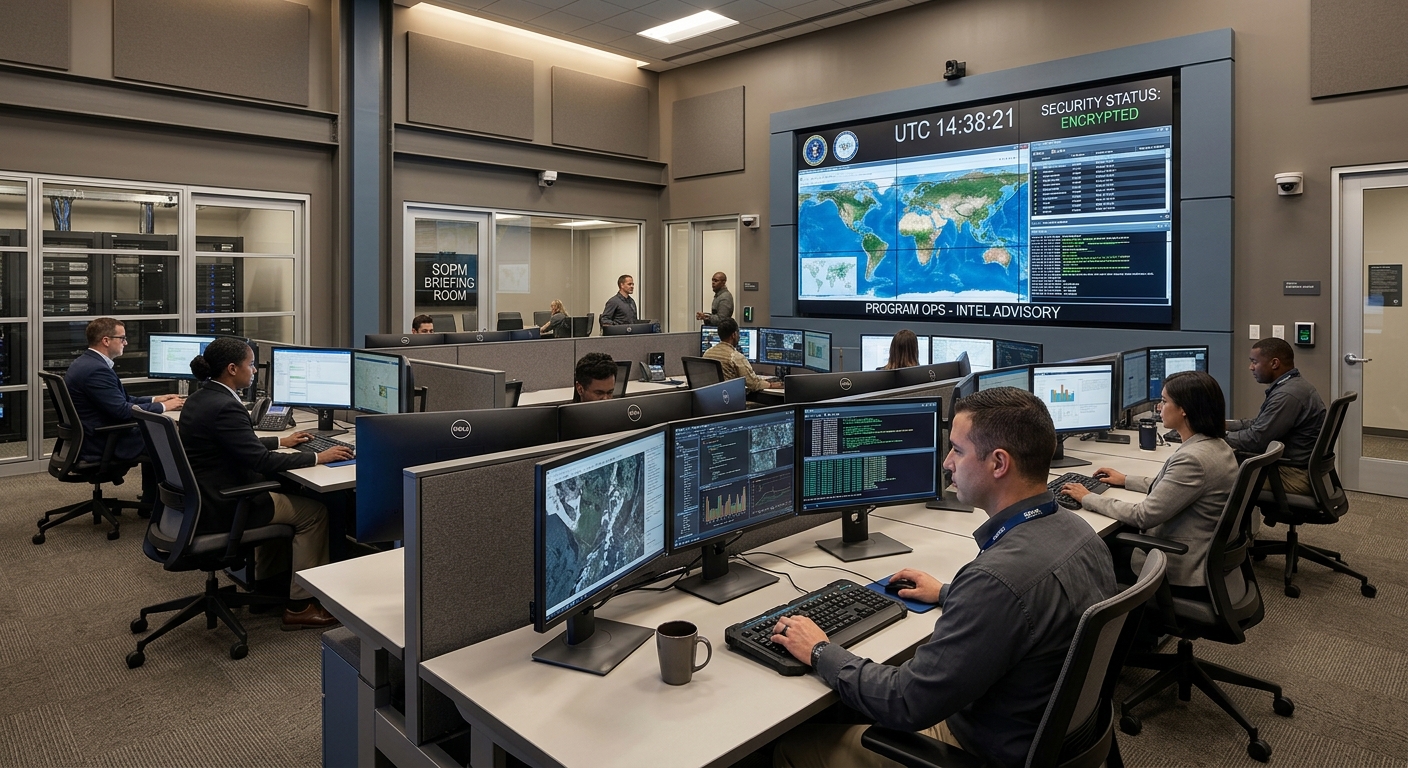
The Enterprise Challenge
Custom AI Development Services for Mission-Critical Intelligence Operations
A premier special operations command responsible for planning and conducting specialized missions that bolster global security and stability depends on immediate access to actionable intelligence for every operational decision it makes. Field operators making time-sensitive decisions in dynamic environments need intelligence that is current, comprehensive, and accessible – not buried in the limitations of a legacy application that was designed for a simpler information environment.
The command’s existing intelligence management system had become increasingly inadequate as operational demands intensified. The legacy application could not handle the diversity of data formats that modern intelligence collection produces – electronic forms, documents, hand-written entries, images, and videos all required manual processing steps that slowed the conversion of raw intelligence into usable information. Search capability was cumbersome and slow, producing poor results for the unstructured data that made up a significant portion of the intelligence record. Field operators were routinely deprived of real-time access to data repositories because the system architecture did not support the offline capability that dynamic operational environments require. And the system lacked the AI and machine learning capabilities that modern intelligence analysis demands.
The command required custom AI development services for a purpose-built intelligence management platform – the Custom Intelligence Management and Data Processing System (CIMDPS) – that would consolidate 230TB of intelligence data from diverse sources into a centralized, searchable repository, deliver AI-powered analysis tools and geospatial capabilities, provide role-based intelligence views appropriate to each operational role, and comply with DoD Net-Ready and NIEM standards to enable safe information sharing with partner agencies.
Strategic Trigger
Legacy System Inadequacy Was Directly Affecting Operational Capability
The forcing function was the direct connection between the intelligence platform’s limitations and the command’s operational effectiveness. When field operators in a dynamic environment cannot quickly locate relevant intelligence because the search capability is inadequate, when they cannot access data repositories in real time because the system architecture requires connectivity that is not always available, and when the system cannot generate the data-driven reports that mission planning requires, the platform is not a supporting tool – it is an operational constraint.
The data format diversity problem was particularly acute. Modern intelligence collection produces structured data in electronic forms, unstructured data in documents and reports, multimedia intelligence in images and videos, and hand-written entries from field personnel that required OCR-capable processing to make searchable. A system designed before these formats were standard could not process them without manual intervention that consumed analyst time that should have been spent on analysis. The AI and machine learning capabilities that could automate this processing – and that commercial intelligence platforms were increasingly providing – were absent from the legacy system entirely.
The NIEM compliance gap had a specific consequence beyond internal operational efficiency: it prevented the command from sharing intelligence with partner agencies through the standard information exchange frameworks that modern joint operations depend on. Intelligence that could not be shared through compliant channels could not inform the partner operations that the command’s mission required it to enable. The platform was not just limiting internal operations – it was limiting the command’s ability to function as an effective partner in joint mission environments.
Is a legacy intelligence or data management system limiting your organization’s operational capability?
If field operators cannot access the intelligence they need because the platform cannot handle modern data formats, does not support offline operation, or produces inadequate search results, the capability gap is measurable. A 15-Business-Day Microsoft Assessment maps the custom AI platform architecture that would replace the limitation with operational capability.
Request the Assessment
▶ Related Insight — A 60-second perspective from our channel
Stakes (What Happens If They Fail)
Operational Intelligence Gaps With Mission Consequences
For a special operations command, the stakes of intelligence platform failure are not measured in productivity loss or administrative delay. They are measured in mission outcomes. When field operators in dynamic environments cannot quickly access relevant intelligence, they make decisions with incomplete information. When the platform cannot process modern intelligence formats without manual intervention, analysts spend time on data handling rather than analysis. When NIEM compliance is absent, partner agencies cannot receive intelligence through standard channels, creating coordination gaps in joint operations that have direct security consequences.
The data governance dimension carried its own specific risk. Intelligence data that is not subject to governance plans, metadata taxonomy, and structured governance processes is intelligence data that cannot be reliably discovered, validated, or shared in the structured way that DoD information sharing requirements demand. An organization that cannot demonstrate data governance compliance is an organization at risk in the DoD accreditation reviews that determine its ability to continue operating on certified platforms.
The maintenance cost of the legacy system was also a strategic resource consideration. Continuing to invest in maintaining a system that could not meet the command’s operational requirements was consuming resources that should have been applied to the operational capability the command actually needed. The replacement was not a technology preference – it was a mission requirement that the existing system was demonstrably failing to meet.
Constraints and Complexity
230TB Data Migration, DoD Compliance, NIEM Standards, and Backwards Compatibility
The 230TB data migration from diverse legacy sources into a centralized repository was the most operationally risky element of the engagement. Intelligence data that has been collected and organized over years cannot be lost or corrupted during migration without permanently destroying institutional knowledge. The migration architecture had to provide backwards compatibility with legacy data formats – ensuring that historical records created in systems with different schemas and metadata structures remained accessible and searchable in the new platform without requiring manual conversion of each record.
The DoD Net-Ready and NIEM compliance requirements governed the entire platform architecture from the first design decision. Every data model decision, every integration pattern, and every information sharing mechanism had to comply with the standards that DoD accreditation requires. Building compliance in at the architecture level – rather than as a compliance review layer applied after the platform was designed – was the approach that made the accreditation path achievable within the project timeline.
The AI and machine learning integration requirement meant the platform had to operate as a coherent system where the Apache SOLR search capability, the IBM Watson AI analysis tools, the OSINT-driven geospatial capabilities, and the “Baseball Card” intelligence layout framework all worked as integrated components rather than as separate tools that analysts had to navigate independently. The human-centered design requirement – nearly two decades of design expertise applied to ensure the interface was genuinely usable rather than technically capable but operationally impractical – shaped every interface decision throughout development. For context on how data governance decisions in complex intelligence environments are architecturally embedded, Integration Governance for MicrosoftPENDING-SCHEDULED covers the governance patterns that make large-scale data platform compliance sustainable.
▶ Related Insight — A 60-second perspective from our channel
Selection Rationale (Why They Chose i3solutions)
Custom AI Platform Specialists With Defense Intelligence Experience
The command required a development partner who had built custom intelligence management platforms for defense environments – not a commercial software vendor adapting a commercial product, and not a general-purpose AI development firm unfamiliar with DoD compliance requirements, NIEM standards, or the specific operational requirements of a special operations intelligence environment.
i3solutions was selected as a Microsoft Gold Partner since 1997 with a documented track record in custom AI development services for defense intelligence organizations where the platform had to be built to mission requirements rather than adapted from commercial off-the-shelf solutions that could not accommodate the operational specificity the engagement required. The Expert Delivery Model that i3solutions operates, staffing every engagement with senior-level architects and developers, was particularly critical in an engagement where AI integration, NIEM compliance, 230TB data migration, and human-centered design all had to be executed correctly simultaneously.
The firm’s Enterprise Delivery Assurance model provided the structured engagement framework that a platform of this complexity required. The requirements process incorporated input from the numerous stakeholder groups across the command’s operational structure, producing a specification that reflected actual operational requirements rather than the requirements of the central technical team. The Microsoft consulting services engagement methodology’s emphasis on collaborative development with operational end-users shaped the interface design process that produced a platform operators would actually use in the field.
The Engagement Approach (Our Plan)
From Legacy Application to AI-Powered CIMDPS Intelligence Platform
PHASE 01
Requirements and Compliance Architecture
Structured requirements sessions with stakeholders across the command’s operational structure, capturing intelligence management workflows, data format requirements, search capability gaps, offline operation requirements, and partner agency information sharing needs. Concurrent compliance architecture design mapping the DoD Net-Ready requirements, NIEM standards, and data governance obligations that would constrain every subsequent architecture decision. This phase produced both the requirements specification and the compliance framework that governed the entire platform design.
PHASE 02
Data Architecture and Search Design
Designing the centralized repository architecture that would consolidate 230TB of intelligence data from diverse legacy sources: the metadata taxonomy that would govern data organization across all data types, the Apache SOLR search configuration delivering structured and unstructured search capability, the IBM Watson AI integration pattern enabling intelligence analysis automation, and the backwards compatibility framework ensuring historical records remained accessible without manual conversion. This phase determined whether the platform would actually be searchable and whether the data migration would preserve institutional knowledge.
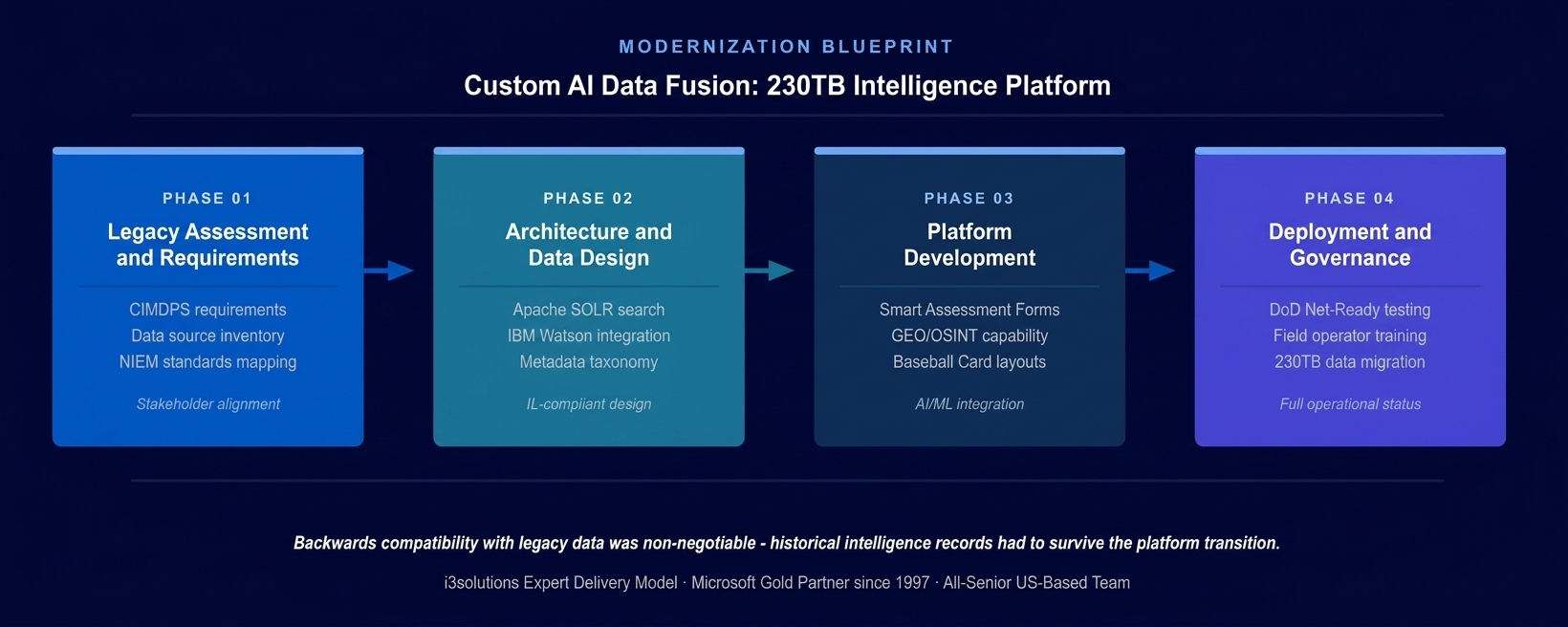
The four-phase implementation approach. Compliance architecture was designed in Phase 1 alongside requirements – embedding DoD Net-Ready and NIEM compliance at the data model level rather than as a retrofit was the decision that made accreditation achievable.
PHASE 03
AI Platform Development
Building the CIMDPS platform: the human-centered search interface supporting structured queries, unstructured searches, and ad-hoc analytical queries; Smart Assessment Forms Automation improving data entry consistency and integrity; the offline field mode allowing operators to capture intelligence for upload when connectivity is restored; the OSINT-driven geospatial capabilities providing situational awareness mapping; the Baseball Card intelligence layouts providing role-based views appropriate to each operational role; and the AI and machine learning integration delivering faster analysis and more accurate pattern recognition across the consolidated intelligence repository.
PHASE 04
DoD Compliance Validation and Deployment
DoD Net-Ready compliance testing and validation; NIEM standard verification for information sharing capability; 230TB data migration from legacy systems with backwards compatibility validation; field operator training on the new interface and operational workflows; staged deployment beginning with controlled operational units before full command-wide rollout; ongoing platform enhancement program supporting continued capability evolution.
Execution Evidence
230TB Consolidated, NIEM Compliant, AI-Powered, Field-Ready
The centralized repository successfully consolidated 230TB of intelligence data from diverse legacy sources into a unified, searchable environment. The metadata taxonomy applied during migration enabled consistent organization across all data types – structured forms, unstructured documents, images, and video – and the backwards compatibility framework ensured that historical records remained accessible without the manual conversion that would have made the migration prohibitively time-consuming.
The Apache SOLR search capability delivered a qualitative improvement in intelligence retrieval that the legacy system’s cumbersome search had made impossible. Analysts could perform structured queries against specific data fields, unstructured searches across the full text of intelligence documents, and ad-hoc analytical queries that surfaced relationships across the data the legacy system’s siloed structure had obscured. The IBM Watson AI integration added analysis automation that reduced the time required to process intelligence inputs and surface actionable patterns.
The offline field mode addressed a specific operational requirement that the legacy system had never supported. Field operators in environments where continuous connectivity cannot be guaranteed could now capture intelligence data using the CIMDPS interface, store it locally during periods of disconnection, and upload it to the centralized repository when connectivity was restored. The intelligence capture happened at the operational moment rather than after the fact when the operator returned to a connected environment.
The honest challenge in this engagement was the data migration scope. The 230TB of legacy data included formats, schemas, and organizational structures that had accumulated across multiple legacy systems over many years, and some legacy data sources had inconsistent metadata that required additional normalization work during migration. Addressing this systematically required the additional discovery work to map every legacy data source and format before migration began – and the willingness to extend the migration timeline to do it correctly rather than accept a migration that worked for most data but failed for the edge cases that often turned out to hold important historical intelligence records.
Technical Transformation
From Legacy Application to AI-Powered Intelligence Hub
Before CIMDPS, the command’s intelligence management operated through a legacy application that could not handle modern data formats, produced cumbersome search results for unstructured data, denied field operators real-time access in disconnected environments, lacked AI capability for analysis automation, and could not share intelligence with partner agencies through NIEM-compliant information exchange frameworks.
After CIMDPS, the command operated a custom AI intelligence platform that consolidated 230TB across all data types into a unified searchable repository, delivered AI-powered search and analysis through Apache SOLR and IBM Watson, supported offline field intelligence capture, provided geospatial situational awareness through OSINT integration, and shared intelligence with partner agencies through NIEM-compliant channels – all within a human-centered interface designed for operational usability rather than technical capability alone.
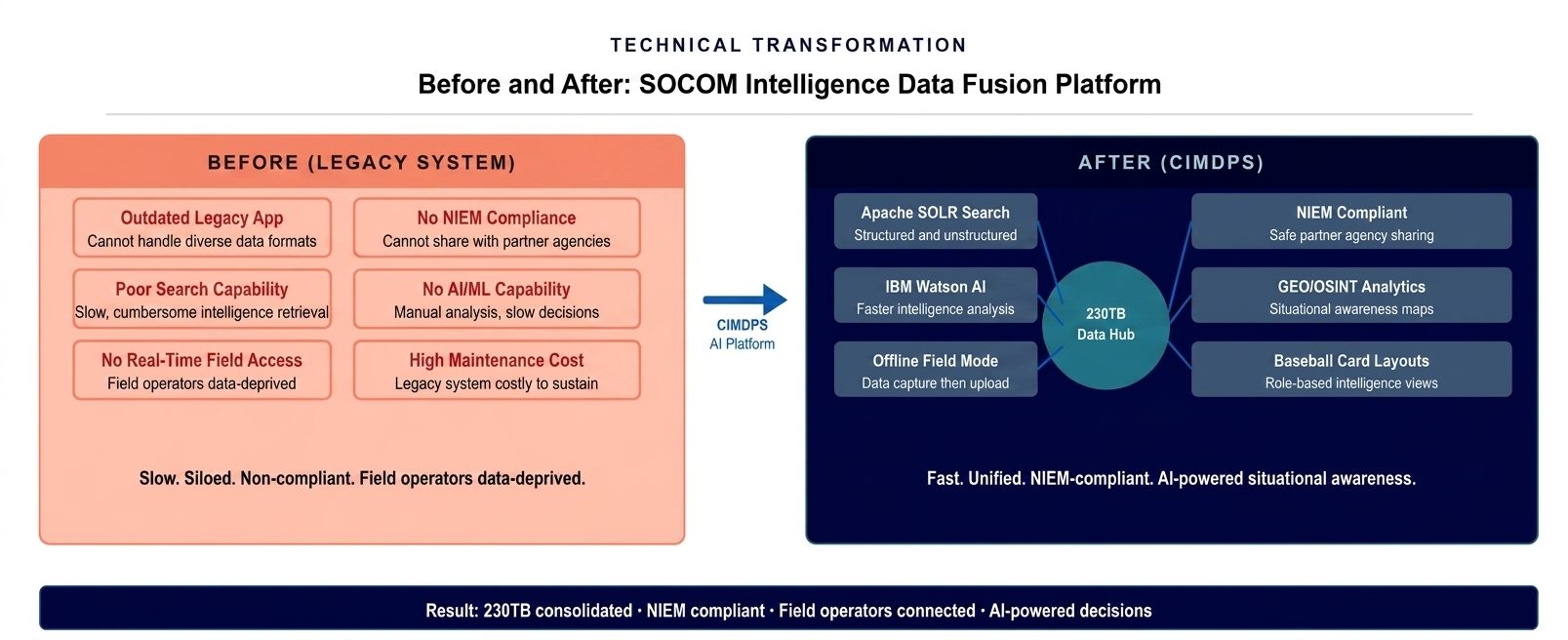
The intelligence management state before and after CIMDPS. A cumbersome legacy application replaced by a DoD Net-Ready, NIEM-compliant AI platform that consolidates 230TB of intelligence across all data types into a unified, searchable operational environment.
The Governance Readiness Ladder applied to this engagement showed the intelligence management environment at Level 1 (Ad Hoc) at the start: fragmented data in legacy systems, no unified search, no data governance framework, no NIEM compliance. CIMDPS delivered Level 3 (Governed): centralized repository with metadata taxonomy and structured governance processes, DoD Net-Ready and NIEM compliance active, AI-powered search and analysis operational, and partner agency information sharing enabled through compliant channels.
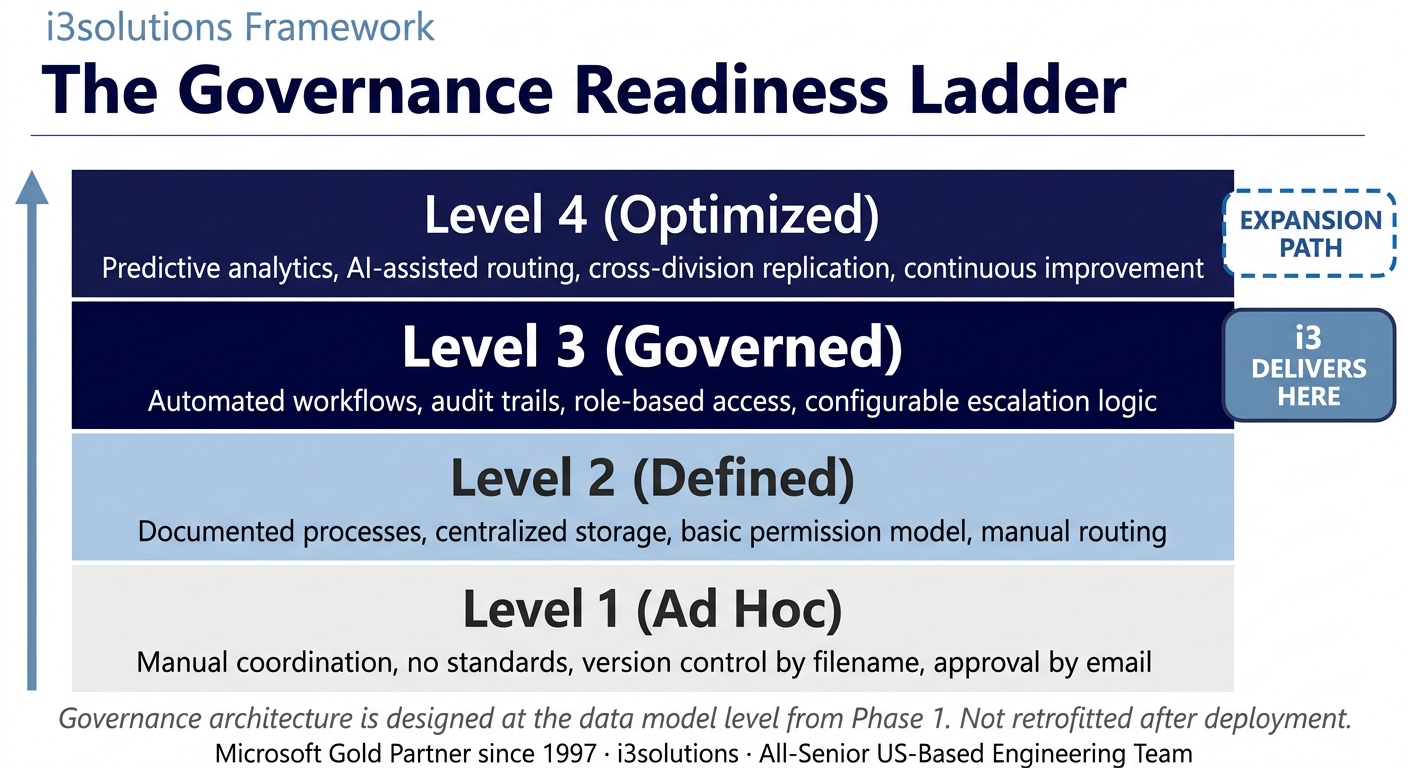
The Governance Readiness Ladder applied to this engagement. CIMDPS delivered Level 3 intelligence governance across 230TB of consolidated data. The modular architecture supports Level 4 as emerging AI capabilities and additional analytical tools are integrated.
▶ Related Insight — A 60-second perspective from our channel
Measurable Outcomes
230TB Consolidated, NIEM Compliant, Operational Capability Restored
| Metric | Before | After | Improvement |
|---|
| Intelligence data consolidation | Fragmented across multiple legacy systems in diverse, incompatible formats | 230TB consolidated into unified CIMDPS repository with metadata taxonomy | 230TB unified in searchable platform |
| Search capability | Cumbersome – slow results, poor unstructured data performance | Apache SOLR delivering structured, unstructured, and ad-hoc search across full repository | Comprehensive search across all data types |
| AI analysis capability | None – manual analysis of all intelligence inputs | IBM Watson AI integration delivering automated analysis and pattern recognition | AI-powered intelligence analysis operational |
| Field operator data access | Connectivity-dependent – field operators data-deprived in disconnected environments | Offline mode – intelligence captured in field, uploaded when connectivity restored | Operational data capture in any environment |
| Partner agency information sharing | Not possible – legacy system not NIEM compliant | NIEM-compliant information exchange operational across partner agencies | Joint intelligence sharing enabled |
| DoD data governance compliance | Not meeting Net-Ready requirements – accreditation risk | DoD Net-Ready compliance validated, governance plans and metadata taxonomy active | Full DoD compliance achieved |
| Legacy system maintenance cost | High – maintaining outdated system that could not meet operational requirements | Legacy systems replaced – maintenance cost consolidated into CIMDPS operational budget | Legacy maintenance cost eliminated |
[PENDING-CLIENT-QUOTE: insert 1-3 sentence outcome-focused quote in the client’s own language from a role matching the reader’s role.]
[Name or Role], [Organization type]
The primary mission impact of CIMDPS was the restoration of intelligence operational capability to the standard the command’s mission required. The specific improvements in search speed, data format coverage, offline field operation, and partner sharing capability were not incremental enhancements to a functional platform – they were the difference between a system that could support the command’s operational requirements and one that demonstrably could not. The platform modernization converted an operational constraint into an operational capability.
The NIEM compliance achievement had an impact beyond internal data access. Intelligence that can be shared with partner agencies through compliant channels supports the joint operations that the command’s mission requires it to enable. Every joint operation that depends on the command’s intelligence input is better served by a platform that can transmit that intelligence through standard, secure, compliant channels rather than through informal workarounds that introduce both security risk and processing delay.
Is a legacy intelligence or data management platform limiting operational effectiveness?
A Risk and Roadmap Assessment maps the custom AI platform architecture that would replace the legacy system’s limitations with operational capability – including the compliance architecture that makes DoD accreditation achievable and the data migration approach that preserves the institutional knowledge in legacy data.
Schedule the Assessment
Credibility Anchors
A Modular Platform Designed to Absorb Emerging Capabilities
CIMDPS was designed with modularity as a foundational architectural principle. The platform’s integration of Apache SOLR, IBM Watson, OSINT-driven geospatial capabilities, and AI/ML analysis tools was structured to allow new analytical capabilities to be integrated as they emerged without requiring architectural redesign of the core intelligence management platform. The “future-proof by design” principle meant that the investment in the CIMDPS platform would continue to deliver operational value as the AI and intelligence analysis landscape evolved.
An intelligence analyst described the operational change simply: with the legacy system, finding relevant historical intelligence on a specific topic meant knowing exactly where to look and having the patience to work through inadequate search results. With CIMDPS, you describe what you are looking for and the system surfaces what is relevant. The time from question to intelligence has compressed by an order of magnitude.
The Smart Assessment Forms Automation capability addressed a data quality problem that had undermined intelligence record consistency for years. When intelligence data is entered through inconsistent forms by field personnel with varying data entry practices, the resulting records are difficult to search reliably because similar information is captured in structurally different ways. Forms automation that standardizes the capture process produces consistently structured records that the AI search and analysis tools can process with higher accuracy and lower false-positive rates.
i3solutions has completed more than 600 technology implementations as a Microsoft Gold Partner since 1997. CIMDPS represents the most technically complex class of custom platform engagement in i3solutions’ portfolio: DoD compliance requirements, 230TB data migration, AI integration across multiple platforms, offline field operation, and NIEM-compliant partner sharing – all delivered in a human-centered interface that field operators use in operational environments rather than behind desks.
Frequently Asked Questions
Custom AI Development for Defense Intelligence Platforms
What is custom AI development for defense intelligence management?
Custom AI development for defense intelligence management involves building purpose-built platforms that consolidate intelligence data from diverse sources into a unified, searchable repository and apply AI and machine learning capabilities to accelerate analysis, pattern recognition, and information sharing. Unlike commercial intelligence management products designed for the broadest possible market, custom AI platforms are built to the specific operational requirements of the organization, the data format diversity of its intelligence collection, and the compliance standards of its operating environment.
What is NIEM compliance and why does it matter for defense intelligence platforms?
NIEM (National Information Exchange Model) compliance means an intelligence platform implements the standard data exchange framework that enables structured information sharing across DoD and partner agencies. A NIEM-compliant platform can transmit intelligence data to partner organizations through standard, secure channels without requiring custom integration for each sharing relationship. For a special operations command whose mission requires intelligence coordination with diverse partner agencies, NIEM compliance is the difference between systematic, secure intelligence sharing and ad-hoc workarounds that introduce both security risk and operational delay.
How does Apache SOLR improve intelligence search capability?
Apache SOLR improves intelligence search capability by providing a high-performance search engine that handles both structured queries against specific data fields and full-text unstructured search across document content, images with text, and other intelligence formats that legacy database search approaches handle poorly. For an intelligence repository containing 230TB of diverse data types including documents, reports, images, and hand-written entries, SOLR’s indexing and query capabilities deliver the fast, accurate, and comprehensive search results that analyst productivity requires.
What is offline field mode in an intelligence management platform?
Offline field mode in an intelligence management platform allows field operators to capture intelligence data using the platform’s interface in environments where continuous network connectivity cannot be guaranteed, store that data locally on their device, and synchronize it to the central repository when connectivity is restored. This is a critical capability for special operations environments where intelligence capture happens in dynamic conditions that may not include reliable network access, ensuring that intelligence is captured at the operational moment rather than reconstructed from memory after the fact when the operator returns to a connected environment.
What are Baseball Card layouts in an intelligence management platform?
Baseball Card layouts in an intelligence management platform are standardized, role-based intelligence views that present the most relevant information for a specific operational role in a consistent, scannable format. Just as a baseball card presents a player’s key statistics in a standardized layout, an intelligence Baseball Card presents the entity- or situation-specific intelligence most relevant to the viewer’s operational role in a format that enables rapid comprehension without requiring navigation through the full intelligence record. This interface approach is a product of human-centered design for operational users who need to extract actionable intelligence quickly under operational time pressure.
What is Smart Assessment Forms Automation in intelligence collection?
Smart Assessment Forms Automation in intelligence collection applies structured form design, validation rules, and auto-population capabilities to the data entry process that creates intelligence records. When field personnel enter intelligence through consistently structured forms that enforce data completeness and format standards, the resulting records are more searchable, more comparable, and more suitable for AI analysis than records created through unstructured free-text entry or inconsistent form designs. Forms automation also reduces the cognitive burden on field operators during data capture, allowing them to focus on the intelligence content rather than the recording process.
How does human-centered design improve defense intelligence platform adoption?
Human-centered design improves defense intelligence platform adoption by prioritizing the operational usability of the interface over the technical completeness of the underlying capabilities. A platform that is technically comprehensive but operationally impractical will not be used consistently by field operators under time and operational pressure, regardless of its capability. Human-centered design engages operational end-users throughout the development process, tests interface designs against actual operational workflows, and produces an interface that operators use because it reduces the effort required to access and contribute intelligence – not because they are required to use it.
What makes custom AI development more appropriate than commercial products for defense intelligence?
Custom AI development is more appropriate than commercial products for defense intelligence management when the operational requirements, data format diversity, compliance standards, and security constraints of the specific organization cannot be adequately served by a commercial product without fundamental compromises. Commercial intelligence products are designed to serve the broadest possible market, which typically means they provide adequate capability for standard use cases and inadequate capability for the specialized requirements of a defense organization that needs NIEM compliance, DoD Net-Ready certification, offline field operation, and integration of multiple AI systems in a classified operating environment.
Conclusion
230TB of Intelligence in a Platform Built for the Mission
A special operations command responsible for global security operations replaced a legacy intelligence application that could not handle modern data formats, denied field operators real-time access in disconnected environments, lacked AI analysis capability, and could not share intelligence with partner agencies through compliant channels – with CIMDPS, a custom AI data fusion platform that consolidated 230TB of intelligence into a unified, NIEM-compliant repository, delivered Apache SOLR and IBM Watson AI-powered search and analysis, supported offline field intelligence capture, and provided geospatial situational awareness through OSINT integration. Through custom AI development services that prioritized operational usability alongside technical capability, the command moved from an intelligence constraint to an intelligence advantage.
For defense and intelligence organizations where legacy data management systems are creating operational limitations, custom AI development services and power platform governance offer a documented path from inadequate legacy architecture to purpose-built AI platforms that meet both the operational requirements and the compliance obligations of the defense information environment.
Back to Case Study Library
60 enterprise Microsoft implementations documented
Related Insights
From the i3solutions YouTube Channel
Short-form perspectives on the delivery and technology challenges in this case study.
Who This Engagement Serves
This engagement is relevant if
- A defense agency requiring secure, disconnected artificial intelligence tools for sensitive field intelligence operations and analysis.
- Special operations forces needing a proprietary platform to ingest and analyze multi-domain data in austere environments.
- A national security organization requiring bespoke large language models tailored to sensitive, air-gapped data sets.
Less relevant if
- A civilian commercial enterprise looking for standard, off-the-shelf generative AI solutions for public-facing business workflows.
- A research university seeking an open-source AI model for collaborative, unclassified academic projects and data sharing.
Ready to replace a legacy intelligence platform that is limiting what your operators can do?
The 15-Business-Day Microsoft Assessment maps your legacy platform’s specific gaps against the custom AI architecture that would replace them, the data migration approach that preserves institutional knowledge, and the compliance framework that makes DoD accreditation achievable. Purpose-built. Compliant. Operationally ready.
Microsoft Gold Partner since 1997. 600+ implementations. All senior. All US-based.
Schedule the Assessment