Case Study · Financial Services
$40 Billion in Loans, Manual Processes: How the federal lending institution Automated Mortgage Acquisition
Client: the federal lending institution

The Enterprise Challenge
The the federal lending institution of Atlanta, Cincinnati, Indianapolis, Pittsburgh, and Seattle are part of a national network of 12 District Banks that collectively provide funding, community lending, and banking services to over 7,700 member financial institutions across the country. Their mission is to support community-based banks, credit unions, thrifts, and insurance companies with affordable liquidity, enabling those institutions to extend credit to homebuyers, businesses, and farms in their communities.
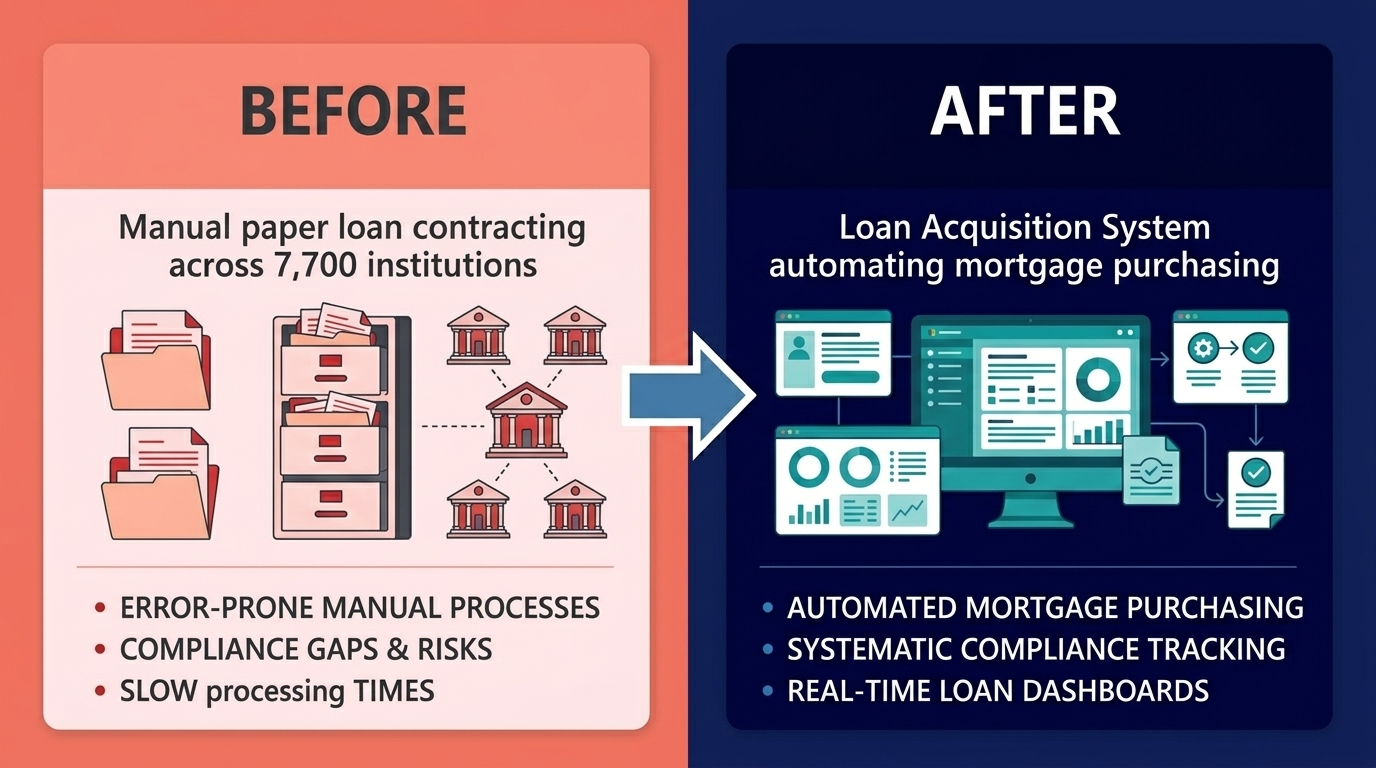
Behind that mission is an enormous volume of mortgage contracting and transaction processing. The banks purchase mortgage loans from member institutions as part of their core lending programs, a process involving complex contracting, compliance verification, pricing calculations, and transaction recording across thousands of participating institutions. This entire operation was running on manual paper-based processes: contracts were processed by hand, compliance checks were performed manually, and transaction data was recorded without automation. At the scale of $40 billion in managed loans, this manual approach carried significant risk and inefficiency.
The Strategic Trigger
The the federal lending institution needed a web-based Loan Acquisition System (LAS) that could automate the full mortgage purchasing workflow, from member institution submission through contracting, compliance review, pricing, and recording, across all participating banks in the network. The system had to handle the compliance requirements of federally regulated mortgage acquisition and the volume of transactions across 7,700+ institutions.
The Engagement Approach
Strategic Trigger
Operational Risks Force Action in Loan Acquisition
A high-profile near-miss, resulting from a minor human error in a complex spreadsheet, led to a critical breakdown in data validation. This incident highlighted the systemic weaknesses in the existing manual processes. The escalating frequency of reporting discrepancies and increased transaction times had begun to draw scrutiny from internal audit teams. A significant backlog of loan acquisitions was accumulating, threatening member bank relationships. The sheer complexity of managing large-scale, high-value asset purchases through fragmented spreadsheets and manual data entry had become unsustainable. The status quo was no longer an option.
Recognizing the need for a fundamental transformation, the federal lending institution leadership committed to a comprehensive modernization effort. They formally recognized that the existing manual processes were fundamentally incompatible with their strategic goals of enhancing operational efficiency and risk management. This commitment was not just an investment in new technology, but a strategic decision to rebuild a critical core function from the ground up. The board authorized a significant budget and resource allocation, signifying that a robust, governed, and automated digital workflow was essential to future-proof their operations and maintain their reputation as a trusted financial institution.
Stakes
Inaction Risks Regulatory Penalties and Reduced Trust
The direct consequences of inaction were severe. Continued reliance on manual processes increased the risk of significant financial inaccuracies in loan valuation, which could lead to direct monetary losses. The potential for a major regulatory compliance failure was high, with a single misstep in reporting or documentation leading to costly penalties, fines, and potentially severe reputational damage. Persistent process inefficiencies would have led to increased operational costs and a deterioration in member bank satisfaction, potentially impacting the federal lending institution’s ability to fulfill its mission effectively. The status quo was a ticking time bomb.
Furthermore, the long-term strategic risks were profound. Failing to modernize would have severely hindered the federal lending institution’s ability to adapt to changing market conditions and manage a growing and increasingly complex loan portfolio. This could have eroded trust among member banks and other stakeholders, jeopardizing the federal lending institution’s standing as a cornerstone of the housing finance system. The failure to address these critical operational challenges would have not only resulted in immediate financial and compliance penalties but would also have had lasting strategic and reputational implications, limiting their future growth and relevance in a rapidly evolving financial landscape.
Constraints and Complexity
Seamless Integration with Multiple Legacy Systems Required
The hardest implementation challenge was ensuring the new, modern workflow integrated flawlessly with a multitude of deeply embedded, decades-old legacy systems. These systems were built with vastly different data models and communication protocols, making data exchange a significant technical hurdle. Developing a real-time data integration layer that could handle complex transformations and data mappings without disrupting critical day-to-day operations was a formidable task. This required a deep understanding of legacy architectures and a careful orchestration of data flows to prevent data loss or corruption during the migration and ongoing operations.
Additionally, migrating a massive volume of historical loan data was an enormous undertaking, further complicated by inconsistent data quality and fragmented record-keeping. Overcoming resistance to change among end-users who had grown accustomed to the existing manual processes was also a major organizational hurdle. Addressing these complex constraints required meticulous planning, rigorous data validation, comprehensive training, and a phased implementation strategy to minimize operational disruption and ensure widespread user adoption. This complexity made the custom development approach essential for tailoring the solution to these unique requirements and existing infrastructure.
Selection Rationale
Senior Microsoft Specialists with Proven Delivery Depth
the federal lending institution considered other options, including several major consulting firms and a few niche providers specializing in loan management systems. Larger, general-purpose firms were dismissed due to concerns about their heavy reliance on offshore resources, which was seen as a risk in terms of project communication, data security, and cultural alignment. They were also perceived as lacking the specific, in-depth technical expertise required for such a critical and complex custom development effort. Commodity staffing models offered by other providers were deemed insufficient for a project that demanded a highly experienced and cohesive team capable of navigating intricate technical and domain challenges.
i3solutions emerged as the clear choice for several compelling reasons. As a long-standing Microsoft Gold Partner, their deep-seated expertise and proven track record with complex Microsoft technology implementations were undeniable. With over 600 successful implementations under their belt, they demonstrated a level of experience and specialized knowledge that was unmatched. Their all-senior, all-US-based team of experts was a key differentiator, providing the federal lending institution with the high-level technical skills and communication clarity essential for a project of this magnitude. This combination of deep technical expertise, extensive real-world experience, and a commitment to quality and collaboration made i3solutions the ideal partner.
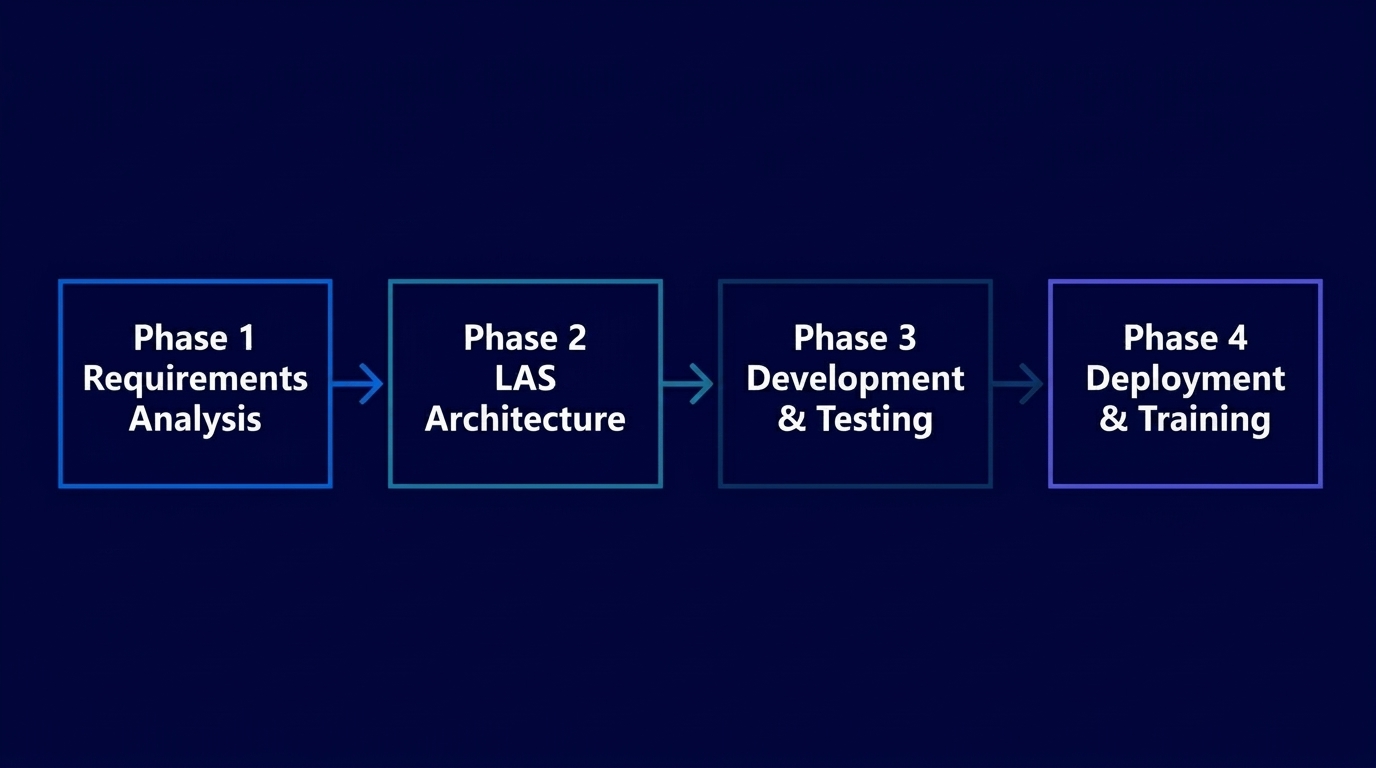
Phase 1
Requirements Analysis
Worked with bank operations and compliance teams to define the full mortgage acquisition workflow, regulatory requirements, and data standards across all 5 participating banks.
Phase 2
LAS Architecture
Designed a custom web-based Loan Acquisition System with workflow automation, compliance validation logic, and a transaction database architecture.
Phase 3
Development & Testing
Built and tested the LAS against real transaction scenarios, compliance rules, and volume requirements.
Phase 4
Deployment & Training
Deployed across participating banks with training for operational staff and documentation for ongoing administration.
Technical Transformation
i3solutions delivered a custom Loan Acquisition System that automated the the federal lending institution’ mortgage purchasing workflow from end to end. Member institutions now submit loan acquisition requests through the web platform, where automated workflows handle compliance validation, pricing calculations, and contract generation. Manual processes that previously consumed significant staff time were replaced with automated workflows that process transactions faster, more accurately, and with complete audit trails.
Measurable Outcomes
| Metric |
Result |
| Automation Scale |
Mortgage acquisition workflow automated across a network supporting $40+ billion in managed loans |
| Compliance Accuracy |
Automated compliance validation replaces manual verification, reducing regulatory exposure |
| Transaction Speed |
Loan acquisition processing time reduced through automated workflows replacing manual paper-based processing |
| Network Coverage |
System supports mortgage purchasing operations across 7,700+ member financial institutions |
| Audit Trail |
Complete digital transaction records replace manual documentation, supporting regulatory examination requirements |
[PENDING-CLIENT-QUOTE: insert 1-3 sentence outcome-focused quote in the client’s own language from a role matching the reader’s role.]
[Name or Role], [Organization type]
Frequently Asked Questions
What is a Loan Acquisition System and how does it support federal banking operations?
A Loan Acquisition System (LAS) is a web-based platform that automates the process by which a bank or banking system purchases mortgage loans from member institutions. For the federal lending institution, this includes the submission, compliance review, pricing, contracting, and recording steps that were previously manual. i3solutions built the LAS to handle all of these steps through automated workflows, reducing processing time, improving accuracy, and generating complete audit trails for regulatory examination.
How does i3solutions approach custom financial system development for federally regulated institutions?
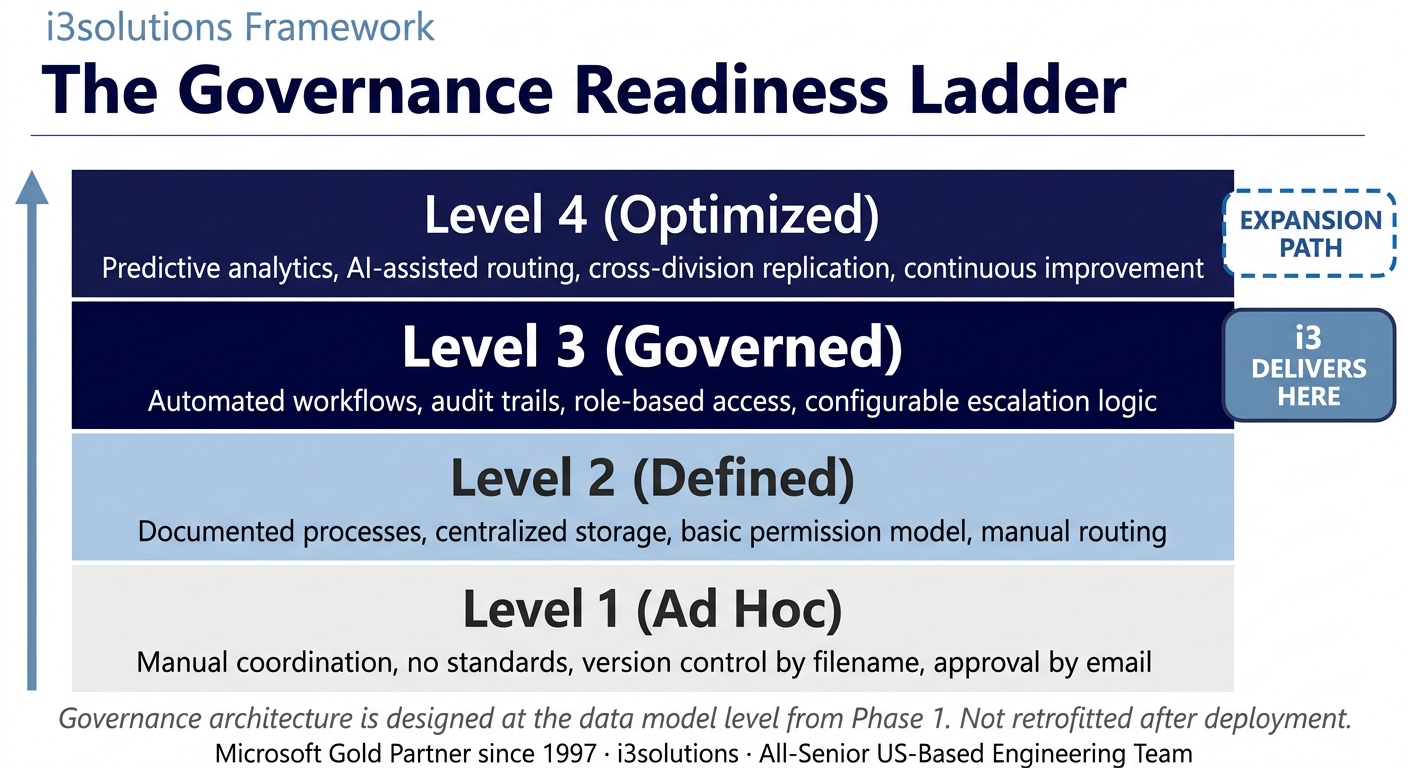
i3solutions begins with a structured requirements analysis that captures both operational workflow requirements and regulatory compliance constraints. For federally regulated financial institutions, compliance logic is built into the system architecture from the start, not added as an afterthought. The development process includes extensive testing against real transaction scenarios and compliance rule sets before any production deployment.
How does automated compliance validation work in a loan acquisition system?
i3solutions configures compliance rules as validation logic embedded in the transaction workflow. When a member institution submits a loan for acquisition, the system checks the submission against defined compliance criteria, loan type, documentation requirements, eligibility rules, before routing the transaction forward. Submissions that fail validation are flagged for review with specific exception details, rather than passing through to manual discovery.
What ROI should federal banking networks expect from loan acquisition automation?
Federal banking networks that automate manual mortgage acquisition workflows typically see 3 categories of return: operational cost reduction from eliminating manual processing steps, compliance quality improvement from replacing human verification with validated rule logic, and capacity expansion, the same operational staff can process more transactions through an automated system than through manual workflows.
Why choose i3solutions for custom financial system development?
i3solutions has built custom financial applications for clients including Brown Advisory, BankFinancial, and the the federal lending institution, consistently delivered on-time, in-scope, and in-production. Our all-senior, all US-based team brings 600+ Microsoft platform implementations and 27 years as a Gold Partner to every financial system engagement. Our 15-Business-Day Microsoft Assessment gives financial institutions a clear development plan before any commitment.
Who This Engagement Serves
This engagement is relevant if
- Regional banks managing complex loan participation agreements without centralized digital tracking or workflow automation tools.
- Mortgage aggregators relying on spreadsheets to track and acquire loan portfolios from varied correspondent lenders.
- Government lending programs struggling with inefficient, document-heavy manual processes for loan application and approval workflows.
Less relevant if
- Small credit unions handling all loan processing manually and maintaining all documentation solely on physical paper.
- Small community banks with low loan volume that only utilize established third-party loan origination systems.
Ready to establish a governed Microsoft environment?
i3solutions delivers enterprise digital transformation on-time, in-scope, in-production. Microsoft Gold Partner since 1997. 600+ implementations. All-senior, all US-based team.
Schedule a 15-Business-Day Microsoft Assessment