Case Study • Defense / Federal R&D • Program Management
240% ROI in Year One: How DARPA Replaced Paper Wall Charts with a Real-Time Program Tracking Database

The Enterprise Challenge
Program Management Automation for the Nation’s Preeminent Defense Research Agency
The Defense Advanced Research Projects Agency is responsible for developing the breakthrough technologies that maintain United States technological superiority in national security. DARPA’s program managers track hundreds of active research programs across every domain of defense technology – advanced weapons, communications, sensing, autonomy, and beyond. The status of those programs, and the ability to access, query, and report on that status in real time, is not an administrative preference. It is an operational requirement for an agency whose work shapes national security for decades.
The system DARPA was using to meet that requirement was a combination of large paper charts displayed on physical walls and multiple Excel spreadsheets maintained by hand. Program status was displayed on the wall charts – but only as of the last time someone had physically updated them. The Excel spreadsheets were more current, but distributed across multiple files with no unified query capability. When decision-makers needed current program status, the information they received was as current as the last manual update, which was rarely today.
i3solutions was contracted to build the Program Database Management Solution – a .NET web application backed by a Microsoft Access database that would replace paper wall charts and fragmented Excel files with real-time online access, full-text search, advanced multi-term query capability, and automated reporting and charting.
Strategic Trigger
Decisions Were Being Made on Yesterday’s Program Status
The forcing function was the gap between when program status changed and when that change was reflected in the information decision-makers were using. A research program that hits a milestone, encounters a problem, or changes trajectory does not pause while someone updates the wall chart. At an agency where program managers are making decisions that ripple into billion-dollar defense investments, operating on stale status is not a small inefficiency – it is a decision-quality problem.
The search gap compounded the staleness problem. Even if the Excel spreadsheets were current, finding relevant program information required knowing which spreadsheet contained it, opening that file, and manually scanning or filtering. A full-text search across all program data – the kind of query a program manager actually needed to answer a question like “which programs involve this sensor technology?” – was impossible in the paper and Excel environment.
Is your organization tracking critical programs through paper processes or fragmented spreadsheets?
If program status is only as current as the last manual update and decision-makers cannot query across all programs simultaneously, the information architecture is the constraint. A 15-Business-Day Microsoft Assessment maps the database and search architecture that would deliver real-time program access with full-text query capability.
Request the Assessment
Stakes
Operational Inefficiencies Risk Misallocated National Defense Funding
Relying on physical wall charts and manual tracking for complex defense programs created immediate operational risks regarding data integrity and financial accuracy. The administrative overhead required to maintain these disconnected systems deferred significant resources away from core mission objectives. Without a centralized, real-time digital system, program managers faced consistent challenges in accurately tracking budget allocations and expenditures across multiple initiatives. This manual approach increased the probability of costly accounting errors, potential anti-deficiency violations, and the misallocation of critical funds necessary for maintaining defense readiness and advancing innovation.
Beyond the immediate financial risks, continued reliance on antiquated tracking methods posed severe strategic and security consequences. In an era of rapid technological advancement by peer adversaries, decision-making velocity is paramount. The delay inherent in updating paper-based systems meant leadership often operated on lagging or fragmented information, hindering agile responses to emerging threats. Furthermore, manual systems lack necessary security controls and audit trails required for sensitive defense data. Continued inaction would have eroded confidence in DARPA’s stewardship of public funds and compromised the security of critical program logistics.
Constraints and Complexity
Integrating Disparate Data Under Strict Security Protocols
The primary challenge lay in developing a custom application that could centralize vast amounts of disparate program data while strictly adhering to rigorous Department of Defense (DoD) security standards. The existing workflow involved sensitive financial and operational data stored across various offline formats and legacy spreadsheets. Transitioning this to a cohesive digital platform required a solution that not only met the specialized reporting needs of defense program managers but also achieved the necessary security accreditation (ATO). Balancing the requirement for enhanced user accessibility with stringent air-gapped environment constraints was essential.
Data migration from the unstructured, manual systems to a structured relational database presented significant technical complexity. Decades of institutional knowledge were trapped on physical charts, requiring a meticulous digital transformation strategy that ensured no data loss or corruption during the process. Furthermore, cultural resistance to change within an established organization posed a significant adoption risk. The custom solution had to be intuitive enough to gain rapid acceptance among users accustomed to tangible tracking methods, ensuring a seamless transition and minimizing disruption to ongoing defense operations.
Selection Rationale
Senior Microsoft Specialists with Proven Delivery Depth
DARPA evaluated several alternative approaches, including commercial off-the-shelf (COTS) program management software and larger, generic systems integrators. However, these options were deemed inadequate. COTS solutions lacked the requisite flexibility to adapt to the unique and complex workflows of defense R&D tracking without extensive, costly modifications. Conversely, larger integrators often rely on junior-heavy staffing models, which introduced unacceptable risks concerning the quality, security, and velocity of development needed for a mission-critical application within a highly regulated defense environment.
DARPA selected i3solutions due to our unmatched Microsoft expertise and proven track record with complex, high-security custom developments. As a Microsoft Gold Partner since 1997 with over 600 successful implementations, we provided the necessary depth. Crucially for a defense agency, i3solutions utilizes an all-senior, all US-based team, ensuring direct communication with the actual developers. Our specialists possessed the necessary clearances and understanding of DoD security requirements to deliver a tailored, secure custom application that perfectly aligned with DARPA’s operational needs and security constraints.
The Engagement Approach
PHASE 01
Discovery and Requirements
Complete documentation of the paper and Excel-based tracking process, including every manual step in the status update cycle and the specific search and reporting needs of DARPA program managers. User interface design requirements for a system that would serve users across multiple versions of Microsoft Office. Output: full requirements specification for the Program Database Management Solution.
PHASE 02
System Architecture
.NET framework selection providing the web-based delivery model that would give any authorized user real-time access from any workstation. Microsoft Access database schema designed for the program data structure DARPA maintained. Search architecture designed to support full-text search, advanced multi-term queries, search history, and criteria import/sorting.
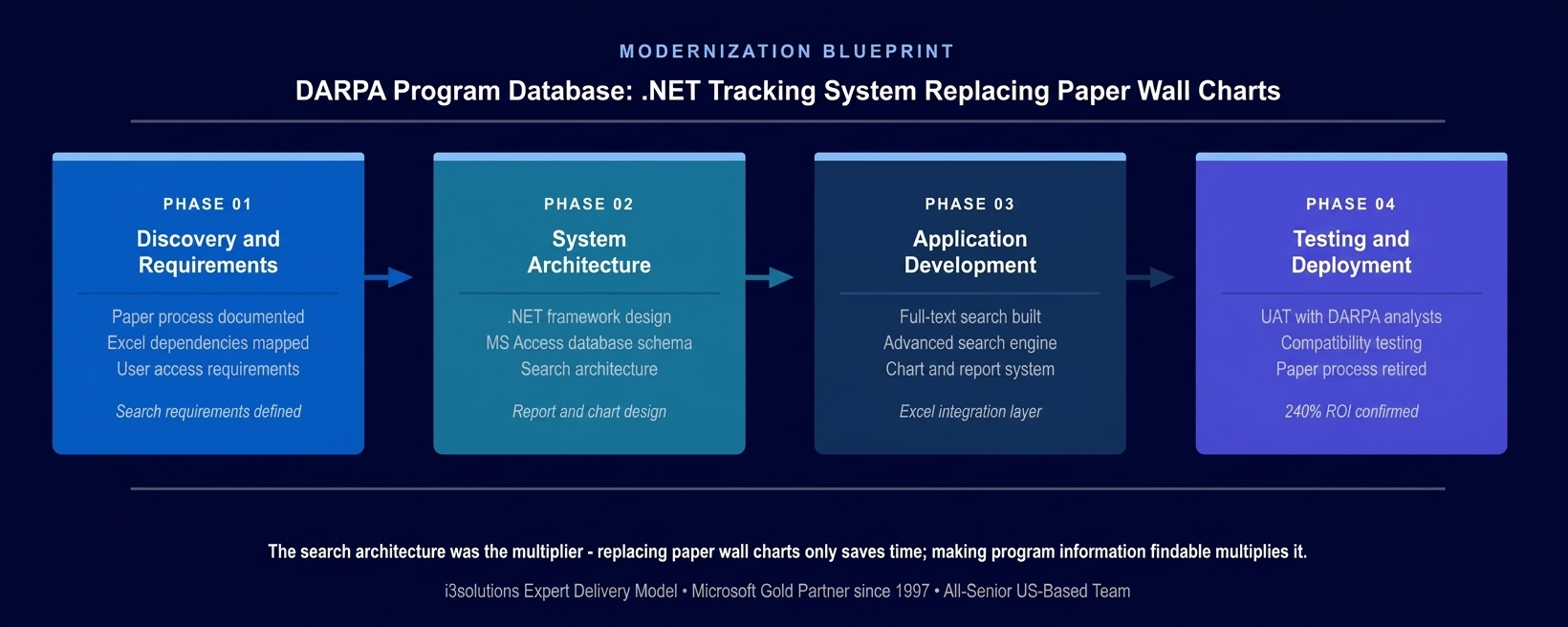
The four-phase approach. The search architecture in Phase 2 determined the ROI – basic database access would have replaced paper; advanced search replaced an entire way of working with program information.
PHASE 03
Application Development
Full-text search engine enabling any-word queries across all program data. Advanced search with multi-term query support and refinement capability. Search history maintained for recurring queries. Criteria import and sorting for structured search workflows. Compatibility remediation ensuring the application functioned correctly across all Microsoft Office versions in use at DARPA. Automated chart and report generation integrated directly with Microsoft Excel for polished status reports.
PHASE 04
Testing and Deployment
User acceptance testing with DARPA program managers across the range of query types and reporting needs they used in their actual work. Compatibility validation across Microsoft Office versions. Paper wall charts retired. Excel-based tracking retired. Post-deployment validation confirming the 240% ROI projection against the actual reduction in manual program management labor.
Technical Transformation
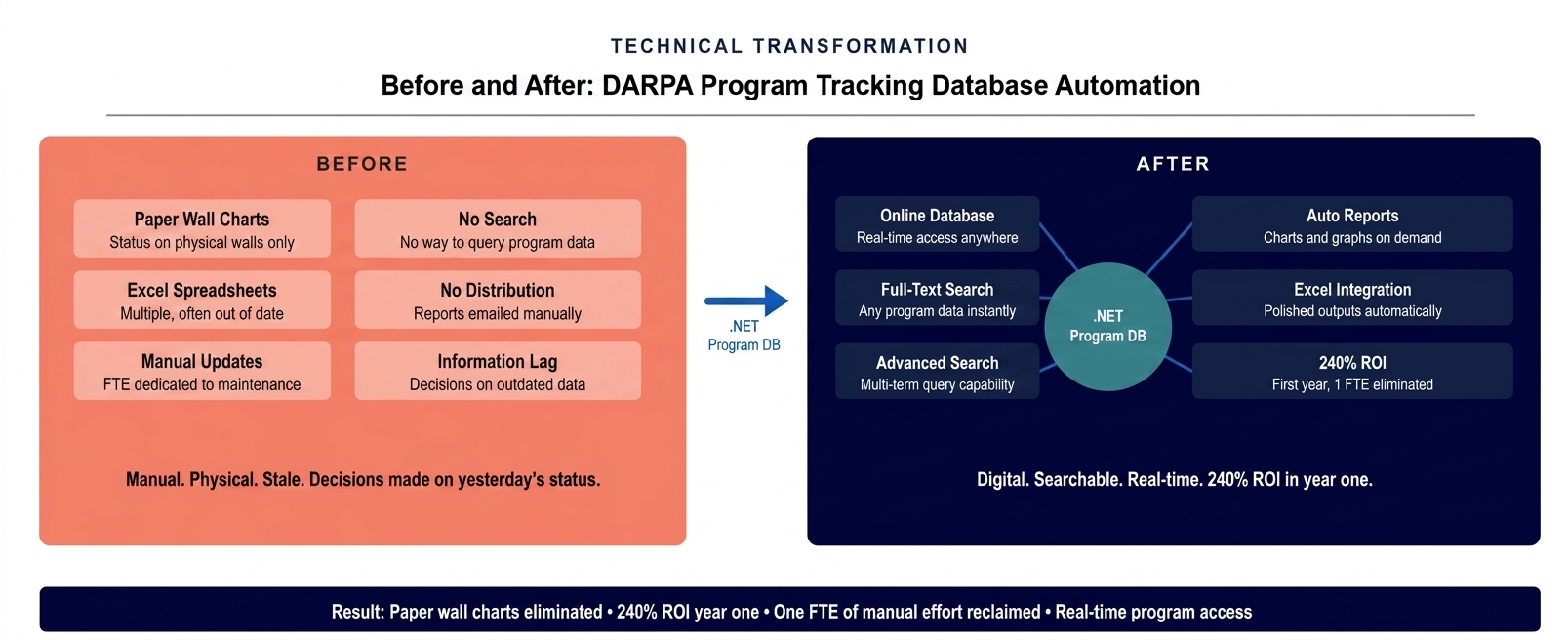
Before and after. Paper wall charts and fragmented Excel files replaced by a .NET web application with real-time access, full-text search, advanced multi-term query capability, and automated Excel-integrated reporting.
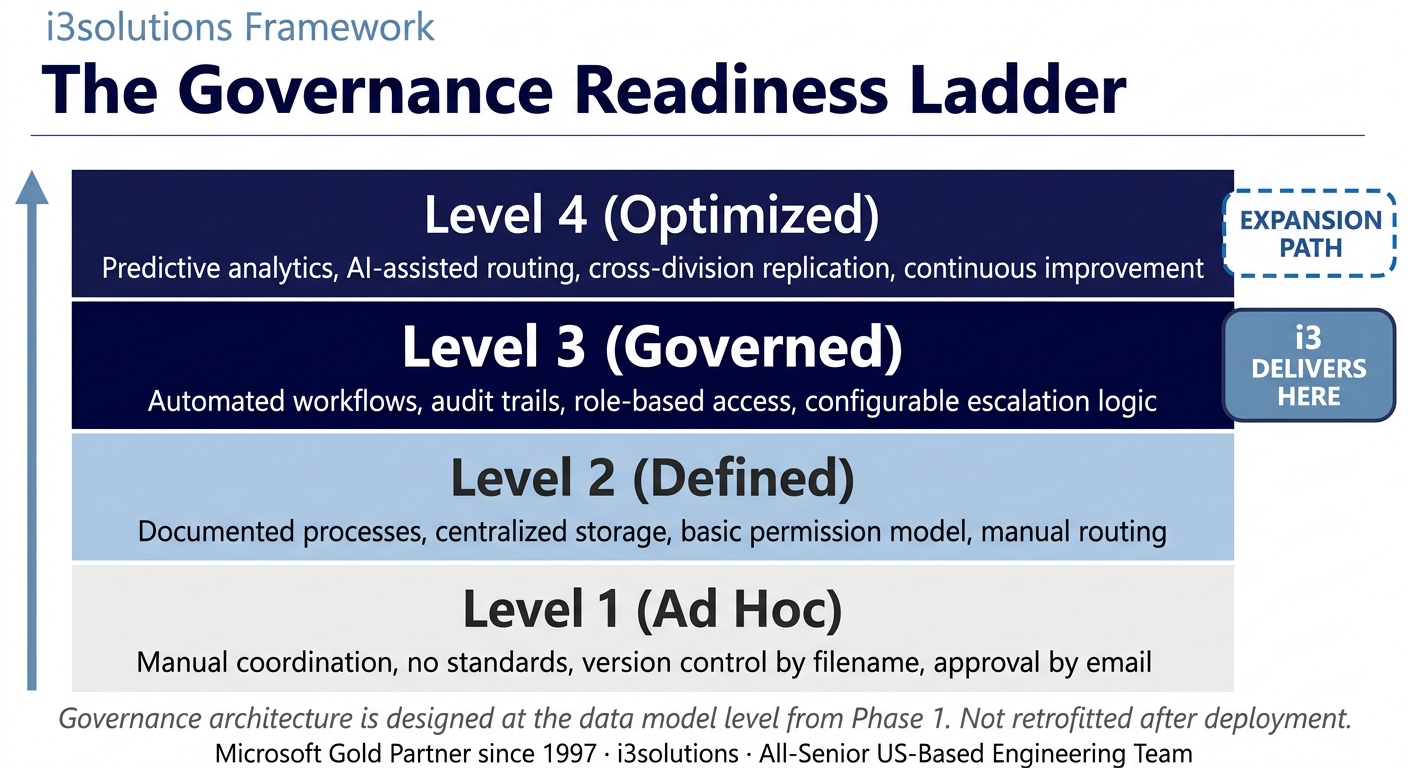
The Governance Readiness Ladder applied. The Program Database Management Solution delivered Level 3 program tracking governance. The architecture supports Level 4 as analytics and predictive program management capabilities are built on the data foundation.
Measurable Outcomes
| Metric | Before | After | Improvement |
|---|
| Program status currency | As current as the last manual wall chart or Excel update | Real-time – status updated as it changes, visible to all users | Real-time program access |
| Search capability | None – manual scanning of paper and Excel files | Full-text search plus advanced multi-term query with history | Enterprise search active |
| Manual tracking labor | Approximately one full-time employee dedicated to maintenance | Eliminated – system maintained automatically | 1 FTE reclaimed |
| Return on investment | Not applicable – no system to measure | 240% ROI in the first year | 240% first-year ROI |
| Report generation | Manual – data pulled from multiple sources, formatted by hand | Automated – charts and reports generated directly from live data | Reporting automated |
[PENDING-CLIENT-QUOTE: insert 1-3 sentence outcome-focused quote in the client’s own language from a role matching the reader’s role.]
[Name or Role], [Organization type]
Frequently Asked Questions
Program Management Automation for Defense and Federal Agencies
What is program management automation for defense agencies?
Program management automation for defense agencies replaces paper charts, fragmented spreadsheets, and manually updated status reports with a centralized database application that maintains real-time program status, provides full-text search across all program data, and generates automated reports. For agencies like DARPA managing large portfolios of technically complex programs, automation is the foundation for informed decisions, managers need current data, not data that was current when someone last updated the wall chart.
How does i3solutions approach a custom program tracking database engagement?
i3solutions begins every program tracking engagement by documenting the current tracking process in precise detail, every manual step, every place where status becomes stale, every search or reporting need that the current system cannot meet. The application architecture is then designed to address those specific gaps rather than delivering a generic database that program managers must adapt to. For DARPA, that meant a .NET web application with full-text search, multi-term advanced query, search history, and Excel-integrated charting, features derived from the actual analytical workflows DARPA’s program managers used, not from a product feature list.
Why did DARPA achieve 240% ROI in the first year?
DARPA achieved 240% ROI in the first year because the Program Database Management Solution eliminated approximately one full-time employee’s worth of manual maintenance labor while simultaneously improving the quality and speed of program status access for every user. The ROI calculation reflects both the cost of the labor eliminated and the value of the productivity improvement, program managers spending less time searching for information and more time acting on it. Engagements that eliminate a known manual process with a measurable labor cost tend to have faster, more certain ROI than technology deployments whose benefits are primarily qualitative.
What is the difference between a custom program tracking system and an off-the-shelf project management tool?
A custom program tracking system is built around the specific data structure, search requirements, reporting needs, and user workflows of the organization it serves. An off-the-shelf project management tool provides a generic framework that the organization must adapt its processes to fit. For an agency like DARPA with highly specific program tracking requirements, the fields that matter, the search patterns program managers actually use, the report formats that decision-makers need, a custom system delivers those requirements exactly, while an off-the-shelf tool delivers them approximately, if at all. The 240% first-year ROI DARPA achieved reflects a system that fit the organization’s actual workflows rather than a compromise.
How does i3solutions handle compatibility requirements in federal program tracking applications?
i3solutions addresses compatibility requirements during the requirements and architecture phase, before development begins. For DARPA, this meant designing the Program Database Management Solution to function correctly across multiple versions of Microsoft Office that were in use across the organization, a compatibility gap that had made prior solutions unworkable. i3solutions tests compatibility systematically across the target environment, not as an afterthought after development is complete. Federal environments frequently include a range of software versions due to procurement and upgrade cycles, and a solution that works on the IT team’s development machines but fails on users’ actual workstations is a failed solution.
Back to Case Study Library
60 enterprise Microsoft implementations documented
Related Insights
From the i3solutions YouTube Channel
Short-form perspectives on the delivery and technology challenges in this case study.
Who This Engagement Serves
This engagement is relevant if
- Federal agencies still managing complex R&D portfolios using disconnected spreadsheets and physical tracking systems.
- Large-scale defense contractors struggling to consolidate program data across multiple siloed legacy software applications.
- Scientific research organizations needing real-time visibility into distributed projects and dynamic resource allocation metrics.
Less relevant if
- Small businesses with simple project management needs that are easily served by commercial off-the-shelf software.
- Organizations requiring immediate, low-cost solutions without the budget or necessity for bespoke software development.
Ready to replace paper program tracking with real-time database access?
The 15-Business-Day Microsoft Assessment maps the database architecture, search capability, and reporting system that would replace your manual program tracking with real-time digital access – and quantifies the ROI of eliminating the maintenance labor your current system requires.
Microsoft Gold Partner since 1997. 600+ implementations. All senior. All US-based.
Schedule the Assessment