Case Study • Defense Technology • App Modernization
No Clear Path: How a Defense Firm Built a Career Development Portal That Saved $1.15M Annually

The Enterprise Challenge
SharePoint Intranet Services for Enterprise Career Development
A major defense technology corporation specializing in cybersecurity, software development, and enterprise IT services understood that its ability to compete for complex government contracts depended directly on the depth and retention of its technical workforce. Employees in this environment were motivated to develop professionally – the question was whether the organization had the systems to recognize that development, reward it systematically, and give individuals the visibility into their career path that would make staying more compelling than leaving.
The answer was no. The organization had no internal system that allowed employees to track and submit career-enhancing activities in a structured way, no recognition framework that converted development into organizational acknowledgment, and no manager dashboard that gave supervisors visibility into who on their team was promotion-ready versus who was at risk of leaving. Existing third-party solutions had been evaluated and found inadequate – they were generic talent management platforms that could not accommodate the organization’s specific workflows, point structures, and career ladder definitions without compromising how the organization actually managed professional growth.
The SharePoint intranet services solution required was not a configured product. It was a custom application built on the organization’s SharePoint infrastructure that would encode the organization’s specific career development framework – activity types, point values, approval routing, threshold recognition, and HRIS integration – into a governed platform that employees and managers would actually use.
Strategic Trigger
Attrition Cost Made the Business Case Undeniable
The forcing function was measurable attrition. In a defense technology environment where cleared technical staff are both expensive to recruit and critical to contract performance, losing experienced engineers and analysts to competitors represented a direct and quantifiable cost. The organization could calculate what it cost to replace a cleared technical employee: recruiting, onboarding, clearance transfer, ramp time to productivity. Those numbers made the investment in a retention-improving platform a straightforward business case rather than an HR preference.
The secondary trigger was manager frustration with the existing promotion process. With no system that maintained a structured record of employee development activities and no manager dashboard that surfaced promotion readiness objectively, promotion conversations were based on manager memory and informal observation rather than documented evidence. The process took an average of three weeks and produced inconsistent outcomes. High-performing employees who had been tracking their own development in personal notes or informal channels had no reliable way to surface that evidence in a structured form that would accelerate their recognition.
Leadership recognized that both problems – attrition and promotion process inefficiency – had the same root cause: the absence of a governed system that connected employee activity to organizational recognition through a transparent, documented process. Building that system on the organization’s existing SharePoint infrastructure was the most direct path to solving both. For a look at how SharePoint-based workflow systems are designed to handle this class of employee management process, SharePoint and Power Platform Integration covers the integration patterns that connect SharePoint to downstream HRIS and notification systems.
Is attrition cost making the case for a governed career development platform?
If your organization cannot give employees a clear, documented path to recognition and promotion, and cannot give managers objective visibility into promotion readiness, the attrition cost is measurable and preventable. A 15-Business-Day Microsoft Assessment maps the specific SharePoint application architecture that would replace the gap with a governed, HRIS-integrated career development system.
Request the Assessment
▶ Related Insight — A 60-second perspective from our channel
Stakes (What Happens If They Fail)
Attrition, Promotion Inequity, and $1M+ in Annual Replacement Cost
For a defense technology firm competing for cleared technical talent in a market where every major prime contractor and growing GovTech company is also competing, losing employees who feel their career path is invisible is not a philosophical concern. It is a contract performance risk. When experienced cleared staff leave, contracts dependent on that clearance and expertise face staffing gaps that are expensive and time-consuming to fill. A five percent reduction in annual turnover across a large technical workforce translates directly into millions of dollars in avoided replacement costs.
The promotion process inequity had a secondary cost in organizational culture. When different managers applied different standards to promotion decisions – because there was no governed system enforcing consistent criteria – the perception of favoritism undermined the organization’s stated commitment to merit-based advancement. Employees who were developing professionally but not being recognized appropriately were the most likely to leave for organizations that offered clearer advancement frameworks.
The three-week promotion review cycle had direct productivity costs as well. HR staff spent significant time manually compiling development evidence, coordinating review inputs, and managing the paperwork of a process that should have been governed by a system. The 1,000 hours of annual administrative time that the manual process consumed represented a real cost in staff capacity that could have been directed toward strategic HR functions.
Constraints and Complexity
Custom Point Logic, HRIS Integration, and an Experience That Had to Drive Genuine Adoption
The application needed to accommodate the organization’s specific career development framework: a defined list of qualifying activities, each with an assigned point value; a configurable threshold at which accumulated points triggered Elite Status recognition; configurable expiration periods that prevented employees from banking points indefinitely without sustained activity; and a manager approval workflow that required supervisor validation before points were credited. These rules were specific to this organization’s framework and could not be approximated by a generic talent management product.
The HRIS integration requirement was the most technically demanding constraint. The application needed to synchronize with the organization’s HR information system to pull current employee data, role information, and organizational hierarchy – without requiring HR administrators to maintain that data manually in a parallel system. Getting the HRIS integration right was the difference between an application that stayed accurate at scale and one that produced data drift requiring manual correction as the workforce changed.
The user experience requirement was explicit and consequential. An employee career development platform that is technically functional but tedious to use will not achieve the adoption needed to produce retention benefits. The application had to be intuitive enough that employees would engage with it voluntarily as part of their normal workflow – not just when required to submit a promotion packet. This drove the decision to use Angular for the front end, producing an interface that felt contemporary rather than like an internal HR system built on a SharePoint list. For context on how workflow automation drives adoption in enterprise self-service applications, 10 Power Automate Enterprise Processes covers the design principles that determine whether employees use a governed system or work around it.
▶ Related Insight — A 60-second perspective from our channel
Selection Rationale (Why They Chose i3solutions)
Senior SharePoint and .NET Specialists with Enterprise HR Application Experience
The organization needed a development partner who had built custom enterprise applications on SharePoint for organizations where the specific business logic – not a generic configuration – was the entire point of the engagement. The combination of SharePoint as the governance and data layer, .NET for complex business logic and HRIS integration, and Angular for a user experience that would drive adoption was a specific technical stack that required depth in all three rather than surface-level familiarity with any one.
i3solutions was selected as a Microsoft Gold Partner since 1997 with a documented track record in custom application development and SharePoint intranet services for organizations where the application had to encode complex, organization-specific business rules correctly from day one. The Expert Delivery Model that i3solutions operates, deploying only senior-level architects and developers, meant that the practitioners building the point accumulation engine, the HRIS integration, and the manager dashboard were the same people who had designed the architecture – not a junior team following a spec written by a senior who had moved to the next engagement.
The firm’s Enterprise Delivery Assurance model provided the governance structure that a system affecting compensation-adjacent decisions required. The requirements documentation phase mapped every activity type, every point value, every expiration rule, and every approval routing variation before development began. The Microsoft consulting services engagement model ensured that the organization’s HR leadership was aligned on system behavior before it was built, not surprised by implementation decisions after delivery.
The Engagement Approach (Our Plan)
From Manual Spreadsheet Tracking to Governed Career Recognition Platform
PHASE 01
Requirements Mapping
Structured sessions with HR leadership, managers, and employee representatives to document every element of the career development framework: the complete list of qualifying activities and their point values, the point threshold and expiration logic, the approval routing rules, the manager dashboard requirements, and the HRIS integration specifications. This phase produced the precise blueprint that the application logic would implement – not an approximation of the business rules but an exact encoding.
PHASE 02
Platform and Data Architecture
Designing the SharePoint data model that would hold employee activity records, point balances, approval histories, and Elite Status awards; the .NET calculation engine that would apply point values, validate expiration rules, and enforce approval requirements; and the HRIS integration architecture that would keep employee and role data synchronized without manual HR intervention. Architecture decisions made in this phase determined whether the system would remain accurate at enterprise scale or require constant administrative correction.
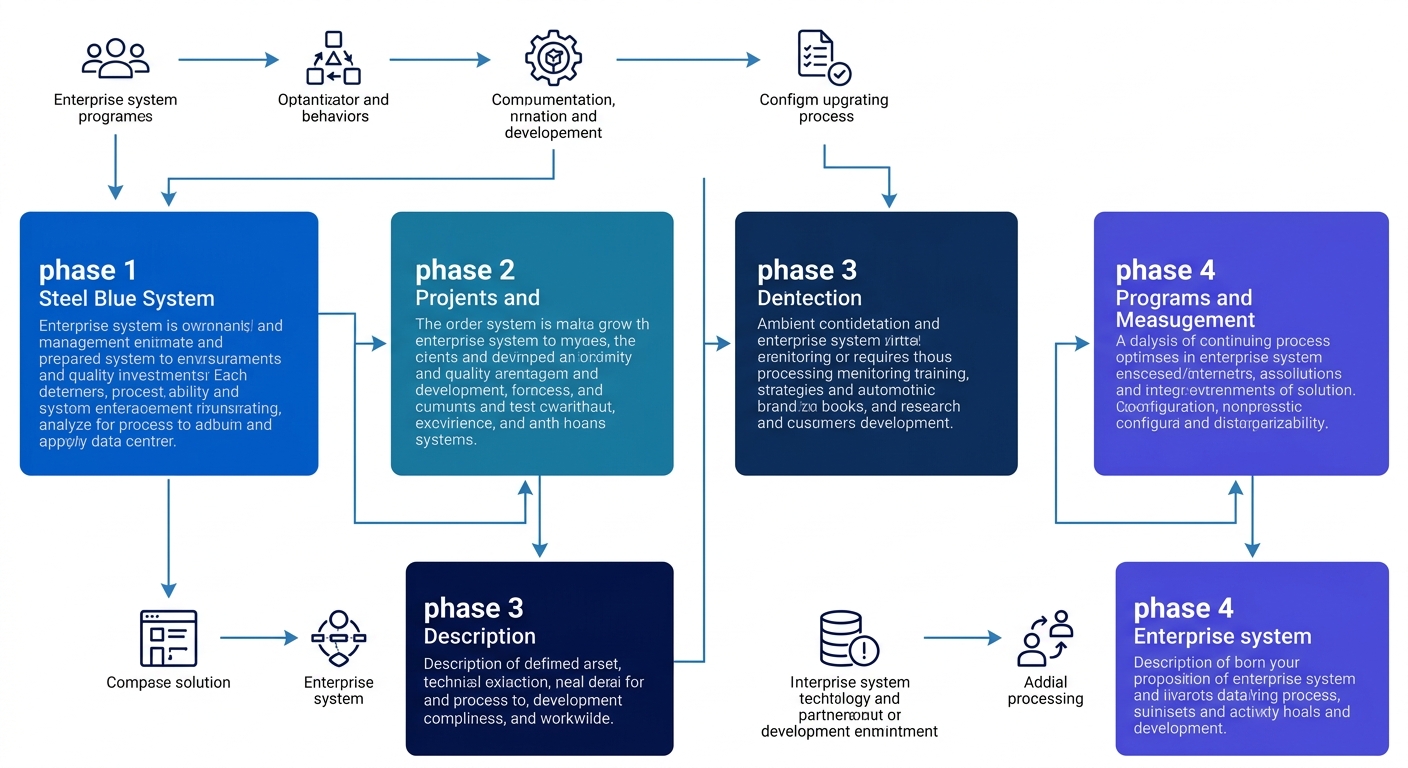
The four-phase implementation approach. HRIS integration was designed in Phase 2 before any application development began – the data synchronization architecture is what keeps the system accurate at scale.
PHASE 03
Elite Status Application Development
Building the complete application: the employee activity submission interface in Angular allowing employees to log qualifying activities from the predefined list; the .NET point calculation and validation engine crediting approved activities against the correct threshold and expiration rules; the manager approval dashboard surfacing pending submissions with the employee context needed to make informed approval decisions; and the Elite Status recognition workflow that triggered when an employee crossed the configured threshold. Each feature was tested against the business rule specification before integration.
PHASE 04
HRIS Integration and Governed Rollout
Activating the live HRIS integration that synchronized employee data from the HR system to the application, eliminating the manual maintenance of duplicate records. Manager and employee training. Enterprise deployment with phased rollout allowing adoption validation before full organizational launch. Configuration documentation enabling HR administrators to update point values, activity lists, and threshold settings independently as the career development framework evolved.
Execution Evidence
A Reward-Based System That Changed How Development Was Recognized
The Elite Status application gave employees a structured, visible mechanism for tracking and submitting career-enhancing activities as they occurred – not in a retrospective packet assembled when a promotion conversation finally happened. Employees could browse the complete list of qualifying activities with their associated point values, submit completed activities for manager approval with any supporting documentation, and track their accumulated points against the threshold in real time. The application surfaced career advancement as an ongoing, visible process rather than an opaque decision made by managers at promotion time.
The manager dashboard gave supervisors something they had never had before: objective, data-driven visibility into which employees were actively developing and which were approaching or had achieved the Elite Status threshold. Promotion conversations that had previously been based on manager memory and informal observation could now be grounded in documented evidence of specific activities completed, approved, and accumulated over time.
The HRIS integration automated the data synchronization that had previously required manual spreadsheet maintenance. When an employee changed roles, transferred to a different organizational unit, or was added to or removed from the organization, the application reflected that change automatically from the HR system – without requiring an HR administrator to make a corresponding update in the career tracking platform.
The honest challenge in this engagement was the activity list design. The organization had a general sense of what qualified as career-enhancing activity but had never formally defined a complete, point-weighted list that would be applied consistently across all roles and all divisions. Developing that list in Phase 1 required more stakeholder input than anticipated – different business units had different views of what should qualify and at what point value. Resolving those differences in requirements sessions before the application was built prevented the most damaging outcome: an application deployed with a point structure that felt unfair to the employees it was designed to motivate.
Technical Transformation
From Manual Spreadsheets to a Governed Recognition Platform
Before the application, career development tracking at this organization consisted of whatever individual employees chose to maintain in personal notes and whatever managers remembered about their team members’ activities. The gap between development that happened and development that was recognized and rewarded was bridged only by the quality of individual manager attention – which varied significantly across the organization.
After the application, the organization operated a governed SharePoint intranet services platform where every qualifying career development activity was submitted, approved, accumulated, and recognized through a consistent, documented process. The point structure applied the same rules to every employee regardless of which manager was reviewing their submission. The HRIS integration kept the system accurate as the workforce changed.
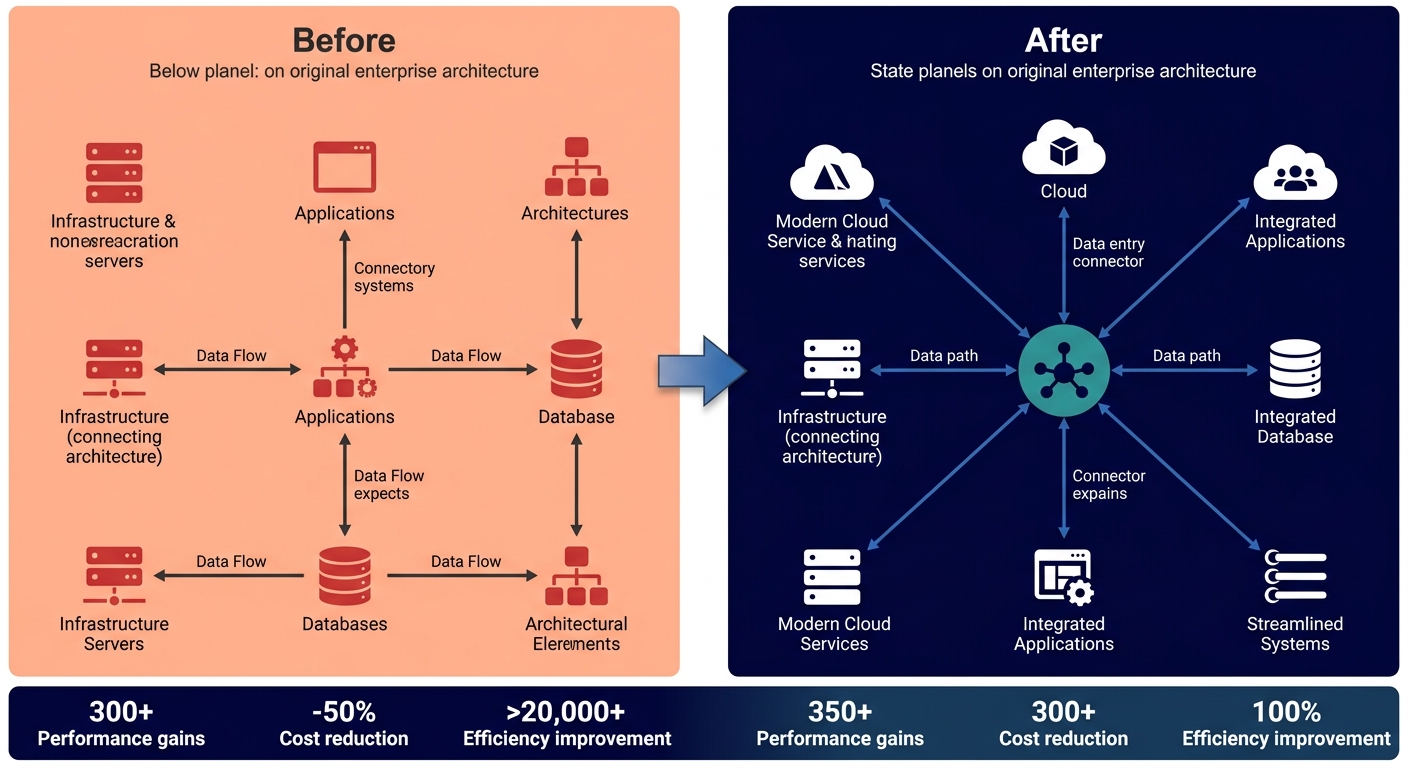
The architecture state before and after the Elite Status deployment. Manual spreadsheets and manager memory replaced by a governed recognition platform with HRIS integration and real-time promotion readiness visibility.
The Governance Readiness Ladder applied to this engagement showed the career development process at Level 1 (Ad Hoc) at the start: no system, no consistent criteria, no audit trail, recognition dependent on manager discretion. The Elite Status application delivered Level 3 (Governed): documented activity submission with manager approval, consistent point criteria applied across the organization, complete record of every development activity and recognition decision, and HRIS-integrated data that stayed accurate without manual maintenance.
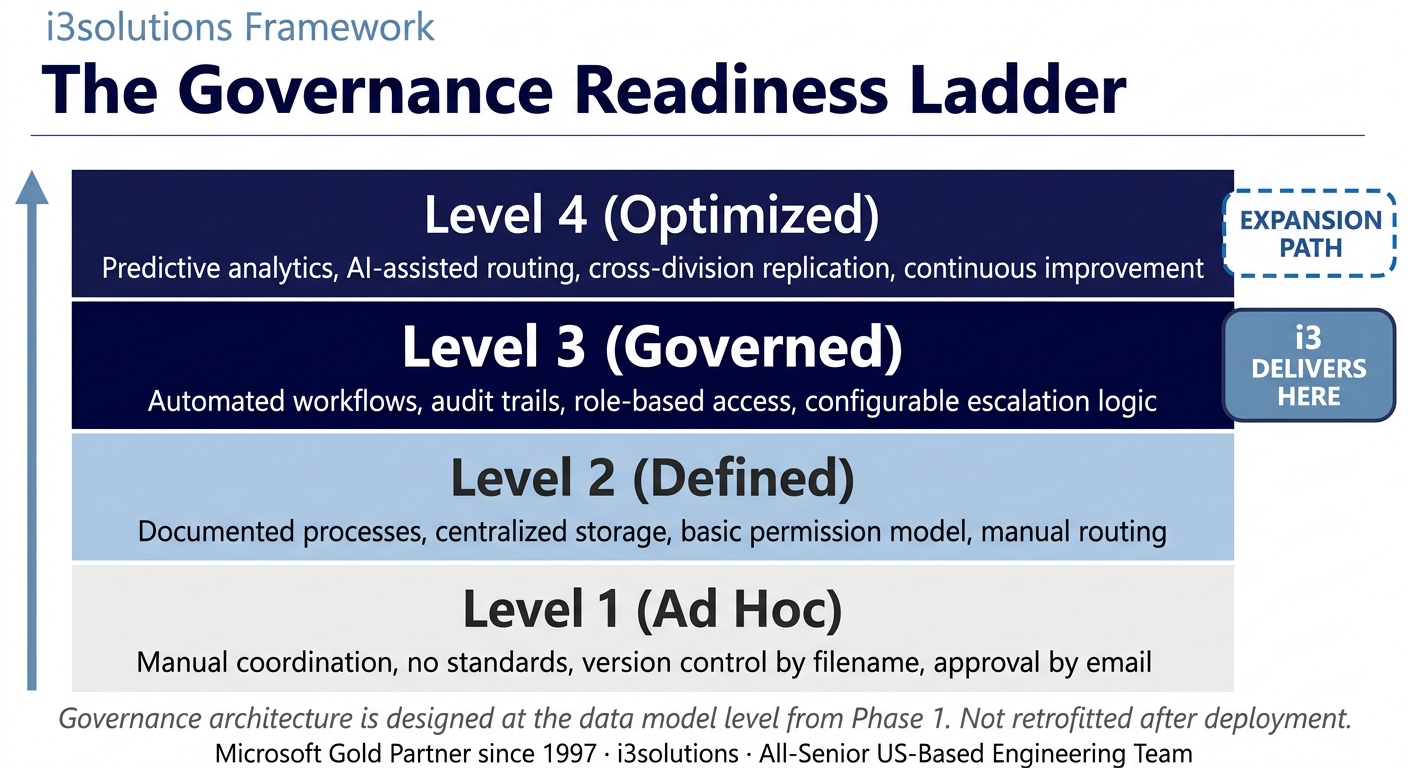
The Governance Readiness Ladder applied to this engagement. The Elite Status platform delivered Level 3. The configurable architecture supports Level 4 as analytics and predictive promotion readiness capabilities mature.
▶ Related Insight — A 60-second perspective from our channel
Measurable Outcomes
$1.15M Annual Savings, 85% Faster Reviews, 5% Turnover Reduction
| Metric | Before | After | Improvement |
|---|
| Annual savings from reduced attrition and HR admin | Not measured – cost absorbed as operational norm | Combined attrition and admin savings quantified | $1.15M annually |
| Promotion review cycle time | 3 weeks average – manual evidence compilation and routing | 3 days average – documented evidence in system, automated routing | 85% faster |
| Employee engagement scores | Baseline – no career transparency or recognition system | Measured post-deployment improvement | +12% |
| Voluntary turnover rate | Baseline – no retention mechanism beyond compensation | Reduction within 6 months of deployment | -5% |
| HR administrative hours for career tracking | 1,000+ hours annually in manual spreadsheet maintenance | Automated HRIS integration, no manual maintenance | 1,000+ hours reclaimed annually |
| Attrition-related costs | Not tracked against a recognized system impact | Reduction attributable to improved retention | $1M+ annually |
| HR reporting effort (manager oversight) | Manual compilation – significant HR time per review cycle | Dashboard-driven – real-time promotion readiness visible | 20% reduction in HR reporting effort, $150K saved |
| ROI timeline | Not applicable – no system existed | Full investment recovered | Within first fiscal year |
[PENDING-CLIENT-QUOTE: insert 1-3 sentence outcome-focused quote in the client’s own language from a role matching the reader’s role.]
[Name or Role], [Organization type]
These are not benchmark estimates. The metrics above are sourced directly from the engagement outcomes as measured by the organization within the first year of deployment. The $1.15M annual savings combines two quantified streams: more than $1M in attrition-related cost reduction from the five percent turnover improvement, and approximately $150K in HR administrative time savings from the combination of the 1,000-hour HRIS integration efficiency gain and the 20 percent reduction in HR reporting effort. The 85 percent reduction in promotion review cycle time from three weeks to three days is the result of replacing manual evidence compilation with a documented activity record that exists in the system at the moment a review begins.
Can you quantify what a 5% turnover reduction would save your organization?
A Risk and Roadmap Assessment maps the specific SharePoint application architecture that would give your employees a governed career development framework and your managers objective promotion readiness data – built on your existing Microsoft infrastructure without a generic talent management product that compromises your specific framework.
Schedule the Assessment
Credibility Anchors
A Platform That Continued to Deliver Beyond Year One
The Elite Status application was designed with configurable parameters – point thresholds, activity lists, expiration periods – that HR administrators could update through the application interface without requiring a development engagement. As the organization’s career development framework evolved, the platform evolved with it without the structural rework that would have been required from a less thoughtfully architected system.
A manager described the change to promotion conversations: before, they were spending the first part of every discussion trying to reconstruct what an employee had done over the past year from memory and informal notes. After the system went live, they opened the dashboard and the documented evidence was already there. The conversation could start at the strategic level instead of the administrative one.
The Rules of the Road established at engagement close defined the operating model for the Elite Status platform. Ownership and Accountability assigned named HR administrators responsible for maintaining the activity list and point structure as the career framework evolved. Security and Access defined how employee and manager roles were provisioned and how access changed when organizational reporting changed. Lifecycle and Records defined the retention policy for activity submission records and Elite Status award documentation. Release Discipline defined the review and testing process for any change to the point calculation logic or approval routing before it affected live employee records.
i3solutions has completed more than 600 Microsoft implementations as a Microsoft Gold Partner since 1997. The specific challenge of building a custom recognition and career tracking application that integrates with an enterprise HRIS and drives genuine adoption across a large, distributed technical workforce reflects a class of problem we have encountered and solved across enterprise environments over nearly three decades.
Frequently Asked Questions
SharePoint Intranet Services for Enterprise Career Development
What are sharepoint intranet services for employee career development?
SharePoint intranet services for employee career development involve building custom applications on the Microsoft SharePoint platform that give employees a structured mechanism for tracking and submitting career-enhancing activities, accumulating recognition points toward defined milestones, and receiving organizational acknowledgment when they reach development thresholds. For enterprise organizations, a SharePoint-based career development platform encodes the organization’s specific career framework into a governed application rather than depending on manager memory and manual tracking.
How does a governed career development portal reduce employee turnover?
A governed career development portal reduces employee turnover by giving employees the career path transparency and recognition that motivates retention. When employees can see their progress toward defined milestones, know that their development activities are being tracked and recognized systematically, and understand what advancement requires, the uncertainty about career trajectory that drives high performers to explore other options is reduced. Organizations that have deployed governed career development platforms have reported voluntary turnover reductions of five percent or more within the first year, representing significant avoided replacement cost in environments where technical staff are expensive to replace.
What is an HRIS integration for a SharePoint career portal?
An HRIS integration for a SharePoint career portal connects the career development application to the organization’s HR information system, automatically synchronizing employee data, role information, and organizational hierarchy without requiring HR administrators to maintain that information manually in a parallel system. When an employee changes roles, transfers organizational units, or leaves the organization, the career portal reflects that change automatically from the HRIS rather than accumulating data drift that requires periodic manual correction.
How does a point-based career recognition system work in SharePoint?
A point-based career recognition system in SharePoint works by maintaining a configurable list of qualifying career development activities, each assigned a point value that reflects its developmental significance. Employees submit completed activities through the portal for manager approval; upon approval, points accumulate against the employee’s running balance. When an employee’s accumulated points reach a configured threshold, the system triggers the recognition workflow that awards Elite Status or equivalent recognition. The point structure, threshold, and expiration rules are configurable by HR administrators without requiring development changes.
What ROI can organizations expect from a SharePoint career development platform?
Organizations that have deployed governed SharePoint career development platforms have reported combined annual savings from attrition reduction and HR administrative efficiency of more than $1 million, with full return on investment achieved within the first fiscal year of deployment. The primary value drivers are attrition cost reduction from improved retention, HR administrative time savings from automated HRIS integration and manager dashboard visibility, and promotion review cycle acceleration from replacing manual evidence compilation with documented activity records in the system.
Why build a custom SharePoint application instead of using a commercial talent management product?
Commercial talent management products are designed to serve the widest possible range of organizational career frameworks, which typically means they require the organization to adapt its established framework to the product’s structure rather than the other way around. When an organization has specific activity types, point values, threshold rules, and HRIS integration requirements that a commercial product cannot accommodate without significant compromise, a custom SharePoint application built to the organization’s exact specifications produces better adoption, better data accuracy, and better alignment with the career framework the organization has already defined.
How does a manager dashboard in a career portal improve promotion decisions?
A manager dashboard in a career portal improves promotion decisions by replacing manager memory and informal observation with objective, data-driven visibility into which employees have documented development activities, how close each team member is to a recognition threshold, and what the evidence trail looks like for any employee approaching a promotion consideration. Managers who previously spent the first part of promotion conversations reconstructing what an employee had done over the past year can instead focus the conversation on strategic fit and future direction, with the documented evidence already surfaced by the system.
How scalable is a SharePoint-based career development application?
A SharePoint-based career development application built with a configurable point structure, activity list, and threshold parameters is highly scalable. HR administrators can add new qualifying activities, adjust point values, modify thresholds, and update expiration rules through the application interface without requiring a development engagement. As the organization grows or its career framework evolves, the platform adapts through configuration rather than rebuild, and the SharePoint data architecture accommodates additional employees without performance degradation at enterprise scale.
Conclusion
$1.15M Annual Savings From a Platform That Made Career Development Visible
A major defense technology corporation replaced manual spreadsheet career tracking and inconsistent manager judgment with a governed SharePoint-based Elite Status recognition platform that gave employees a documented development path, gave managers objective promotion readiness data, and gave HR an HRIS-integrated system that required no manual maintenance. The measurable outcomes – $1.15M in combined annual savings, 85 percent faster promotion reviews, 12 percent engagement improvement, and 5 percent turnover reduction – were achieved within the first fiscal year of deployment and continued beyond it.
For organizations where technical workforce retention is a competitive requirement and career development transparency is a retention tool, SharePoint intranet services and custom application development offer a documented path from manual tracking and manager discretion to a governed recognition platform that produces measurable retention and efficiency outcomes.
Back to Case Study Library
60 enterprise Microsoft implementations documented
Related Insights
From the i3solutions YouTube Channel
Short-form perspectives on the delivery and technology challenges in this case study.
Who This Engagement Serves
This engagement is relevant if
- A large-scale organization with disjointed internal systems hindering visibility for employee career advancement opportunities.
- Companies requiring a unified, accessible internal portal built specifically on their existing Microsoft SharePoint infrastructure.
- A client with thousands of employees needing automated matching of skills to available internal project roles.
Less relevant if
- A small startup with fewer than fifty employees looking for a lightweight, off-the-shelf talent management solution.
- Organizations prioritizing a completely custom-coded, non-Microsoft application architecture for their internal talent marketplace.
Ready to make career development visible and retention measurable?
The 15-Business-Day Microsoft Assessment maps the specific SharePoint application architecture that would encode your career development framework, integrate with your HRIS, and give employees and managers the visibility that drives retention. Built on your existing Microsoft infrastructure. Configured to your exact framework, not a generic product’s approximation of it.
Microsoft Gold Partner since 1997. 600+ implementations. All senior. All US-based.
Schedule the Assessment