Case Study • Aerospace / Defense • Excel to Web Modernization
ROM on a Spreadsheet: How an Aerospace Manufacturer Converted a Critical Pricing Tool to a Governed Web Application

The Enterprise Challenge
Excel to Web Application Modernization for Aerospace Proposal Pricing
A major aerospace manufacturer designing and building advanced aircraft engines and auxiliary power systems for commercial, military, and business aviation markets wins contracts through a proposal development process where accuracy, compliance, and timeliness are not competitive differentiators – they are baseline requirements. A proposal that arrives late, contains pricing errors, or cannot demonstrate compliance with solicitation requirements does not lose on merit. It is eliminated before merit is evaluated.
The manufacturer’s Rough Order of Magnitude calculator – the ROM tool used to estimate costs and develop pricing for proposal submissions – was built in Excel. The spreadsheet was complex, reflecting years of accumulated pricing logic developed by engineers and pricing specialists. It was also fragile: version conflicts were common, calculation errors were possible without automated validation, and there was no audit trail documenting how a particular ROM estimate had been reached. When an estimate was challenged during proposal review or contract negotiation, reconstructing the calculation logic from the spreadsheet was a manual, error-prone process.
The ROM calculator was also disconnected from the broader proposal management platform. Pricing information developed in the spreadsheet had to be manually transferred into the proposal system, creating another opportunity for transcription error and another gap in the audit trail. The manufacturer needed an excel to web application that would replace the fragile Excel ROM calculator with a governed web application that validated inputs, enforced pricing rules, maintained a complete audit trail, and integrated directly with the proposal management platform.
Strategic Trigger
Spreadsheet Fragility Was Creating Pricing Risk on Contracts Worth Millions
The forcing function was the financial scale of the contracts at stake. A ROM calculation error on a major defense or commercial aviation contract is not a minor administrative issue that can be corrected in the next revision. It is a pricing commitment that may be contractually binding before the error is discovered. In an environment where a single contract can represent hundreds of millions of dollars in revenue, the risk embedded in a fragile, unvalidated spreadsheet pricing tool is disproportionate to the cost of replacing it with a governed web application.
The version conflict problem had become materially worse as proposal volumes grew. Multiple proposal teams working in parallel on different proposals would each start from the most recent version of the ROM spreadsheet they had access to – which might or might not be the current version. When pricing decisions in different proposals were made from different versions of the same underlying calculation logic, the organization had no reliable way to ensure that its pricing approach was consistent across the portfolio. For a complex aerospace manufacturer with both commercial and defense proposal pipelines, pricing inconsistency was both a compliance risk and a competitive exposure.
Leadership recognized that the combination of the ROM calculator modernization and the broader proposal management platform represented a comprehensive opportunity to address the manufacturer’s proposal development infrastructure as an integrated system. The ROM calculator was the component most visibly in need of modernization, but its integration with the proposal platform was where the full value of the transformation would be realized. For context on how integration governance decisions determine whether modernized tools operate as a coherent system or as isolated improvements, Integration Governance for MicrosoftPENDING-SCHEDULED covers the change control architecture that sustains integrated platform quality over time.
Is a critical pricing or analysis tool still living in a spreadsheet with no audit trail?
If your ROM calculator, cost model, or pricing tool depends on spreadsheet accuracy without automated validation, the risk is proportional to the contract values it informs. A 15-Business-Day Microsoft Assessment maps the specific web application architecture that would replace the spreadsheet with a governed tool that validates inputs, enforces calculation rules, and produces an audit trail that can be defended in contract review.
Request the Assessment
▶ Related Insight — A 60-second perspective from our channel
Stakes (What Happens If They Fail)
Contract Pricing Errors, Compliance Audit Exposure, and Proposal Rework Consuming Engineering Capacity
The primary risk of a spreadsheet-based ROM calculator for a defense and commercial aerospace manufacturer is the combination of calculation error and audit trail absence. A calculation error in a government contract proposal can result in a pricing commitment that the manufacturer cannot meet profitably – or cannot sustain through a DCAA audit. The absence of a documented audit trail of how the estimate was developed means that when a calculation is questioned, the manufacturer’s ability to demonstrate that it was produced through a consistent, documented process is limited to whatever the spreadsheet’s own structure reveals.
The rework cost was also significant. When proposals were submitted with pricing errors discovered during review – whether internal or customer-facing – the correction process required engineers and pricing specialists to reconstruct the original calculation, identify where the error occurred, and produce a corrected estimate. In a complex aerospace pricing environment, this rework consumed hours of skilled engineering and pricing capacity that should have been directed toward the next proposal in the pipeline. A governed web application that validated inputs and enforced calculation rules would eliminate the category of errors that were not caught until review.
The disconnection from the proposal platform had a compounding cost. Each manual transfer of ROM data from the spreadsheet to the proposal system was a transcription step that introduced error risk and required reconciliation. When pricing data in the proposal system disagreed with the ROM spreadsheet, determining which was authoritative required manual investigation that consumed proposal manager time during the compressed periods when proposals were actively being developed.
Constraints and Complexity
Complex Calculation Logic, Compliance Requirements, and a VPC Integration That Had to Be Seamless
The ROM calculation logic in the existing spreadsheet was the accumulated product of years of aerospace pricing expertise. Converting that logic correctly from Excel formulas into validated web application calculation code was the most technically demanding element of the engagement. Calculation errors introduced during conversion would be worse than the original spreadsheet – because users would trust a web application’s output more than a spreadsheet’s, making silent errors harder to detect. Every calculation in the converted application had to be independently validated against the original spreadsheet before the web application was accepted as the authoritative source.
Defense contract pricing is subject to DCAA audit requirements that govern how costs are estimated, what documentation must support an estimate, and how changes to estimates are tracked over time. The ROM web application had to produce the audit trail that DCAA compliance requires – not as a post-hoc documentation exercise, but as a built-in feature of every calculation the application performed. Every input, every assumption, every calculation step, and every output had to be traceable to the user who performed it and the version of the calculation rules that applied at the time.
The VPC integration requirement connected the ROM calculator to the manufacturer’s Virtual Proposal Center – the SharePoint-based proposal management platform that i3solutions had previously built. Pricing data developed in the ROM calculator needed to flow directly into the VPC without manual transfer, maintaining the data integrity between the pricing tool and the proposal platform and ensuring that the proposal system always reflected the current ROM estimate rather than a manually copied version that might lag the ROM calculator by hours or days during active proposal development. For context on how this class of SharePoint integration is architected to maintain data consistency, SharePoint and Power Platform Integration covers the integration patterns that keep connected tools operating as a coherent platform.
▶ Related Insight — A 60-second perspective from our channel
Selection Rationale (Why They Chose i3solutions)
The VPC Partner With Aerospace Pricing Application Experience
The selection was in significant part driven by the existing engagement relationship. i3solutions had built the manufacturer’s VPC – the proposal management platform that the ROM calculator would integrate with. The architects who had designed the VPC knew the data model, the integration patterns, and the specific requirements of the manufacturer’s proposal development workflow. Engaging a different partner for the ROM calculator modernization would have required an onboarding investment to understand the VPC architecture that could instead be applied directly to the integration design.
Beyond the VPC context, i3solutions was selected as a Microsoft Gold Partner since 1997 with demonstrated experience in excel to web application for complex, calculation-intensive enterprise tools where getting the calculation logic correct was the primary acceptance criterion. The Expert Delivery Model that i3solutions operates, staffing every engagement with senior-level developers and architects only, was specifically critical for a calculation conversion engagement where a junior developer misinterpreting a pricing formula would produce a tool that was demonstrably wrong from day one.
The firm’s Enterprise Delivery Assurance model provided the governance structure that a compliance-sensitive pricing tool required. The Business Process Management methodology used to map the ROM calculation logic before development began – producing a documented representation of every calculation step, every input requirement, and every output definition – served as both the development specification and the compliance documentation that the DCAA audit trail requirement would reference.
The Engagement Approach (Our Plan)
From Fragile Spreadsheet to Governed, Auditable, VPC-Integrated Pricing Application
PHASE 01
ROM Logic Documentation and BPM Mapping
Structured sessions with pricing specialists and engineers to document every calculation in the existing ROM spreadsheet: inputs, assumptions, formula logic, output definitions, and the variation rules that applied different calculation approaches to different contract types and pricing categories. BPM process mapping converted the spreadsheet logic into a documented, reviewable representation that served as the development specification and the compliance documentation simultaneously. This phase was the highest-value investment in the engagement – incorrect documentation of the ROM logic would have produced a web application that calculated incorrectly and passed all functional tests.
PHASE 02
Application Architecture and VPC Integration Design
Designing the web application architecture: the data model holding ROM calculations, the calculation engine implementing the documented BPM logic with validated inputs and enforced calculation rules, the audit trail architecture recording every user action and calculation output, the SharePoint backend serving as the governance and data management layer, and the VPC integration pattern connecting ROM outputs directly to the proposal management platform. The integration design ensured that pricing data flowed from the ROM calculator to the VPC as a system action rather than a manual transfer, maintaining consistency without user intervention.
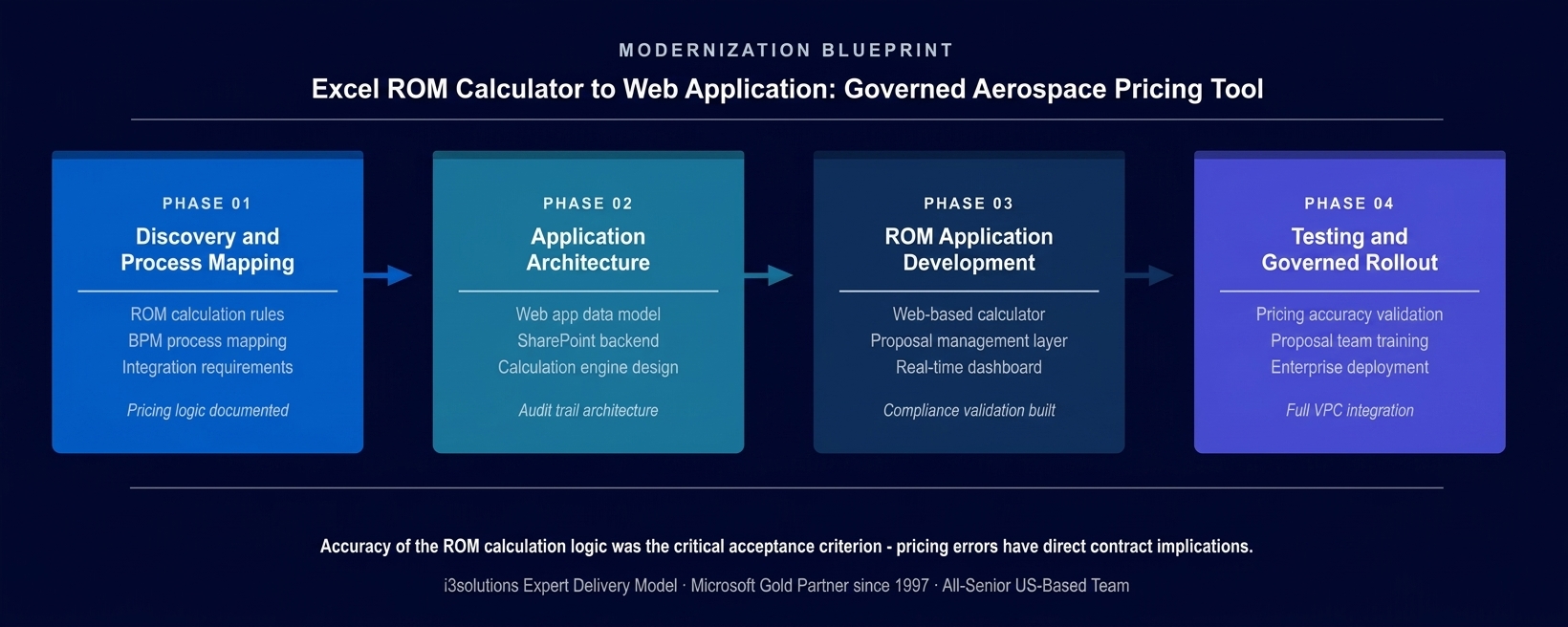
The four-phase implementation approach. BPM documentation of the ROM calculation logic in Phase 1 was the highest-value investment in the engagement – every subsequent development decision depended on getting that documentation right.
PHASE 03
ROM Web Application Development
Building the complete
excel to web application: validated input forms enforcing data completeness and type constraints before calculation is permitted; the governed calculation engine implementing each ROM formula as validated code rather than spreadsheet formula; real-time dashboards providing proposal managers and pricing specialists with current ROM status across the active proposal portfolio; compliance validation workflows that flagged calculations requiring review before submission; and the audit trail logging every input, every calculation, and every output with user attribution and timestamp.
PHASE 04
Validation, VPC Integration, and Governed Rollout
Systematic validation of every ROM calculation in the web application against the original spreadsheet, with sign-off from the pricing specialists responsible for the original logic before any production deployment. VPC integration activation connecting ROM outputs to the proposal management platform. Parallel operation period allowing proposal teams to validate web application outputs against their existing spreadsheet before full cutover. Training for pricing specialists and proposal managers. Full production deployment with the spreadsheet formally retired.
Execution Evidence
Validated Calculation Engine, Complete Audit Trail, Direct VPC Integration
The ROM web application’s calculation engine implemented every formula from the BPM-documented logic as validated application code with explicit input validation and range checking. Where the original spreadsheet accepted any numerical input without constraining whether that input was physically reasonable for the pricing category, the web application’s validated form layer enforced input constraints appropriate to each field – preventing the category of calculation errors that originated from technically valid but physically implausible inputs entering the spreadsheet unchecked.
The audit trail embedded in every calculation met the DCAA documentation requirements that the spreadsheet could not satisfy. When a ROM estimate was produced, the application recorded: the user who initiated the calculation, the date and time, every input value and its source, the calculation version applied, and every intermediate and final output. When a calculation was modified, the application recorded the modification as a new version rather than overwriting the original, maintaining the full history of how an estimate evolved through the proposal development process.
The real-time proposal portfolio dashboard gave proposal managers the aggregate visibility that the spreadsheet environment had never provided. Rather than asking each proposal team for the current status of their ROM development, managers could view the full pipeline from a single interface – which proposals had completed ROM calculations, which were in progress, which had flagged compliance review items, and which were at risk of missing proposal deadlines based on their current ROM development status.
The honest challenge in this engagement was the calculation validation phase. The ROM spreadsheet had accumulated calculation variations for specific contract categories that were not documented anywhere other than in the spreadsheet formulas themselves. Several of these variations reflected pricing policy decisions that had been made years earlier by staff who were no longer with the organization, with no documentation of the rationale. Surfacing these undocumented variations during Phase 1 BPM documentation – before the web application was built – gave the pricing leadership the opportunity to make explicit decisions about which variations to preserve, which to standardize, and which reflected outdated policy that should be updated. This resulted in a web application that implemented current pricing policy, not historical accident.
Technical Transformation
From Fragile Spreadsheet to Governed, Auditable, Integrated Pricing Platform
Before the engagement, the manufacturer’s ROM pricing capability consisted of a complex Excel spreadsheet with no input validation, no audit trail, no version control, and no connection to the proposal management platform. Pricing estimates were produced in an environment where calculation errors were possible without detection, version conflicts were common during active proposal periods, and the transfer of ROM data to the proposal system was a manual step that introduced additional error risk.
After the engagement, the manufacturer operated a governed excel to web application where inputs were validated before calculation, every calculation step was documented in an unalterable audit trail, pricing data flowed directly to the VPC without manual transfer, and proposal managers had real-time visibility into ROM status across the full proposal portfolio. The spreadsheet was retired – not supplemented – by a tool that was more accurate, more compliant, and more integrated with the proposal development process it supported.
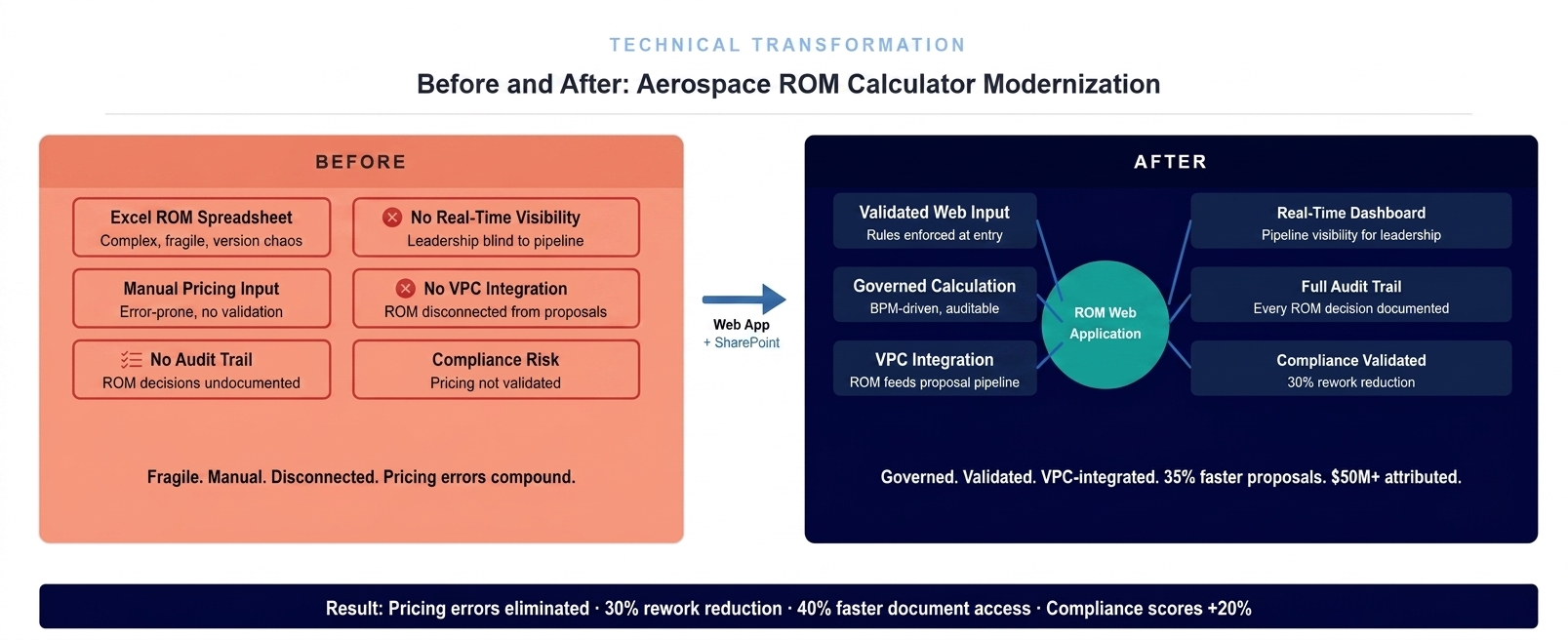
The architecture state before and after the ROM web application deployment. Fragile spreadsheet with no validation replaced by governed web application with enforced input validation, complete audit trail, and direct VPC data integration.
The Governance Readiness Ladder applied to this engagement showed the ROM pricing process at Level 1 (Ad Hoc): spreadsheet-based, no validation, no audit trail, version conflicts common, disconnected from the proposal platform. The delivered application placed the process at Level 3 (Governed): validated inputs enforced before calculation, complete and unalterable audit trail on every estimate, pricing data synchronized to the VPC as a system action, and the calculation logic documented and reviewable rather than embedded in opaque spreadsheet formulas.
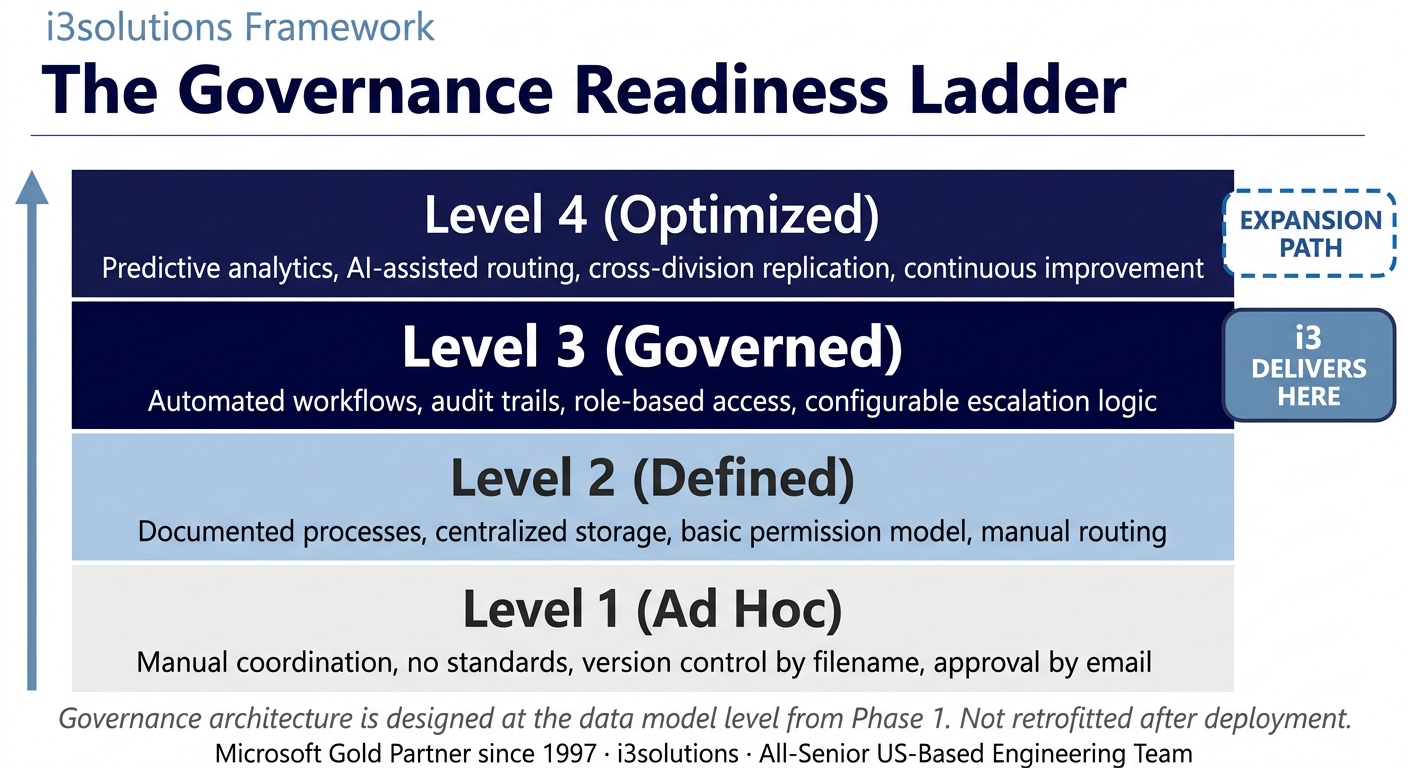
The Governance Readiness Ladder applied to this engagement. The ROM web application delivered Level 3 pricing governance. The audit trail architecture supports Level 4 as DCAA compliance reporting and pricing analytics capabilities mature.
▶ Related Insight — A 60-second perspective from our channel
Measurable Outcomes
Pricing Errors Eliminated, Compliance Audit Trail Complete, 35% Faster Proposals
| Metric | Before | After | Improvement |
|---|
| ROM calculation preparation time | 10 days average for full ROM development | 6.5 days average with validated web application and VPC integration | 35% reduction in preparation time |
| Document access time during proposal | Manual search across spreadsheet versions and shared drives | Centralized in governed platform with real-time portfolio dashboard | 40% faster document access |
| Proposal rework from pricing errors | Significant rework cycles from calculation errors and compliance gaps | Validation rules prevent error categories that drove rework | 30% reduction in rework |
| Compliance audit scores | Baseline – limited documentation of ROM calculation process | Improvement attributable to complete audit trail and BPM-documented logic | 20% improvement in compliance audit scores |
| Staff capacity recovered | Engineering and pricing staff time consumed by spreadsheet management | Recovered capacity redeployed to proposal development | $800K annually in recovered staff capacity |
| DCAA audit documentation | Not producible from the tool – required manual reconstruction | Complete audit trail producible from the application for any calculation | Full DCAA-ready documentation |
| VPC data consistency | Manual transfer from ROM to VPC – transcription errors possible | Direct system integration – ROM outputs synchronized to VPC automatically | Manual transfer eliminated |
[PENDING-CLIENT-QUOTE: insert 1-3 sentence outcome-focused quote in the client’s own language from a role matching the reader’s role.]
[Name or Role], [Organization type]
The 35 percent reduction in proposal preparation time from ten days to six and a half days is the most directly measurable outcome of the engagement as reported by the organization. The combination of validated calculation inputs reducing rework, VPC integration eliminating manual data transfer, and the real-time portfolio dashboard reducing management overhead produced a proposal development process that was meaningfully faster without reducing accuracy or compliance quality. The $800K in recovered staff capacity represents the engineering and pricing specialist time previously consumed by ROM spreadsheet management, version conflict resolution, and manual data transfer.
The compliance audit score improvement addressed the manufacturer’s DCAA posture directly. Moving from a pricing tool that could not produce its own audit trail to one where every calculation was fully documented from input through output gave the manufacturer the compliance documentation that government contract auditing requires – and that the spreadsheet environment could not provide.
Is a critical pricing or estimation tool still a spreadsheet that cannot produce its own audit trail?
A Risk and Roadmap Assessment maps the specific web application architecture that would replace your spreadsheet pricing tool with a governed application that validates inputs, enforces calculation rules, produces an unalterable audit trail, and integrates directly with your proposal management platform. No manual transfers. No version conflicts. No calculation errors that survive to submission.
Schedule the Assessment
Credibility Anchors
A Pricing Platform That Scales With the Proposal Portfolio
The ROM web application was delivered as a component of the manufacturer’s integrated proposal development platform – the VPC that managed the full proposal lifecycle and the ROM calculator that supported the pricing development that fed into it. Together, these systems formed a coherent proposal infrastructure where every phase of development from ROM estimation through proposal submission was governed, documented, and connected through a shared data environment.
A pricing specialist described what changed about their daily work: before, the first thing you checked when opening the ROM spreadsheet was whether you had the right version. After the web application went live, that question stopped existing. There was one tool. Everyone was working from the same calculation engine. Version conflicts were just gone.
The Rules of the Road established at engagement close defined the governance model for the ROM application and its integration with the VPC. Ownership and Accountability defined the pricing team leadership responsible for the ROM calculation logic and the process for requesting calculation rule updates. Security and Access defined how pricing specialists and proposal managers were provisioned for the application and how access was managed for proposals with different classification or sensitivity requirements. Lifecycle and Records defined the audit trail retention policy for ROM calculations in compliance with DCAA requirements. Release Discipline defined the validation and sign-off process required before any change to the calculation logic could be deployed to the production application – reflecting the lesson from Phase 1 that undocumented calculation variations embedded in a spreadsheet were precisely the governance failure the web application was built to prevent from recurring.
i3solutions has completed more than 600 Microsoft implementations as a Microsoft Gold Partner since 1997. The Pratt and Whitney ROM calculator modernization was the second major engagement with this client, following the Virtual Proposal Center implementation. The pattern of deepening engagement over time – where a well-delivered first implementation establishes the trust and institutional knowledge that makes subsequent engagements more effective – is one of i3solutions’ most consistent relationship outcomes with major enterprise clients.
Frequently Asked Questions
Excel to Web Application Modernization for Aerospace Pricing and Proposal Management
What is excel to web application modernization for aerospace pricing tools?
Excel to web application modernization for aerospace pricing tools involves converting complex spreadsheet-based calculation tools into governed web applications that validate inputs, enforce pricing rules, maintain a complete audit trail, and integrate with the broader proposal management platform. For aerospace manufacturers where ROM calculators and cost estimation tools inform contract pricing commitments worth millions of dollars, this modernization replaces the fragility and audit trail absence of spreadsheet tools with compliant, auditable, and integrated applications that reduce pricing risk and improve proposal development efficiency.
How does a governed ROM calculator web application reduce pricing errors?
A governed ROM calculator web application reduces pricing errors by enforcing input validation constraints before calculations are permitted, implementing pricing rules as application code that cannot be accidentally overridden by an out-of-range spreadsheet entry, and automatically flagging calculation outputs that fall outside expected ranges for compliance review before submission. The category of pricing errors that originate from valid-but-incorrect inputs, formula errors introduced by spreadsheet editing, or version conflicts between team members working from different spreadsheet copies is structurally eliminated by the application architecture.
What DCAA audit trail requirements apply to aerospace ROM pricing tools?
DCAA audit requirements for ROM pricing tools in defense contract environments include documentation of the inputs used in each estimate, the calculation methodology applied, the assumptions underlying the estimate, and the identity and authorization of the personnel who produced the estimate. A web application that logs every input, every calculation step, and every output with user attribution and timestamp produces this documentation automatically as part of the calculation process rather than requiring manual reconstruction when an audit examines a specific estimate.
How does BPM process mapping support Excel to web conversion for complex pricing tools?
BPM process mapping supports Excel to web conversion for complex pricing tools by producing a documented, reviewable representation of every calculation in the spreadsheet before any development begins. For aerospace ROM calculators that have accumulated years of pricing logic in spreadsheet formulas, BPM mapping makes the logic explicit and reviewable by pricing subject matter experts who can confirm that the documented logic is correct, identify calculation variations that reflect current versus outdated policy, and sign off on the specification before the web application implements it. This prevents the most damaging outcome in pricing tool conversion: a web application that calculates incorrectly and passes functional tests because the error was in the specification rather than the code.
How does Excel to web application integration with a proposal management platform work?
Excel to web application integration with a proposal management platform works by connecting the ROM calculator’s data output directly to the proposal platform’s data model through a governed integration layer rather than relying on manual data transfer between the two systems. When a ROM calculation is completed and approved, the integration automatically updates the corresponding proposal record in the platform with the current pricing data, maintaining data consistency without requiring a pricing specialist to manually copy values from one system to the other. This eliminates both the transcription error risk and the timing lag between ROM completion and proposal system update that characterize manual transfer processes.
What should aerospace organizations look for in an Excel to web conversion partner?
Aerospace organizations evaluating Excel to web conversion partners for pricing and proposal tools should prioritize experience with calculation-intensive applications where the accuracy of the converted logic is the primary acceptance criterion, defense contract compliance requirements including DCAA audit trail documentation, integration experience connecting pricing tools to proposal management platforms, and a delivery model that staffs the engagement with senior engineers who have encountered complex spreadsheet conversion challenges before. An all-senior team reduces the risk of calculation logic errors that would require full redevelopment to correct.
How long does Excel to web application conversion take for a complex aerospace pricing tool?
Excel to web application conversion for a complex aerospace pricing tool typically spans several months from BPM documentation through production deployment, with timeline driven by the complexity of the calculation logic, the number of pricing categories and their variations, the integration requirements with existing proposal management platforms, and the validation period required to confirm calculation accuracy against the original spreadsheet before cutover. Engagements that invest adequately in BPM documentation before development begins consistently deliver applications with fewer post-deployment calculation corrections than those that begin development before the logic is fully documented and reviewed.
What governance model keeps a web-based pricing application accurate over time?
A web-based pricing application stays accurate over time through a governance model that defines a formal process for requesting and approving changes to the calculation logic, requires validation of proposed changes against known test cases before deployment, maintains version history for all deployed calculation rule sets with documentation of what changed and why, and assigns named ownership to the pricing policy decisions that the application logic implements. Without this governance model, web-based pricing applications accumulate informal modifications that reintroduce the undocumented variation that the Excel to web conversion was designed to eliminate.
Conclusion
A Governed Pricing Tool Built on the Proposal Platform That Already Served the Business
A major aerospace manufacturer replaced a fragile, unvalidated Excel ROM calculator with a governed excel to web application that validated inputs, enforced pricing rules, maintained a complete DCAA-ready audit trail, and integrated directly with the existing VPC proposal management platform. Through excel to web application and custom application development, the manufacturer moved from a spreadsheet pricing environment characterized by version conflicts, calculation errors, and manual data transfer to a governed platform where proposal preparation time was reduced 35 percent, compliance audit scores improved 20 percent, and $800K in engineering capacity was recovered annually.
For aerospace and defense manufacturers where critical pricing and estimation tools still live in Excel, excel to web application and custom application development offer a documented path from spreadsheet fragility to governed, auditable web applications that produce the documentation that compliance requires and the accuracy that contract commitments demand.
Back to Case Study Library
60 enterprise Microsoft implementations documented
Related Insights
From the i3solutions YouTube Channel
Short-form perspectives on the delivery and technology challenges in this case study.
Who This Engagement Serves
This engagement is relevant if
- Manufacturing companies struggling with complex, version-controlled Excel engineering estimation models across global teams.
- Industrial organizations needing a web-based, collaborative interface for legacy desktop-based cost and risk assessment tools.
- Aviation firms seeking automated, auditable workflows for generating internal rough order of magnitude (ROM) price estimates.
Less relevant if
- Small businesses managing simple projects with standardized pricing that does not require bespoke calculation logic.
- Companies seeking pre-built, off-the-shelf configure-price-quote (CPQ) software rather than custom application development.
Ready to retire the spreadsheet and govern the pricing tool your proposals depend on?
The 15-Business-Day Microsoft Assessment maps every calculation in your Excel pricing tool against the web application architecture that would implement it with validated inputs, enforced rules, complete audit trail, and integration with your proposal management platform. No calculation errors that survive to submission. No audit trails reconstructed after the fact.
Microsoft Gold Partner since 1997. 600+ implementations. All senior. All US-based.
Schedule the Assessment