Case Study • Federal Government / Executive Office • Workflow Automation
Bluecast Is Dead: How a Federal Drug Policy Office Automated Executive Correspondence
The Office of National Drug Control Policy (ONDCP), Executive Office of the President • SharePoint and Nintex Correspondence Workflow •
Nintex workflow development

The Enterprise Challenge
Nintex Workflow Development to Replace a Decommissioned Federal Correspondence System
The Office of National Drug Control Policy, operating within the Executive Office of the President, is responsible for coordinating the nation’s drug control strategy across federal agencies, state governments, and community organizations. Its correspondence function is not incidental to this work – tracking incoming requests from Congress, responding to governmental communications, managing event information, and overseeing the correspondence lifecycle that keeps an Executive Office agency operating at the pace the EOP requires is central to the organization’s ability to function.
ONDCP’s correspondence management system, Bluecast, was approaching decommissioning. Built on obsolete technology, Bluecast had served its purpose but could not be sustained as a supported platform. The agency faced an urgent requirement: develop a modern replacement that would handle all of the functions Bluecast performed – tracking incoming correspondence packages with unique identifiers, managing event and response information, overseeing the correspondence routing workflow, and providing the audit documentation that compliance required – without the operational disruption of a gap between the old system going down and the new system going live.
i3solutions developed a customized Nintex workflow development solution on SharePoint, using Nintex for form creation and workflow automation, jQuery for interface enhancement, and SharePoint’s document management and list infrastructure as the governance backbone. The solution was designed specifically to ONDCP’s correspondence processes, not adapted from a commercial correspondence management product that would require the agency to compromise its specific workflow requirements.
Strategic Trigger
A Hard Decommissioning Deadline With No Commercial Off-the-Shelf Path
The forcing function was non-negotiable: Bluecast had a decommissioning date. An Executive Office agency cannot operate without a correspondence management system and cannot defer the replacement of a system that is being decommissioned. The urgency of the requirement shaped every subsequent decision in the engagement – the solution had to be developed, tested, and deployed in a timeline that coincided with the Bluecast shutdown, not after it.
The decision to build a custom SharePoint and Nintex solution rather than adopt a commercial correspondence management product reflected the specific requirements of ONDCP’s workflows. The agency’s correspondence processes – the specific routing rules, the review and approval structures, the way packages were categorized and tracked, the reporting requirements against the existing system’s baseline – were specific enough that a commercial product would have required the agency to significantly adapt its established processes to match the product’s assumptions. Building on SharePoint and Nintex allowed the new system to implement ONDCP’s actual workflows rather than approximating them.
The compliance dimension added urgency. Bluecast had accumulated audit findings related to its compliance documentation – gaps in the audit trail that reviewers had flagged but the legacy system could not address without a fundamental architectural change. The replacement was an opportunity to close those findings by building a system with a complete, automated audit trail from day one, rather than carrying legacy compliance gaps into a new platform. For context on how correspondence workflow governance is designed to sustain compliance posture over time, Integration Governance for MicrosoftPENDING-SCHEDULED covers the change control architecture that keeps governed workflow systems audit-ready as the organization evolves.
Is a federal agency operating correspondence management on a system approaching decommissioning?
If your correspondence management system is built on obsolete technology, has audit findings that cannot be addressed without a system replacement, or is facing a decommissioning date that creates an urgent replacement requirement, the 15-Business-Day Microsoft Assessment maps the specific SharePoint and Nintex architecture that would replace it on your timeline.
Request the Assessment
▶ Related Insight — A 60-second perspective from our channel
Stakes (What Happens If They Fail)
Operational Continuity at Risk, Audit Findings Unresolved, 3,000+ Staff Hours Lost Annually
For an Executive Office agency, correspondence management failure is not a productivity problem that can be absorbed over a quarter while a replacement is developed. Congressional correspondence, governmental communications, and event management require continuous, reliable tracking that an agency operating at the EOP level cannot allow to lapse. The urgency of the Bluecast replacement was proportional to the operational importance of the function it served.
The audit compliance dimension had immediate consequences. Audit findings that remain open because the system cannot close them are not resolved by acknowledging them – they are resolved by demonstrating that the underlying control gap has been addressed. A new correspondence management system that preserved Bluecast’s compliance gaps would inherit its audit findings without the excuse of legacy system constraints. The new system had to be built with the audit trail completeness that closed the existing findings, not merely with a plan to address them in a future enhancement.
The operational efficiency cost of the legacy approach was also significant. Quantified at 3,000 staff hours annually consumed by manual routing and status checks, plus 1,500 hours annually lost to inefficient collaboration loops in the manual review process, the combined administrative overhead was measurable and avoidable. At fully loaded staff costs, these hours represented approximately $150K in annual productivity loss that the new system would reclaim. The compliance cost avoidance from closing the audit findings was estimated at an additional $50K to $75K per year in avoided corrective action costs.
Constraints and Complexity
Urgent Timeline, EOP Compliance Standards, and Workflows That Had to Match Established Practice
The timing constraint was the most operationally consequential element of the engagement. The solution had to be designed, developed, tested, and deployed in a timeline that did not allow for the extended development cycles that a non-urgent replacement might accommodate. This shaped the architecture decision to build on SharePoint and Nintex – a proven platform combination with known development velocity and deployment characteristics – rather than on a more novel technology stack that would have required longer validation cycles.
The EOP compliance requirements governed the solution’s audit trail design from the first architecture discussion. Every correspondence package had to carry a unique identifier that persisted through every stage of its lifecycle. Every action taken on a package – intake, routing, review, comment, approval, disposition – had to be logged automatically by the workflow rather than requiring manual documentation by staff. The dashboard that gave managers real-time visibility into package status had to draw on this automated audit trail, not on manual status updates that could be incomplete or delayed. The system had to be able to produce a complete, unbroken audit record for any package in the system at any point in time, not reconstruct one from partial records after the fact.
The workflow specificity requirement was equally constraining. ONDCP’s correspondence processes had been developed over years of operational refinement. The routing rules, the review and approval structures, the package categorization and metadata schema, the reporting requirements – all of these had established patterns that the new system had to implement accurately rather than approximately. A system that routed correspondence differently from the established process, or that captured package metadata in a different structure, would require staff retraining and process change at exactly the moment when the agency needed the transition to be as invisible as possible to the workflow. For context on how workflow governance design determines whether a new system is adopted or worked around, 10 Power Automate Enterprise Processes covers the principles that make enterprise workflow automation genuinely absorb established practice rather than disrupt it.
▶ Related Insight — A 60-second perspective from our channel
Selection Rationale (Why They Chose i3solutions)
SharePoint and Nintex Specialists With Federal Agency Experience
ONDCP required a partner who had built SharePoint and Nintex correspondence and document management solutions for federal agencies where the compliance requirements, the workflow specificity, and the timeline constraints were all simultaneously demanding. A partner experienced only with commercial correspondence products could not deliver the custom workflow solution the agency required. A partner without federal compliance experience would not understand the audit trail requirements without a learning curve the timeline could not accommodate.
i3solutions was selected as a Microsoft Gold Partner since 1997 with a documented track record in Nintex workflow development and SharePoint development services for federal agencies in regulated environments where the workflow had to implement established practice accurately from deployment rather than after a round of post-launch corrections. The Expert Delivery Model that i3solutions operates, staffing every engagement with senior-level SharePoint developers and workflow architects, meant that the practitioners building the Nintex forms and workflow automation had encountered the specific challenges of federal correspondence workflow development before and knew where the implementation risk was concentrated.
The firm’s Enterprise Delivery Assurance model provided the structured requirements process that a workflow replacement of this sensitivity required. Every routing rule, every review and approval step, every package metadata field, and every audit trail requirement was documented before development began. The Microsoft consulting services engagement model’s emphasis on working closely with ONDCP correspondence staff throughout development ensured that the system implemented their actual workflows rather than the i3solutions team’s interpretation of what those workflows might be.
The Engagement Approach (Our Plan)
From Bluecast to SharePoint Nintex Workflow Automation
PHASE 01
Legacy System Analysis and Requirements
Structured analysis of Bluecast’s functional scope: every correspondence type it managed, every routing rule it applied, every metadata field it maintained, every reporting requirement it served. Structured sessions with ONDCP correspondence staff to capture the established workflows, the exception cases, and the specific compliance documentation requirements the audit findings had identified. This phase produced the precise workflow specification that the Nintex automation would implement and identified the compliance gaps that the new system’s audit trail architecture had to close.
PHASE 02
SharePoint and Nintex Architecture
Designing the SharePoint list and document library architecture that would serve as the governance backbone for correspondence package management: the unique ID generation system that would assign persistent identifiers to every package, the metadata schema that would capture the categorization and routing information each package required, the permission model governing which staff could view, route, and act on packages at each stage, and the Nintex workflow architecture that would automate routing, notification, review, and approval based on the correspondence rules documented in Phase 1.
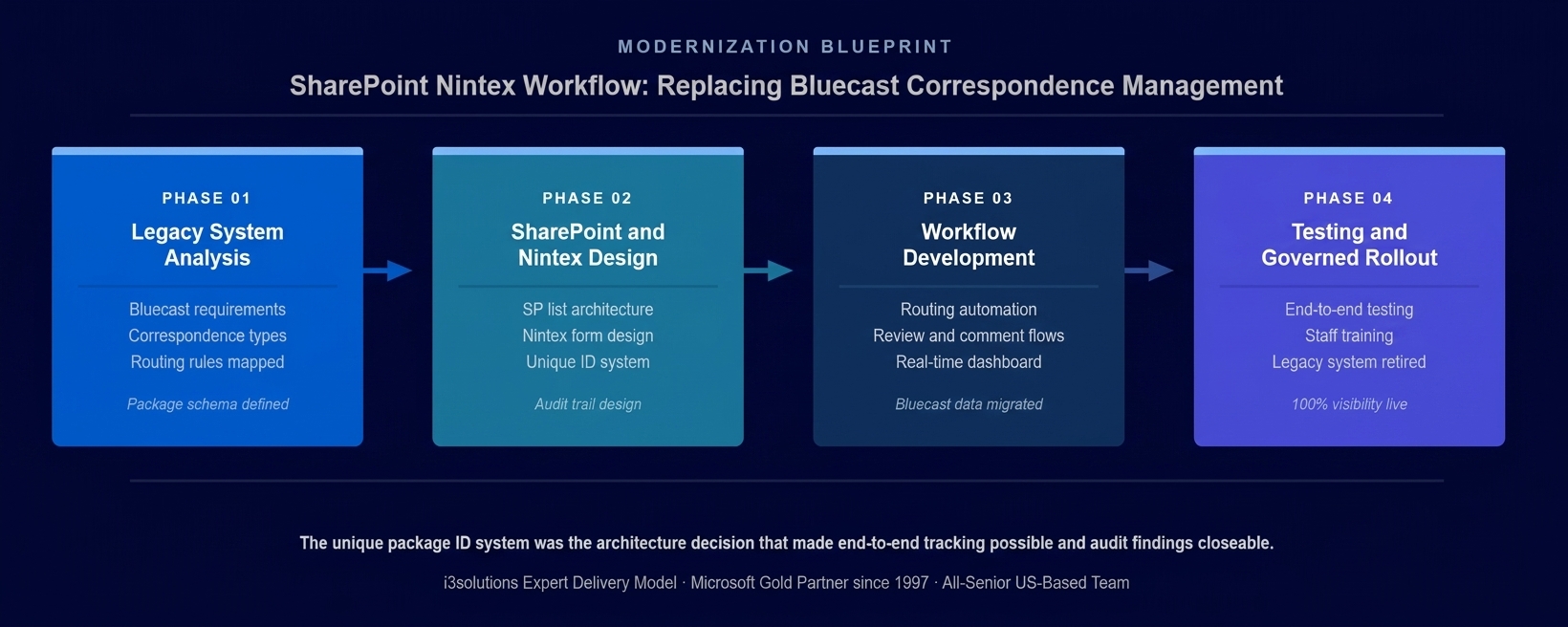
The four-phase implementation approach. The unique package ID system was designed in Phase 2 as an architecture decision, not a development detail – every compliance audit capability depends on the ID persisting correctly through every workflow stage.
PHASE 03
Workflow Development and Data Migration
Building the complete correspondence management system: Nintex Forms providing structured package intake with validation rules enforcing data completeness; automated routing workflows directing packages to the correct reviewers based on correspondence type and routing rules; in-system review and comment workflows allowing staff to annotate, discuss, and update packages without leaving the system; the real-time status dashboard giving managers visibility into every active package; the complete audit trail logging every workflow action automatically; and Bluecast historical data migration ensuring continuity of correspondence records.
PHASE 04
Testing, Staff Training, and Go-Live
End-to-end workflow testing against the routing rules and compliance requirements documented in Phase 1, with ONDCP correspondence staff validating that the system handled their established workflows correctly. Staff training covering both the daily correspondence intake and routing functions and the exception handling procedures for correspondence types that required manual routing decisions. Coordinated go-live with Bluecast decommission, with historical records accessible in the new system from day one through the migrated data. Post-launch monitoring confirming audit trail completeness and routing accuracy under live operational conditions.
Execution Evidence
45% Faster Processing, 3,000 Hours Reclaimed, Audit Findings Closed
The Nintex Forms intake process replaced the unstructured email and document submission process with a structured form that captured all required package information at intake, validated completeness before submission, and automatically assigned the unique package ID that would track the correspondence through every subsequent workflow stage. The structured intake eliminated the processing delays that had previously occurred when packages arrived without complete information and had to be returned to the submitter for completion before routing could begin.
The automated routing workflow directed each package to the correct reviewer based on the correspondence type and routing rules that the Phase 1 analysis had documented. What had previously required manual routing decisions and email distribution was replaced by a workflow that applied the routing rules automatically on intake, notified the assigned reviewer, and tracked the review period against the expected response timeline. When a package was approaching a deadline without reviewer action, the workflow generated automated escalation notifications that brought management attention to the exception without requiring someone to manually monitor the queue for overdue items.
The in-system review and comment workflow eliminated the document version chaos and communication overhead that had characterized the manual process. Reviewers who previously received package documents via email, annotated them locally, and returned their comments through email chains now reviewed, commented, and returned packages through the system, maintaining a single, versioned correspondence record with a complete history of every review action and comment. The version that was acted on at each stage was the version in the system, not a copy that might have been modified in transit through email.
The honest challenge in this engagement was the Bluecast data migration scope. The historical correspondence records in Bluecast were stored in a format specific to that system’s data model, and mapping them to the metadata schema of the new SharePoint system required careful field-by-field analysis and transformation logic for cases where the old and new schemas did not align directly. Addressing this systematically before migration – rather than discovering the mismatches during the migration itself – prevented the category of migration failures that produce partially migrated records that appear in the system but cannot be correctly searched or reported on.
Technical Transformation
From Obsolete Bluecast to Governed SharePoint Nintex Workflow Platform
Before the replacement, ONDCP’s correspondence management operated through Bluecast – an obsolete system approaching decommissioning, with an incomplete audit trail, manual routing requiring days of email back-and-forth, version chaos in the review process, and no manager visibility into package status except through manual status checks. The system was consuming 3,000 staff hours annually in routing overhead and 1,500 hours annually in collaboration inefficiency, while accumulating compliance findings it could not structurally address.
After the replacement, ONDCP operated a custom Nintex workflow development platform on SharePoint where every correspondence package received a unique persistent identifier at intake, automated routing applied the agency’s established rules without manual distribution, in-system review and comment workflows maintained a single governed correspondence record, real-time dashboards gave managers 100% visibility into every active package, and a complete automatic audit trail supported the compliance documentation requirements that had generated Bluecast’s findings.
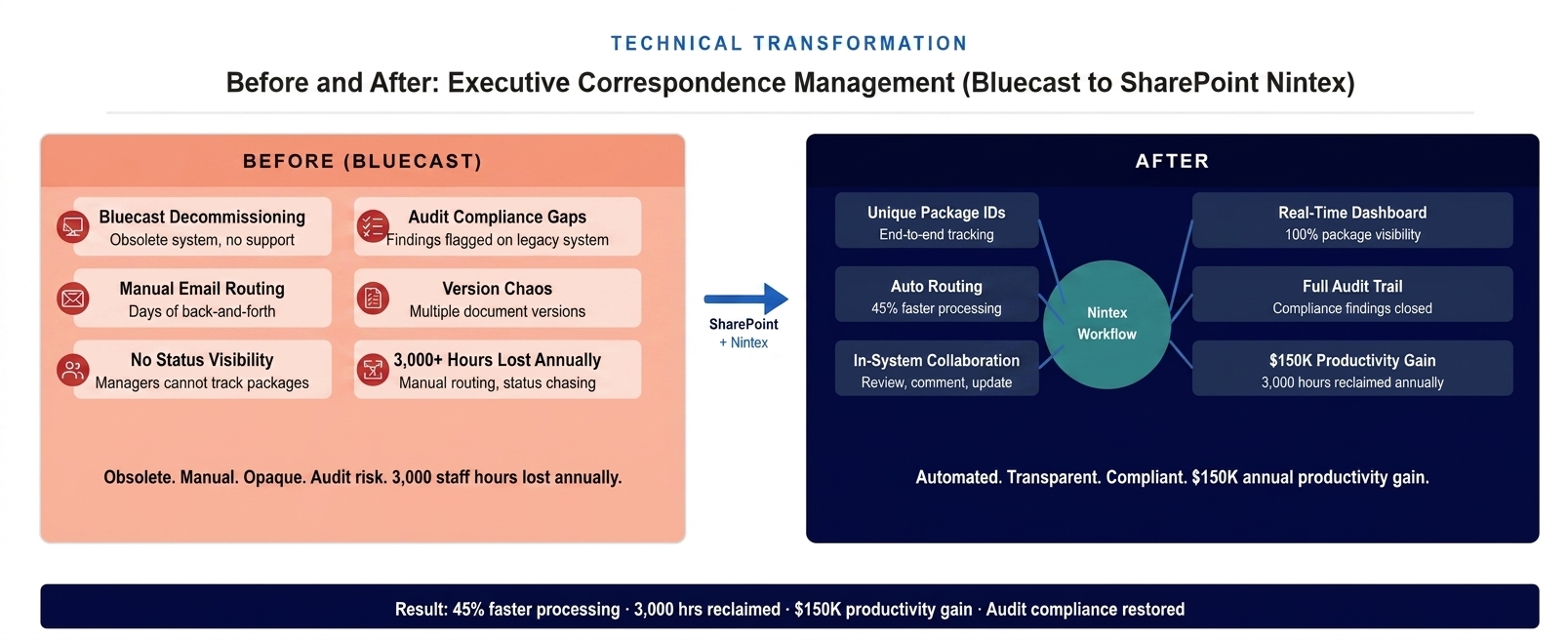
The correspondence management state before and after the deployment. An obsolete Bluecast system with audit compliance gaps replaced by a governed SharePoint Nintex workflow platform delivering 45% faster processing, 3,000 hours reclaimed annually, and 100% audit trail visibility.
The Governance Readiness Ladder applied to this engagement showed the correspondence management process at Level 1 (Ad Hoc): manual routing, no unique package tracking, incomplete audit trail, no real-time visibility, compliance findings open. The deployed system placed correspondence management at Level 3 (Governed): automated routing by correspondence type, unique package IDs tracking every package through every stage, complete audit trail generated automatically by every workflow action, real-time dashboard visibility for managers, and compliance findings closed through the audit trail architecture.
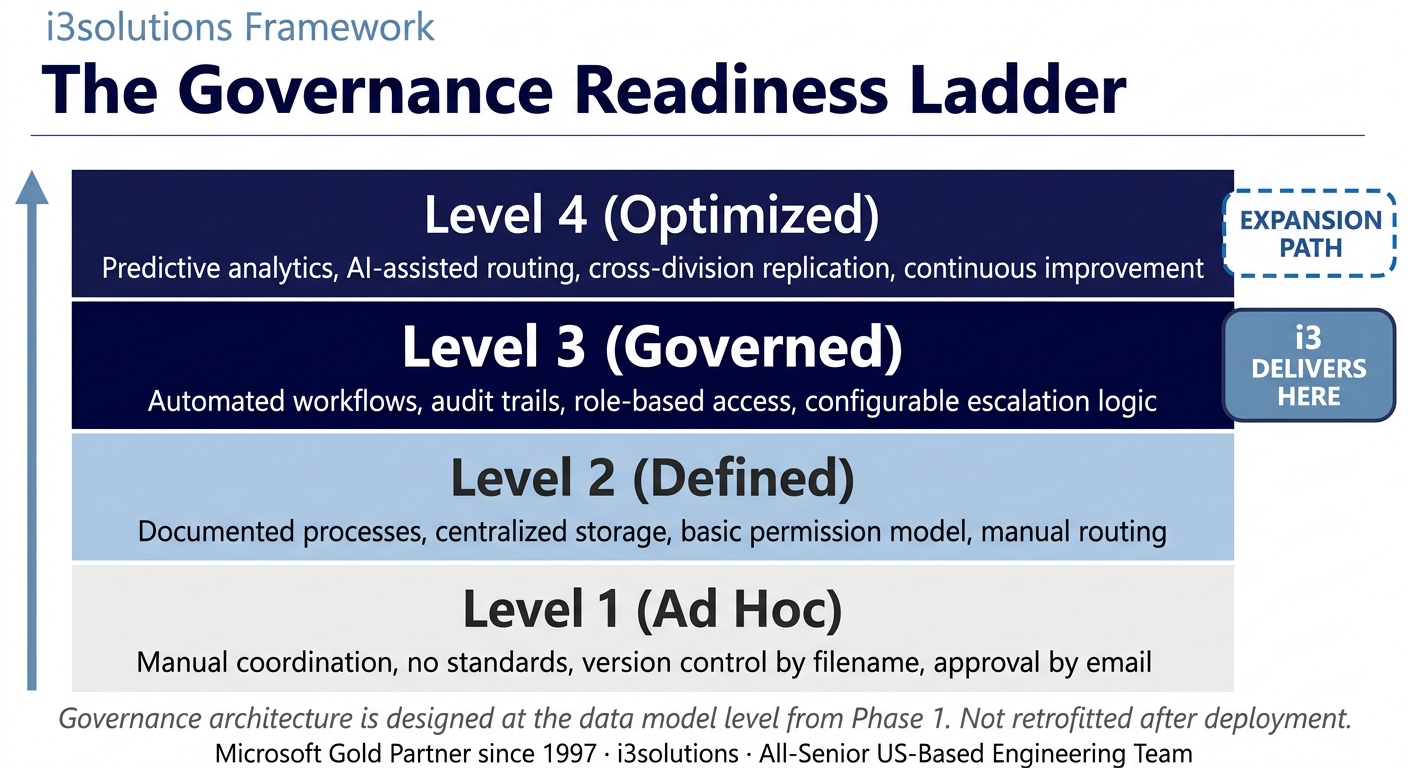
The Governance Readiness Ladder applied to this engagement. The SharePoint Nintex workflow delivered Level 3 correspondence governance across ONDCP. The platform architecture supports Level 4 as advanced analytics and predictive workload management capabilities are added.
▶ Related Insight — A 60-second perspective from our channel
Measurable Outcomes
$150K Annual Productivity Gain, 3,000 Hours Reclaimed, Audit Compliance Restored
| Metric | Before (Bluecast) | After | Improvement |
|---|
| Correspondence processing time | Multiple days – manual email routing, back-and-forth coordination | Hours – automated routing, 45% processing time reduction | 45% faster processing |
| Annual staff hours in routing and status | 3,000+ hours consumed by manual routing and status check communication | Automated routing and dashboard visibility eliminate manual overhead | 3,000 hours reclaimed annually |
| Annual productivity value of time savings | Not measured – cost absorbed as operational norm | Quantified against fully loaded staff costs | $150K annual productivity gain |
| Annual hours lost to collaboration overhead | 1,500 hours annually in email threads, version confusion, missed updates | In-system review and comment eliminates collaboration loop waste | 1,500 hours reclaimed annually |
| Compliance cost avoidance | Audit findings open – potential corrective action costs not yet quantified | Findings closed through complete audit trail architecture | $50K-$75K annual compliance cost avoidance |
| Package status visibility | Zero real-time visibility – managers relied on manual status checks | 100% real-time visibility – every package status visible on dashboard | 100% visibility achieved |
| Audit trail completeness | Incomplete – compliance gaps flagged by audit findings | Complete – every workflow action logged automatically, findings closed | Full audit compliance achieved |
| Document version control | Email-distributed documents with version chaos across review cycles | Single governed record in SharePoint – one version, complete history | Version chaos eliminated |
[PENDING-CLIENT-QUOTE: insert 1-3 sentence outcome-focused quote in the client’s own language from a role matching the reader’s role.]
[Name or Role], [Organization type]
These metrics are not projections or industry benchmarks. They are documented outcomes from the ONDCP engagement as reported by the agency. The 45% processing time reduction from multiple days to hours was measured against the pre-deployment baseline. The 3,000 hours of annual routing and status overhead was quantified against the manual process documentation captured during Phase 1 requirements. The $150K productivity gain represents the fully loaded staff cost of those 3,000 hours. The $50K to $75K compliance cost avoidance reflects the estimated corrective action costs that closing the audit findings prevents.
The combination of processing time reduction and collaboration overhead elimination produced outcomes that compounded rather than added. Faster routing meant packages moved through the review cycle more quickly. In-system review meant each review cycle was completed without the communication overhead of the email-based process. The two improvements together produced a correspondence management system that handled the same volume of packages with a fraction of the administrative overhead, freeing staff capacity for the substantive correspondence work rather than the administrative process of moving it through the system.
Is your federal agency operating correspondence management on a legacy system with open audit findings?
A Risk and Roadmap Assessment maps the specific SharePoint and Nintex architecture that would replace your legacy system, implement your established correspondence workflows precisely, close the compliance gaps that have been flagged, and reclaim the staff hours currently consumed by manual routing and status management.
Schedule the Assessment
Credibility Anchors
A Platform Designed for the Correspondence Volume of an EOP Agency
The SharePoint and Nintex architecture delivered for ONDCP was designed for the correspondence volume and workflow complexity of an Executive Office agency, not for a generic enterprise use case. The unique package ID system, the correspondence-type-based routing rules, the EOP-specific audit trail requirements, and the manager dashboard designed around ONDCP’s oversight workflow were all specific implementations rather than default configurations of a commercial product.
A correspondence manager at ONDCP described the operational change directly: with Bluecast, knowing where a package was required asking someone. With the new system, you open the dashboard and every active package tells you exactly where it is, when it moved, and what needs to happen next. The question that used to take a phone call now takes five seconds.
The Rules of the Road established at engagement close defined the governance model for the correspondence management platform. Ownership and Accountability defined the correspondence coordinator role responsible for maintaining the routing rules and overseeing the workflow configuration. Security and Access defined how new staff were provisioned into the system with the correct permissions for their correspondence role. Lifecycle and Records defined the retention and disposition policy for correspondence package records in compliance with federal records management requirements. Release Discipline defined the testing and compliance review required before any change to the routing rules or workflow logic could be deployed to the production system.
i3solutions has completed more than 600 Microsoft implementations as a Microsoft Gold Partner since 1997. Federal correspondence management on SharePoint and Nintex for Executive Office agencies represents one of the most workflow-specific implementation challenges in our portfolio – the system must implement established practice precisely, produce compliance documentation that closes audit findings, and be delivered on a timeline that accommodates a decommissioning date rather than an organizational preference. These are the engagements where senior-only delivery is not a quality preference but an operational requirement.
Frequently Asked Questions
Nintex Workflow Development for Federal Correspondence Management
What is nintex workflow development for federal correspondence management?
Nintex workflow development for federal correspondence management involves building structured workflows on SharePoint that automate the routing, review, approval, and tracking of correspondence packages through a defined organizational process. Nintex extends SharePoint with visual form design and workflow automation capabilities that replace manual email routing with governed, trackable digital processes. For federal agencies managing executive-level correspondence, Nintex enables unique package tracking, automated routing based on correspondence type, in-system review and comment workflows, and real-time dashboard visibility into the status of every package in the system.
Why did ONDCP replace Bluecast with a SharePoint and Nintex solution?
ONDCP replaced Bluecast with a SharePoint and Nintex solution because Bluecast was built on obsolete technology that was approaching decommissioning, had compliance gaps flagged in audit findings, and could not be sustained as a supported platform. Rather than finding another commercial correspondence management product, ONDCP chose a custom solution built on SharePoint and Nintex because this approach allowed the system to be configured precisely to ONDCP’s specific correspondence workflows, routing rules, and reporting requirements without the compromises that commercial products impose.
How does unique package ID tracking improve correspondence management?
Unique package ID tracking improves correspondence management by providing a persistent reference that follows a correspondence package through every stage of its lifecycle, from initial receipt through review, approval, and final disposition. When every package has a unique identifier associated with all actions taken on it, managers can query the system for the current status of any package at any time, audit logs can show the complete history of every action taken on a package, and compliance reviewers can demonstrate that correspondence handling followed the required process. Without unique IDs, correspondence tracking depends on manual status checks and informal communication that produces the 3,000 hours of annual overhead the ONDCP system was designed to eliminate.
What is the ROI of replacing manual correspondence routing with Nintex workflow automation?
The ROI of replacing manual correspondence routing with Nintex workflow automation for ONDCP included 45% faster processing time, 3,000 staff hours reclaimed annually from manual routing and status checks, $150K in annual productivity gains based on fully loaded staff costs, 1,500 hours per year recovered from inefficient collaboration loops, and $50K to $75K in annual compliance cost avoidance from closed audit findings. These are direct, documented outcomes from the ONDCP engagement, not projections.
How does SharePoint support executive correspondence management for federal agencies?
SharePoint supports executive correspondence management for federal agencies by providing the governance infrastructure for document management, the list infrastructure for package tracking, and the integration point for Nintex forms and workflow automation. SharePoint’s document management capabilities maintain version control and access control for correspondence packages. Its list infrastructure stores the metadata, routing history, and status information associated with each package. And its integration with Nintex allows form-based data entry, automated routing rules, and workflow-driven review and approval processes to be built on top of SharePoint’s governance foundation.
What compliance benefits does automated correspondence management provide for EOP agencies?
Automated correspondence management provides several compliance benefits for Executive Office of the President agencies. The complete audit trail embedded in every workflow action demonstrates that correspondence was handled according to defined procedures, which directly addresses the type of compliance findings that auditors typically flag in manual correspondence systems. The 100% visibility that real-time dashboards provide into the status of every package allows managers to identify and resolve exceptions before they become compliance issues. And the records retention capability built into the SharePoint document management layer ensures that correspondence history is maintained according to federal records management requirements.
What is the difference between Nintex Forms and standard SharePoint forms for correspondence intake?
Nintex Forms provides richer form design capabilities than standard SharePoint forms, including conditional logic that shows or hides fields based on previous inputs, validation rules that enforce data completeness before submission, calculated fields that automatically populate metadata based on user inputs, and a more flexible layout engine that can produce the structured forms that correspondence intake requires. For executive correspondence management where the intake form is the first step in a governed process, Nintex Forms’ ability to enforce complete and structured data entry reduces the downstream processing issues that incomplete or inconsistent intake data causes.
How does real-time dashboard visibility improve correspondence management for federal agencies?
Real-time dashboard visibility improves correspondence management for federal agencies by replacing the informal status-checking communication that consumes staff time in manual systems with a self-service view of current correspondence status accessible to managers and reviewers at any time. When a manager wants to know the status of a specific package or identify correspondence approaching a deadline, the dashboard answers that question instantly without requiring the manager to contact the correspondence coordinator, review email chains, or follow up with the responsible reviewer. This transformation from pull-based status checking to push-based visibility is the primary source of the 1,500 hours per year recovered from collaboration overhead in the ONDCP engagement.
Conclusion
$150K Annual Productivity Gain, 45% Faster Processing, Audit Compliance Restored
The Office of National Drug Control Policy replaced a decommissioning legacy correspondence system with a custom Nintex workflow development solution on SharePoint – delivering 45% faster processing through automated routing, 3,000 staff hours reclaimed annually from manual coordination, $150K in quantified annual productivity gains, 1,500 collaboration hours recovered from email-based review overhead, and $50K to $75K in annual compliance cost avoidance through a complete audit trail that closed the findings Bluecast had left open. Through Nintex workflow development and SharePoint development services that implemented ONDCP’s established correspondence workflows precisely rather than approximating them with a commercial product, the agency moved from an obsolete, compliance-gapped system to a governed, dashboard-visible, audit-ready correspondence platform.
For federal agencies whose correspondence management systems are approaching decommissioning, carrying open audit findings, or consuming staff hours in manual routing and status overhead, Nintex workflow development and SharePoint development services offer a documented path from legacy constraint to governed, measurably more efficient correspondence management built on Microsoft infrastructure.
Back to Case Study Library
60 enterprise Microsoft implementations documented
Related Insights
From the i3solutions YouTube Channel
Short-form perspectives on the delivery and technology challenges in this case study.
Who This Engagement Serves
This engagement is relevant if
- Large government organizations requiring auditable correspondence tracking for official paper and digital communication.
- Highly regulated businesses managing critical documentation without existing automated workflows or digital management systems.
- Federal agencies needing to modernize paper-based processes and formalize routing using existing SharePoint environments.
Less relevant if
- Agile startups who are already fully digital and lack structured, formal correspondence management requirements.
- Organizations without a SharePoint footprint seeking a completely new stand-alone process automation platform.
Ready to replace a legacy correspondence system and close the compliance findings it cannot address?
The 15-Business-Day Microsoft Assessment maps your specific correspondence workflows, the SharePoint and Nintex architecture that would implement them precisely, the unique package tracking design that produces the audit trail your compliance obligations require, and the data migration approach that brings your historical correspondence records into the new system from day one. Custom to your workflows. Compliant from deployment.
Microsoft Gold Partner since 1997. 600+ implementations. All senior. All US-based.
Schedule the Assessment