Case Study • Federal Government • IT Systems Analysis
Two Legacy Systems, One Decision, $1.5 Million at Stake: How HUD’s IT Systems Analysis Saved the Budget
Strategic Trigger
Modernization funding requires accurate IT systems assessment first
The U.S. Department of Housing and Urban Development (HUD) was poised to receive a substantial capital investment intended for a sweeping modernization of its critical, mission-specific IT systems. For decades, the agency had relied on an accumulation of disparate applications, some quite antiquated, to administer its vast portfolio of housing assistance and community development programs. Years of localized patches and insufficient enterprise-wide documentation had obscured the true dependencies, code quality, and operational risks within this ecosystem, creating significant technical debt. This lack of visibility now directly threatened the effective planning and deployment of the impending modernization funds, as leadership could not precisely determine where investment was most urgently needed or how existing structures would react to significant changes.
Recognizing this critical information gap, HUD leadership determined that proceeding with a massive modernization effort without a comprehensive baseline understanding of its current IT state would be fiscally irresponsible and strategically flawed. They acknowledged the absolute necessity for a rigorous, data-driven systems analysis of the entire enterprise application portfolio before any major new investment could be responsibly allocated. This fundamental shift in strategy mandated a baseline assessment to generate an accurate inventory, identify systemic weaknesses, and evaluate the cloud readiness of their core legacy platforms. The new priority became establishing a foundation of objective data to inform all subsequent decisions regarding modernization pathways, risk mitigation, and future-state technology architecture.
Stakes
Investing millions without baseline risks massive financial waste
Proceeding with a major modernization initiative absent an accurate baseline assessment exposed HUD to significant, tangible financial and compliance consequences. Without a precise understanding of the current applications’ interdependencies, code quality, or even a comprehensive inventory, new software development and integration efforts were likely to trigger catastrophic failures in existing, misdiagnosed systems. Such service disruptions would directly jeopardize the timely distribution of essential housing assistance and grants to vulnerable populations and communities nationwide. Furthermore, an inefficient allocation of capital, spending millions on redundant or unnecessary upgrades while critical, hidden vulnerabilities remained unaddressed, would constitute a colossal waste of taxpayer funds and violate federal mandates for responsible IT stewardship.
Beyond the immediate operational and financial fallout, HUD faced profound reputational and strategic risks if the modernization effort failed due to inadequate preparation. Repeated failures to modernize effectively would severely erode congressional confidence and public trust in the agency’s capacity to execute its vital mission. This political vulnerability could complicate future appropriations, making it increasingly difficult to secure the resources needed to address the aging technology that continues to strain the agency’s resources. Failure here meant reinforcing a narrative of government operational inefficiency, potentially hindering HUD’s long-term ability to leverage modern technology to adapt to evolving housing needs and provide effective, efficient service to the American public.
Constraints and Complexity
Mapping decade-old legacy dependencies across siloed program offices
The IT landscape at HUD was characterized by extreme decentralized complexity, which presented significant organizational constraints for any comprehensive systems analysis. Decades of fragmented development, driven by the individual needs of various program offices and funding streams, had resulted in numerous siloed and poorly documented applications. These systems, often critical to specific HUD missions, lacked standardized documentation, a centralized repository, or a unified architecture, making a full discovery process exceptionally difficult. The analysis team faced the challenge of gaining cross-functional buy-in and cooperation to access proprietary information and secure the time of key subject matter experts who possessed the only remaining institutional knowledge of how these legacy systems truly operated.
Compounding the organizational silos was the technical debt embedded in the legacy complexity itself. Many of HUD’s core transactional and financial systems were decades old, leveraging antiquated programming languages and database structures long since obsolete. The lack of reliable up-to-date documentation meant that determining critical interdependencies between systems was often a manual and error-prone process. Identifying hardcoded references, direct database manipulations, and obsolete integration points within this massive code base required a level of deep, specialized analysis that exceeded the capabilities of HUD’s internal staff. Safely assessing the cloud migration potential of these brittle systems without risking catastrophic operational failures was a primary concern.
Selection Rationale
Senior Microsoft Specialists with Proven Delivery Depth
Prior to selecting a partner, HUD evaluated several potential avenues, including relying solely on internal IT staff and engaging generalist management consulting firms. The internal team, while possessing valuable institutional context, lacked the specialized toolsets and dedicated, deep technical expertise required to perform an exhaustive, objective systems analysis across such a diverse and aged application portfolio; their time was also already consumed by operational demands. Generalist firms offered broad strategic frameworks but often lacked the specific technical depth in antiquated systems, code-level analysis, and cloud readiness assessment necessary to provide actionable, low-level recommendations for each individual application in HUD’s complex ecosystem.
HUD selected i3solutions because of their unique combination of strategic insight and deep technical delivery depth. As a Microsoft Gold Partner since 1997 with over 600 successful implementations, i3solutions brought a proven track record of analyzing and modernizing complex environments. Their model, utilizing all-senior, all-US-based personnel, provided HUD with immediate access to specialists capable of dissecting decades of legacy code and accurately mapping intricate dependencies. This expertise, particularly in Microsoft technologies that underpinned much of HUD’s environment, ensured that the resulting systems analysis would not only be thorough but would also deliver a clear, actionable roadmap for future-state architecture and cloud migration.
The Enterprise Challenge
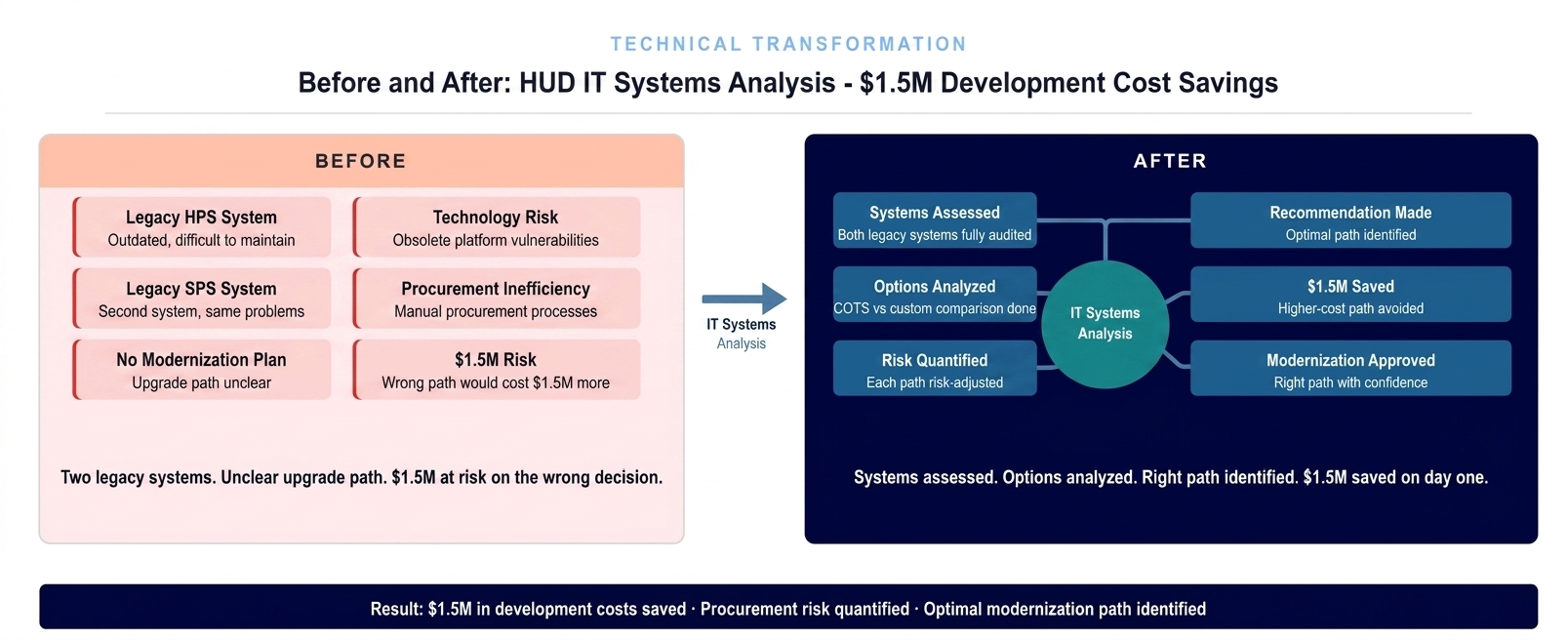
The U.S. Department of Housing and Urban Development is responsible for increasing homeownership, supporting community development, and expanding access to affordable housing free from discrimination. HUD relied on two legacy procurement systems – HPS and SPS – to manage contracts and procurement processes across multiple departments. Both systems were outdated, built on obsolete technologies that made them difficult to maintain, inefficient, and increasingly incompatible with the modern technology environment.
HUD recognized the need to modernize but faced a decision that was as consequential as it was complex: should it build a custom replacement, adopt a commercial off-the-shelf solution, or take a hybrid path? The wrong answer had a price tag. i3solutions performed a comprehensive IT Systems Analysis that assessed both legacy systems, evaluated the modernization options with full risk and cost analysis, and delivered the recommendation that allowed HUD to make the right decision with confidence – saving $1.5 million in development costs by identifying the higher-cost path before any development began.
The Engagement Approach
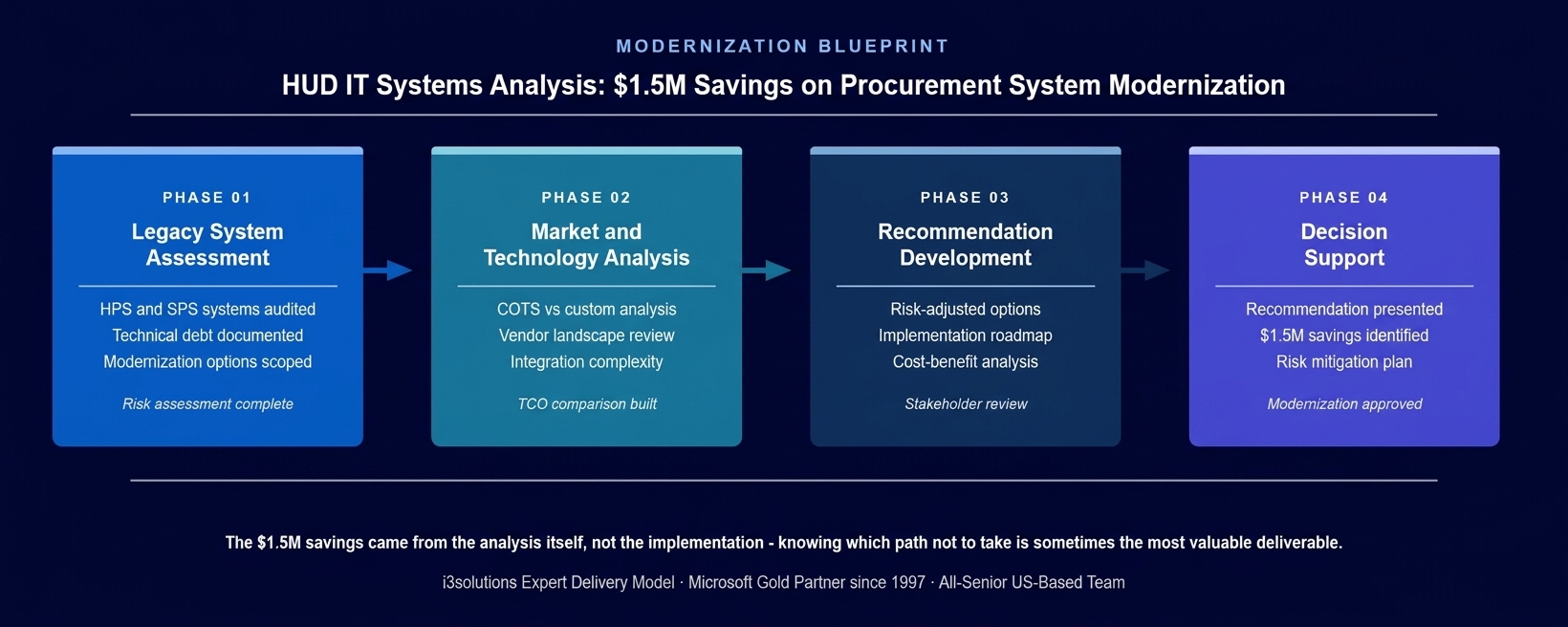
PHASE 01
Legacy System Assessment
Complete technical audit of HPS and SPS – architecture, technology stack, customizations, integration dependencies, and technical debt. Documentation of what each system did, what it cost to maintain, and what would be lost or migrated in any modernization path.
PHASE 02
Market and Technology Analysis
COTS product evaluation against HUD’s procurement requirements. Custom development scope and cost estimation. Hybrid approach analysis. Integration complexity assessment for each path. Total cost of ownership comparison across the options.
PHASE 03
Recommendation Development
Risk-adjusted analysis of each modernization option incorporating implementation risk, migration complexity, vendor dependency, and long-term maintenance cost. Implementation roadmap for the recommended path. Cost-benefit analysis with the $1.5M savings finding documented for stakeholder review.
PHASE 04
Decision Support
Recommendation presented to HUD leadership with full analysis documentation supporting the decision. Implementation planning for the recommended modernization path. Risk mitigation strategies for the transition.
Technical Transformation
Measurable Outcomes
| Metric | Before | After | Improvement |
|---|
| Decision clarity | Unclear – multiple options with no rigorous comparative analysis | Clear – risk-adjusted recommendation with full cost-benefit documentation | Decision made with confidence |
| Development cost risk | $1.5M at risk on the wrong modernization path | $1.5M saved by identifying the higher-cost path before development | $1.5M cost savings |
| Legacy system risk | Ongoing – obsolete technology with growing maintenance cost | Quantified – risk assessment documented for each modernization option | Risk formally quantified |
| Procurement modernization | Stalled – no clear path forward | Unblocked – approved modernization path with implementation roadmap | Modernization approved |
| Stakeholder alignment | Absent – no shared understanding of options and tradeoffs | Achieved – documented analysis supports cross-stakeholder decision | Stakeholders aligned |
[PENDING-CLIENT-QUOTE: insert 1-3 sentence outcome-focused quote in the client’s own language from a role matching the reader’s role.]
[Name or Role], [Organization type]
Frequently Asked Questions
IT Systems Analysis for Federal Procurement and Legacy Modernization
What is an IT systems analysis and when does a federal agency need one?
An IT systems analysis is a structured assessment that evaluates existing legacy systems, documents their current capabilities and technical debt, analyzes the available modernization options, custom development, commercial off-the-shelf adoption, or hybrid approaches, and delivers a risk-adjusted recommendation with cost-benefit documentation. A federal agency needs one when it faces a significant legacy modernization decision and the cost of choosing wrong is material. For HUD, the cost of choosing the wrong path for its procurement system modernization was $1.5 million in avoidable development cost. The systems analysis identified that risk before any development investment had been made, making the analysis itself one of the highest-ROI engagements in HUD’s technology portfolio.
How does i3solutions conduct an IT systems analysis for a federal procurement system?
i3solutions conducts federal IT systems analyses in four phases: complete legacy assessment auditing both systems against current technical and operational requirements; market and technology analysis comparing COTS products, custom development, and hybrid approaches against the agency’s specific requirements and integration constraints; recommendation development that applies risk-adjusted analysis across all options including implementation risk, vendor dependency, migration complexity, and total cost of ownership over a five-to-ten year horizon; and decision support that presents the recommendation with the full analysis documentation that federal stakeholders need to authorize a modernization program with confidence. Every analysis produces a deliverable that answers the question the agency actually needs answered: which path minimizes total risk and total cost given this agency’s specific constraints.
How does an IT systems analysis save money before a single line of code is written?
An IT systems analysis saves money by identifying which modernization path costs significantly more than the alternatives before any development investment commits the agency to that path. For HUD, the analysis identified that one of the available modernization approaches would cost $1.5 million more than the recommended alternative, a finding that, once documented, protected HUD from making that choice based on assumption or incomplete information. The cost of the analysis itself is a fraction of the savings it protects. The analysis also identifies implementation risks that would have caused schedule delays, cost overruns, or failed deployments if encountered after development had begun, converting those risks from expensive surprises into manageable known factors with mitigation strategies.
What is the deliverable from an i3solutions IT systems analysis engagement?
The deliverable from an i3solutions IT systems analysis engagement is a documented recommendation with the full supporting analysis, legacy system assessment findings, market and technology evaluation, option comparison with risk and cost quantification, and an implementation roadmap for the recommended path. The documentation is designed to support the federal acquisition and authorization process: stakeholders who were not in the room for the analysis can read the deliverable and understand exactly why the recommended path was chosen, what the alternatives were and why they were not recommended, and what the implementation plan looks like. HUD used the i3solutions analysis deliverable to authorize the modernization program with cross-stakeholder alignment, because the analysis gave every stakeholder the same factual basis for the decision.
Why choose i3solutions for a federal legacy modernization analysis?
i3solutions brings two specific advantages to federal legacy modernization analyses: deep Microsoft platform expertise that allows the analysis to accurately assess which modernization options can be delivered on the Microsoft stack that most federal agencies already use, and an all-senior delivery model that puts experienced architects, not junior analysts, on the assessment. A systems analysis is only as valuable as the judgment behind it. An analysis that recommends a path because it looks good on paper without the implementation experience to assess whether it will actually work in the agency’s environment is a risk, not a protection. i3solutions has delivered 600+ Microsoft platform implementations across federal civilian, defense, and international development clients, giving our analysts the pattern recognition to identify feasibility issues that a purely theoretical analysis would miss.
Back to Case Study Library
60 enterprise Microsoft implementations documented
Related Insights
From the i3solutions YouTube Channel
Short-form perspectives on the delivery and technology challenges in this case study.
Who This Engagement Serves
This engagement is relevant if
- A public housing authority needing to evaluate existing IT infrastructure before launching a multi-year digital transformation initiative.
- A government agency seeking to establish a clear performance baseline prior to investing in legacy system modernization.
- An organization requiring a comprehensive analysis of current IT systems to justify and plan future capital investments.
Less relevant if
- A company that has recently completed a full IT modernization and already possesses up-to-date system documentation.
- An organization with a mature IT baseline looking only for specific software development services, not strategic analysis.
Ready to make a defensible legacy system modernization decision before development begins?
The 15-Business-Day Microsoft Assessment maps your legacy system portfolio, evaluates the modernization options with full risk and cost analysis, and delivers the recommendation that lets you commit to the right path with documentation your stakeholders can stand behind.
Microsoft Gold Partner since 1997. 600+ implementations. All senior. All US-based.
Schedule the Assessment