Case Study • Commercial Real Estate • Work Order Management
Paper Work Orders, Spreadsheet Tracking, No Tenant Visibility: How Merritt Properties Modernized Service Operations

Strategic Trigger
Inability to track requests creates major operational blindspot
For years, Merritt Properties had managed tenant work orders and service requests primarily through a decentralized system of phone calls and emails. While this approach initially allowed for personal interaction, as the portfolio grew, the lack of a structured, centralized intake system began to reveal significant vulnerabilities. Maintenance teams struggled to prioritize urgent issues, and the administrative burden of manually tracking and dispatching requests was becoming unsustainable. There was often no clear record of what had been completed, leading to redundant efforts and increased operational costs. In short, the reactive nature of their process was starting to negatively impact overall efficiency.
The lack of visibility extended to tenants, who often felt left in the dark about the status of their requests. Inquiries about progress required staff to hunt down information from various sources, a time-consuming and frustrating experience for everyone involved. Leadership at Merritt recognized that this was not merely an administrative bottleneck; it was a fundamental customer service problem that threatened their reputation for excellence. A strategic decision was made to modernize the work order lifecycle, and they committed to building a digital platform that would provide end-to-end transparency for both internal operations and their valued tenants.
Stakes
Undetected maintenance failures create significant financial liability risk
The manual work order system presented a significant financial risk to Merritt Properties. Without a centralized digital trail, critical maintenance issues, especially those involving safety or compliance, could be easily overlooked or forgotten. The failure to address a leaking roof or a faulty HVAC system in a timely manner could lead to costly structural damage, specialized remediation requirements, or legal liabilities. The operational inefficiencies of a disconnected process were already increasing maintenance costs, but the potential financial fallout from a major, unaddressed failure, particularly one that led to a compliance violation or significant property damage, posed a far more substantial financial threat.
Beyond direct financial losses, the opacity of the old system posed a severe long-term risk to Merritt’s hard-earned brand reputation. In a competitive commercial real estate market, responsiveness and proactive facility management are key differentiators. If tenants consistently experienced long delays, poor communication, or repeated issues due to the lack of a streamlined request process, their overall satisfaction would inevitably decline. This dissatisfaction would lead to lower retention rates, more difficult lease renewals, and eventually, a damaged reputation that would impede the acquisition of new high-value tenants, a core component of their long-term growth strategy.
Constraints and Complexity
Modernizing legacy workflows while ensuring continuous tenant service
The shift from a decades-old, relationship-based workflow was one of the project’s primary hurdles. Resistance to change from long-tenured employees, who were accustomed to handling requests their own way, had to be carefully managed. The project team needed to design a solution that, while modernized and streamlined, still captured the essential elements of the personal service that Merritt was known for. This meant that any digital implementation had to be intuitive and not significantly disrupt the existing culture, and the operational workflows had to be standardized without becoming inflexible, requiring careful stakeholder management throughout the entire transition.
A second layer of complexity lay in the need for real-time visibility and communication. Creating a tenant portal wasn’t just about providing status updates; it required building a dynamic, bidirectional system that connected with the internal maintenance application. Ensuring seamless data synchronization across the entire platform, while providing a secure and reliable experience for all users, required deep technical expertise. It was essential that any system they deployed had zero downtime during implementation and provided the highest level of stability. The complexity wasn’t merely technological; it was organizational, ensuring that the new digital system truly supported, and didn’t complicate, their day-to-day work.
Selection Rationale
Senior Microsoft Specialists with Proven Delivery Depth
Merritt originally evaluated off-the-shelf facility management platforms, but found they were often too rigid to accommodate their specific relationship-driven operational model. They considered using smaller, boutique dev firms, but were concerned about their long-term stability and deep expertise. Given the critical nature of this initiative and their existing technology stack, they ultimately decided they needed a partner with a deep understanding of the Microsoft ecosystem who could provide a customized solution. After evaluating several options, including large system integrators and niche Microsoft partners, they determined that i3solutions was the ideal fit for their needs.
i3solutions emerged as the clear partner of choice due to our unique combination of technical depth and proven delivery. Since 1997, i3solutions has specialized in tailoring complex Microsoft technologies, including SharePoint, Power Apps, and Dynamics 365. As a Microsoft Gold Partner with over 600 successful implementations, we offered Merritt the confidence that comes with decades of deep expertise. Our model, which employs an all-senior, all-US-based team of consultants, provided Merritt with access to highly experienced strategists and developers who could work closely with them to design and deliver a solution that truly met their complex operational requirements.
The Enterprise Challenge
Merritt Properties is a leading privately held commercial real estate firm specializing in the design, development, leasing, and management of industrial and office properties across the Baltimore-Washington region. Committed to providing high-quality service to its tenants, Merritt Properties continuously seeks innovative ways to enhance operations and customer satisfaction. As the property portfolio grew, the company faced increasing challenges in managing work orders efficiently while maintaining the exceptional tenant service that its reputation depended on.
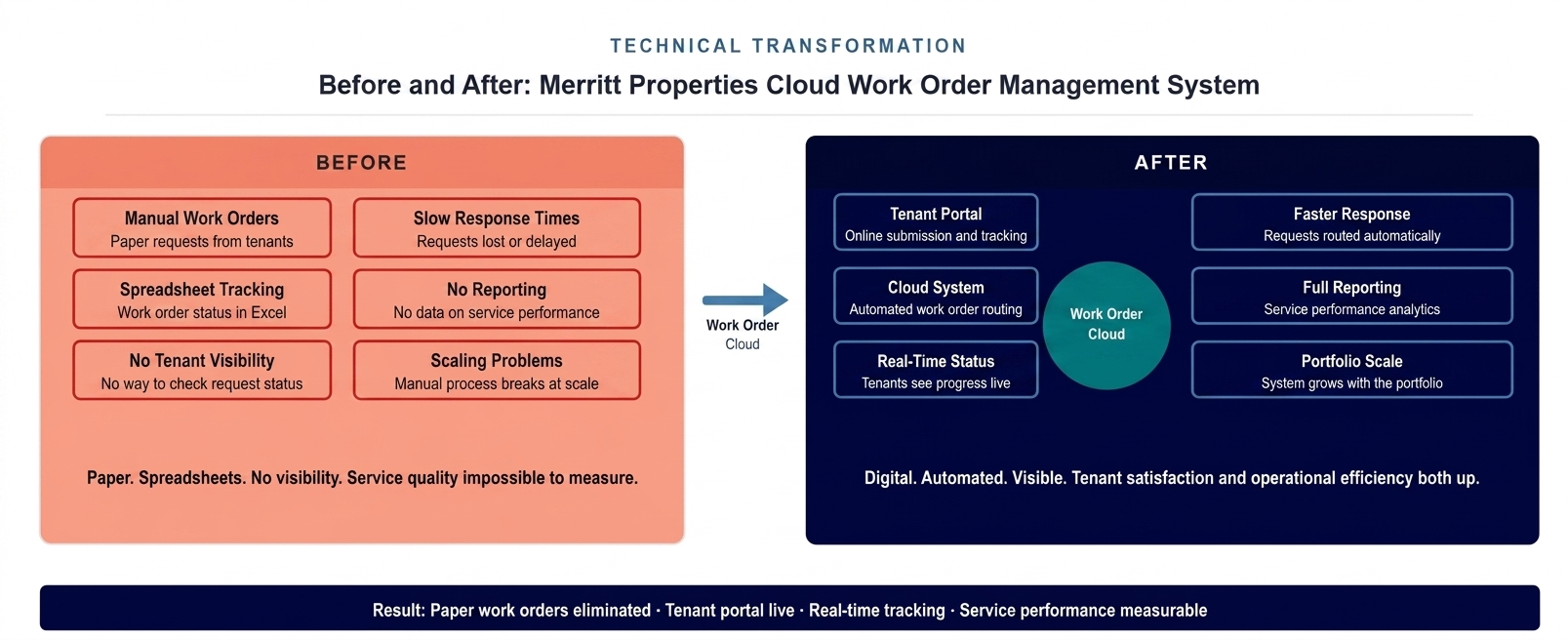
The existing system for handling work requests relied on manual processes and cumbersome spreadsheets. Tenants had no way to check the status of their service requests without calling the management office directly. Work orders could be lost or delayed in the manual routing process. There was no data on service response times or completion rates that management could use to evaluate and improve performance. i3solutions built a cloud-based work order management system that gave tenants a self-service submission portal, automated work order routing, and real-time status visibility – while giving management the analytics to measure and improve service performance across the portfolio.
The Engagement Approach
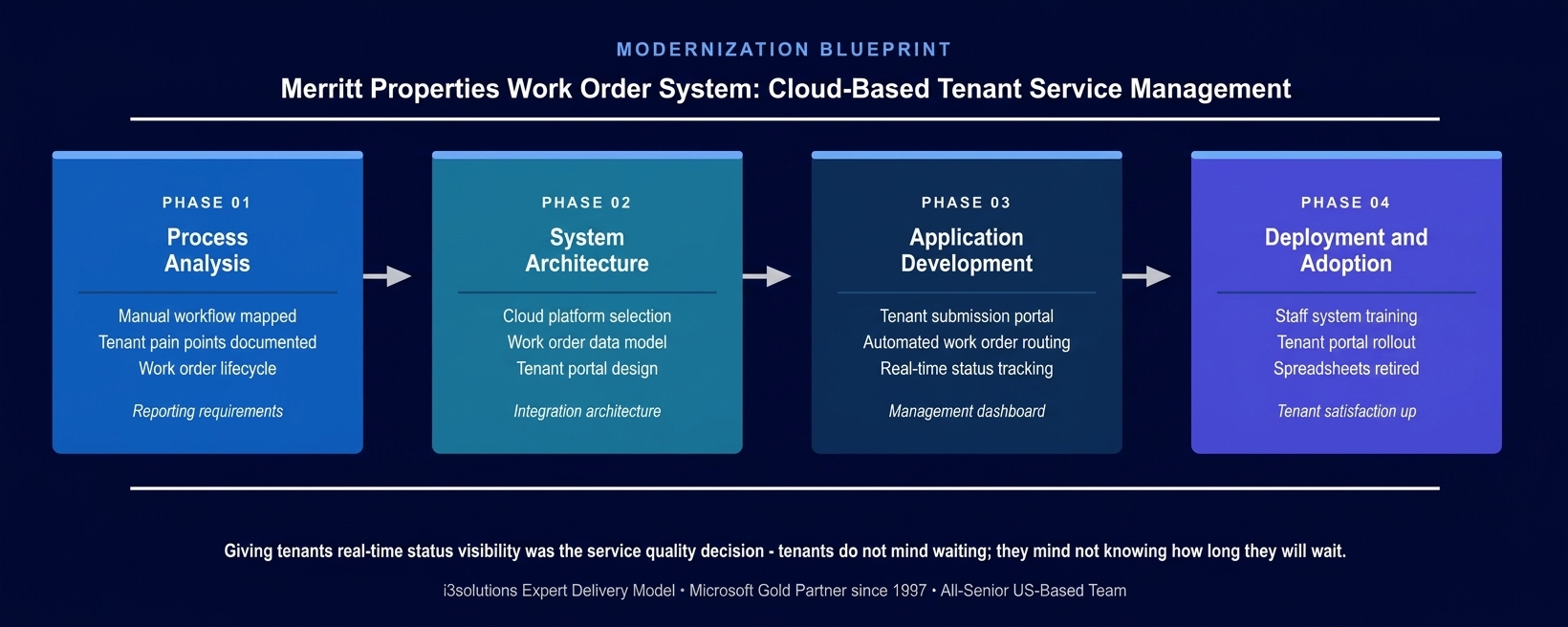
PHASE 01
Process Analysis
Mapping of the manual work order process from tenant request through completion. Tenant pain point documentation. Work order lifecycle requirements. Reporting and performance analytics specifications.
PHASE 02
System Architecture
Cloud platform design. Work order data model. Tenant submission portal design. Automated routing rules. Real-time status tracking architecture. Management analytics dashboard.
PHASE 03
Application Development
Tenant web portal for online work order submission. Automated routing directing requests to the appropriate maintenance staff. Real-time status tracking giving tenants current visibility without calling the management office. Management dashboard providing portfolio-wide service performance analytics.
PHASE 04
Deployment and Adoption
Management and maintenance staff training. Tenant portal announced to all tenants. Paper work order process retired. Spreadsheet tracking retired. Tenant satisfaction measured against prior period.
Technical Transformation
Measurable Outcomes
| Metric | Before | After | Improvement |
|---|
| Work order submission | Paper requests, phone calls | Online tenant portal with confirmation | Paper process eliminated |
| Work order routing | Manual – staff assigned each request by hand | Automated – routed to maintenance staff immediately | Routing automated |
| Tenant status visibility | None – tenants had to call to check status | Real-time status visible in the tenant portal | Self-service status visibility |
| Response time | Delayed by manual routing and potential for lost requests | Faster – automated routing, no requests lost | Response time improved |
| Service analytics | No data on performance | Full dashboard tracking response times and completion rates | Service analytics active |
| Portfolio scalability | Manual process breaks at scale | Cloud system scales with portfolio growth | Scales with portfolio |
[PENDING-CLIENT-QUOTE: insert 1-3 sentence outcome-focused quote in the client’s own language from a role matching the reader’s role.]
[Name or Role], [Organization type]
Frequently Asked Questions
Work Order Management System for Commercial Real Estate
What is a work order management system for commercial real estate?
A work order management system for commercial real estate is a cloud-based platform that replaces paper, phone, and spreadsheet-based tenant service request processes with a digital workflow, online submission, automatic routing to maintenance staff, real-time status tracking, and management analytics. The result is faster service delivery, fewer dropped requests, and a measurable improvement in tenant satisfaction. For property managers with growing portfolios, a work order system also provides the data, average response times, completion rates, issue categories, that makes it possible to continuously improve service quality rather than just react to complaints.
How does i3solutions approach a work order management implementation for a property management firm?
i3solutions begins every work order management engagement with process analysis before selecting a platform or writing a line of code. That means documenting the current work order lifecycle from tenant request through resolution, identifying exactly where requests are being dropped or delayed, and understanding the specific workflows, by property type, issue category, and escalation path, that the digital system needs to support. The solution is then designed around those documented workflows rather than forcing the property management operation to adapt to a generic tool. Implementation includes the tenant portal, automated routing rules, management dashboard, and staff training, with a post-deployment period where i3solutions confirms the system is performing against the service level targets the engagement was designed to hit.
Why is manual work order management a service quality risk for growing property portfolios?
Manual work order management is a service quality risk for growing property portfolios because its failure modes scale with volume. A paper or spreadsheet-based process can function adequately when the portfolio is small, when there are few enough requests that a property manager can track them personally. As the portfolio grows, requests multiply, tracking becomes harder, and the failure modes emerge: requests fall through the cracks, status is unknown until a tenant calls to follow up, and maintenance staff receive requests through informal channels with no priority structure. The tenant experience degrades not because service quality dropped, but because the process that supported service quality could not scale with the portfolio.
What ROI should a commercial real estate firm expect from a work order management system?
A commercial real estate firm should expect ROI from a work order management system across three categories. First, staff time savings: eliminating the manual work of logging requests, routing them, following up on status, and fielding tenant calls about status frees property management staff to manage more properties without headcount growth. Second, tenant retention: faster response times and proactive status communication reduce the service quality friction that contributes to non-renewal decisions. Third, maintenance efficiency: a system with analytics on issue categories and response times allows maintenance teams to spot recurring problems and address them preventively rather than reactively. Together these typically justify implementation cost within the first year of operation.
How does i3solutions integrate a work order system with existing property management software?
i3solutions assesses integration requirements during the discovery phase of every engagement, before architecture decisions are made. For property management firms already running industry platforms for leasing, accounting, or tenant management, the work order system is designed to exchange data with those platforms rather than operating as a parallel silo. Common integration patterns include synchronizing the tenant directory so the work order portal knows which tenants are associated with which units, passing completed work order records into the maintenance cost tracking in the property management system, and surfacing work order status in whatever tenant-facing communication channel the firm already uses. The integration scope and feasibility is confirmed before implementation begins.
Back to Case Study Library
60 enterprise Microsoft implementations documented
Related Insights
From the i3solutions YouTube Channel
Short-form perspectives on the delivery and technology challenges in this case study.
Who This Engagement Serves
This engagement is relevant if
- You are a property management company struggling with phone and email work order routing.
- Your operational efficiency is hindered because maintenance teams lack real-time visibility into new requests.
- Your current property management systems cannot integrate to provide comprehensive operational tracking and visibility.
Less relevant if
- You run a small operation where a simple spreadsheet manages all current work orders.
- Your existing property management platform already includes robust, functional maintenance dispatching and reporting features.
Ready to give tenants real-time service visibility and give management performance analytics?
The 15-Business-Day Microsoft Assessment maps the tenant portal design, automated routing rules, and analytics dashboard for a work order management system scaled to your property portfolio.
Microsoft Gold Partner since 1997. 600+ implementations. All senior. All US-based.
Schedule the Assessment