Case Study · Trade Association
Outdated Platform, 2,650 Members Underserved: How the automotive aftermarket association Modernized Its Association Management System
Client: the automotive aftermarket association (the automotive aftermarket association)
The Enterprise Challenge
The the automotive aftermarket association (the automotive aftermarket association) represents 2,650 member companies that collectively conduct business worldwide in the motor vehicle aftermarket industry, a sector encompassing everything from replacement parts and accessories to tools and equipment. As a trade association, the automotive aftermarket association’s value to members is directly tied to the quality of services and information it can deliver: member directories, event management, industry resources, and data services that help member companies operate and grow.
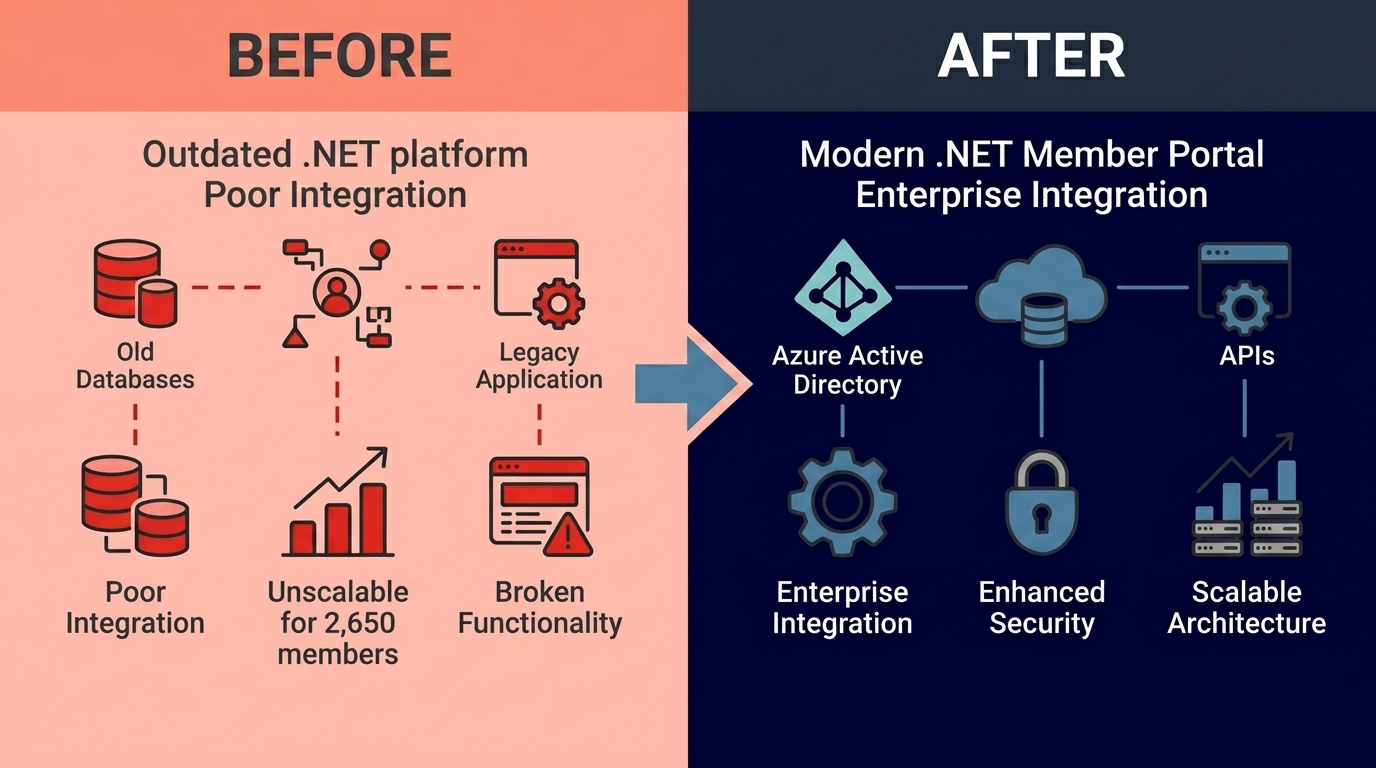
the automotive aftermarket association’s member services application was built on an aging platform that was failing on multiple dimensions simultaneously. Integration with modern enterprise applications was limited, forcing manual data transfers and synchronization workarounds. Security controls were insufficient for the scale of member data being managed. Performance degraded under concurrent user load. And the architecture could not accommodate new service offerings without significant rework. The system was becoming a liability rather than a member benefit.
The Strategic Trigger
The association needed a full platform modernization, not a patch, that would deliver enterprise-grade integration, robust security, and the performance and scalability required to serve 2,650 member companies without degradation. The transition also had to preserve data integrity and minimize disruption to members who relied on the system for daily operations.
The Engagement Approach
Strategic Trigger
Incompatible Systems Paralyzed Membership Growth and Retention
The association was constrained by a decades-old, proprietary member management application that had become a critical bottleneck. This monolithic system operated in total isolation, lacking APIs or modern integration points. Simple operational tasks, such as synchronizing member data with the marketing platform, processing dynamic membership renewals, or updating the online directory, were executed via manual, error-prone batch exports and imports. This disconnect led to persistent data discrepancies, delayed membership activations, and a significant erosion of member trust, resulting in visible retention issues that leadership could no longer overlook or mitigate through manual labor.
When the lack of integration made it impossible to launch an essential new digital member-only resource portal, the executive board officially recognized that their current technology stack had become a threat to the association’s mission and long-term viability. They formally acknowledged that the fragmented data ecosystem was the primary driver behind member attrition and the inability to attract new, younger industry professionals. Continued investment in maintaining the obsolete legacy system was deemed strategically irresponsible. They committed to a complete, ground-up custom modernization to unify data and enable real-time engagement capabilities across the association.
Stakes
Revenue Loss and Data Risks Imperiled Association’s Future
The immediate consequences of continued inaction were financially and operationally severe. Automated billing failures caused by data lags were leading to significant revenue leakage and uncollectible dues, a critical threat to the non-profit organization’s budget and services. Manually processing thousands of renewels and certifications required excessive administrative overhead, consuming 30% of the operational staff’s time and preventing them from engaging in value-added member retention activities. Furthermore, maintaining the legacy system’s unpatched code and aging infrastructure created a critical vulnerability, exposing sensitive member financial and personal data to escalating cybersecurity and compliance risks.
Strategically, the association faced an existential crisis by falling behind peer organizations that offered personalized, data-driven digital experiences. Their outdated member experience was driving away the next generation of industry leaders, which eroded the association’s claim as the authoritative voice for the automotive aftermarket sector. Inability to leverage unified member data to offer segmented advocacy or targeted professional development meant their influence was rapidly waning. A continued failure to modernize would solidify their reputation as obsolete, jeopardizing their ability to drive industry-wide initiatives and leading to an irreversible decline in relevance.
Constraints and Complexity
Zero-Downtime Migration for Twenty Years of Fragmented Records
The core constraint was developing a custom modern application that could fully replace the deeply embedded legacy functions without disrupting ongoing member services or event registrations. The solution required a highly secure, scalable architecture built on custom .NET development to handle complex membership tiering and sophisticated workflows that off-the-shelf software could not support. Furthermore, the new system needed complex, real-time integration via robust APIs with a third-party Learning Management System, a specialized event management platform, and the core financial system, requiring meticulous architectural design and extensive cross-system testing.
Data complexity was extreme, involving the migration of two decades of inconsistent, poorly structured member records, transaction histories, and certification data. The legacy database schema was undocumented, filled with duplicate records and contradictory information, requiring massive, high-risk data cleansing and transformation processes before the new system could go live. Furthermore, the change management aspect was significant; a veteran staff comfortable with decades-old workflows had to be transitioned to an entirely new, sophisticated digital ecosystem, demanding a strategic, phased adoption plan to ensure buy-in and maintain operational continuity.
Selection Rationale
Senior Microsoft Specialists with Proven Delivery Depth
The association recognized that their complex modernization effort required more than just coding; it demanded deep architectural expertise and strategic guidance to navigate intricate data dependencies. Larger consulting firms were rejected because their high-overhead models often deployed junior resources or generic offshore teams that could not provide the consistent, personalized attention required for a project with this level of custom logic and security risk. Commodity development shops lacked the sophisticated understanding of long-term maintainability and performance optimization necessary for a critical, custom-built application meant to serve as the organization’s backbone for the next decade.
i3solutions was chosen based on their unique combination of specialized expertise and deep experience in architecting robust custom solutions. As a Microsoft Gold Partner since 1997 with over 600 successful implementations, i3solutions demonstrated the proven delivery depth and architectural rigor mandatory for this complex integration challenge. Crucially, their entire team is senior and US-based, ensuring immediate access to expert architects, direct clear communication, and a level of dedicated partnership that was essential for navigating the association’s unique constraints and complex legacy data migration with total transparency.
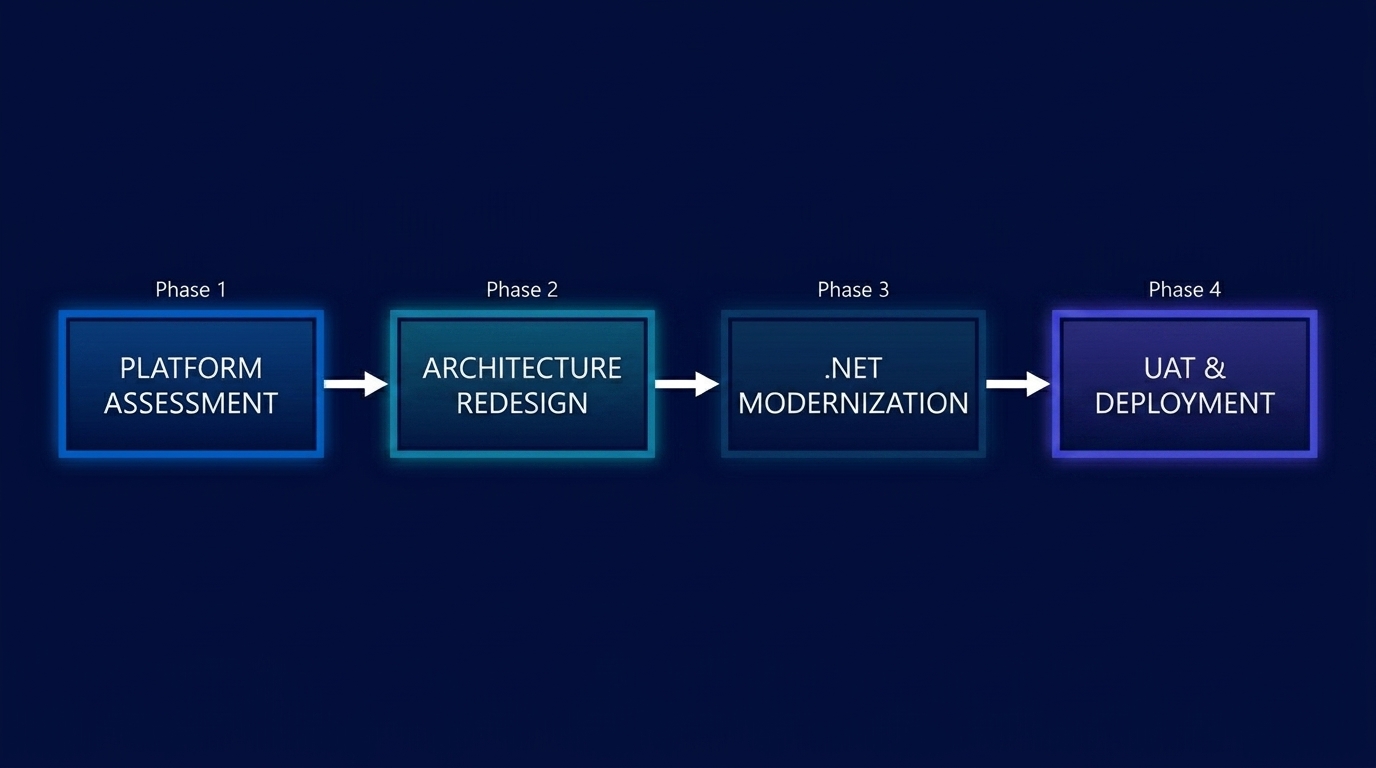
Phase 1
Platform Assessment
Conducted a comprehensive audit of the existing system, identifying integration gaps, security vulnerabilities, performance bottlenecks, and data quality issues.
Phase 2
Architecture Redesign
Designed a modern .NET-based member services architecture with enterprise integration patterns, role-based security, and a scalable data model.`,`.NET Modernization: Built the upgraded member services application with enhanced functionality, improved navigation, and API-ready integration endpoints.
Phase 3
UAT & Deployment
Conducted user acceptance testing with the automotive aftermarket association staff and member representatives, then executed a phased deployment to minimize service disruption.
Technical Transformation
i3solutions rebuilt the automotive aftermarket association’s member services application on a modern .NET platform with the integration, security, and scalability characteristics the association needed. The new system connects cleanly with external data sources and enterprise applications without manual workarounds. Security controls are role-based and auditable. Performance under concurrent load is stable. the automotive aftermarket association staff gained a more capable administration environment, and member companies gained a more reliable service experience.
Measurable Outcomes
| Metric |
Result |
| Platform Stability |
Eliminated performance degradation under concurrent member load across 2,650 companies |
| Integration Capability |
New API-ready architecture enables clean data exchange with enterprise applications without manual workarounds |
| Security Posture |
Role-based access controls and improved authentication protect member company data at scale |
| Administrative Efficiency |
the automotive aftermarket association staff gained direct control over member data management without IT-mediated manual processes |
| Growth Foundation |
Scalable architecture supports new member service offerings without requiring platform rebuilds |
[PENDING-CLIENT-QUOTE: insert 1-3 sentence outcome-focused quote in the client’s own language from a role matching the reader’s role.]
[Name or Role], [Organization type]
Frequently Asked Questions
What is association management system modernization and when does an organization need it?
Association management system modernization is the process of replacing an aging member services platform with a modern architecture that can integrate, scale, and secure member data at current requirements. An organization typically needs modernization when it faces any combination of: integration failures with modern applications, security gaps, performance issues under load, or the inability to add new member services without significant technical rework. the automotive aftermarket association faced all four.
How does i3solutions approach .NET application modernization for membership organizations?
i3solutions begins with a structured platform assessment that evaluates integration architecture, security controls, data model integrity, and performance characteristics. For membership organizations, the additional complexity is that the modernized system must serve multiple audiences, members, staff, and potentially partner organizations, with different access needs. i3solutions designs the new architecture to accommodate all user segments cleanly before writing a line of code.
How does API-ready architecture future-proof a membership platform?
An API-ready architecture exposes the platform’s core functions as standardized interfaces that other systems can call without manual intervention. For a trade association, this means member data can flow cleanly to event management systems, data analytics platforms, and industry reporting tools without spreadsheet exports or manual imports. i3solutions designs API layers into the modernized architecture so integrations are built-in, not bolted on.
What ROI should trade associations expect from member portal modernization?
Associations that modernize outdated member platforms typically see improvement in 3 dimensions: member retention (better service experience increases membership value), staff efficiency (administrators spend less time on manual workarounds and data reconciliation), and revenue capacity (a scalable platform can support new service offerings that generate additional association revenue). the automotive aftermarket association gained all 3 through its .NET modernization.
Why choose i3solutions for association and nonprofit technology modernization?
i3solutions has delivered technology modernization for membership organizations, nonprofits, and federal agencies across 27 years as a Microsoft Gold Partner. Our all-senior, all US-based team brings 600+ implementations worth of pattern recognition to every engagement. We offer a 15-Business-Day Microsoft Assessment that gives associations a clear, scoped plan before any modernization commitment is made.
Who This Engagement Serves
This engagement is relevant if
- A trade association needing to integrate a custom .NET portal with an external association management system.
- A professional society seeking custom member functionality beyond standard capabilities provided by off-the-shelf software solutions.
- A member-based organization requiring automated dues renewal and membership data synchronization across multiple distinct systems.
Less relevant if
- An organization looking for a pre-configured, low-code SaaS membership platform with native integration capabilities.
- A small non-profit requiring a simple contact database with minimal specific workflow or integration needs.
Ready to establish a governed Microsoft environment?
i3solutions delivers enterprise digital transformation on-time, in-scope, in-production. Microsoft Gold Partner since 1997. 600+ implementations. All-senior, all US-based team.
Schedule a 15-Business-Day Microsoft Assessment