Case Study · Defense / Government
41 Subcontractors, No Unified View: How the US Army Streamlined Future Force Warrior Program Tracking
Client: US Army Future Force Warrior Program

The Enterprise Challenge
The US Army’s Future Force Warrior (FFW) Program is one of the most technically ambitious modernization initiatives in defense history, a multi-year, multi-agency effort to develop the next generation of integrated soldier systems. Managing that complexity required tracking hundreds of concurrent project tasks, milestones, and deadlines across a network of 41 subcontracting agencies. The Program Management Office (PMO) was responsible for consolidating all of this activity into coherent reporting for senior leadership.
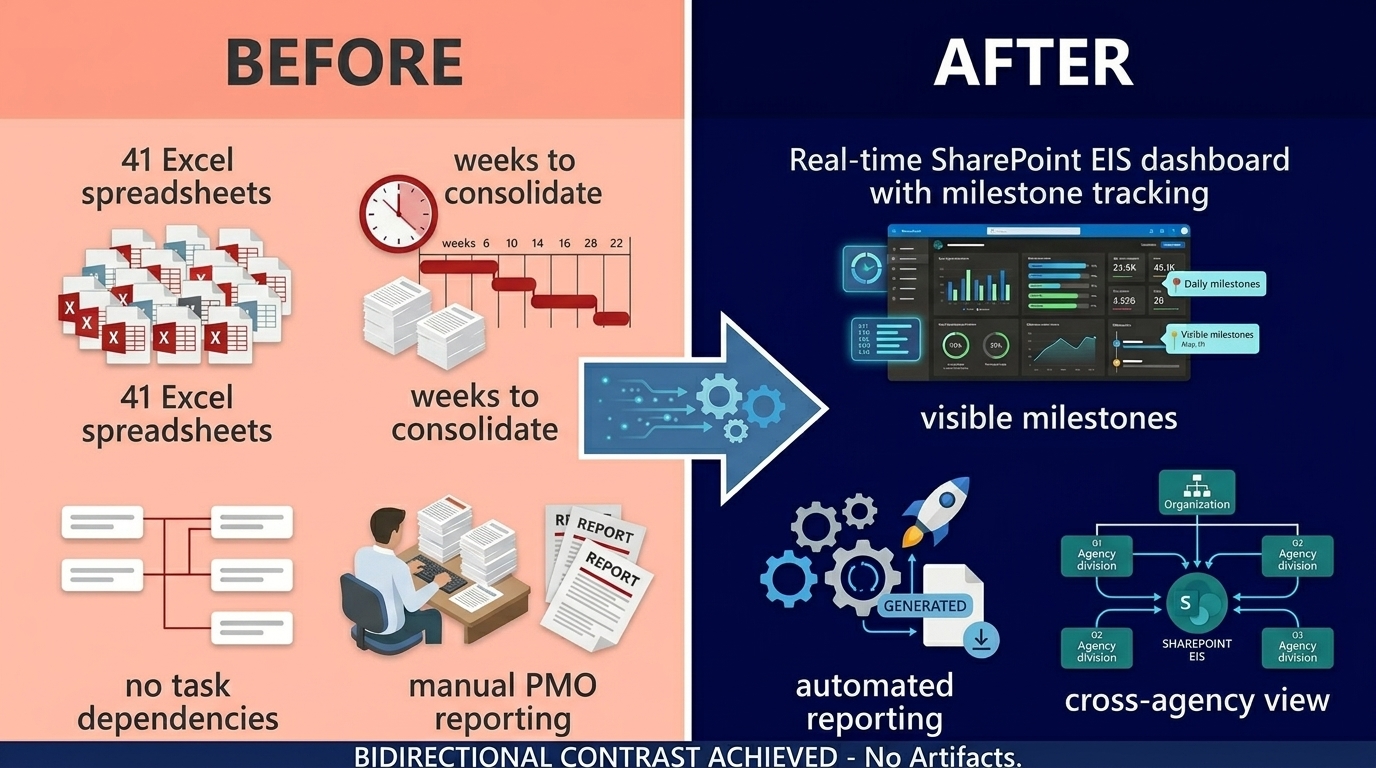
The existing approach relied entirely on Excel spreadsheets, individual workbooks maintained by each subcontractor, manually collected, individually reviewed, and painstakingly merged by PMO staff. This process consumed weeks of analyst time each reporting cycle. Worse, the spreadsheets were structurally disconnected: there were no dependencies or links between task items, no way to see how a delay in one area cascaded to another, and no shared calendar that gave the PMO a consolidated view of the entire program.
The Strategic Trigger
The Army needed a centralized system that could ingest, normalize, and display task data across 41 agencies in real time, not just at reporting cycle. They needed dependencies between tasks, milestone tracking against contractual deadlines, a shared calendar that reflected the full program, and dashboards that gave leadership an accurate program status view without requiring weeks of analyst assembly. The solution had to accommodate classified and sensitive information handling requirements.
The Engagement Approach
Strategic Trigger
Operational Criticality Compromised by Manual Spreadsheet Reporting
The U.S. Army Command responsible for a high-value technology modernization program was drowning in data but starved for information. They relied heavily on fragmented, manual spreadsheets to track program milestones, resource allocations, and risk registers. This outdated workflow was unsustainable. Every month, the Command spent over 300 man-hours simply consolidating and verifying performance data from disparate teams. Critical program reviews frequently relied on data that was already two to four weeks old. This operational delay made it impossible for leadership to make timely, data-driven decisions regarding resource optimization and risk mitigation.
The triggering event was a critical program milestone where conflicting versions of a spreadsheet reported radically different progress metrics, causing confusion and a major delay in key approvals. This incident highlighted the systemic instability. Leadership formally recognized that their reliance on manual data entry and lack of a single, trusted source of truth was not just inefficient, it was a strategic vulnerability jeopardizing the success of this multi-year program. Continued failure was not an option; they needed a scalable, enterprise-grade data management solution that provided instant, accurate visibility to ensure mission readiness.
Stakes
Millions at Risk and Compromised Audit Readiness
If this critical visibility issue remained unsolved, the consequences would be severe and multi-faceted. Most immediately, the lack of accurate, real-time data flow directly threatened the program budget. The Command was unable to identify and react to cost overruns until it was too late, leading to persistent funding gaps and the potential for millions of dollars in inefficiently spent or wasted resources. Furthermore, this manual approach left the Command in a constant state of pre-audit panic, as they struggled to demonstrate the mandatory data provenance and regulatory compliance required for such a high-stakes federal program.
Beyond the immediate financial and compliance risks, the continued reliance on antiquated manual processes posed a major strategic and reputational threat. As a flagship initiative, any perceived inability to manage this program effectively would severely damage the Command’s credibility and erode the trust of both Department of Defense (DoD) leadership and Congress. A failure here could jeopardize funding for future critical modernization efforts, potentially hindering the U.S. Army’s long-term operational capabilities and leaving the nation less prepared to meet evolving strategic challenges. The risks were clearly both immediate and existential.
Constraints and Complexity
Complex DoD Compliance in Highly Regulated Environments
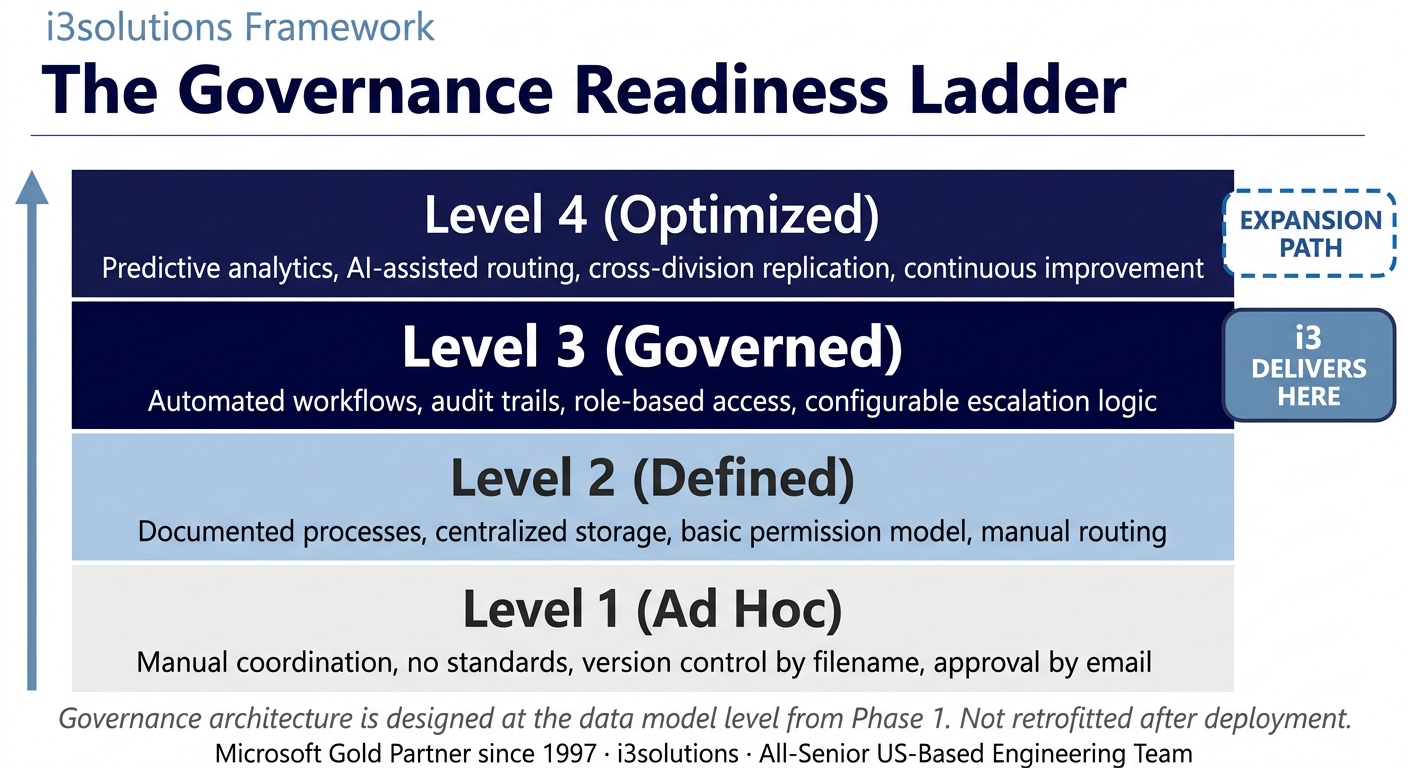
Implementing any technology solution within the U.S. Army introduces extraordinary complexity. The new SharePoint platform had to meet the DoD’s incredibly stringent security and compliance requirements, including complex Authorization to Operate (ATO) protocols and strict data classification controls. This was not a standard deployment; the team had to architect a system that ensured data integrity and controlled access while operating on a classified network infrastructure. The solution needed to provide seamless visibility to stakeholders while simultaneously enforcing rigid need-to-know protocols, creating a unique balancing act of accessibility and security.
The data challenge was equally daunting. Decades of critical program history were locked in thousands of disconnected, inconsistently formatted, and potentially outdated Excel files spread across the enterprise. The migration process required not just copying files, but a comprehensive effort to clean, normalize, and validate this data before ingesting it into a structured SharePoint architecture. Standardizing these diverse data structures and ensuring complete data lineage was essential. Achieving this while maintaining program operations required a phased, meticulous approach to data integration, user training, and cultural change to ensure widespread and effective adoption.
Selection Rationale
Senior Microsoft Specialists with Proven Delivery Depth
The U.S. Army Command conducted a rigorous evaluation of potential partners, ranging from large, global systems integrators to generic staffing firms. They quickly determined that larger firms, while impressive in scale, frequently proposed business models built on offshore resources for development and a commodity staffing approach, which was entirely unsuitable for this project. The security requirements alone, including necessary clearances and strict DoD network compliance, ruled out anyone without a deeply rooted, all-U.S.-based operational presence. They needed a partner with dedicated, specialized expertise, not a generic team learning on their time.
Ultimately, i3solutions was selected for their deep specialization and unique qualifications. As a dedicated Microsoft Gold Partner since 1997, they possessed the deep technical bench and proven experience, including over 600 successful implementations, the Command required. Crucially, i3solutions provided a team comprised entirely of senior, U.S.-based specialists with the technical mastery and deep understanding of DoD security environments to navigate the project’s complexities. This seniority ensured that the Command was getting proven strategic leadership and direct hands-on expertise from specialists who had successfully delivered on similar high-stakes, highly regulated federal initiatives, ensuring immediate impact and mission success.
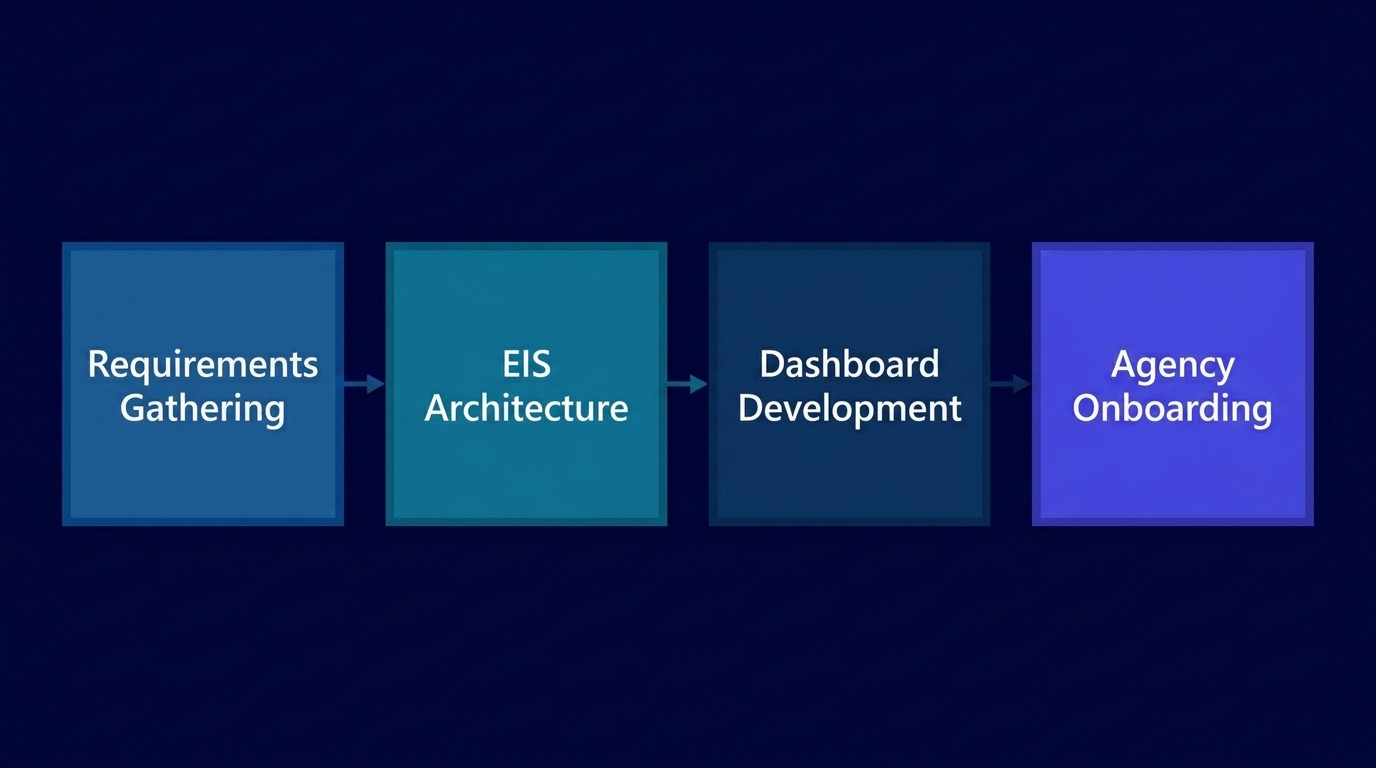
Phase 1
Requirements Gathering
Worked with PMO leadership and subcontractor representatives to define data structures, reporting requirements, and dashboard specifications across all 41 agencies.
Phase 2
EIS Architecture
Designed the SharePoint-based Executive Information System with a centralized data model, task dependency mapping, and role-based access for each subcontractor.
Phase 3
Dashboard Development
Built real-time milestone dashboards, cross-agency status reports, shared program calendar, and automated reporting workflows.
Phase 4
Agency Onboarding
Trained all 41 subcontracting agencies on data entry protocols and PMO staff on dashboard management and report generation.
Technical Transformation
i3solutions replaced the Army’s weeks-long manual consolidation process with a SharePoint Executive Information System that aggregates task data from all 41 subcontractors in real time. Program managers can now see milestone status, task dependencies, and deadline risks without waiting for a reporting cycle. The shared program calendar surfaces upcoming deadlines across all agencies simultaneously. Leadership dashboards provide accurate, current program status on demand, eliminating the weeks of analyst effort that previously separated leadership from the data they needed.
Measurable Outcomes
| Metric |
Result |
| Reporting Speed |
PMO reporting time reduced from weeks to real-time access to consolidated program status |
| Subcontractor Visibility |
Live dashboard view across all 41 subcontracting agencies eliminates manual data collection cycles |
| Milestone Accuracy |
Automated milestone tracking with dependency mapping surfaces risks before deadlines are missed |
| Decision Quality |
Leadership receives accurate, current program data enabling faster, better-informed decisions |
| Analyst Efficiency |
PMO staff redirected from manual consolidation work to higher-value program analysis |
[PENDING-CLIENT-QUOTE: insert 1-3 sentence outcome-focused quote in the client’s own language from a role matching the reader’s role.]
[Name or Role], [Organization type]
Frequently Asked Questions
What is a SharePoint Executive Information System for defense program management?
A SharePoint Executive Information System (EIS) is a centralized platform that aggregates project data from multiple sources, subcontractors, work streams, or agencies, into real-time dashboards and reports for program leadership. Unlike static spreadsheet reporting, an EIS reflects current task status, milestone progress, and risk indicators without requiring manual consolidation. i3solutions built the FFW Program EIS to replace a weeks-long manual reporting process with instant, always-current visibility.
How does i3solutions approach multi-agency program management system implementation?
i3solutions begins by mapping every data source, every reporting requirement, and every stakeholder group, in the FFW case, 41 subcontractors with different data formats and reporting cadences. We then design a normalized data model that can ingest inputs from all sources and represent them consistently in dashboards and reports. Onboarding all agencies to a new data entry discipline is as important as the technology build, and i3solutions plans for that change management work explicitly.
How does task dependency tracking work in a SharePoint program management system?
SharePoint’s task lists support predecessor/successor relationships that model real-world dependencies between work items. When one task slips, the system can surface the downstream impact automatically. i3solutions configures these dependency maps during the architecture phase based on the program’s actual work breakdown structure, so milestone risk becomes visible to program managers before it becomes a missed deadline.
What ROI should defense programs expect from replacing Excel-based PMO tracking?
Programs that replace manual spreadsheet consolidation with a centralized EIS typically recover significant analyst time, in the FFW case, the multi-week consolidation cycle was replaced by real-time dashboards. Beyond time savings, the quality improvement in leadership decision-making is measurable: faster access to accurate data means faster identification of risks, and faster response to those risks before they become contractual issues.
Why choose i3solutions for defense program management systems?
i3solutions has delivered program management and reporting systems for DARPA, INSCOM, General Dynamics, and the US Army, consistently on-time, in-scope, in-production. Our all-senior team brings pattern recognition from 600+ Microsoft platform implementations and a 27-year track record as a Gold Partner. Our 15-Business-Day Microsoft Assessment gives defense PMOs a clear, costed implementation plan before any commitment is required.
Who This Engagement Serves
This engagement is relevant if
- A large federal agency needing to replace manual spreadsheet processes with a collaborative SharePoint solution for real-time reporting.
- A major defense contractor struggling with disconnected systems and needing to unify program metrics using existing Microsoft platforms.
- A military command requiring a secure, centralized dashboard to provide leadership with instant visibility into readiness status.
Less relevant if
- A small business requiring a basic, low-cost project management tool without complex data integration needs.
- A highly decentralized organization with no existing Microsoft 365 or SharePoint infrastructure already in place.
Ready to establish a governed Microsoft environment?
i3solutions delivers enterprise digital transformation on-time, in-scope, in-production. Microsoft Gold Partner since 1997. 600+ implementations. All-senior, all US-based team.
Schedule a 15-Business-Day Microsoft Assessment