Case Study · State Government
Legacy System, 50,000 Members Underserved: How the the state legal licensing authority Modernized Its Bar Management Platform
Client: the state legal licensing authority (the state legal licensing authority)

The Enterprise Challenge
The the state legal licensing authority (the state legal licensing authority) is an administrative agency of the Supreme Court of Virginia, responsible for the regulation and licensing of over 50,000 legal professionals across the state. As a regulatory body, the state legal licensing authority manages attorney licensing, continuing legal education tracking, dues collection, disciplinary proceedings, and a range of member services that the legal profession in Virginia depends on for its professional standing and compliance requirements.
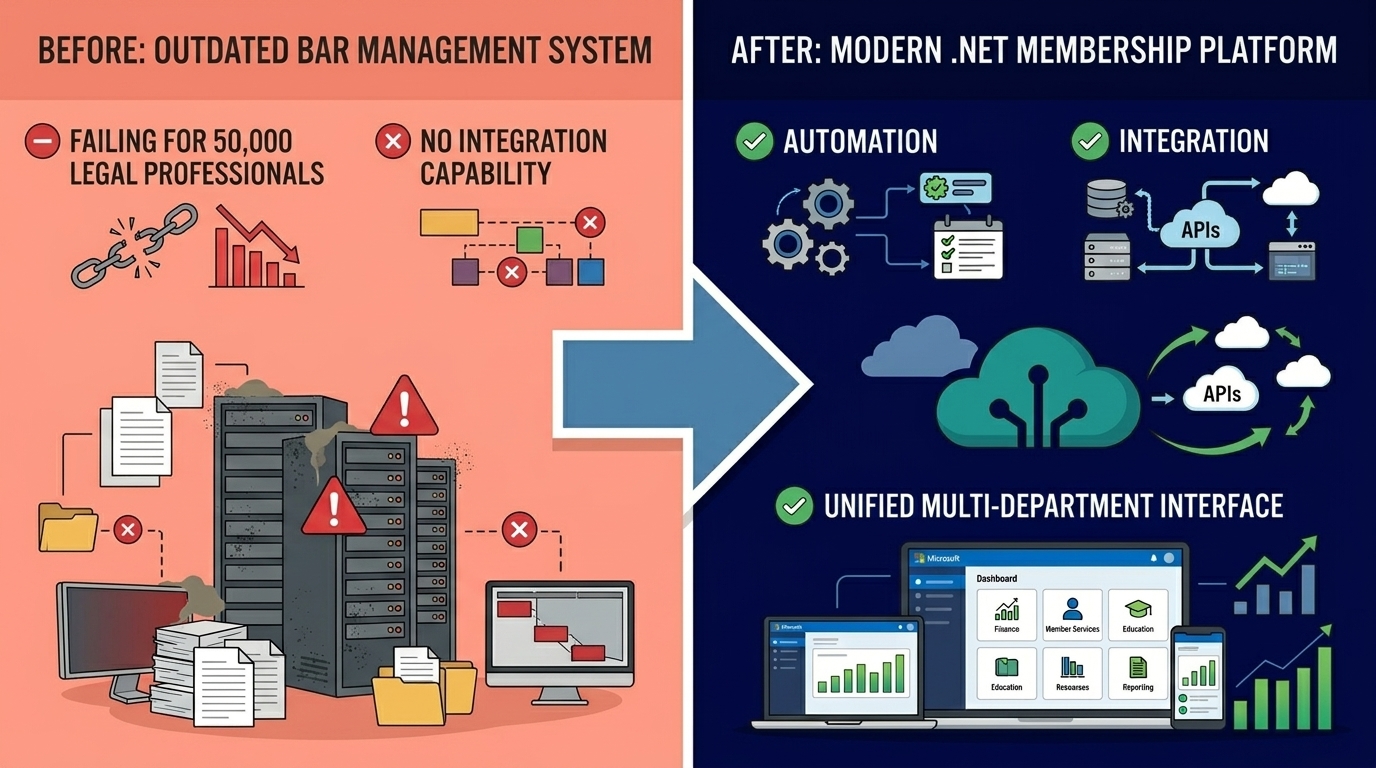
the state legal licensing authority’s existing Bar Management System had reached the limits of its useful life. Maintenance was increasingly difficult and expensive, the system was built on aging architecture with limited vendor support. Reliability issues were disrupting member-facing services that 50,000 attorneys depended on for their professional compliance. The system lacked integration capability with modern external systems, preventing the state legal licensing authority from automating workflows that required data exchange with court systems, CLE providers, and member-facing online services. Multiple internal departments worked in isolated silos with no unified interface.
The Strategic Trigger
the state legal licensing authority needed a full platform modernization that would deliver a stable, integrated .NET system capable of supporting 50,000 member records, automating key compliance workflows, connecting to external systems through standard integrations, and providing a unified interface across all the state legal licensing authority departments, without disrupting ongoing member services during the transition.
The Engagement Approach
Strategic Trigger
Legacy system instability threatens daily bar operations
The the state legal licensing authority’s existing management system, a monolithic and aging application, had reached its breaking point. Routine tasks, such as membership renewals and attorney compliance tracking, were becoming increasingly arduous. The system was prone to frequent crashes and performance bottlenecks, leading to significant delays and frustration among staff and the 50,000 legal professionals it served. Furthermore, the lack of modern APIs made integrating the legacy system with other essential tools, such as continuing legal education (CLE) portals and regulatory databases, a nearly impossible task, further hindering operational efficiency.
Recognizing the critical nature of these challenges, the state legal licensing authority leadership acknowledged that patchwork fixes were no longer viable. The system’s instability wasn’t just an inconvenience; it was a fundamental bottleneck preventing the organization from meeting its regulatory mandates effectively. A complete overhaul was necessary to ensure the long-term viability of the Bar’s operations and to maintain the trust and confidence of its members. They committed to a modernization initiative that would replace the outdated system with a custom-built solution, capable of scaling to meet future needs and providing a streamlined, efficient experience for all users.
Stakes
Compliance failures risk regulatory gridlock and lawsuits
The stakes were exceptionally high. If the legacy system were to fail completely, the impact on Virginia’s legal landscape would be catastrophic. Attorney regulatory functions, including licensure renewals and character and fitness investigations, would grind to a halt. This could lead to a backlog of thousands of cases, delaying the ability of new attorneys to practice law and potentially impacting the administration of justice in the Commonwealth. Furthermore, the risk of data breaches and compliance failures with ever-evolving data privacy regulations could expose the the state legal licensing authority to significant legal liabilities and financial penalties, eroding public trust.
Beyond the immediate operational and financial risks, the continuous failure of the legacy system posed a significant threat to the the state legal licensing authority’s reputation. Legal professionals expect and deserve a level of professional competence and technological sophistication from their regulatory body. Continued system issues would damage the the state legal licensing authority’s standing within the legal community and the public eye. This could lead to calls for greater oversight, loss of autonomy, and difficulty in attracting and retaining top-tier talent. Maintaining a robust, modern, and reliable technology infrastructure was therefore crucial for preserving the the state legal licensing authority’s integrity and long-term viability as an effective regulatory entity.
Constraints and Complexity
Migrating 50,000 member records with total accuracy
One of the most complex aspects of the project was the intricate and highly specialized nature of the the state legal licensing authority’s operations. The new system needed to accurately mirror the unique workflows and regulatory requirements specific to the Commonwealth’s legal profession. This required a deep understanding of complex rules governing attorney ethics, continuing legal education, and professional responsibility. Additionally, the system had to be highly secure and compliant with strict data confidentiality standards, as it would house sensitive personal and professional information for thousands of attorneys. Navigating these requirements within a legacy environment, where existing data was often siloed and inconsistently formatted, presented a formidable technical challenge.
Data migration emerged as a critical bottleneck. Transferring decades of historical data from the aging system to the new platform required meticulous planning and execution. The legacy data structure was complex and undocumented, making it difficult to extract and map to the new system’s modernized schema. Over the years, inconsistencies and data integrity issues had accumulated, which needed to be cleansed and remediated prior to migration. A phased approach was essential, with extensive testing and validation at each stage to ensure no loss of critical information. Ensuring a seamless transition for 50,000 legal professionals was paramount to minimizing disruption to daily bar operations.
Selection Rationale
Senior Microsoft Specialists with Proven Delivery Depth
The selection process was rigorous, with alternatives evaluated against specific criteria for technical expertise, reliability, and past performance. Large, offshore-focused firms were deemed unsuitable due to the complexity and sensitivity of the project. Commodity staffing models, which often involve high turnover and lack a cohesive team structure, were also rejected. The the state legal licensing authority required a partner with deep, localized expertise in Microsoft technologies and a proven track record of delivering successful, custom application development projects for highly regulated industries. A demonstrated commitment to client satisfaction and a collaborative approach were also essential factors.
The the state legal licensing authority selected i3solutions for its exceptional qualifications and alignment with their specific needs. As a Microsoft Gold Partner since 1997, i3solutions has a deep history of delivering over 600 successful implementations across diverse industries. Crucially, their entire delivery team is composed of senior-level, US-based resources, ensuring clear communication, direct collaboration, and a deep understanding of the regulatory landscape relevant to the the state legal licensing authority. This commitment to hiring only seasoned professionals with specialized skills provides clients with the highest level of expertise and accountability, ultimately leading to higher-quality outcomes and minimized risk.
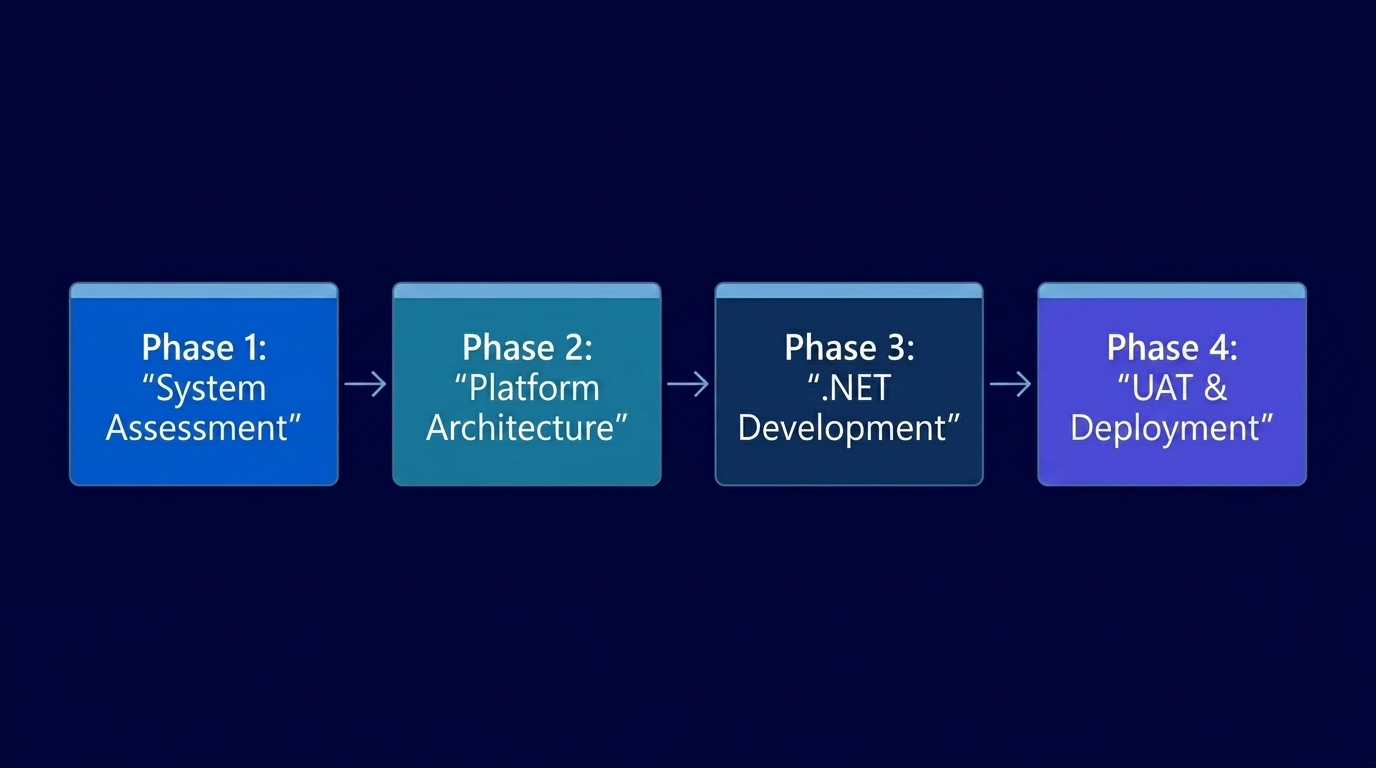
Phase 1
System Assessment
Conducted a comprehensive audit of the existing Bar Management System, data model, workflows, integration points, and functional requirements across all the state legal licensing authority departments.
Phase 2
Platform Architecture
Designed a modern .NET-based membership management architecture with a unified data model, API integration framework, and multi-department workflow support.`,`.NET Development: Built the modernized Bar Management System with member record management, CLE tracking, dues processing, disciplinary case management, and integration connectors for external systems.
Phase 3
UAT and Deployment
Conducted user acceptance testing with the state legal licensing authority staff across all departments, then executed a phased deployment with parallel system operation to ensure continuity of member services.
Technical Transformation
i3solutions delivered a modernized .NET Bar Management System that replaced the state legal licensing authority’s aging legacy platform with a stable, integrated system capable of supporting 50,000 member records reliably. CLE tracking, dues processing, and member licensing workflows are automated with external system integration. All the state legal licensing authority departments operate from a unified interface that eliminated the siloed work patterns of the old system. The maintenance burden and reliability risk of the legacy platform were eliminated, and the state legal licensing authority gained an architecture that can accommodate new member services and regulatory requirements without platform rebuilds.
Measurable Outcomes
| Metric |
Result |
| Platform Stability |
Eliminated the maintenance failures and reliability issues of the aging legacy Bar Management System |
| Member Scale |
Modernized system reliably manages 50,000 attorney records with automated licensing and compliance workflows |
| Integration Enabled |
API integration framework connects the state legal licensing authority systems with courts, CLE providers, and member-facing online services |
| Departmental Unification |
Unified interface replaced siloed workflows across the state legal licensing authority departments with a consistent shared system |
| Growth Foundation |
Modern .NET architecture accommodates new regulatory requirements and member services without platform rebuilds |
[PENDING-CLIENT-QUOTE: insert 1-3 sentence outcome-focused quote in the client’s own language from a role matching the reader’s role.]
[Name or Role], [Organization type]
Frequently Asked Questions
What is bar management system modernization and when does a state bar need it?
Bar management system modernization is the process of replacing an aging membership and licensing platform with a modern system that can integrate, automate, and scale to current requirements. A state bar typically needs modernization when maintenance failures affect member services, when the system can’t integrate with modern external systems, or when the architecture prevents workflow automation. The the state legal licensing authority faced all three.
How does i3solutions approach .NET platform modernization for regulatory and government agencies?
i3solutions begins with a comprehensive system assessment that maps every data element, every workflow, and every integration point in the existing system. For regulatory agencies like the state legal licensing authority, the migration plan must ensure continuity of member-facing services, 50,000 attorneys cannot experience disruption to their licensing or CLE compliance records. i3solutions designs phased deployments with parallel operation periods to eliminate transition risk.
How does API integration work in a modernized bar management system?
i3solutions builds a standards-based API integration layer that allows the the state legal licensing authority platform to exchange data with external systems, court management systems, CLE providers, online member portals, through secure, documented interfaces. This replaces manual data exports and imports with automated data flows that keep systems synchronized in real time.
What ROI should state regulatory agencies expect from membership platform modernization?
State regulatory agencies that modernize aging membership platforms typically see ROI in three areas: direct cost reduction from eliminating expensive legacy system maintenance, staff efficiency from workflow automation that replaces manual processes, and service quality improvement for the professional members who depend on reliable, accurate licensing and compliance management.
Why choose i3solutions for government and regulatory agency platform modernization?
i3solutions has delivered platform modernization for government agencies and regulatory bodies including HUD, ONDCP, and the the state legal licensing authority. Our all-senior, all US-based team brings 600+ Microsoft platform implementations and the security awareness required for government and legal sector deployments. Our 15-Business-Day Microsoft Assessment gives regulatory agencies a clear, low-risk modernization plan.
Who This Engagement Serves
This engagement is relevant if
- State licensing boards or professional associations struggling with outdated legacy systems supporting over 30,000 members and complex regulatory workflows.
- Self-regulatory organizations needing to modernize antiquated constituent management systems with custom, secure, and highly scalable technology solutions.
- Government or non-profit entities requiring robust, tailored .NET applications to efficiently manage high-volume member data and compliance.
Less relevant if
- Small organizations or bar associations with under 5,000 members seeking standard, low-cost commercial off-the-shelf software rather than custom dev.
- Entities requiring minor system updates, rather than a comprehensive, full-scale digital transformation of their critical infrastructure.
Ready to establish a governed Microsoft environment?
i3solutions delivers enterprise digital transformation on-time, in-scope, in-production. Microsoft Gold Partner since 1997. 600+ implementations. All-senior, all US-based team.
Schedule a 15-Business-Day Microsoft Assessment