Case Study · Professional Services
Spreadsheets to the CEO’s Office: How Deloitte Built a Real-Time Project Portfolio Dashboard
Client: Deloitte

The Enterprise Challenge
Deloitte is one of the world’s largest professional services organizations, a Big Four accounting and advisory firm providing audit, consulting, financial advisory, risk advisory, and tax services to clients across industries and geographies globally. Managing Deloitte’s own project portfolio at the organizational level requires visibility into hundreds of concurrent engagements, milestone statuses, delivery risks, and resource allocations across the firm.
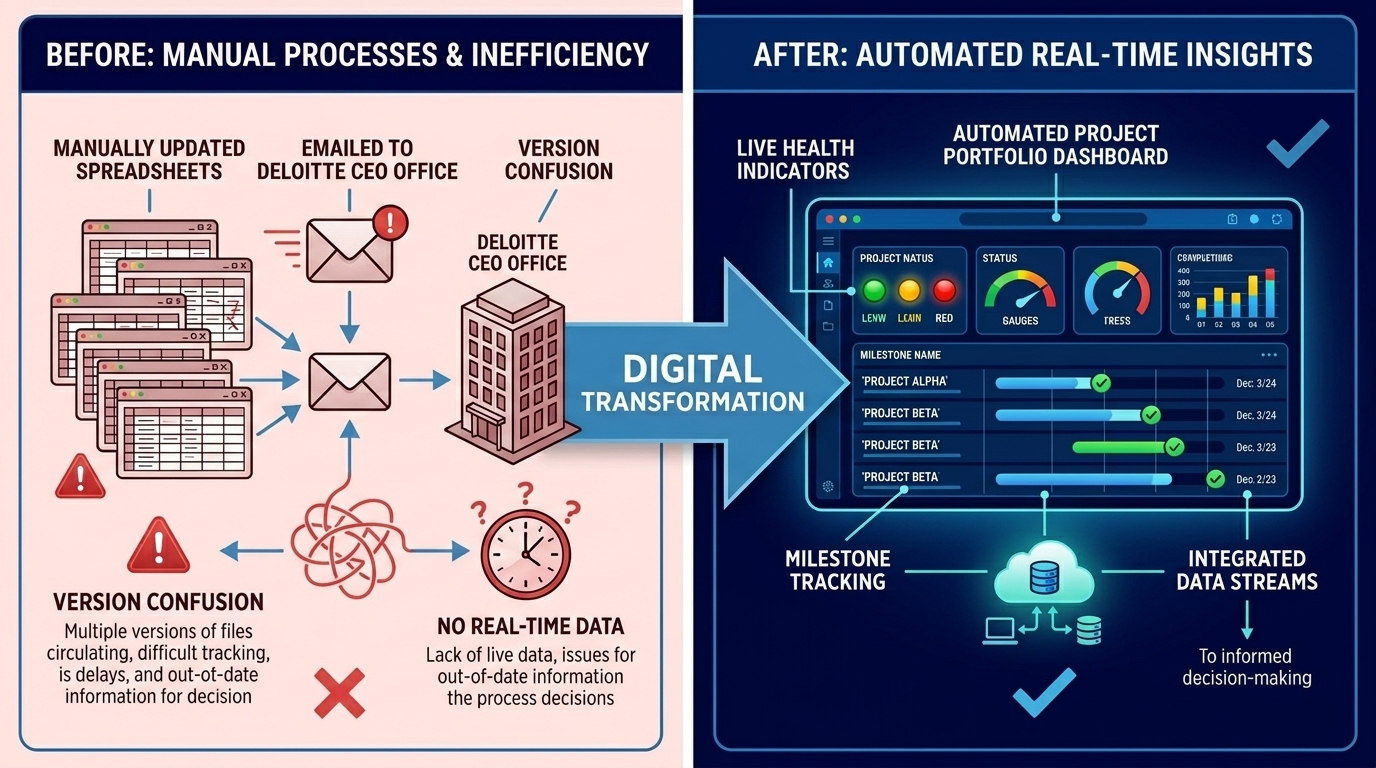
The Office of the CEO was managing that portfolio visibility through a process that was fundamentally misaligned with the speed at which decisions needed to be made. Project and milestone data was maintained in spreadsheets and static documents, manually updated by project leaders and emailed to executive leadership on a scheduled basis. By the time the CEO’s office received a portfolio update, the underlying project data had already changed. Version control was a persistent problem, different recipients might be reviewing different versions of the same report. Real-time risk visibility was impossible in a system where data arrived days after it was current.
The Strategic Trigger
Deloitte’s CEO office needed a real-time executive dashboard that aggregated live project portfolio data automatically, delivering current milestone status, project health indicators, and risk flags without manual compilation or scheduled email delivery, and that gave leadership a quick-reference view of the firm’s project portfolio that could inform faster, better-grounded decisions.
The Engagement Approach
Strategic Trigger
Global Portfolio Visibility Sabotaged by Manual Spreadsheet Mania
The Office of the CEO struggled to gain a clear, real-time view of its vast global project portfolio, relying instead on manual data collection that was both labor-intensive and prone to significant errors. Dozens of spreadsheets were emailed monthly, each potentially containing inconsistencies or outdated figures, creating a fragmented picture that made strategic oversight nearly impossible. This fragmented view led to critical near-misses where leadership nearly approved overlapping redundant initiatives while simultaneously failing to identify and allocate resources to high-priority global programs, resulting in inefficient resource allocation, slower project delivery, and significant delays in realizing strategic objectives.
Recognizing this systemic failure, Deloitte’s senior leadership committed to a complete digital transformation of the PMO data collection process. The previous methodology was formally identified as a key bottleneck during a comprehensive strategic review, highlighting how the dependency on manual data aggregation directly impeded executive decision-making speed and accuracy. The Office of the CEO declared that gaining reliable, real-time access to accurate cross-functional project data was no longer just an operational efficiency goal but a mandatory requirement to maintain market leadership and ensure the successful, agile execution of the firm’s overarching global strategy.
Stakes
Inaccurate Data Imperils Strategic Investments and Growth Targets
Failure to resolve the visibility gaps created a high probability of significant misinvestment of capital and resources. If left unaddressed, the fragmented data landscape directly threatened to cause the misallocation of millions of dollars toward projects that no longer aligned with shifted strategic priorities or, conversely, would have resulted in the continued underfunding of critical growth initiatives. This lack of centralized visibility also increased the operational risk that delayed detection of underperforming or failing projects would lead to significant cost overruns, missing major compliance milestones, and ultimately the cancellation of vital strategic programs with no return on initial investment.
Beyond the immediate financial risks, the continued reliance on inadequate manual reporting presented substantial reputational and strategic threats. The Office of the CEO’s inability to definitively track and report progress on key global mandates undermined executive credibility and trust among internal stakeholders, who were increasingly frustrated by opaque prioritization and competing resource demands. This persistent inability to execute strategically and agilely risked ceding significant market share to more computationally efficient, faster-moving competitors. Proving the ROI of major change initiatives became increasingly difficult, threatening the firm’s long-term competitive position in a rapidly evolving consulting market.
Constraints and Complexity
Aggregating Non-Standardized Data Across a Fragmented Landscape
The primary challenge lay not in technology, but in enforcing standardized processes across hundreds of disparate, fiercely independent operating units and global regions, each with its own ingrained project management practices. The Office of the CEO mandated a single, consolidated view, but the underlying data sets across the firm were fundamentally incompatible. Decades of decentralized project management had resulted in inconsistent data structures, conflicting key performance definitions (e.g., varying calculations of “project budget variance”), and a complete lack of common taxonomies, making traditional data aggregation virtually impossible without significant pre-processing or complex custom translation layers.
The custom solution had to ingest and normalize data from a multitude of legacy project management tools, countless bespoke local databases, and thousands of unstructured spreadsheets. Deloitte’s rigid security and compliance policies required the new system to integrate seamlessly and securely with numerous disparate, region-specific Microsoft SharePoint environments, which housed sensitive financial information and proprietary project data. This required the development of highly complex, secure middleware to facilitate data extraction and transformation while maintaining strict data governance, ensuring compliance with varied international data privacy laws (like GDPR) across every region of operation.
Selection Rationale
Senior Microsoft Specialists with Proven Delivery Depth
Deloitte’s Office of the CEO initially evaluated several alternative partners, including global systems integrators and larger offshore outsourcers, to address their project portfolio visibility challenges. However, these larger firms predominantly offered junior-heavy commodity staffing models and relied extensively on offshore resources to control costs, which Deloitte identified as incompatible with the complexity of the custom development and the need for high-level security clearances. Leadership realized that a standardized “lift and shift” approach common with large generalists would not suffice for the specialized architectural and security requirements demanded by their decentralized SharePoint environment and complex data integration needs.
Deloitte ultimately selected i3solutions due to their unique standing as a Senior Microsoft Gold Partner with a 600+ project delivery depth dating back to 1997. The deciding factor was i3solutions’ commitment to providing an all-senior, all-US-based team, ensuring direct access to seasoned consultants with the deepest Microsoft expertise. This model guaranteed that Deloitte would work only with highly experienced developers who understood the intricacies of custom SharePoint application development and secure data integration from day one. Their proven ability to deliver complex solutions in highly regulated environments and directly collaborate with senior executives cemented their selection over larger, less specialized competitors.
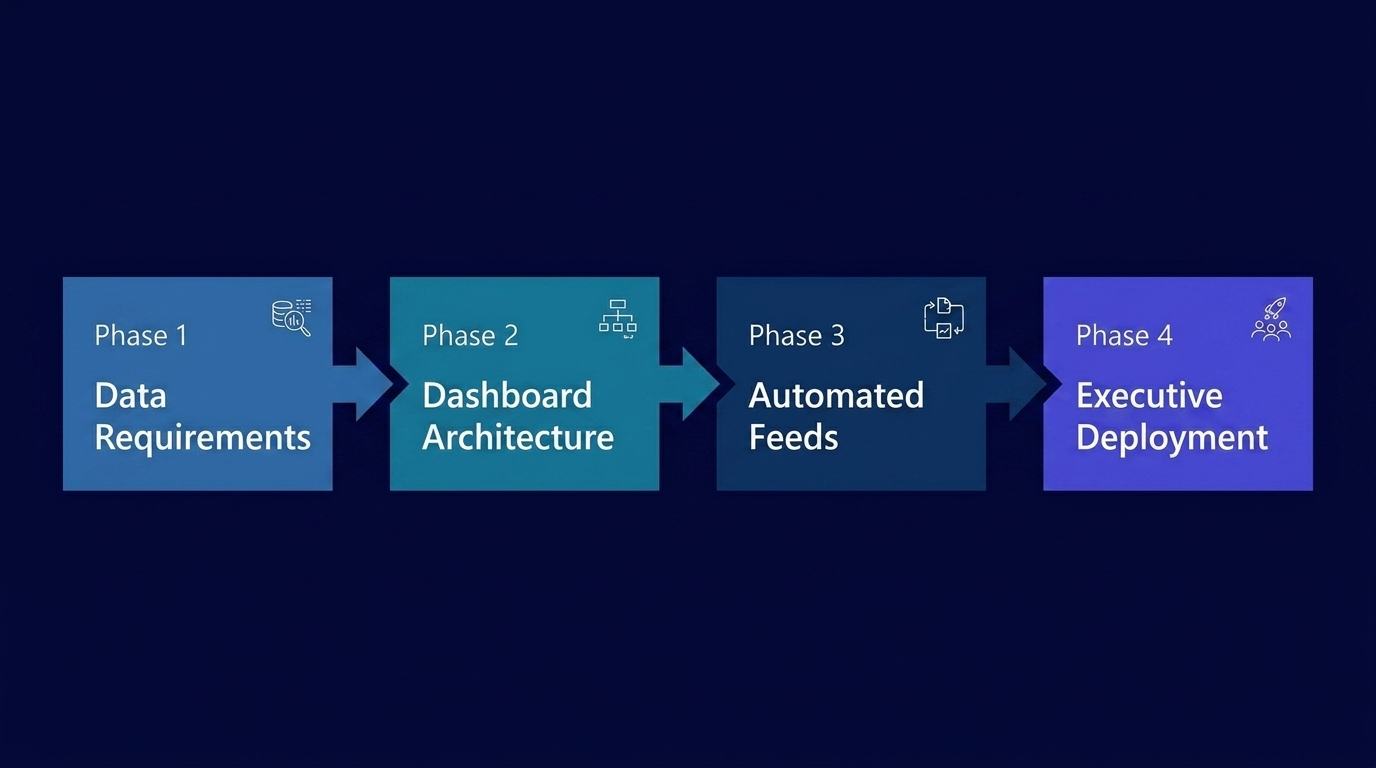
Phase 1
Data Requirements
Worked with the Deloitte CEO’s office to define the specific project metrics, health indicators, and milestone data elements required for executive portfolio management.
Phase 2
Dashboard Architecture
Designed a custom real-time executive dashboard with automated data feeds, project health scoring, milestone tracking, and risk indicator visualization.
Phase 3
Automated Feeds
Built data connectors that pulled project status from Deloitte’s project management systems automatically on a defined refresh schedule.
Phase 4
Executive Deployment
Deployed the dashboard with secure executive access provisioning and trained the CEO’s office staff on dashboard navigation and data interpretation.
Technical Transformation
i3solutions delivered a real-time executive project portfolio dashboard that replaced Deloitte’s manual spreadsheet reporting cycle with automated, always-current project visibility. The CEO’s office sees live project health indicators, milestone status, and risk flags, updated automatically from project systems rather than compiled manually by staff. Portfolio decisions that previously waited for the next scheduled report can now be informed by current data. The manual compilation and email distribution process was eliminated, recovering finance and operations staff time while improving the quality of the information leadership receives.
Measurable Outcomes
| Metric |
Result |
| Data Currency |
CEO’s office receives live project portfolio data updated automatically, not manually compiled on a schedule |
| Version Eliminated |
All executive users see identical current data from a single authoritative dashboard, no spreadsheet version conflicts |
| Risk Visibility |
Real-time risk indicators surface project issues as they develop rather than at the next scheduled reporting cycle |
| Decision Speed |
Leadership makes portfolio decisions based on current data rather than waiting for the next manual reporting cycle |
| Staff Time Recovered |
Manual report compilation and email distribution process eliminated, staff redirected to higher-value analytical work |
[PENDING-CLIENT-QUOTE: insert 1-3 sentence outcome-focused quote in the client’s own language from a role matching the reader’s role.]
[Name or Role], [Organization type]
Frequently Asked Questions
What is a real-time executive project portfolio dashboard?
A real-time executive project portfolio dashboard is a web-based reporting interface that aggregates current project data automatically from operational systems and presents it to leadership in a structured, always-current format. Unlike manual spreadsheet reporting, a real-time dashboard reflects the current state of every project at the moment leadership views it, eliminating the data latency and version confusion of scheduled email delivery.
How does i3solutions approach executive dashboard development for large professional services organizations?
i3solutions begins by working with executive stakeholders to define exactly what information is needed, at what level of detail, and for what decisions. For organizations like Deloitte, the dashboard must aggregate data from systems that span multiple business units and geographies. i3solutions designs the data architecture to consolidate this diversity into a coherent executive view without requiring changes to underlying operational systems.
How do automated data feeds work in an executive portfolio dashboard?
i3solutions builds data connectors that extract defined project metrics from operational systems on a scheduled basis, project status, milestone completion, resource utilization, financial performance. The extracted data is validated and transformed into the dashboard data model, which the visualization layer reads to render current project health indicators. This approach protects operational systems from dashboard query load while keeping leadership data current.
What ROI should professional services firms expect from executive dashboard implementation?
Professional services firms that replace manual portfolio reporting with automated dashboards typically see ROI in three dimensions: staff time recovered from manual compilation, decision quality improvement from current data, and risk reduction from faster identification of project issues before they become client-visible problems. For a firm of Deloitte’s scale, each of these dimensions represents significant financial value.
Why choose i3solutions for executive dashboard development?
i3solutions has delivered executive dashboards for organizations including Deloitte, the nuclear energy consortium, DARPA, and Milestone Group, consistently on-time, in-scope, in-production. Our all-senior, all US-based team brings 600+ Microsoft platform implementations and the technical experience to build dashboards that integrate reliably with complex enterprise systems. Our 15-Business-Day Microsoft Assessment gives professional services organizations a clear dashboard development plan.
Who This Engagement Serves
This engagement is relevant if
- Large organizations where the executive office still depends on manually consolidated spreadsheets for strategic project visibility.
- Executive leadership teams requiring real-time, aggregated data on highly confidential cross-functional initiatives and priorities.
- Organizations transitioning from manual reporting processes to custom-built digital solutions for better executive decision-making support.
Less relevant if
- Small businesses with low-complexity project portfolios that are easily managed using standard spreadsheet software.
- Companies already successfully utilizing automated PPM tools for executive-level reporting on their strategic initiatives.
Ready to establish a governed Microsoft environment?
i3solutions delivers enterprise digital transformation on-time, in-scope, in-production. Microsoft Gold Partner since 1997. 600+ implementations. All-senior, all US-based team.
Schedule a 15-Business-Day Microsoft Assessment