Case Study • Professional Services / Big Four • Identity Management
Duplicate Accounts, Delayed Access, Redundant Entry: How Deloitte Automated Identity Provisioning for 125,000 Users

Strategic Trigger
Global Audit Compliance Threatened by Fragmented Manual Identity Management
As Deloitte’s global workforce expanded, its dependency on manual identity provisioning became a critical operational bottleneck. IT administrators were overwhelmed by the sheer volume of new hires, role changes, and departures across diverse business units, each requiring access to a complex array of applications. The reliance on emails, spreadsheets, and manual tickets resulted in substantial onboarding delays, often leaving new consultants unproductive for days. More critically, the lack of timely de-provisioning created serious security gaps, leaving orphaned accounts active long after employees departed, directly violating internal access control policies and increasing the risk of unauthorized data access and audit failures.
Recognizing that the current manual processes were unsustainable and a direct threat to operational efficiency and security compliance, Deloitte leadership committed to a comprehensive identity and access management transformation. They understood that to support the firm’s agility and safeguard its reputation, they must move away from decentralized, labor-intensive workflows. The strategic imperative was clear: implement a robust, automated solution centered on tight Active Directory integration. This initiative aimed to create a single source of truth for user identities, streamline the entire identity lifecycle, enforce consistent access policies globally, and dramatically reduce the risk profile associated with manual access management.
Stakes
Rising Audit Failures and Potential Multi-Million Dollar Non-Compliance Fines
The financial stakes associated with maintaining the status quo were substantial and immediate. Continued reliance on manual provisioning guaranteed rising operational costs as more IT resources were required to manage access for a growing workforce. Furthermore, prolonged onboarding times directly impacted revenue generation, as consultants could not be billed to client projects until they had the necessary system access. Most significantly, the accumulation of orphaned accounts and inconsistent access rights significantly increased the risk of catastrophic audit failures. Non-compliance with strict regulatory frameworks like GDPR or Sarbanes-Oxley could result in devastating multi-million dollar fines, significantly damaging Deloitte’s profitability and financial stability.
Beyond direct financial penalties, the reputational risk of a security breach stemming from improper access management was immeasurable. As a premier professional services firm, Deloitte’s business is built on trust and the secure handling of sensitive client data. Any breach attributed to orphaned accounts or excessive privileges would severely damage this trust, causing existing clients to reassess their relationship and deterring potential new clients. In a hyper-competitive market, a compromised reputation for security and compliance can lead to a significant loss of market share and long-term erosion of brand equity, far outweighing the cost of implementing a robust identity management solution.
Constraints and Complexity
Complex AD architecture hindered automated identity lifecycle management
The highly sensitive nature of the data required a solution that met strict compliance standards. The presence of disjointed directories meant any single authoritative source for identity data had to be consolidated across different domains, which included various on-premise Active Directory environments and some external legacy systems. Strict security and auditing requirements had to be maintained without interrupting existing workflows. We had to implement fine-grained access control while accommodating variations in job roles, user permissions, and compliance rules across various departments and different project teams.
Integrating different existing directories, some of which were managed by varying technical standards and versions, into a single, comprehensive Active Directory environment was a significant undertaking. The migration involved transitioning hundreds of thousands of user accounts and ensuring permissions, group memberships, and security policies were mapped accurately across the new, streamlined infrastructure. To minimize operational disruption, the adoption process had to be carefully planned with automated synchronization, thorough testing, and comprehensive user training, while also accounting for the phasing out of older, legacy authentication mechanisms.
Selection Rationale
Senior Microsoft Specialists with Proven Delivery Depth
Deloitte initially evaluated several generic identity and access management (IAM) vendors, many of whom offered feature-rich platforms but lacked specific expertise in complex, large-scale Active Directory environments. While these solutions were powerful, their implementation would have required substantial custom development and significant changes to Deloitte’s core infrastructure, increasing both cost and risk. Other alternatives were ruled out because they heavily relied on offshore resources or junior consultants, raising concerns about quality, communication consistency, and adherence to Deloitte’s rigorous security and compliance standards. These options failed to provide the required deep understanding of Microsoft’s ecosystem, leaving the critical AD integration success in doubt.
Ultimately, Deloitte selected i3solutions due to their unparalleled Microsoft technology expertise and proven track record in architecting and delivering complex identity solutions. As a Microsoft Gold Partner since 1997, i3solutions possessed a deep, institutional understanding of Active Directory, ensuring seamless integration with Deloitte’s existing infrastructure. Their model of deploying only senior, US-based consultants meant that every team member possessed a decade or more of experience in tackling intricate integration challenges. This depth of knowledge, combined with i3solutions’ focus on client satisfaction and successful delivery of 600+ complex implementations, provided the assurance Deloitte needed to execute this business-critical initiative with confidence and minimize operational risk.
The Enterprise Challenge
Deloitte is a global professional services firm and one of the Big Four accounting organizations, providing audit, consulting, financial advisory, risk advisory, and tax services worldwide. With 125,000 users requiring access to Deloitte’s internal systems, the identity provisioning process had become a significant operational burden. Fragmented provisioning across disconnected systems meant employees frequently encountered delayed network access, duplicate Active Directory accounts, and inefficient data entry required separately in each platform.
i3solutions implemented a Microsoft BizTalk integration layer that automated provisioning across Active Directory and SAP, delivered single sign-on, and eliminated the manual multi-system workflow that was generating duplicate accounts and slow onboarding for the firm’s entire workforce.
The Engagement Approach
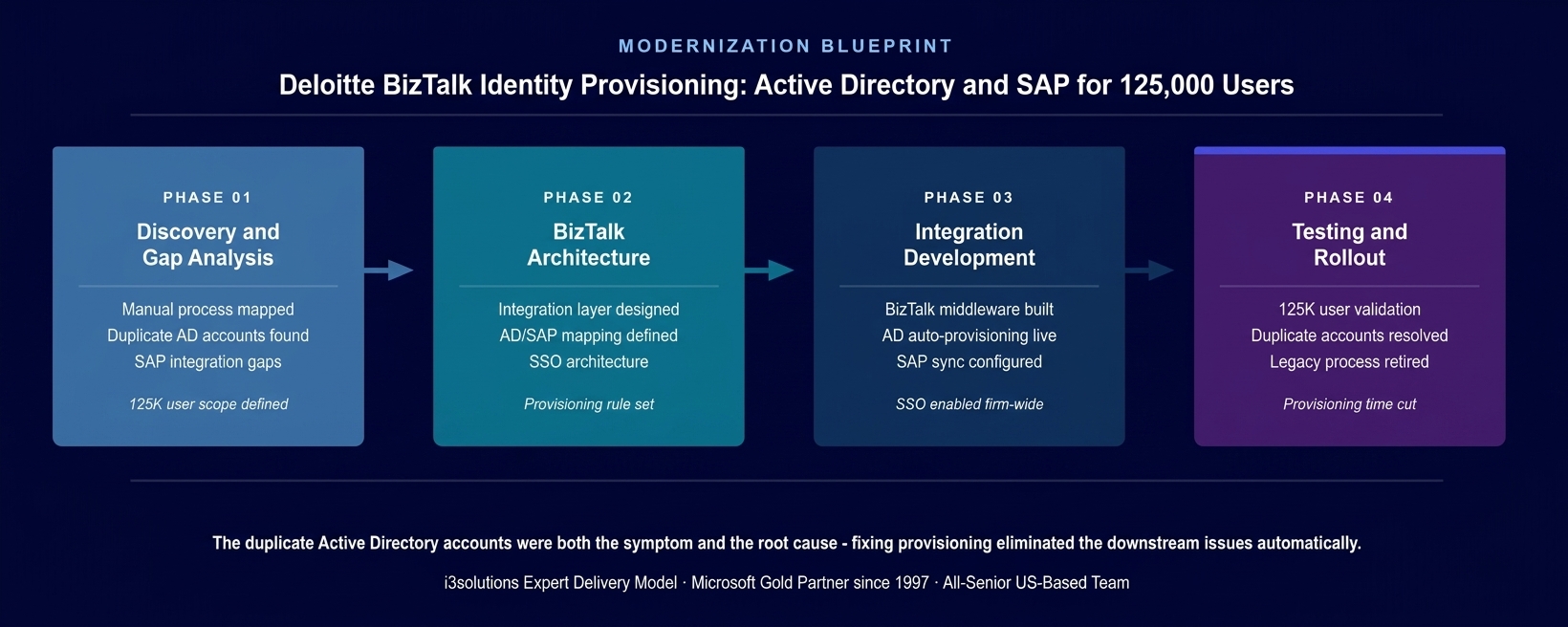
PHASE 01
Discovery and Gap Analysis
Mapping of the manual provisioning process across all systems. Identification of specific AD/SAP integration gaps causing duplicate accounts and delayed access. 125,000-user scope definition.
PHASE 02
BizTalk Architecture
BizTalk middleware architecture connecting Active Directory and SAP. Provisioning rule set for full user lifecycle. SAP synchronization mapping. SSO configuration design.
PHASE 03
Integration Development
BizTalk middleware developed. AD automated provisioning confirmed. SAP synchronization validated. SSO configured across the application environment.
PHASE 04
125K Rollout
Full user base validation. Duplicate AD accounts resolved. Legacy manual provisioning retired. IT transitioned to exception handling.
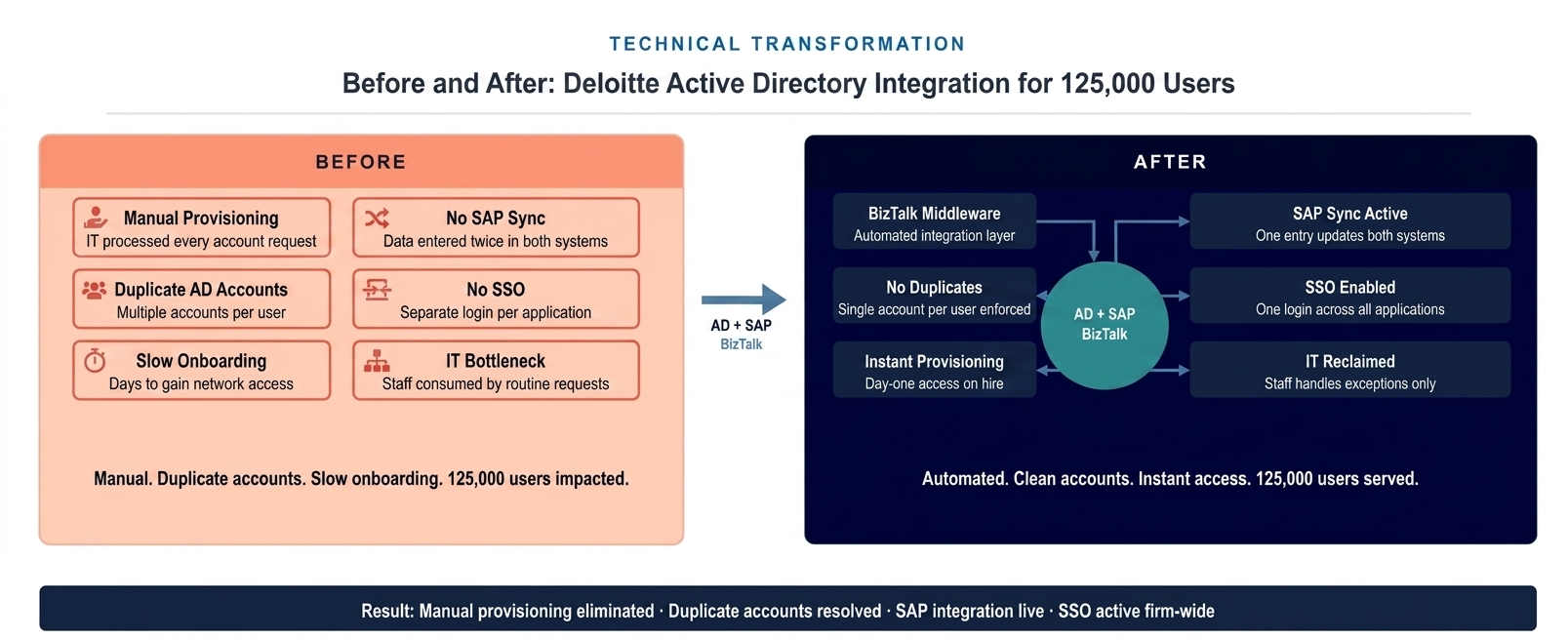
Technical Transformation
Measurable Outcomes
| Metric | Before | After | Improvement |
|---|
| Provisioning method | Manual IT processing across multiple systems | BizTalk middleware automates on lifecycle events | Manual provisioning eliminated |
| Duplicate AD accounts | Frequent – fragmented provisioning created duplicates | Eliminated – one automated process, one account per user | Duplicate accounts resolved |
| Onboarding access time | Delayed – days to provision new hire access | Same-day – day-one access automatically provisioned | Same-day access on hire |
| SAP/AD synchronization | Manual – data entered separately in each system | Automated – one entry propagated to all systems | Redundant entry eliminated |
| SSO | Not available | Enabled across the integrated application environment | SSO active firm-wide |
| IT overhead | Staff processing routine provisioning daily | IT handles exceptions only | Routine overhead eliminated |
[PENDING-CLIENT-QUOTE: insert 1-3 sentence outcome-focused quote in the client’s own language from a role matching the reader’s role.]
[Name or Role], [Organization type]
Frequently Asked Questions
Active Directory Integration and Identity Automation for Enterprise Organizations
What is Active Directory integration with enterprise HR and ERP systems?
Active Directory integration with enterprise HR and ERP systems connects the identity management system that governs user access to applications with the business systems that hold the authoritative record of employees and their organizational roles. When an employee joins, changes roles, or departs, the integrated system automatically creates, updates, or deactivates the corresponding Active Directory account and all connected application access, without requiring manual IT ticket processing. For large organizations like Deloitte with 125,000 users, integration transforms identity provisioning from a manual, error-prone process into a governed, automated lifecycle that operates consistently at scale.
How does i3solutions approach a Microsoft BizTalk integration engagement for identity management?
i3solutions begins BizTalk integration engagements with a detailed gap analysis that maps exactly where the provisioning process is breaking down, which integration points are missing, which manual steps are introducing delay and error, and which downstream problems like duplicate accounts are symptoms of root cause integration failures rather than independent issues to fix one by one. The integration architecture is then designed to address root causes, not symptoms. For Deloitte, that meant a BizTalk middleware layer that automated the exchange of identity data between Active Directory and SAP and enabled SSO, eliminating not just the manual provisioning steps but all the downstream problems they caused.
How does automated provisioning reduce security risk in large organizations?
Automated provisioning reduces security risk by eliminating the time gap between lifecycle events and access changes. In manual provisioning environments, a departing employee’s access may remain active for hours or days after departure while IT processes the offboarding ticket. An employee who changes roles may retain access to systems relevant to their old role while their new role’s access is still being provisioned. Automated provisioning triggered by HR system events eliminates both gaps, access is revoked or changed the moment the lifecycle event occurs in the authoritative source, not when IT gets to the ticket. For organizations handling sensitive client data like Deloitte, eliminating that window is a meaningful security improvement.
What is single sign-on and why does it matter for large professional services firms?
Single sign-on (SSO) allows users to authenticate once with their organizational credentials and then access all connected applications without re-entering credentials for each one. For large professional services firms like Deloitte with dozens of connected applications, SSO eliminates the daily friction of multiple authentication steps while also improving security, users with one set of credentials to manage are more likely to follow good password practices, and administrators have a single point of access control to revoke when an employee departs. BizTalk-enabled SSO integrates the identity federation across the application environment so that a single Active Directory authentication session is honored by all connected systems.
Why choose i3solutions for an enterprise Active Directory integration project?
i3solutions brings specific Microsoft BizTalk and integration architecture expertise to AD integration engagements, combined with the all-senior delivery model that large-scale enterprise integrations require. Integrating identity management across Active Directory, SAP, and a complex application environment at 125,000-user scale is not a configuration task, it is an architecture and engineering challenge where decisions made in the design phase determine whether the integration performs correctly at full scale or produces the fragmentation and inconsistency it was designed to eliminate. i3solutions has been a Microsoft Gold Partner since 1997 specifically because of the depth of platform engineering expertise that enterprise-scale integration requires.
Back to Case Study Library
60 enterprise Microsoft implementations documented
Related Insights
From the i3solutions YouTube Channel
Short-form perspectives on the delivery and technology challenges in this case study.
Who This Engagement Serves
This engagement is relevant if
- Large enterprises currently relying on manual workflows for user onboarding and access management in Active Directory environments.
- Organizations using Active Directory that experience high employee turnover or frequent internal role changes and access adjustments.
- Companies seeking to eliminate security risks and operational overhead associated with non-automated user account provisioning and deprovisioning.
Less relevant if
- Small organizations using cloud-native directories with built-in, automated provisioning for their limited application stacks.
- Businesses completely satisfied with their current manual procedures and possessing no plans to migrate away from them.
Ready to automate identity provisioning across Active Directory and connected systems?
The 15-Business-Day Microsoft Assessment maps the BizTalk integration architecture, provisioning rule set, and SSO configuration that would eliminate manual provisioning from your identity management process.
Microsoft Gold Partner since 1997. 600+ implementations. All senior. All US-based.
Schedule the Assessment