Case Study • Government / Legal • Case Management
150% More Efficient, 50% Lower Cost: How the municipal housing authority Built a Legal Case Management System for 1 Million Properties
NYC Department of Housing Preservation and Development (the municipal housing authority) • .NET Legal Case Management System •
Legal case management system
Strategic Trigger
Missing Deadlines and Inaccessible Paper Legal Records
The NYC Department of Housing Preservation and Development (the municipal housing authority) was burdened by a cumbersome, paper-based system for tracking legal cases. Staff attorneys had minimal visibility into case statuses, resulting in missed court deadlines and inefficient workflows. Administrative overhead was overwhelming, with staff spending excessive time searching for physical files and manually updating records. The lack of a centralized, digital system hindered collaboration and prevented real-time reporting. As the volume of cases increased, the weaknesses in this manual approach became unsustainable, jeopardizing the agency’s ability to effectively enforce housing codes and manage litigation. Leadership recognized that a fundamental shift was required to modernize their operations.
Recognizing the critical nature of these challenges, the municipal housing authority leadership committed to a comprehensive digital transformation of their legal case management processes. They realized that the agency’s effectiveness was directly tied to the efficiency and accuracy of its legal operations. The goal was to eliminate reliance on paper files and replace them with a modern, secure, and intuitive digital solution. This transformation was not just about adopting new technology; it was about empowering staff attorneys with the tools and information needed to be more productive, improving case outcomes, and enhancing transparency across the department. Leadership prioritized this initiative as a critical step toward fulfilling the municipal housing authority’s mission more effectively.
Stakes
Rising Litigation Risks and Potential Financial Penalties
Inaction posed severe operational and financial risks for the municipal housing authority. Inadequate case visibility directly translated to missed court appearances and deadlines, which could lead to case dismissals or default judgments against the city. The operational inefficiencies inherent in the paper-based system resulted in significant resource drain, increasing costs and reducing the productivity of legal staff. Failure to modernize meant continued vulnerability to errors and delays, directly impacting the agency’s ability to enforce housing regulations and protect tenants. The risk of significant financial penalties and legal liability was a constant threat, as antiquated processes could not keep pace with the demands of a complex legal environment.
The strategic and reputational risks of failing to address these challenges were equally significant. Public trust in the municipal housing authority’s ability to effectively manage housing preservation and development initiatives was at stake. Continued inefficiencies and high-profile failures in legal cases would undermine the agency’s credibility and weaken its position with stakeholders, including other government entities and the public. A modernized, effective case management system was essential not only for operational efficiency but also for reinforcing the integrity of the municipal housing authority’s enforcement actions. The strategic risk involved being seen as an agency stuck in the past, unable to fulfill its mandate in an increasingly digital and demanding landscape.
Constraints and Complexity
Customizing workflows and managing massive physical data
the municipal housing authority’s unique operational requirements presented significant custom development challenges. A one-size-fits-all solution was insufficient; the new system needed to mirror intricate workflows specific to NYC housing laws and departmental procedures. Integration with other municipal systems was essential, adding layers of technical complexity and requiring robust data exchange protocols. The solution also had to meet stringent security and compliance standards inherent to legal data management within a large government agency. Balancing these bespoke requirements with the need for user-friendliness and rapid deployment created a complex development environment, demanding high expertise in custom software engineering and a deep understanding of the municipal housing authority’s specific legal and administrative processes.
The transition required migrating an enormous volume of existing case information from physical paper files and multiple disconnected digital systems into the new application. This data migration was a complex and sensitive undertaking, requiring meticulous planning and execution to ensure accuracy and data integrity. Converting decades of paper records into a structured, searchable digital format posed significant logistical and technical hurdles. Furthermore, the agency faced considerable organizational change management challenges. Overcoming deep-rooted resistance to abandoning familiar, paper-based workflows was crucial, necessitating comprehensive training programs and strategic communication to drive user adoption and ensure the successful integration of the new system into daily operations.
Selection Rationale
Senior Microsoft Specialists with Proven Delivery Depth
the municipal housing authority evaluated several alternatives, including off-the-shelf case management software and proposals from large, generalist consulting firms. Off-the-shelf solutions were deemed inadequate as they lacked the necessary customization capabilities to support the unique and complex workflows specific to NYC’s housing litigation and regulatory enforcement. Large consulting firms often proposed complex, multi-year projects using diverse technology stacks, lacking a specialized focus on the Microsoft technologies the municipal housing authority favored for integration with their existing infrastructure. Furthermore, these large firms often utilized offshore teams, raising concerns about responsiveness, communication, and adherence to specific security protocols. the municipal housing authority needed a partner that combined deep technical expertise with a proven track record of delivering custom solutions in complex environments.
i3solutions emerged as the ideal partner due to its standing as a Microsoft Gold Partner since 1997 and its extensive history of over 600 successful implementations. Their all-senior, all-US-based team provided the municipal housing authority with the deep Microsoft expertise necessary for a seamless and high-quality implementation, ensuring efficient development and high-level support. This proven depth in custom Microsoft development, combined with an understanding of complex public sector requirements, gave the municipal housing authority confidence that i3solutions could deliver a tailored solution. The decision was validated by i3solutions’ focus on rigorous delivery methodologies and direct access to seasoned specialists, mitigating the risks associated with less experienced teams or offshore models, and ensuring a solution that truly met the municipal housing authority’s critical operational needs.
The Enterprise Challenge
The the municipal housing authority is the largest municipal housing agency in the United States, responsible for preserving affordable housing and enforcing the Housing Maintenance Code across more than one million residential properties. the municipal housing authority’s legal team files court cases to compel compliance when building owners or tenants violate the Housing Maintenance Code – a legal portfolio requiring accurate tracking of thousands of active cases across the court system.
the municipal housing authority’s existing system was a collection of spreadsheets and manual processes that had reached the limits of what manual case management could support at scale. i3solutions built a custom .NET case management application replacing the spreadsheet environment with real-time case tracking, court filing integration, and analytics across the full legal portfolio – achieving 150% efficiency improvement and 50% administrative cost reduction.
The Engagement Approach
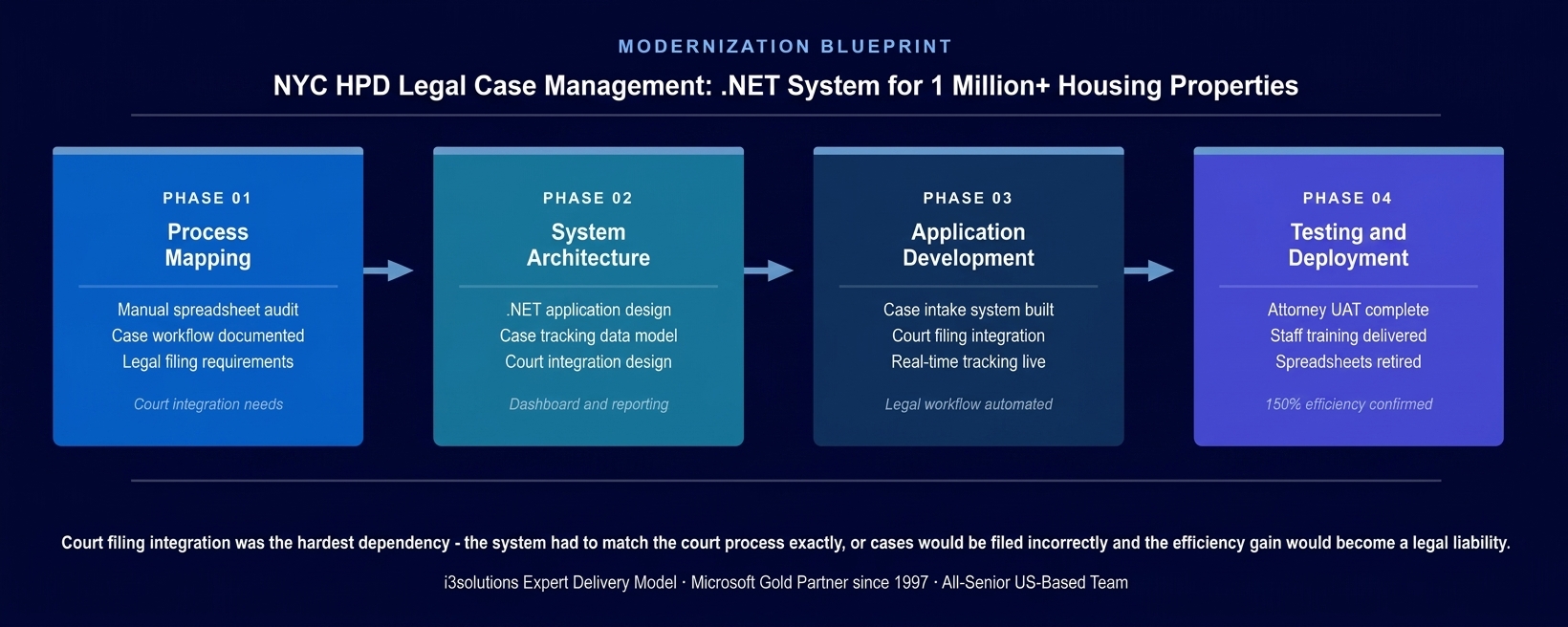
PHASE 01
Process Mapping
Documentation of the court case filing process from violation identification through resolution. Manual step mapping identifying error and delay sources. Court integration and legal filing requirements.
PHASE 02
System Architecture
.NET application architecture. Case tracking data model. Court filing integration design. Real-time dashboard and analytics specifications.
PHASE 03
Application Development
Case intake replacing spreadsheet rows. Court filing integration for digital submission. Real-time status tracking. Legal workflow routing through required review steps. Analytics dashboard for management.
PHASE 04
Testing and Deployment
Attorney UAT across the full case lifecycle. Staff training. Spreadsheets retired. 150% efficiency gain and 50% cost reduction confirmed.
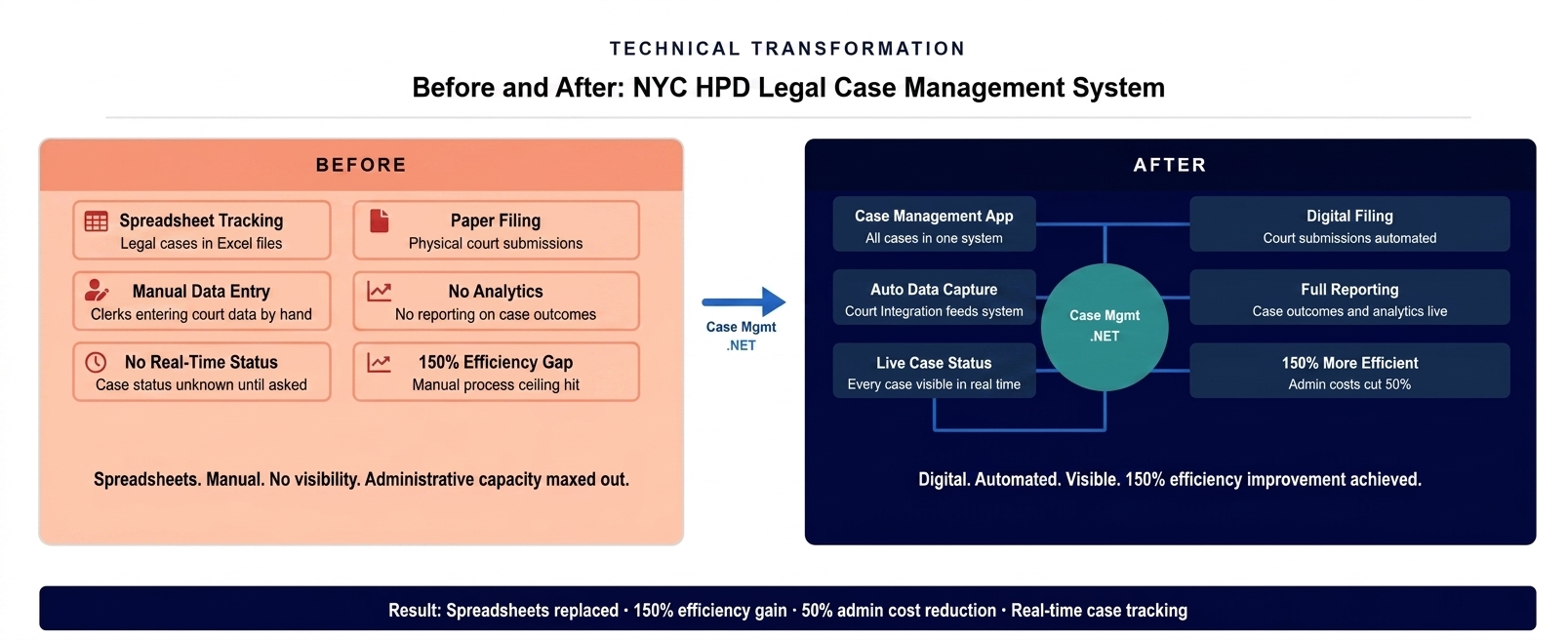
Technical Transformation
Measurable Outcomes
| Metric | Before | After | Improvement |
|---|
| Case tracking method | Spreadsheets – manually maintained | Custom .NET application with real-time tracking | Spreadsheets replaced |
| Case status visibility | Unknown until someone was asked | Real-time visibility for all authorized staff | Live case status |
| Court filing | Manual paper submission | Digital court filing integration | Filing automated |
| Analytics | No reporting on case portfolio | Full analytics dashboard across legal portfolio | Analytics active |
| Legal staff efficiency | Constrained by administrative overhead | 150% more efficient – focused on legal work | 150% efficiency gain |
| Administrative cost | Significant manual case management overhead | Reduced 50% through automation | 50% cost reduction |
[PENDING-CLIENT-QUOTE: insert 1-3 sentence outcome-focused quote in the client’s own language from a role matching the reader’s role.]
[Name or Role], [Organization type]
Frequently Asked Questions
Legal Case Management Systems for Municipal and Government Agencies
What is a legal case management system for municipal housing agencies?
A legal case management system for municipal housing agencies is a custom application that replaces spreadsheet-based case tracking with a centralized database that maintains real-time case status, automates court filing, provides analytics across the full case portfolio, and routes cases through required legal review and approval workflows. For agencies like the municipal housing authority managing thousands of active cases against a portfolio of one million-plus properties, a purpose-built case management system is the infrastructure that makes it possible to operate a legal enforcement program at scale, something no spreadsheet, regardless of how elaborate, can deliver.
How does i3solutions approach a custom legal case management engagement?
i3solutions begins legal case management engagements with detailed process mapping of the existing case workflow, every step from violation identification through case resolution, every manual handoff, every point where the spreadsheet-based system creates errors or delays. The application architecture is then designed to support the actual legal workflow, including court filing integration, approval routing, and the specific data fields and status categories that attorneys and legal support staff use. For the municipal housing authority, this meant a .NET application with court filing integration that matched the municipal housing authority’s actual legal process exactly, not a generic case management tool that the municipal housing authority’s legal team had to adapt to.
How does court filing integration improve legal operations for government agencies?
Court filing integration improves legal operations by eliminating the manual data entry step between the case management system and the court’s electronic filing system. Without integration, legal staff must enter case information in the case management system, then re-enter the same information in the court’s system to file, creating duplication of effort, error risk in legal filings, and a gap in the case record where the filing action is not automatically captured. With integration, a filing action taken in the case management system transmits directly to the court system, with the result automatically recorded in the case record. the municipal housing authority’s 150% efficiency improvement was largely driven by eliminating the manual double-entry that paper-based filing created.
What analytics does a legal case management system provide for government enforcement programs?
A legal case management system provides analytics across the full enforcement portfolio: case volume by violation type, property type, and neighborhood; resolution rates and average time to resolution by case category; court hearing schedules and compliance deadlines; attorney and staff workload distribution; and trends in filing and resolution patterns over time. For the municipal housing authority, these analytics transformed enforcement management from reactive case-by-case oversight to portfolio-level strategic management, allowing leadership to identify where enforcement resources were most needed, which violation types were resolving efficiently and which were not, and how the program was performing against housing quality outcomes.
Why choose i3solutions for a government legal case management system?
i3solutions brings three specific advantages to government legal case management engagements: deep .NET custom application development expertise for complex legal workflow requirements, experience navigating court system integration requirements that are specific to each jurisdiction, and an all-senior delivery model that keeps experienced architects engaged through the full engagement rather than transitioning to junior developers after the design phase. Legal case management systems have narrow tolerance for error, a case management system that loses a filing date, misroutes an approval, or fails to record a court action creates legal and operational consequences that generic project delays do not. i3solutions has been a Microsoft Gold Partner since 1997 and delivered 600+ enterprise implementations specifically because that level of consequence requires that level of experience.
Back to Case Study Library
60 enterprise Microsoft implementations documented
Related Insights
From the i3solutions YouTube Channel
Short-form perspectives on the delivery and technology challenges in this case study.
Who This Engagement Serves
This engagement is relevant if
- A large-scale public entity managing high-volume legal caseloads within critical urban infrastructure projects.
- A municipal department requiring centralized, real-time attorney visibility across thousands of decentralized regulatory enforcement actions.
- Any city agency needing to transition from manual, paper-based legal tracking to transparent digital workflows.
Less relevant if
- A boutique private law firm that manages only a few highly complex litigation cases annually.
- An organization seeking a pre-built legal software product rather than a tailored solution for unique processes.
Ready to replace spreadsheet-based legal case management with a purpose-built application?
The 15-Business-Day Microsoft Assessment maps the case tracking data model, court integration requirements, and analytics architecture for a legal case management system scaled to your enforcement portfolio.
Microsoft Gold Partner since 1997. 600+ implementations. All senior. All US-based.
Schedule the Assessment