Case Study • Aviation Standards / Federal Nonprofit • Azure Platform
Outdated System, 5,000 Waiting Users: How the aviation standards organization Built an Azure Aviation Standards Platform

The Enterprise Challenge
Azure Application Development for Aviation Standards Committees
the aviation standards organization, Inc. is a nonprofit organization that develops technical guidance for the aviation industry by convening committees of experts from the FAA, airlines, equipment manufacturers, and other aviation stakeholders. The the aviation standards organization committee process produces the technical standards – MOPS, MPS, and other guidance documents – that govern the development, certification, and operation of aviation technology. The committees that produce these standards include participants from dozens of organizations, operating across the regulatory, industry, and manufacturing sectors of the aviation ecosystem.
The platform supporting this committee process had become a constraint. Participants from the FAA, airlines, avionics manufacturers, and other organizations – approximately 5,000 users in total – needed to collaborate on technical documents, cast votes on standards proposals, coordinate meeting schedules, and access committee resources. The existing system had been built for a smaller, simpler committee structure and could not adequately support the digital collaboration, structured voting, and multi-organization access control that a modern standards development process required.
i3solutions developed a new Azure-based committee collaboration platform that modernized the aviation standards organization’s digital infrastructure: multi-organization access control allowing participants from FAA, airlines, and manufacturers to operate within a single platform with appropriate permission boundaries; structured digital voting replacing paper or email balloting; event scheduling and coordination tools; and document collaboration capability for the technical content that committees produce.
Strategic Trigger
A Standards-Setting Process Cannot Run on a Below-Standard Platform
The forcing function was the incongruity between the technical sophistication of the aviation standards the aviation standards organization was developing and the inadequacy of the collaboration platform its committees were using to develop them. An organization whose mission is to advance aviation technology through rigorous technical standards development was asking 5,000 aviation experts – including FAA engineers, airline operations staff, and avionics manufacturers – to collaborate through a system that was not designed for their scale or their multi-organization access requirements.
The voting process was the most visible gap. Committee voting on standards proposals is a formal, documented process – the record of how participants voted matters for the integrity of the standards development process. Paper or email-based balloting creates a documentation and audit challenge that a structured digital voting system eliminates. For the aviation standards organization, replacing informal voting methods with a structured digital process was both an operational improvement and a governance requirement.
Is your standards or committee organization running on a platform that cannot support your participant scale?
If multi-organization participants are collaborating through a system that was designed for a smaller, simpler process, the platform is constraining the work. A 15-Business-Day Microsoft Assessment maps the Azure architecture that would deliver multi-org access control, structured voting, and collaboration capability at your scale.
Request the Assessment
Stakes
Regulatory Compliance Failure Risks Grounding New Aircraft Fleets
Aviation technology evolves rapidly; the aviation standards organization must harmonize standards alongside this innovation. Inaction in streamlining collaboration would directly impact global flight safety and commerce. A failure to deliver timely and consolidated Minimum Operational Performance Standards (MOPS) would grind the Federal Aviation Administration (FAA) aircraft certification process to a halt. When new aircraft designs cannot receive airworthiness certification on time, massive delays occur, costing millions in lost revenue for manufacturers, and the airlines cannot deploy new, more efficient, and safer jets as planned. Efficiency in standard development directly impacts safety and economic viability.
the aviation standards organization is the trusted authority for consensus-based technical standards used by the FAA. If their coordination process remains fragmented, they risk losing this central, trusted status to more agile international bodies or private consortia. Furthermore, fragmented collaboration invites inconsistency in standards development. This variance introduces uncertainty in standard application, potentially exposing the entire aviation ecosystem to liability and safety compromises. The lack of a secure, unified collaboration platform also introduces critical intellectual property and security risks, jeopardizing the integrity of the data shared between government and private sector participants in this crucial industry.
Constraints and Complexity
Securely Consolidating Highly Confidential and Proprietary Aviation Data
The solution had to serve thousands of diverse stakeholders from dozens of competing aviation organizations, each with varying levels of technology stack and strict security requirements. The the aviation standards organization platform needed to manage granular access control, ensuring that only authorized individuals could access specific, highly confidential technical data and proprietary intellectual property. This strict segmentation was crucial for maintaining trust and ensuring compliance with strict data protection regulations. The Azure infrastructure required FedRAMP or equivalent certifications to handle information relevant to critical infrastructure and national security, making this integration far more complex than a standard commercial implementation.
Years of critical standards data, meeting minutes, and draft documents were distributed across numerous disparate, disconnected locations, including personal file shares and varying legacy portals. Migrating this massive volume of unstructured data into a structured, searchable Azure environment while maintaining data integrity, version history, and access control was a major challenge. The solution also needed a highly intuitive user interface to ensure adoption among non-technical committee members. Forcing new collaboration workflows on these stakeholders, especially given the strict deadlines for standard delivery, required a change management approach as robust as the technology stack itself.
Selection Rationale
Senior Microsoft Specialists with Proven Delivery Depth
During the initial evaluation, the aviation standards organization considered large international consulting firms that offered broad services, but many of these firms relied on a “commodity staffing” model, leveraging a mix of juniors and offshore resources. the aviation standards organization quickly realized that this complex Azure integration required specialists who could navigate rigorous federal security standards, not generalists learning on the project. These large firms often couldn’t guarantee consistent quality or deep, localized expertise in Azure’s higher-level security features required for FedRAMP. The unique needs of integrating with aviation standards demanded a level of focus and specialization that larger, more generalized firms were not equipped to deliver efficiently.
i3solutions emerged as the premier choice because they are not just Microsoft Gold Partners, but specialists with a long history of successful, complex cloud implementations. Since 1997, they have focused exclusively on Microsoft technologies, and with over 600 implementations, they possess unmatched depth and practical experience. Crucially, i3solutions utilizes an all-senior, all-US-based staffing model. This ensured that the aviation standards organization received immediate, expert-level attention for security and technical challenges, without the time zone, language, or regulatory complications common with offshore teams. i3solutions’ proven track record in complex integrations, particularly those requiring high-level security, gave the aviation standards organization complete confidence.
The Engagement Approach
PHASE 01
Requirements and Legacy Analysis
Audit of the legacy system – its capabilities, limitations, and the specific committee workflow gaps it was unable to address. Requirements gathering across committee participant types: FAA engineers, airline representatives, and manufacturers, each with different organizational contexts and platform needs. Identification of the multi-organization permission model required. Output: the complete platform requirements specification for the Azure development engagement.
PHASE 02
Azure Architecture
Azure Active Directory multi-organization architecture enabling participants from dozens of organizations to authenticate and operate within the platform with appropriate permission boundaries. Committee permission model design governing which participants could access which committee resources. Voting system architecture for structured, documented digital balloting. Event scheduling and calendar integration for committee coordination. Document collaboration architecture for technical standards content.
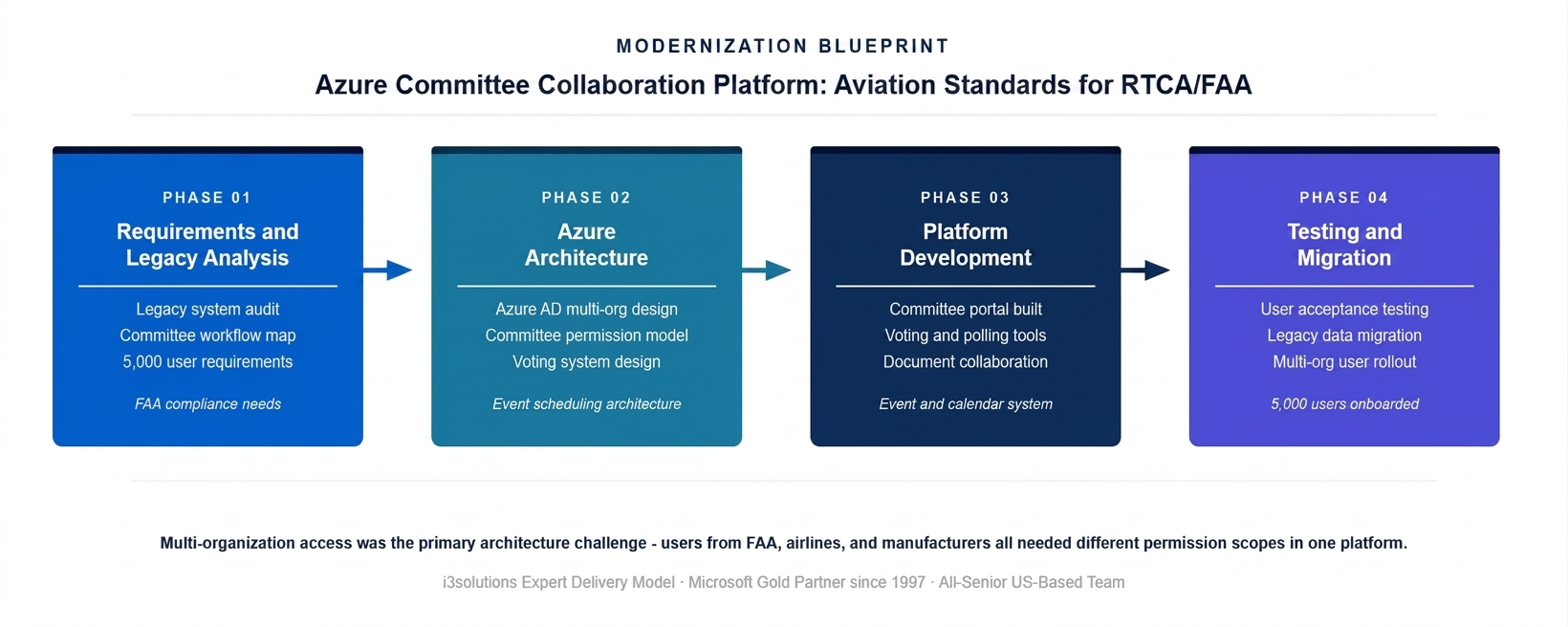
The four-phase approach. Multi-organization Azure AD architecture was the design decision that everything else depended on – getting the identity federation right in Phase 2 determined whether all 5,000 participants could access the platform with the right permissions from day one.
PHASE 03
Platform Development
Committee portal built on Azure with multi-organization access control allowing FAA, airline, and manufacturer participants to operate within appropriate permission boundaries. Structured voting and polling system providing documented, auditable digital balloting for standards proposals. Document collaboration workspace for committee technical content. Event scheduling and committee calendar for meeting coordination. Admin interface for the aviation standards organization staff managing committee composition and access.
PHASE 04
Testing and Migration
User acceptance testing with representatives from each participant organization type. Legacy data migration bringing historical committee content and membership records into the new platform. Multi-organization user rollout onboarding participants from FAA, airlines, manufacturers, and other aviation stakeholders. Full 5,000-user population onboarded. Legacy system retired.
Technical Transformation
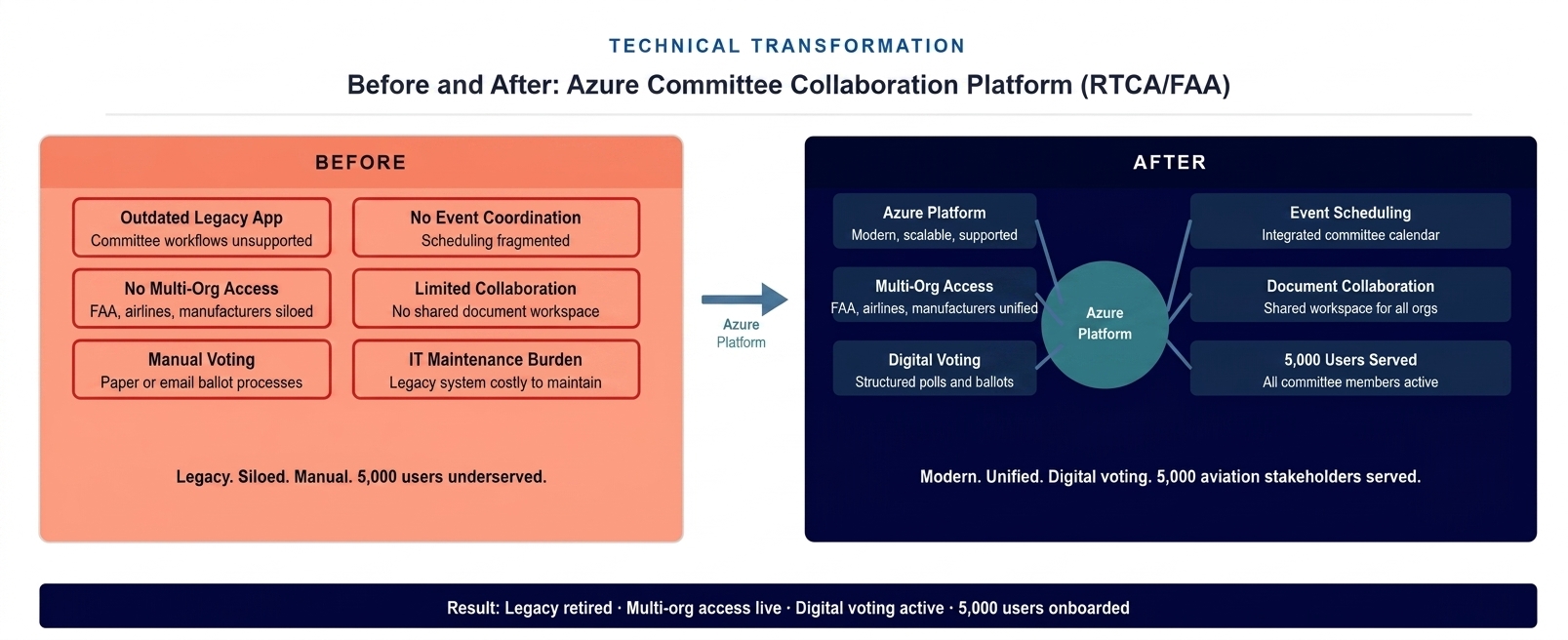
The platform state before and after. Legacy committee system with no multi-org access, no digital voting, and no event coordination replaced by a modern Azure platform serving 5,000 aviation stakeholders from FAA, airlines, and manufacturers.
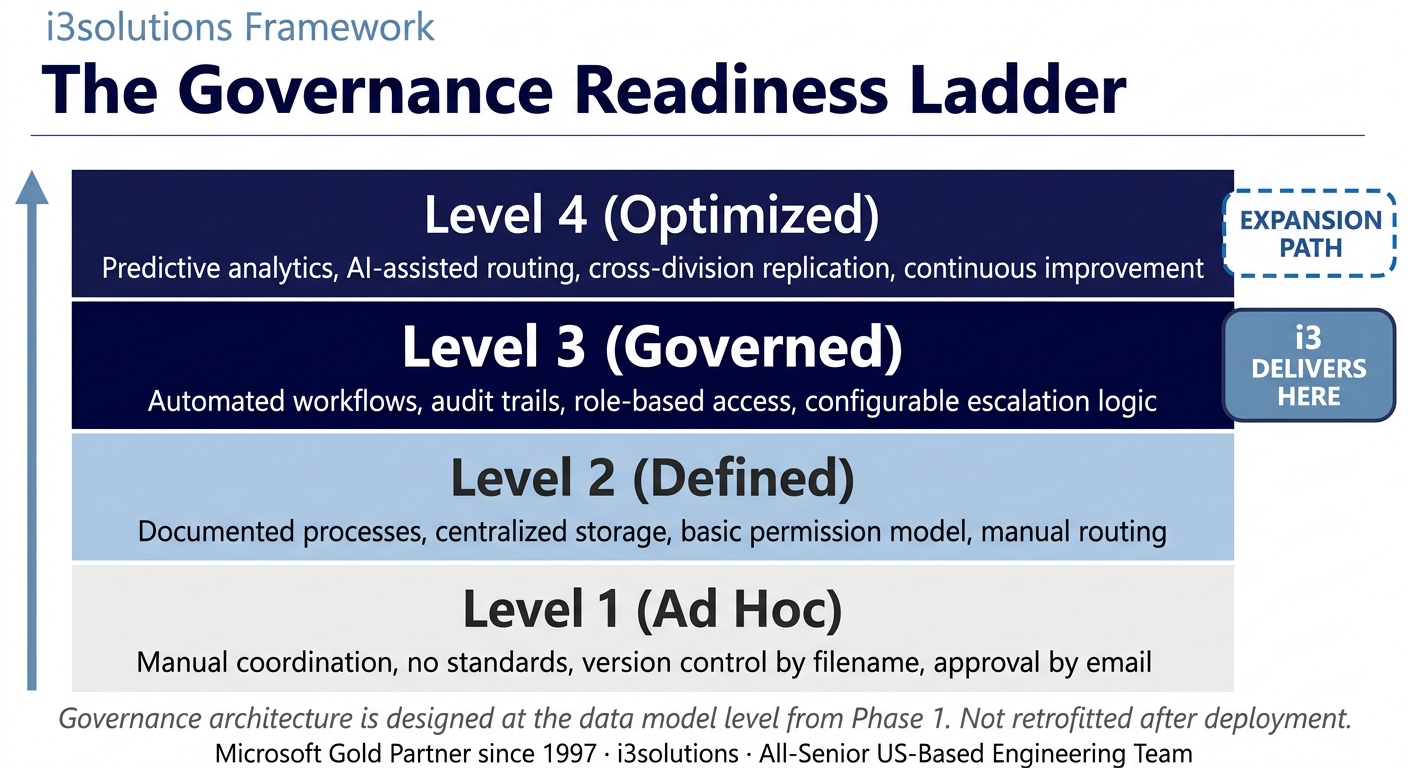
The Governance Readiness Ladder applied. The Azure committee platform delivered Level 3 collaboration governance. The architecture supports Level 4 as analytics on committee participation and standards development metrics mature.
Measurable Outcomes
| Metric | Before | After | Improvement |
|---|
| Platform capability | Legacy system unable to support modern committee collaboration requirements | Azure platform with multi-org access, digital voting, and document collaboration | Full committee platform live |
| Multi-org access | Not available – participant organizations managed separately | FAA, airlines, manufacturers in single platform with appropriate permissions | Multi-organization access delivered |
| Voting process | Paper or email – no structured digital balloting | Structured digital voting with complete audit trail | Digital voting active |
| Event coordination | Fragmented – scheduling not integrated with committee platform | Integrated committee calendar and event scheduling | Coordination centralized |
| User base served | Small legacy system – inadequate for the full participant population | 5,000 aviation stakeholders onboarded and active | 5,000 users served |
| Document collaboration | Limited – no shared workspace for technical committee content | Full document collaboration workspace for committee technical content | Collaboration capability delivered |
[PENDING-CLIENT-QUOTE: insert 1-3 sentence outcome-focused quote in the client’s own language from a role matching the reader’s role.]
[Name or Role], [Organization type]
Frequently Asked Questions
Azure Application Development for Aviation Standards and Committee Organizations
What is azure application development for committee and standards organizations?
Azure application development for committee and standards organizations involves building custom platforms on Microsoft Azure that support the specific collaboration, voting, and access control requirements of multi-organization standards development processes. Key capabilities include Azure Active Directory federation for multi-organization authentication, structured digital voting for formal balloting on standards proposals, document collaboration workspaces for technical content development, and event scheduling tools for committee meeting coordination, all within a permissions model that allows participants from different organizations to operate with appropriate access boundaries in a single governed platform.
How does i3solutions architect a multi-organization Azure platform for aviation industry stakeholders?
i3solutions architects multi-organization Azure platforms using Azure AD B2B federation, which allows users from external organizations, FAA, airlines, manufacturers, to authenticate using their own organizational credentials and access resources in the host Azure tenant with permissions granted by the host organization. The committee permission model is designed at the architecture phase: which participant types have access to which committees, which content is restricted to full members versus observers, and how the permission structure maps to the actual governance model of the standards organization. For the aviation standards organization’s 5,000-user platform serving the FAA and dozens of aviation industry organizations, getting the permission architecture right in Phase 2 determined whether every participant could access exactly what they needed and nothing more.
How does structured digital voting improve aviation standards committee governance?
Structured digital voting improves aviation standards committee governance by converting informal or paper-based balloting into a documented, auditable process with consistent format, automatic tabulation, and a complete record of every participant’s vote. For standards organizations like the aviation standards organization, the record of how members voted on a standards proposal is part of the governance record of that standard, it demonstrates that the adoption process followed the organization’s procedures and that member input was properly recorded. Digital voting also improves participation rates through deadline notifications and automatic reminders, and eliminates the administrative burden of manual ballot collection and tabulation that paper or email voting imposes on committee administrators.
What does i3solutions’s approach to legacy data migration look like for a committee platform?
i3solutions approaches legacy data migration for committee platforms by inventorying the historical content, prior meeting records, past voting results, archived committee documents, member rosters, and assessing which content is worth migrating into the new platform versus which should be archived externally. For the aviation standards organization, historical committee content that members would need to reference in current standards work was migrated into the Azure platform and indexed for search, making it accessible in the same environment as current work rather than requiring members to access a legacy archive. Migration is sequenced to confirm content integrity before the legacy system is retired.
Why choose i3solutions for an aviation industry standards platform on Azure?
i3solutions has built standards and collaboration platforms for aviation, defense, and federal organizations where multi-organization access control and formal governance process requirements are non-negotiable. The specific combination of Azure AD B2B federation expertise, structured voting implementation experience, and multi-organization permission architecture depth is not common in the Microsoft partner ecosystem. i3solutions brings that combination along with an all-senior delivery model that keeps experienced architects engaged through the full engagement, critical when the platform serves 5,000 users across dozens of organizations and permission or federation errors affect everyone simultaneously. Microsoft Gold Partner since 1997. 600+ enterprise implementations.
Back to Case Study Library
60 enterprise Microsoft implementations documented
Related Insights
From the i3solutions YouTube Channel
Short-form perspectives on the delivery and technology challenges in this case study.
Who This Engagement Serves
This engagement is relevant if
- Aviation standards bodies using disparate legacy systems for critical member collaboration and document management functions.
- Global regulatory organizations requiring secured, centralized cloud platforms for complex multi-stakeholder governance processes.
- Complex technical consortia struggling with version control and consensus-building across fragmented communication channels.
Less relevant if
- Small organizations with minimal collaborative requirements easily managed through basic, off-the-shelf software solutions.
- Entities demanding strictly on-premises infrastructure due to severe regulatory constraints that preclude cloud adoption.
Ready to build an Azure collaboration platform for your multi-organization committee process?
The 15-Business-Day Microsoft Assessment maps the Azure AD multi-org architecture, committee permission model, digital voting system, and document collaboration design that would modernize your standards development platform for the full participant population it serves.
Microsoft Gold Partner since 1997. 600+ implementations. All senior. All US-based.
Schedule the Assessment