Case Study • Financial Services / Investment Management • Workflow Automation
No Methodology, Four Transaction Types, Client Money at Stake: How Brown Advisory Built Its Cash Processing System

The Enterprise Challenge
Financial Workflow Automation for an Independent Investment Management Firm
Brown Advisory is an independent investment management and strategic advisory firm serving individuals, families, nonprofits, institutions, and financial intermediaries. The firm manages active public equity and fixed income strategies and holds reliability and trust as core commitments – qualities that depend in part on the operational precision with which client money is handled. When the process for managing client portfolio transactions is manual, undocumented, and methodologically inconsistent, that precision is at risk.
Brown Advisory’s cash processing function managed four distinct transaction types, each with its own process flow, approval requirements, and compliance considerations. None of these four processes was automated. All four ran through manual steps that varied in execution depending on who was handling the transaction on a given day. And the firm had no software development methodology – no documented approach for how technology solutions would be designed, tested, and deployed when business processes needed system support. The combination of manual processing, process inconsistency, and the absence of a methodology meant that building the right solution required starting from further back than just the application development.
i3solutions designed and developed a custom Cash Processing System built on SharePoint and Nintex that automated all four transaction types with structured approval workflows, created comprehensive process documentation – including process maps and wireframes – and introduced a software development methodology that Brown Advisory subsequently adopted for all SharePoint and custom application development across the firm.
Strategic Trigger
Manual Cash Processing for Client Portfolios Is a Compliance Risk, Not Just an Efficiency Problem
The forcing function was the combination of client money, manual processes, and the absence of a consistent methodology. When four transaction types affecting client portfolios are each executed manually and inconsistently, the risk is not primarily that the process is slow – though it is. The risk is that a manual error in a client money process produces an outcome that damages the client relationship and potentially the regulatory standing of the firm. For an investment management firm whose reputation rests on the precision with which it handles client assets, manual cash processing was a compliance and reputational risk, not just an operational inefficiency.
The methodology gap was the second driver, and it made the application development challenge more complex. Brown Advisory could not simply describe their existing process and ask for it to be automated – the existing process was undocumented and inconsistent. The engagement therefore required collaborative process documentation first, creating the process maps and wireframes that defined how the Cash Processing System should work before any development began. The methodology established during this engagement then became the standard approach for all subsequent technology initiatives at the firm.
Are manual cash or financial processing workflows creating compliance risk at your investment management firm?
If client money transactions are processed through undocumented manual workflows without structured approval routing and audit trails, the process is a compliance risk. A 15-Business-Day Microsoft Assessment maps the SharePoint and Nintex architecture that automates your transaction types with documented approval workflows and complete audit controls.
Request the Assessment
Stakes
Regulatory non-compliance and financial loss from manual workflows.
The absence of an automated investment approval process created significant regulatory and financial risks for Brown Advisory. Continued reliance on manual workflows meant that critical decision-making processes were undocumented, leaving the firm vulnerable to severe non-compliance penalties and audit failures. Inaccurate tracking of investment decisions could lead to significant financial losses and operational inefficiencies. Immediate remediation was required to safeguard the firm’s assets, ensure compliance, and mitigate the dangers inherent in these outdated manual practices.
Beyond financial and operational risks, the manual workflow placed Brown Advisory’s reputation and long-term strategy at risk. In an industry where trust and precision are paramount, prolonged inefficiencies could erode client confidence and jeopardize future business opportunities. The inability to produce a comprehensive audit trail could attract negative scrutiny from regulators, potentially damaging the firm’s standing. Failure to address these critical issues could have lasting repercussions, hindering growth and limiting the firm’s capacity to adapt to future challenges and market demands.
Constraints and Complexity
Ensuring strict data security while maintaining operational agility.
Implementing an automated approval system presented significant challenges in balancing strict security protocols with operational efficiency. The nature of the financial industry required unwavering data integrity and access control, making the integration of new technology while protecting sensitive client and firm data a complex task. Adapting existing processes to a new digital system required careful navigation of internal policies and external regulations, adding another layer of complexity to the implementation project and demanding a high level of specialized technical and industry knowledge.
Migrating from established manual workflows to an automated system required substantial change management. Staff were accustomed to existing processes, making initial adoption difficult. Ensuring data consistency during the transition and minimizing disruption to ongoing operations were crucial for success. The complex data landscape and need for integration with other systems made the data migration particularly challenging, requiring meticulous planning and execution to ensure no critical data was lost or compromised during the process. Training staff and fostering widespread acceptance of the new technology was essential to realize the full benefits of the automated system.
Selection Rationale
Senior Microsoft Specialists with Proven Delivery Depth
Brown Advisory evaluated large consulting firms and offshore commodity staffing models. However, large firms often prioritized a standardized approach, potentially missing the nuanced complexities of the asset management industry and requiring costly customization. Offshore commodity staffing presented communication barriers and potentially reduced alignment with the firm’s specific requirements. These alternatives were ultimately deemed inadequate because they lacked the tailored focus and specialized, senior-level attention necessary to successfully navigate the complex regulatory and operational constraints and deliver a solution that truly addressed Brown Advisory’s unique needs.
Brown Advisory selected i3solutions due to our unmatched expertise and track record. We are a Microsoft Gold Partner since 1997, demonstrating a long-standing commitment to the platform and a profound understanding of its capabilities. We have delivered over 600 successful implementations across a broad spectrum of industries, which testifies to our deep experience and proven methodologies. Crucially, all our team members are senior specialists based in the United States, which ensures that Brown Advisory received dedicated, high-quality attention from experts deeply integrated into the American business and regulatory environment, leading to a more robust, reliable, and effective solution.
The Engagement Approach
PHASE 01
Process Documentation
Collaborative process documentation with Brown Advisory’s cash team: working sessions to surface and document the actual steps in each of the four transaction types, identifying variations in execution and the points where inconsistency created compliance risk. Comprehensive process maps capturing each workflow from initiation through completion. Wireframe diagrams translating the process documentation into system design. Output: the process specification and wireframes that the Cash Processing System would implement, and the foundation of the SDLC methodology that would govern all future development.
PHASE 02
System Architecture
SharePoint data model supporting the four transaction type workflows with appropriate data structure and access controls for client portfolio information. Nintex workflow design for each transaction type’s approval routing, notifications, and escalation rules. SDLC methodology documentation establishing the development, testing, and deployment standards that the Cash Processing System would follow and that Brown Advisory would adopt for all subsequent technology initiatives.
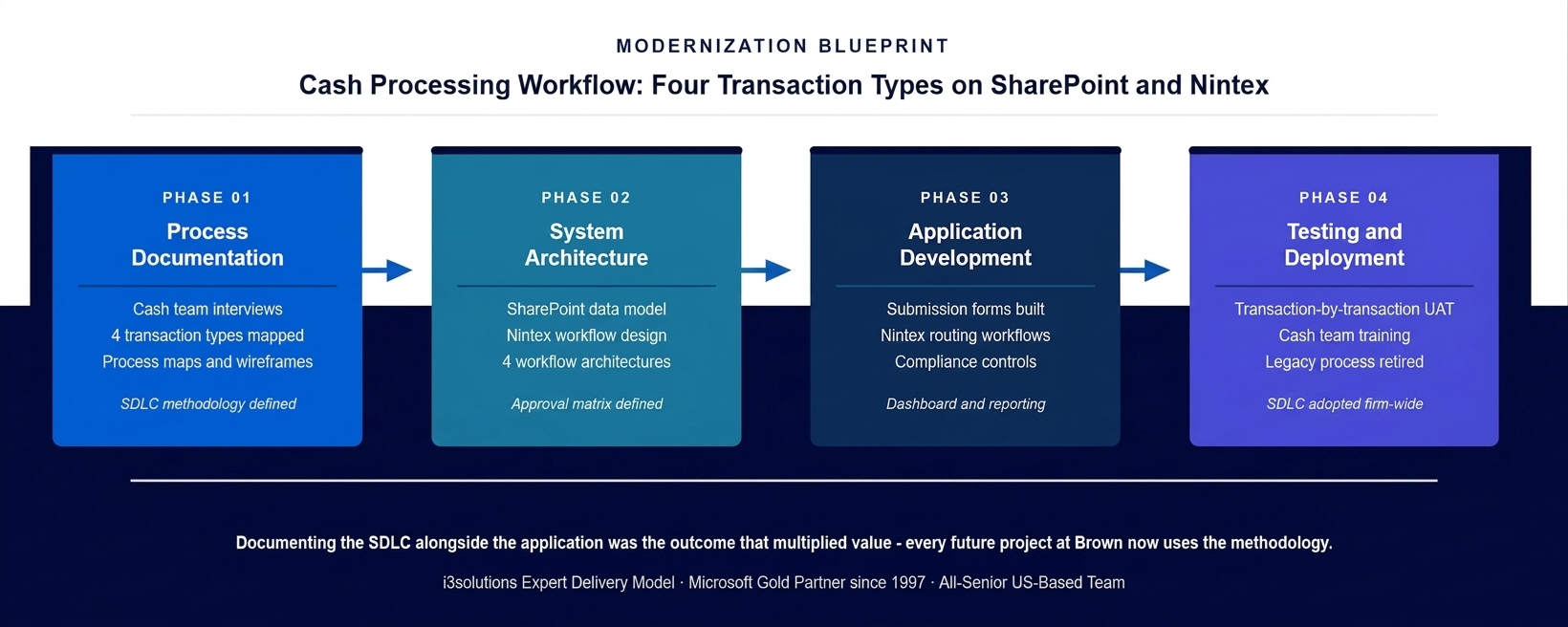
The four-phase approach. Starting with process documentation rather than development was the discipline that made the difference. A Cash Processing System built on an undocumented process would have automated the inconsistency rather than eliminating it.
PHASE 03
Application Development
Custom SharePoint application built for each of the four transaction types with appropriate submission forms, data validation, and audit trail controls. Nintex workflows routing each transaction type through its configured approval chain with notifications, escalation rules, and complete action logging. Compliance controls embedded at each transaction stage. Dashboard and reporting capability providing Brown Advisory’s cash team and compliance staff visibility into transaction status and history.
PHASE 04
Testing and Deployment
Transaction-by-transaction user acceptance testing with Brown Advisory’s cash team, working through each of the four transaction types against real-world scenarios. Training for cash team staff on the system workflow and exception handling. Manual processes retired. SDLC methodology formally adopted by Brown Advisory for all subsequent SharePoint and custom application development. Post-deployment monitoring confirming processing accuracy and compliance control function.
Technical Transformation
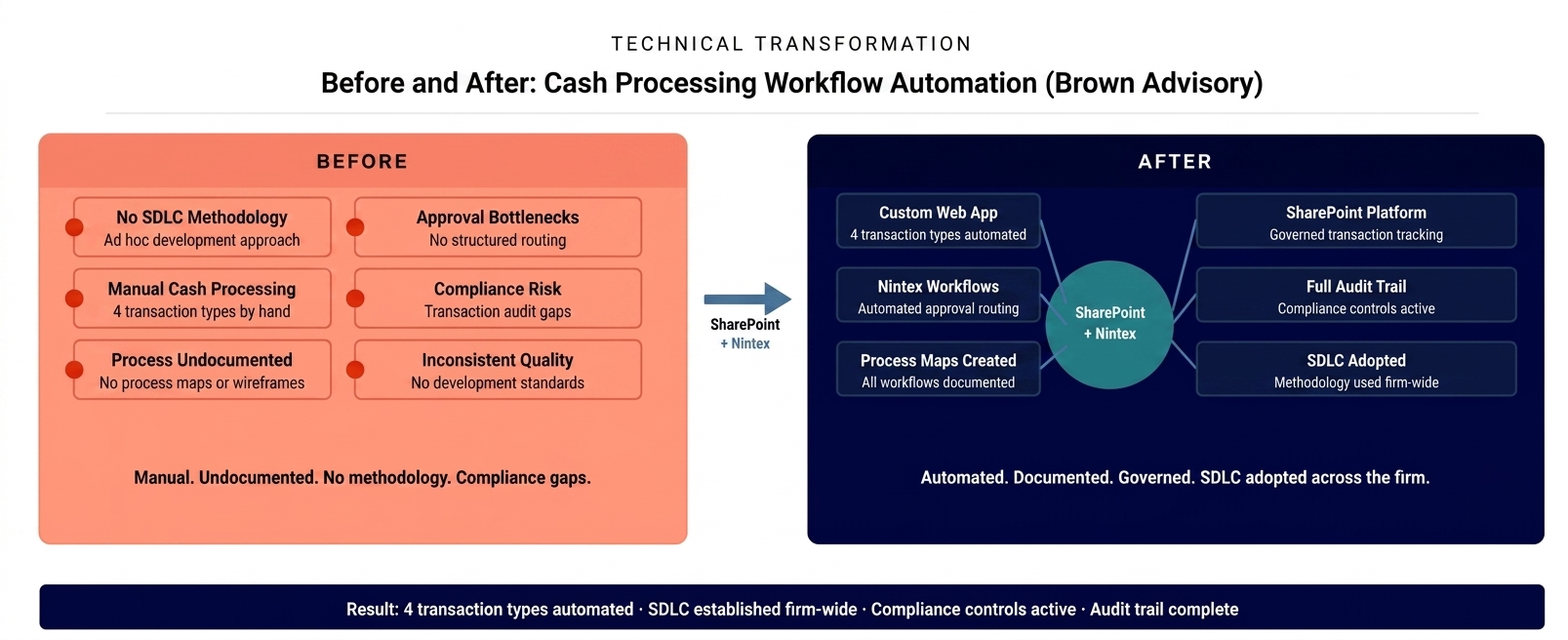
The transaction processing state before and after. Manual, undocumented processing for four transaction types replaced by automated SharePoint and Nintex workflows with structured approval routing, compliance controls, and full audit trail – plus an SDLC methodology adopted firm-wide.
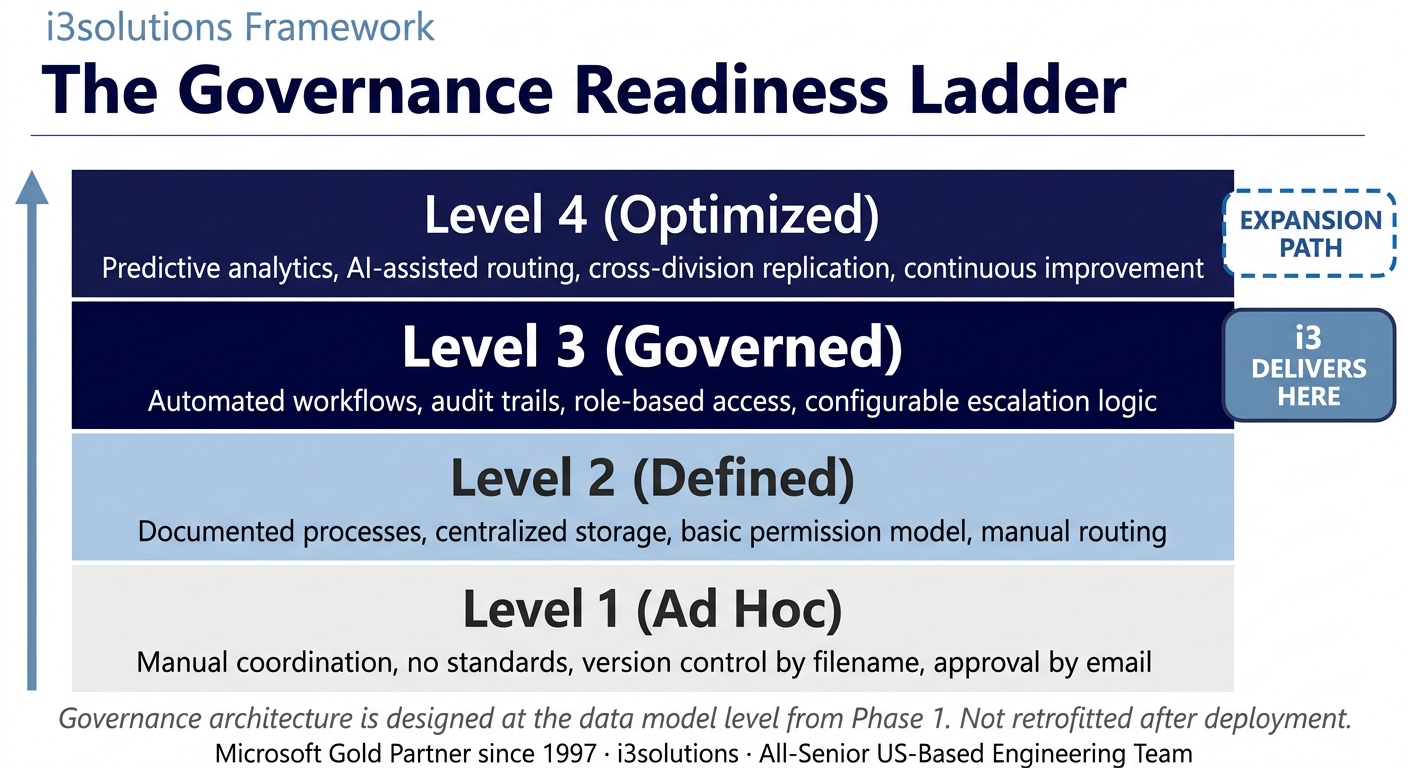
The Governance Readiness Ladder applied. The Cash Processing System delivered Level 3 financial workflow governance. The SharePoint architecture and adopted SDLC methodology support Level 4 as advanced compliance analytics and process automation expand.
Measurable Outcomes
| Metric | Before | After | Improvement |
|---|
| Transaction processing | Manual – four transaction types processed inconsistently by hand | Automated – four transaction types on structured SharePoint/Nintex workflows | All four types fully automated |
| Process documentation | None – no documented process maps or workflow specifications | Comprehensive – process maps and wireframes for all four transaction types | Full process documentation created |
| Approval routing | Ad hoc – approval chain inconsistent across transactions | Structured Nintex workflows – consistent routing, escalation, and logging | Structured approval routing active |
| Audit trail | Incomplete – manual process left gaps in the transaction record | Complete – every transaction stage logged with timestamp and actor | Full audit trail achieved |
| Compliance controls | Inconsistent – dependent on individual execution of manual steps | Embedded – controls enforced by workflow at each required stage | Compliance controls enforced systematically |
| Software development methodology | None – no standard approach for technology development | SDLC adopted firm-wide for all SharePoint and custom application development | SDLC adopted across the firm |
[PENDING-CLIENT-QUOTE: insert 1-3 sentence outcome-focused quote in the client’s own language from a role matching the reader’s role.]
[Name or Role], [Organization type]
Frequently Asked Questions
Financial Workflow Automation for Investment Management Firms
What is financial workflow automation for investment management firms?
Financial workflow automation for investment management firms involves replacing manual transaction processing, cash management, portfolio transactions, client money movements, with structured SharePoint and workflow automation systems that enforce consistent approval routing, embed compliance controls at each process stage, create a complete audit trail of every transaction action, and provide management and compliance staff with real-time visibility into transaction status and history. For Brown Advisory, this meant automating four distinct transaction types, each with its own unique process, approval requirements, and compliance considerations, within a single governed platform.
How does i3solutions approach financial workflow automation for a firm without an existing SDLC methodology?
When i3solutions engages a firm that lacks a documented software development methodology, the SDLC establishment is part of the engagement deliverable, not a prerequisite. For Brown Advisory, we began with collaborative process documentation, working sessions with the cash team to surface and document the actual steps in each of the four transaction types, identifying variations in execution and the points where inconsistency created compliance risk. The process documentation became both the specification for the Cash Processing System and the foundation of the SDLC methodology that Brown Advisory subsequently adopted for all SharePoint and custom application development. The methodology that governed the cash system engagement became the standard for every future technology initiative at the firm.
What compliance controls should a financial cash processing system include?
A financial cash processing system should include: mandatory approval routing that enforces required sign-offs before transactions proceed; data validation preventing transactions from advancing with missing or invalid information; segregation of duties controls preventing the same individual from both initiating and approving transactions; complete audit trail logging every action with timestamp and actor identity; exception handling requiring documented resolution before a non-standard transaction can complete; and reporting capability providing compliance staff visibility into transaction history and any exception events. These controls should be embedded in the workflow logic, enforced by the system, rather than dependent on individual execution of manual steps.
How does Nintex workflow automation integrate with SharePoint for financial transaction routing?
Nintex workflow automation integrates with SharePoint by accessing SharePoint list data and document library content to trigger, route, and complete workflows based on configured rules. For financial transaction routing, a Nintex workflow is configured for each transaction type with the specific approval chain, notification triggers, escalation rules, and compliance checkpoints that transaction type requires. When a cash team member submits a transaction through the SharePoint form, Nintex automatically routes it to the first approver, sends notifications, tracks approval status, escalates if deadlines are missed, and initiates the next step when approval is granted, creating a consistent, governed process regardless of which staff member handles the transaction on a given day.
Why choose i3solutions for financial workflow automation on the Microsoft platform?
i3solutions brings specific SharePoint and Nintex implementation depth for financial services workflows, combined with the SDLC methodology that ensures the system is built and tested to the standard that client money processes require. Financial workflow automation has a particular consequence profile: a system that routes transactions incorrectly, loses an audit trail record, or allows an unauthorized approval creates compliance exposure that a generic project delay does not. i3solutions’ all-senior delivery model keeps experienced architects engaged through the full engagement, and our pattern recognition from 600+ Microsoft platform implementations means common failure modes in financial workflow implementations, edge cases in approval routing, compliance gaps in audit trail design, are identified and addressed before go-live rather than discovered afterward. Microsoft Gold Partner since 1997.
Back to Case Study Library
60 enterprise Microsoft implementations documented
Related Insights
From the i3solutions YouTube Channel
Short-form perspectives on the delivery and technology challenges in this case study.
Who This Engagement Serves
This engagement is relevant if
- You use manual email approvals for high-stakes financial operations or investment decisions.
- Your current non-systematized workflow lacks an immediate, tamper-proof audit trail for regulatory compliance.
- Your organization uses Microsoft 365 and needs low-code solutions to automate internal request and approval processes.
Less relevant if
- Your firm already uses specialized third-party software with full audit logging for modern investment trade approvals.
- Your existing request-to-approval processes are entirely paper-based and resist digitization or cloud adoption.
Ready to automate client money workflows with embedded compliance controls?
The 15-Business-Day Microsoft Assessment maps the SharePoint data model, Nintex workflow configuration, compliance control architecture, and SDLC methodology for your specific transaction types and regulatory requirements – built on the Microsoft investment your firm already has.
Microsoft Gold Partner since 1997. 600+ implementations. All senior. All US-based.
Schedule the Assessment