Case Study • Telecommunications / Technology • Enterprise Intranet
A Cluttered Portal Nobody Used: How a Global Wireless Company Rebuilt Its Enterprise Intranet

The Enterprise Challenge
Enterprise Intranet Modernization for a Global Wireless Technology Company
A global leader in wireless communications technology recognized a problem that many large enterprises face: the company’s intranet, originally designed to serve as a central hub for documents and announcements, had become something it was never intended to be. Over time, the portal had accumulated content without coherent organization, navigation had become confusing and inconsistent, and employees – rather than using the intranet as the operational hub it was supposed to be – had developed workarounds: email chains for announcements that should have been in the portal, shared drives for documents that should have lived in a governed location, informal communication channels for coordination that the intranet should have supported.
The symptoms were consistent across departments: employees could not reliably find critical information when they needed it, the platform did not reflect how teams actually worked together, and there were no collaboration features – employee forums, team spaces, shared project areas – that would have made the intranet something employees chose to use rather than were required to use. Usage data confirmed what employee feedback expressed: the intranet was underutilized, and the workarounds employees had built around it were costing the organization coordination efficiency and information governance at scale.
i3solutions led a comprehensive overhaul of the enterprise intranet, beginning with user research that informed the entire redesign: simplified information architecture, advanced search capability, tailored department-level dashboards, employee forums for community building and collaboration, and a modern design that made the portal something employees engaged with because it made their daily work easier.
Strategic Trigger
Employee Workarounds Were the Signal That the Portal Had Failed Its Purpose
The forcing function was the combination of measurable underutilization and documented workarounds. When employees build consistent, informal systems around a platform that was designed to serve them, the signal is clear: the platform is not doing what it was built to do. The workarounds themselves are informative – each one identifies a specific gap between what the intranet offered and what employees actually needed. For a global wireless technology company, where cross-functional coordination, rapid information access, and employee engagement across distributed teams all matter, those gaps had a measurable cost.
The governance dimension added urgency. When employees bypass the intranet and manage information through email, shared drives, and informal channels, the organization loses the information governance that a well-structured intranet provides. Documents live in multiple inconsistent versions across email attachments and personal folders. Announcements reach only the employees who happened to be on the right email list. Project coordination happens in silos rather than in shared spaces where the full team can participate. Rebuilding the intranet as a platform employees chose to use was also rebuilding the information governance that underutilization had eroded.
Is your enterprise intranet underused while employees build workarounds around it?
If employees are managing information through email and shared drives rather than through the intranet because the portal does not reflect how they work, the adoption gap is diagnostic. A 15-Business-Day Microsoft Assessment maps the information architecture, search, dashboard, and collaboration features that would convert your intranet from an obligation into a tool employees choose.
Request the Assessment
Stakes
Operational inefficiencies and critical compliance vulnerabilities unchecked
A continuation of manual identity governance practices would have led to significant operational backlogs, increasing the burden on IT staff and delaying user access to essential resources. This slow response time directly impacts productivity and can cause considerable downtime for retail and corporate employees. Inaccurate or delayed user lifecycle management creates substantial compliance risks, potentially leading to audit failures, significant financial penalties, and breaches of sensitive data. In the event of a security incident, the lack of an automated process would hinder the ability to rapidly revoke access, increasing the potential for data loss and damage.
The manual approach and absence of automated provisioning would have broader repercussions on the brand and business strategy. A security breach resulting from poor identity management could severely damage Le Creuset’s hard-earned reputation for quality and trust, eroding consumer confidence. This reputational damage can have a long-lasting impact on sales, profitability, and future business opportunities. Inability to efficiently onboard and manage identities would impede agility, making it difficult to scale operations or rapidly adapt to evolving market conditions. This operational rigidity could limit the brand’s ability to innovate and respond to changing customer demands, potentially leading to a competitive disadvantage.
Constraints and Complexity
Integrating highly customized, legacy retail systems
Integrating Entra ID with Le Creuset’s diverse and often customized retail systems presented a complex technical challenge. Many legacy applications lacked native support for modern identity protocols, requiring the development of custom connectors and adapters. This intricate integration process necessitated a deep understanding of each system’s identity schema and data structures. Security was paramount, and ensure a robust and secure connection between Entra ID and these systems was critical to protecting customer and employee data. Managing identities across various geographic locations and business units added another layer of complexity, requiring a unified solution that could accommodate varying local regulations and operational requirements.
Migrating from legacy identity systems to Entra ID involves the significant task of cleansing and normalizing large datasets. The potential for data inconsistencies and discrepancies across different systems requires a meticulous data mapping and validation process. Achieving seamless user adoption of the new system is crucial, demanding a comprehensive change management strategy. This involves extensive user training, clear communication, and ongoing support to ensure that employees are comfortable with the new identity management processes. The migration and adoption process itself must be carefully planned to minimize disruption to business operations, requiring a phased approach and thorough testing at each stage.
Selection Rationale
Senior Microsoft Specialists with Proven Delivery Depth
In evaluating potential partners, Le Creuset carefully considered large global consulting firms. While these organizations offer a broad range of services, they often leverage offshore commodity staffing models for identity governance implementations. This approach can lead to communication barriers, slower response times, and a potential compromise in quality. Furthermore, large firms often lack the specialized focus and deep technical expertise required for complex Microsoft Entra ID projects. They may rely on generic solutions that do not fully address the unique needs and complexities of a global retail brand. Le Creuset sought a partner that could provide a more personalized, expert-driven approach, prioritizing quality and results over mere scale.
i3solutions emerged as the clear choice due to their proven track record as a Microsoft Gold Partner since 1997. With over 600 successful implementations, their deep expertise in Microsoft technologies, including Entra ID, is undeniable. Their unique model of using all-senior, all US-based consultants guarantees exceptional quality and a direct line of communication with experienced specialists. This dedication to senior talent ensures that clients receive strategic guidance and technical excellence, resulting in highly effective and sustainable solutions. By choosing i3solutions, Le Creuset secured a partner with the depth and experience necessary to navigate the complexities of their identity governance challenges.
The Engagement Approach
PHASE 01
User Research and Discovery
Employee feedback sessions across multiple departments and roles – not a survey, but working sessions that drew out the specific navigation frustrations, content access challenges, and collaboration gaps that employees experienced daily. Analysis of the insights to identify the underlying information architecture problems that individual symptoms reflected. Output: a research-based understanding of what employees actually needed from the intranet, organized into the specific design requirements that the rebuilt platform would address.
PHASE 02
Information Architecture
Simplified navigation structure designed around how employees thought about information and tasks rather than around organizational hierarchy or IT preferences. Department site structure providing each department its own appropriately organized space within the unified intranet. Search optimization making the full content of the intranet discoverable rather than requiring employees to know exactly where to navigate. Collaboration framework establishing the design approach for forums, team spaces, and shared project areas.
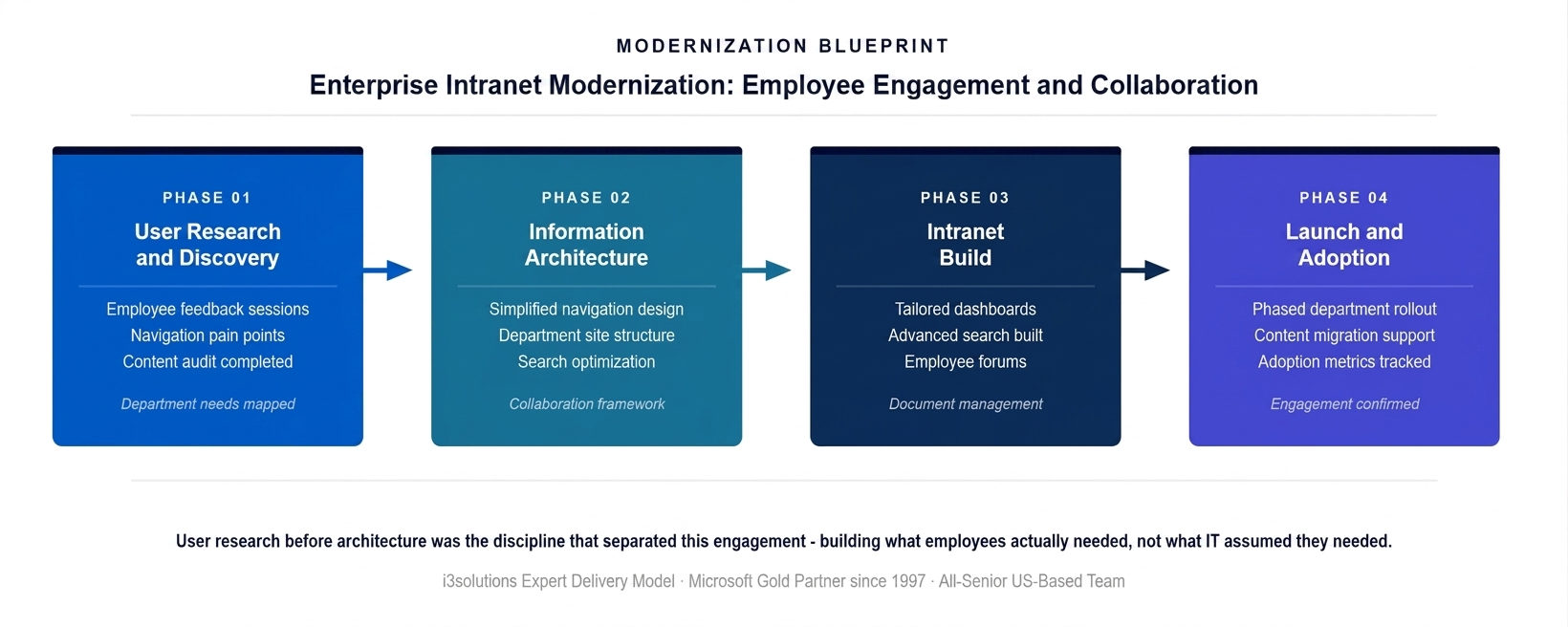
The four-phase approach. User research before information architecture was the investment that separated this engagement from a redesign that would have looked different but failed the same way – the navigation structure derived from how employees actually thought about information, not from how IT organized the server.
PHASE 03
Intranet Build
Tailored departmental dashboards providing each department a customized view surfacing the information, announcements, and tools most relevant to that team’s daily work – replacing the generic one-size-fits-all interface that served no department well. Advanced search with full-text indexing across all intranet content, making documents discoverable without requiring employees to know which department owned them. Employee forums providing community and collaboration spaces for cross-functional discussion and company-wide engagement. Modern document management replacing the informal shared drive patterns that employees had adopted as workarounds.
PHASE 04
Launch and Adoption
Phased department rollout beginning with the departments that had provided the most detailed input during the research phase – their feedback had shaped the design, and their early adoption would demonstrate the platform’s quality to the rest of the organization. Content migration support for the documents, announcements, and resources that needed to move from email and shared drives into the governed intranet structure. Adoption metrics tracking to confirm that the features built in Phase 3 were achieving the engagement the research had predicted.
Technical Transformation
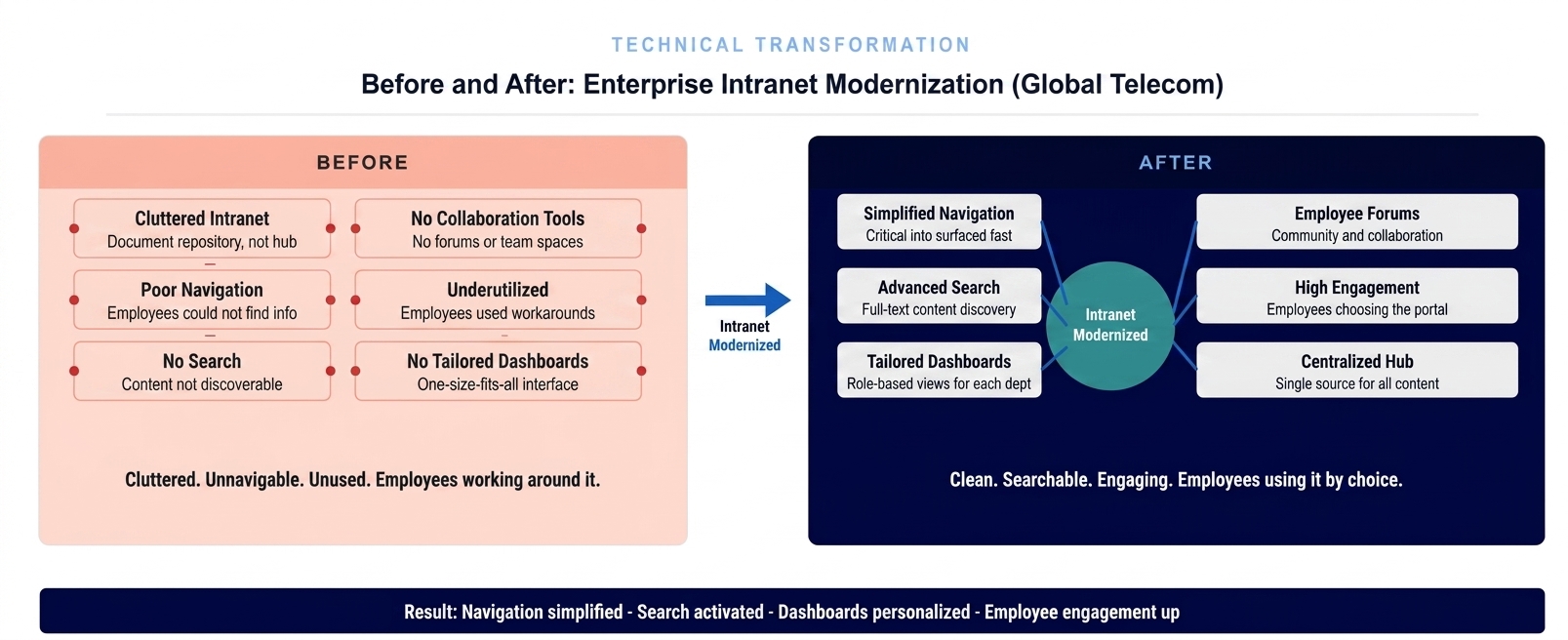
The intranet state before and after. A cluttered, navigation-poor portal that employees worked around replaced by a modern enterprise intranet with simplified navigation, full-text search, tailored dashboards, and employee forums that employees chose to use.
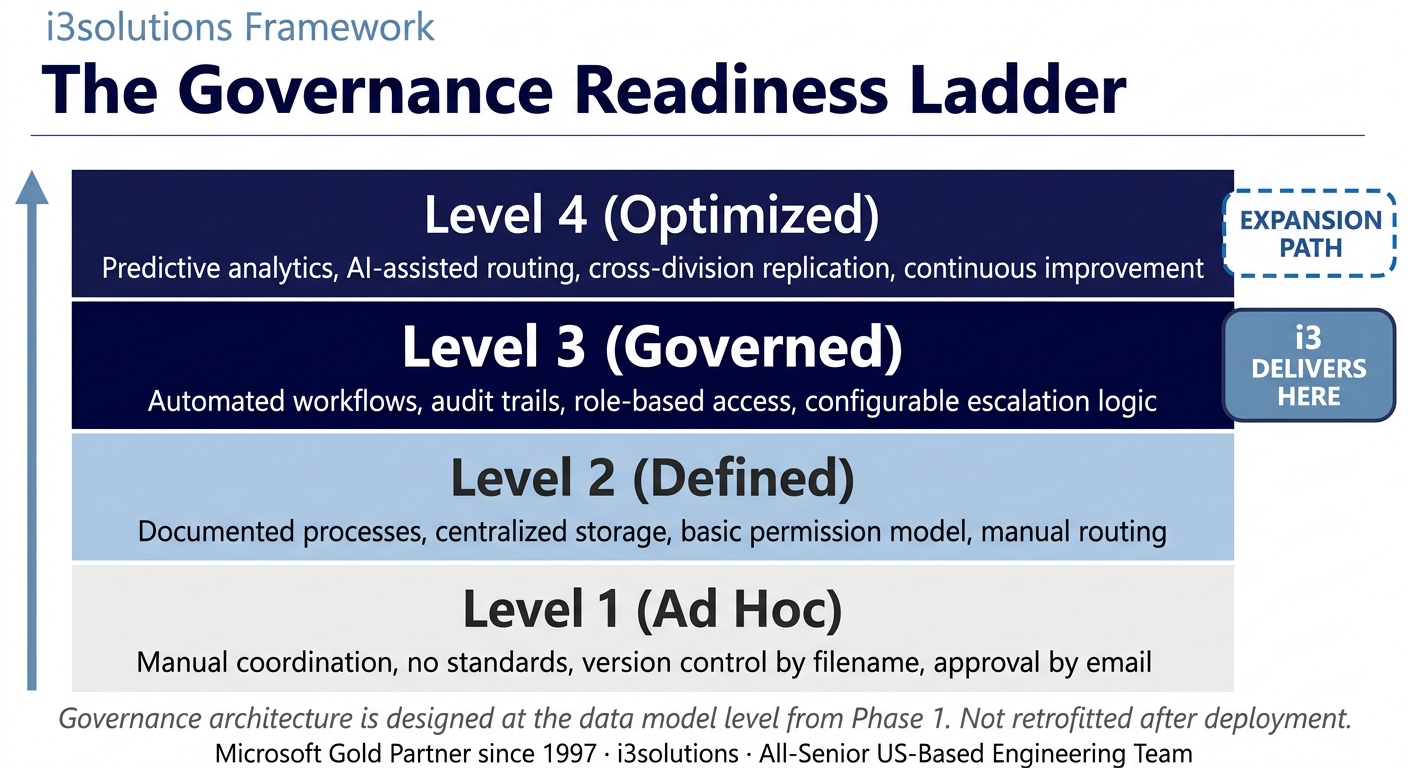
The Governance Readiness Ladder applied. The modernized intranet delivered Level 3 information governance. The architecture and adoption baseline support Level 4 as personalization, analytics, and advanced collaboration capabilities expand.
Measurable Outcomes
| Metric | Before | After | Improvement |
|---|
| Employee adoption | Low – employees built workarounds rather than using the portal | High – employees using the intranet as the daily operational hub | Adoption achieved |
| Navigation | Confusing – information architecture not aligned to employee mental models | Simplified – structure derived from user research, intuitive by design | Navigation confusion eliminated |
| Search capability | None or limited – content not discoverable without knowing exact location | Advanced full-text search – all intranet content discoverable | Enterprise search active |
| Department experience | Generic one-size-fits-all – no department-specific views | Tailored dashboards – each department sees what matters to their work | Personalized dashboards delivered |
| Collaboration tools | None – no forums or community spaces in the portal | Employee forums – cross-functional and department community spaces active | Collaboration capability delivered |
| Information governance | Eroded – employees managing information through email and shared drives | Restored – governed intranet is the authoritative source for company content | Information governance restored |
[PENDING-CLIENT-QUOTE: insert 1-3 sentence outcome-focused quote in the client’s own language from a role matching the reader’s role.]
[Name or Role], [Organization type]
Frequently Asked Questions
Enterprise Intranet Modernization for Technology and Telecommunications Organizations
What is enterprise intranet modernization and how is it different from a redesign?
Enterprise intranet modernization is the process of rebuilding an underperforming intranet platform around what employees actually need, replacing a portal that accumulated content without coherent organization with one built on user research, simplified information architecture, advanced search, personalized departmental dashboards, and collaboration features that employees choose to use. It differs from a redesign in that a redesign applies new visual design to the existing structure, while modernization rebuilds the information architecture from the employee’s perspective and adds functional capabilities, search, dashboards, forums, that drive adoption. A modernized intranet solves the adoption problem; a redesigned one just looks different.
How does i3solutions use employee research to drive intranet modernization?
i3solutions begins intranet modernization engagements with working sessions, not surveys, across departments and roles that draw out the specific navigation frustrations, content access failures, and collaboration gaps that employees experience daily. Surveys capture what employees say they want; working sessions reveal what they actually do, including the workarounds they have built around the current portal. The insights from those sessions directly determine the information architecture, dashboard design, and feature priorities of the rebuilt platform. An intranet designed without this research builds what IT thinks employees need. An intranet designed with it builds what employees have demonstrated they need through their actual work patterns, which is what drives adoption.
What features drive employee adoption of an enterprise intranet?
The features that most consistently drive employee adoption of an enterprise intranet are the ones that make the portal immediately useful for daily tasks: simplified navigation that surfaces critical information without requiring users to know where to look, advanced full-text search that makes all content discoverable without navigating to the right location, tailored departmental dashboards that present each team’s most relevant content on arrival rather than requiring navigation, and collaboration tools, forums, team spaces, that give employees a reason to visit the portal for interaction rather than just information retrieval. Each of these features addresses a specific failure mode of generic intranet implementations: navigation that maps to IT’s folder structure rather than employees’ mental models, search that doesn’t index all content, one-size-fits-all interfaces that serve no department well, and portals that are repositories rather than communities.
How does i3solutions measure intranet adoption success after launch?
i3solutions establishes adoption metrics at the beginning of the engagement, before the intranet is built, based on the specific behaviors the rebuilt portal is designed to drive. For a global telecom company, relevant adoption metrics include daily active users relative to total employee population, search queries per user indicating content discovery activity, forum participation rates, and reduction in help desk calls for information that the intranet should surface. Post-launch monitoring tracks these metrics against the baseline and confirms that the features built in the build phase are achieving the usage patterns the employee research predicted. If a feature is underused relative to expectation, post-launch support identifies whether the issue is training, content quality, or design, and addresses it before it becomes a permanent adoption gap.
Why choose i3solutions for enterprise intranet modernization?
i3solutions has built enterprise intranets for telecommunications, defense, federal, manufacturing, and professional services organizations, developing the pattern recognition that distinguishes an intranet that achieves adoption from one that becomes the place employees uploaded something once and never returned to. The critical success factors, the information architecture decisions, the dashboard personalization approach, the search configuration, and the collaboration feature design, are learned through engagement experience, not generic SharePoint training. i3solutions brings that experience, an all-senior delivery team, and a Microsoft Gold Partner track record since 1997 to every intranet modernization engagement. Our clients can reference not just that we delivered the platform but that employees use it, which is the only measure that matters.
Back to Case Study Library
60 enterprise Microsoft implementations documented
Related Insights
From the i3solutions YouTube Channel
Short-form perspectives on the delivery and technology challenges in this case study.
Who This Engagement Serves
This engagement is relevant if
- Retailers with large frontline workforces struggling to maintain governance over joiner and mover access.
- Organizations migrating complex manual lifecycle processes from legacy systems into Microsoft Entra ID governance.
- Companies requiring strong audit trails for access reviews without immediately deploying full birthright provisioning.
Less relevant if
- Small organizations with minimal staff turnover where current manual processes are not problematic.
- Environments requiring immediate fully automated birthright provisioning rather than established iterative governance controls.
Ready to rebuild your enterprise intranet into a platform employees choose?
The 15-Business-Day Microsoft Assessment maps the user research approach, information architecture, search configuration, dashboard design, and collaboration feature set that would convert your underused portal into the operational hub your organization needs.
Microsoft Gold Partner since 1997. 600+ implementations. All senior. All US-based.
Schedule the Assessment