Case Study · Healthcare
12-Day Wait for IT Access, Paper Forms: How the health system Automated New Hire Onboarding
Client: the health system
The Enterprise Challenge
the health system is one of New Jersey’s leading healthcare systems, delivering nationally recognized inpatient and outpatient care through its hospital and a network of physician practices, urgent care centers, and imaging facilities. In a healthcare environment where clinical staff need immediate access to patient information systems, electronic health records, and clinical applications from their first day of work, the efficiency of the new hire onboarding process is not just an administrative concern, it directly affects patient care capability.
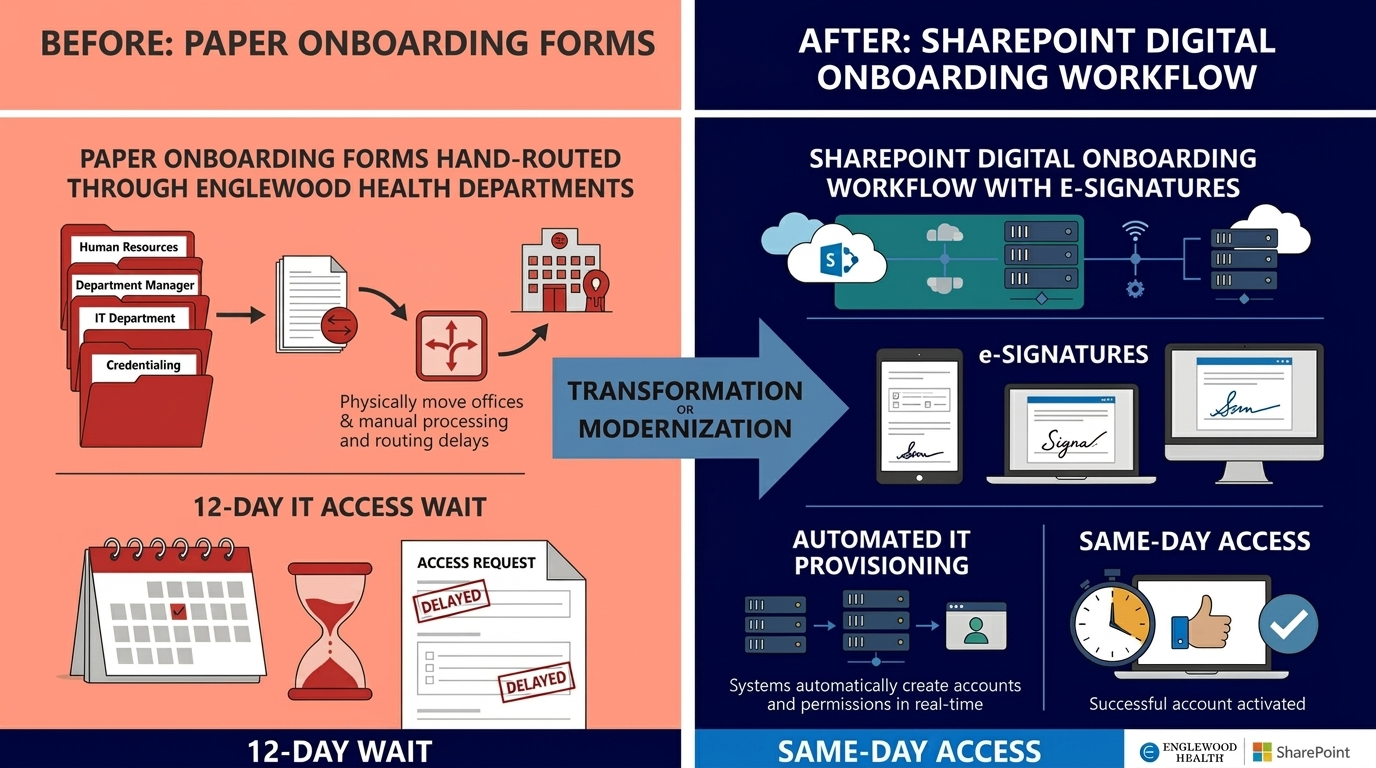
the health system’s onboarding process was creating a significant and measurable problem. New employees, nurses, physicians, administrative staff, and clinical support, were waiting up to 12 days after their start date before gaining full access to the health system’s IT network and applications. The cause was structural: onboarding relied on paper forms that HR staff physically carried between departments, collecting signatures and approvals from multiple stakeholders before IT could provision system access. Documents were lost. Forms were incomplete. There was no tracking mechanism to know where a new hire’s paperwork was in the process or why access was delayed.
The Strategic Trigger
the health system needed a digital onboarding system that would replace paper forms with structured digital equivalents, automate the routing of onboarding requests through the approval chain, provide legally binding electronic signatures, and give HR and IT real-time visibility into every new hire’s onboarding status, reducing the 12-day IT access wait to a matter of hours.
The Engagement Approach
Strategic Trigger
Paper forms caused unacceptable 12-day onboarding delays
New hires at the health system were frequently left unproductive for nearly two weeks, waiting for essential IT systems access. The legacy onboarding process relied heavily on physical paperwork, which often became stuck, lost, or delayed in interdepartmental transit. This bottleneck prevented clinicians, administrative staff, and specialists from accessing electronic medical records, email, and internal applications, crippling their ability to deliver patient care effectively from day one. Leadership recognized this systemic inefficiency was not just an administrative nuisance but a severe operational risk.
The constant feedback loop of frustration from new employees, hiring managers, and IT support teams reached a tipping point. The operational drag was palpable, affecting the hospital’s agility and its reputation as an employer of choice. Recognizing that this administrative failure was negatively impacting patient experience and staff morale, the health system leadership formally mandated a digital transformation of the onboarding process, authorizing the decommissioning of the failing paper-based system in favor of a modern, automated solution using their existing SharePoint infrastructure.
Stakes
Critical delays impacting compliance and operational efficiency
The manual onboarding process introduced significant compliance and operational risks. Delays in system access not only stalled the delivery of care but also complicated required compliance training and security credentialing. Furthermore, the reliance on physical forms created gaps in record keeping and auditing capabilities, increasing the potential for data errors and HIPAA concerns regarding the secure handling of sensitive employee data. Inaction meant continuing to absorb these operational costs and compliance vulnerabilities, which were increasingly unsustainable.
Continued failure was eroding the organization’s reputation and its ability to attract and retain top medical and support talent in a highly competitive market. A broken onboarding experience sent a damaging message about the organization’s technological maturity and operational competence, potentially deterring candidates from accepting offers. This systemic inefficiency was directly undermining strategic efforts to scale services, optimize workforce management, and deliver seamless, technology-enabled care throughout the entire health system.
Constraints and Complexity
Securing sensitive healthcare data on existing infrastructure
The new onboarding solution had to adhere to stringent healthcare regulatory requirements, requiring a secure and auditable workflow for handling personal identifiable information (PII). This meant that the SharePoint solution needed to implement fine-grained access controls, robust data encryption, and comprehensive logging features to ensure that sensitive data remained protected throughout the process. Integrating these mandatory security measures within the existing infrastructure without adding unnecessary friction to the user experience presented a significant technical and architectural challenge.
The primary constraint was converting a highly variable and complex manual process into a structured, automated workflow that all departments could consistently adopt. This involved standardizing diverse forms and approval chains across multiple departments, including HR, IT, and clinical leadership, to ensure a single, streamlined process. Overcoming decades of “paper-based thinking” was critical to driving adoption, as success required moving past the comfortable, yet inefficient, legacy methods and ensuring everyone trusted the new system for critical tasks.
Selection Rationale
Senior Microsoft Specialists with Proven Delivery Depth
the health system recognized that standard “commodity staffing” and generic offshore models were ill-equipped for this highly sensitive integration. The complexity of converting a paper workflow into a secure healthcare solution necessitated specialized expertise, not generic programming resources. Larger, low-cost firms often utilize junior developers with limited vertical knowledge, increasing the risk of misaligned deliverables, data vulnerabilities, and deployment delays. For this critical initiative, the health system needed more than just coding; they required deep-seated architecture and business process optimization knowledge.
i3solutions emerged as the clear choice due to their unique position as an all-senior, US-based implementation team. Their longevity as a Microsoft Gold Partner for over two decades and a track record of 600+ implementations demonstrated profound depth in SharePoint and workflow automation. Their methodology emphasized strategic business analysis over mere technical configuration, ensuring the new digital workflow wasn’t simply replacing paper, but optimizing the entire onboarding process for speed, security, and compliance.
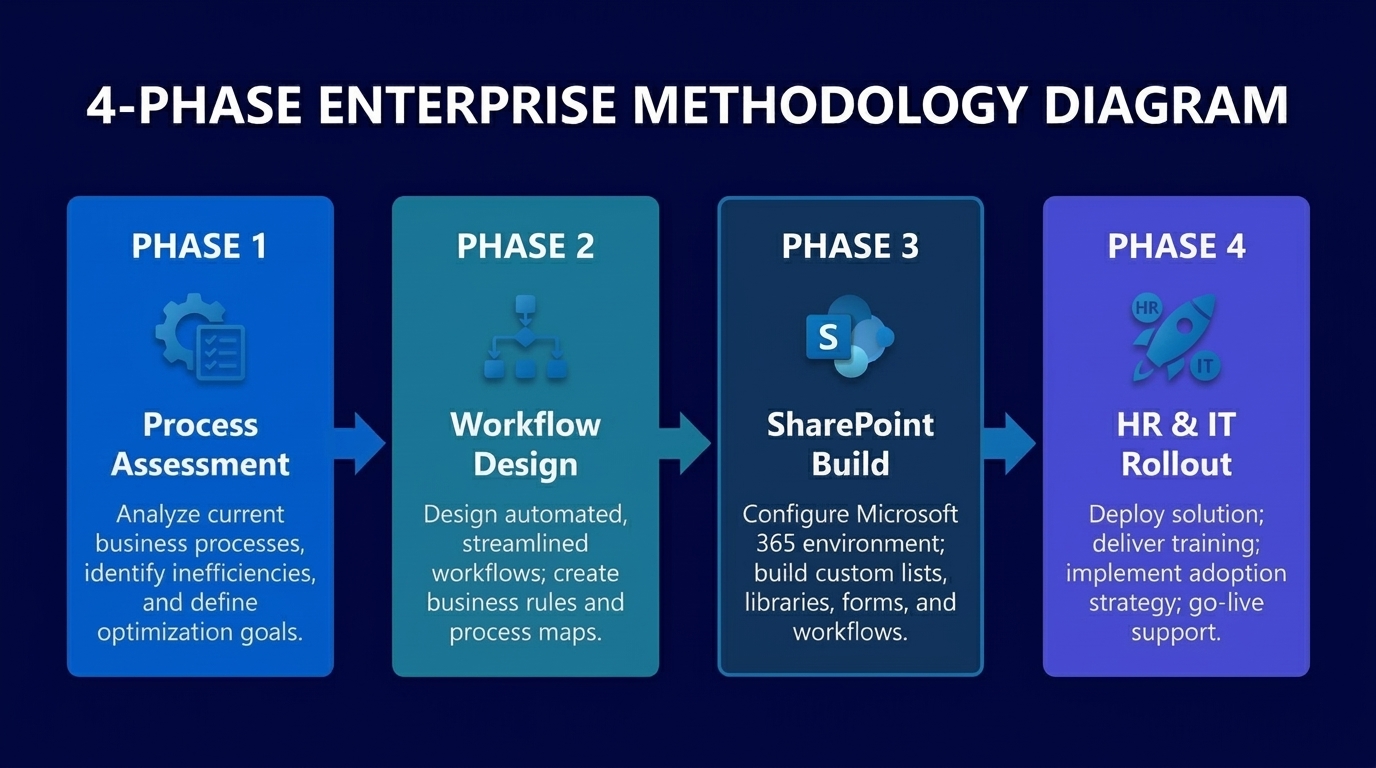
Phase 1
Process Assessment
Mapped the full new hire onboarding workflow from HR initiation through IT provisioning, identifying every approval step, document requirement, and delay point.
Phase 2
Workflow Design
Designed the digital onboarding workflow in SharePoint with automated routing logic, approval notifications, escalation rules for overdue steps, and IT provisioning triggers.
Phase 3
SharePoint Build
Built the digital onboarding intake forms, approval workflows, e-signature integration, and HR/IT management dashboards.
Phase 4
HR and IT Rollout
Deployed the system with training for HR onboarding coordinators and IT provisioning staff, and established new hire communication processes.
Technical Transformation
i3solutions replaced the health system’s paper onboarding process with a digital SharePoint workflow that routes new hire access requests automatically through the required approval chain and triggers IT provisioning on completion. New hire onboarding time dropped from up to 12 days to a matter of hours. HR staff submit structured digital forms that are routed automatically, no physical document handling, no lost paperwork, no status uncertainty. IT receives provisioning requests with complete, validated information that eliminates the back-and-forth of incomplete paper forms. Both departments gain real-time visibility into every active onboarding request.
Measurable Outcomes
| Metric |
Result |
| Onboarding Time |
New hire IT access time reduced from up to 12 days to hours through automated workflow routing and provisioning |
| Paper Eliminated |
Physical onboarding form routing replaced with digital workflow, no more lost documents or manual handoffs |
| Status Visibility |
HR and IT have real-time dashboard view of every active onboarding request and its current approval stage |
| Error Reduction |
Structured digital forms with validation rules eliminated the incomplete or illegible paper submissions that caused IT provisioning delays |
| Clinical Readiness |
Clinical staff access patient systems and clinical applications from day one rather than working with limited access for days after start |
[PENDING-CLIENT-QUOTE: insert 1-3 sentence outcome-focused quote in the client’s own language from a role matching the reader’s role.]
[Name or Role], [Organization type]
Frequently Asked Questions
What is SharePoint onboarding automation and why is it critical for healthcare?
SharePoint onboarding automation replaces paper-based new hire processes with digital workflows that route requests, collect approvals, and trigger IT provisioning automatically. In healthcare, where clinical staff need immediate access to patient information systems for safe and effective care, the speed of IT access provisioning has direct patient care implications. the health system’s 12-day average wait was not just an administrative inefficiency, it represented clinical staff working with limited system access during critical first days.
How does i3solutions approach onboarding workflow automation for healthcare organizations?
i3solutions begins with a detailed process assessment that maps every step from offer acceptance through first-day system access, identifying every approval authority, document requirement, and delay point. For healthcare clients, the workflow design must accommodate the diversity of new hire types, clinical vs. administrative, who may require different approval chains and different system access packages. i3solutions designs the workflow to handle these variations automatically based on the new hire’s role.
How do electronic signatures work in SharePoint onboarding workflows?
i3solutions integrates e-signature capability into the SharePoint onboarding workflow so required signatures, department manager approvals, HR certifications, IT acknowledgments, are captured electronically as part of the automated routing process. E-signatures are legally binding and time-stamped, providing better documentation than physical signatures on paper forms. Signatories receive automated notifications when their signature is required and can sign from any device.
What ROI should healthcare organizations expect from onboarding automation?
Healthcare organizations that automate manual onboarding processes typically see measurable ROI in 3 areas: direct time savings for HR and IT staff from eliminating manual form routing and follow-up, clinical productivity improvement from faster system access for new clinical staff, and compliance improvement from complete, auditable digital records replacing paper processes that were difficult to track and audit.
Why choose i3solutions for healthcare SharePoint workflow automation?
i3solutions has delivered SharePoint workflow automation for healthcare organizations including the health system and Highlight Health, consistently on-time, in-scope, in-production. Our all-senior, all US-based team understands healthcare compliance requirements and designs workflows that meet HIPAA documentation standards. Our 15-Business-Day Microsoft Assessment gives healthcare organizations a clear automation implementation plan.
Who This Engagement Serves
This engagement is relevant if
- Large healthcare systems struggling with slow IT provisioning due to manual, paper-based HR onboarding processes.
- Hospitals requiring tight regulatory compliance and standardized onboarding workflows using their existing Microsoft 365 investment.
- Multi-location medical centers where automated SharePoint workflows can centralize and accelerate role-based system access.
Less relevant if
- Small single-location practices with very low hiring volume where paper onboarding is not a significant bottleneck.
- Organizations already utilizing an advanced, specialized HRIS system that handles automated IT provisioning directly and efficiently.
Ready to establish a governed Microsoft environment?
i3solutions delivers enterprise digital transformation on-time, in-scope, in-production. Microsoft Gold Partner since 1997. 600+ implementations. All-senior, all US-based team.
Schedule a 15-Business-Day Microsoft Assessment