Case Study • Aerospace and Defense • Portfolio Rationalization
Proposal Fragmentation: How Aerospace Improved Bids 35% with Power Apps
The Enterprise Challenge
Power Apps Development for a High-Stakes Proposal Pipeline
For a major aerospace manufacturer, Power Apps development services delivered what a decade of manual coordination could not: a proposal pipeline that ran on schedule, under governance, and connected across every functional team involved in winning complex contracts. This organization designs and builds advanced propulsion systems serving both commercial aviation and military programs, competing in markets where contract values are substantial and proposal quality is directly measurable in win rate.
The organization’s proposal function spans engineering, pricing, legal, program management, and capture teams across multiple product lines. Each proposal cycle requires coordination among dozens of stakeholders, alignment on cost and schedule assumptions, and strict adherence to solicitation requirements that vary by customer, contract vehicle, and program classification level.
For years, the organization managed this coordination through a combination of shared network drives, spreadsheet-based tracking tools, and email chains that crossed department boundaries without a clear owner or version-controlled workflow. As the pipeline grew and the margin for error tightened, proposal professionals were spending a growing proportion of their time managing information rather than developing the technical and commercial substance that wins bids.
The organization already had Microsoft infrastructure in place: Dynamics 365 for CRM, SharePoint Online for document storage, and Microsoft Teams for communication. What it lacked was an architecture connecting those tools into a single governed environment. This is the integration challenge that Microsoft consulting services is built to solve.
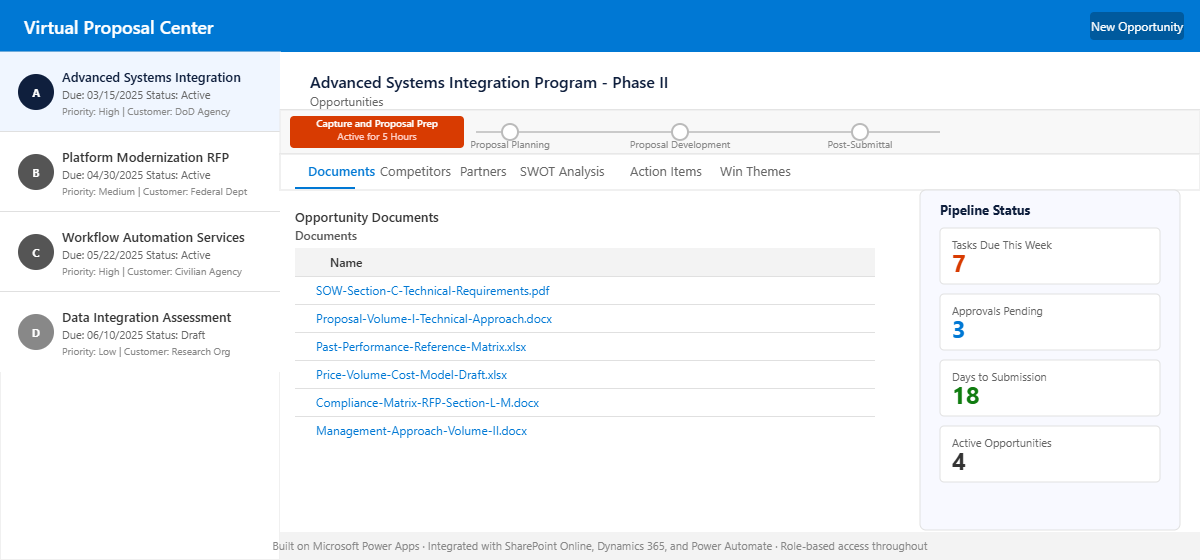
The Virtual Proposal Center dashboard: one governed view for tasks, deadlines, approvals, and pipeline status across all active bids. Built on Microsoft Power Apps with fictional data shown.
Strategic Trigger
Scattered Tools Creating Costly Delays in Proposal Cycles
The forcing function was not a single dramatic failure. It was an accumulation of near-misses that eventually made the status quo indefensible at the leadership level. Proposal teams had begun missing internal preparation deadlines with enough frequency that leaders in capture and program management escalated the issue formally.
A review of recent bid cycles revealed that a significant portion of preparation time was being consumed not by the substantive work of writing, pricing, and reviewing, but by the mechanics of the process itself: locating the correct version of a document among competing copies, following up with a reviewer who did not know their input was overdue, or reconciling pricing assumptions updated in one location but not propagated to the rest of the team.
The organization’s proposal win rate had plateaued at a time when the competitive environment was intensifying. Leadership recognized a direct connection between process friction and submission quality. This dynamic is documented in enterprise Power Platform environments: see Power Platform Center of Excellence for Regulated Enterprises for a breakdown of how ungoverned platform environments create compounding coordination friction over time.
Does this situation look familiar?
If your proposal teams are losing hours to version conflicts, overdue approvals, and disconnected tracking tools, a 15-Business-Day Microsoft Assessment can identify exactly where the friction is and what a governed Microsoft environment would require to eliminate it.
Request the Assessment
▶ Related Insight — A 60-second perspective from our channel
Stakes (What Happens If They Fail)
Revenue Exposure When Proposals Arrive Late or Incomplete
In competitive aerospace procurement, the consequences of proposal quality failure are direct and financial. A non-compliant submission is eliminated at the evaluation threshold regardless of the technical merit of the underlying program. A late submission in most government and commercial procurement environments is automatically disqualified, with no exception regardless of circumstances.
For an organization operating at this scale and complexity, each contract award can represent hundreds of millions in program revenue. The opportunity cost of a single failed submission, in an environment where the organization already has the technical capability to win, is not recoverable. Across a portfolio of dozens of active opportunities at any given time, the cumulative impact of chronic proposal quality and timeline issues represents a material drag on revenue growth.
Beyond the financial exposure, there was a reputational dimension. Customers evaluating this manufacturer as a long-term program partner form judgments about operational discipline based in part on how proposal interactions are managed. A disorganized or reactive proposal function signals broader program management risk to a sophisticated buyer, even when the delivery organization itself is well-run.
Constraints and Complexity
Distributed Teams, Sensitive Programs, and Zero Margin for Error
The proposal environment at this organization operated across multiple product divisions, each with its own pricing methodology, technical vocabulary, and customer relationship history. A solution capable of serving one division’s proposal process would need to be configurable enough to accommodate the operational differences of others without requiring separate instances or separate governance frameworks. For a detailed look at how this type of multi-division governance challenge plays out in Microsoft environments, Power Platform Center of Excellence for Regulated Enterprises covers the structural decisions that determine whether a platform scales or fragments.
The organization’s existing Microsoft environment was sophisticated, but access controls, classification requirements, and security configurations governing proposal content added meaningful complexity to any solution design. Government contract proposals require management within environments meeting federal data handling standards. The solution needed to satisfy these requirements as a foundational design constraint, not as a capability added after the core functionality was established.
Many individuals involved in the proposal process worked across multiple simultaneous bids at different stages of completion. A program manager might be contributing to three proposals concurrently. A pricing analyst might carry responsibility for a dozen cost volumes across as many opportunities. The solution needed to give each contributor a clear, current, role-appropriate view of their responsibilities.
The legacy of the previous process also created a migration challenge. Years of proposal files, historical pricing data, competitive intelligence, and customer-specific documentation were distributed across shared drives, personal folders, and email archives in ways that had no formal taxonomy and no single owner.
▶ Related Insight — A 60-second perspective from our channel
Selection Rationale (Why They Chose i3solutions)
Senior Microsoft Specialists with Enterprise Delivery Depth
The organization evaluated vendor options with a clear understanding of what had failed in previous attempts to improve the proposal environment. Larger technology firms had been assessed and found unsuitable: their proposed solutions were over-engineered relative to what the proposal function actually needed, and their delivery models introduced offshore resource risk into an environment handling controlled content and sensitive competitive information.
The organization required a vendor whose team would be physically present when needed, whose personnel held appropriate clearances or could obtain them, and whose engagement model did not dilute senior expertise with junior staff operating behind a senior-level face. Commodity staffing arrangements had also been considered and set aside. What the organization lacked was a partner who had specifically solved the problem of building a governed, integrated proposal management environment on Microsoft infrastructure.
i3solutions was selected because the firm demonstrated a documented track record of building custom Microsoft-based platforms for organizations with similarly complex coordination requirements. As a Microsoft Gold Partner since 1997 with more than 600 completed implementations, the firm brought institutional pattern recognition that individual practitioners cannot replicate.
Two distinct commitments made the selection defensible. The Expert Delivery Model governs who does the work: every team member is a senior practitioner, all US-based, security clearance capable where the engagement requires it. No junior resources behind a senior face. No offshore delivery risk. The firm’s Enterprise Delivery Assurance model governs how the outcome is governed: controls, scope discipline, senior oversight, and delivery accountability applied throughout the engagement to move work from high-risk to predictable, in-scope, in-production execution. One commits to the execution structure. The other commits to the outcome. A CIO explaining this vendor choice to a CFO could do so without hedging.
The Engagement Approach (Our Plan)
From Fragmented Process to Governed Proposal Infrastructure
The engagement opened with a structured discovery and assessment phase conducted with proposal managers, capture leads, pricing analysts, and IT stakeholders across the affected divisions. The goal was to identify the specific friction points consuming the most time and producing the most downstream risk to proposal quality and timeline compliance.
PHASE 01
Discovery and Assessment
Stakeholder interviews across engineering, pricing, legal, program management, and capture teams. Friction-point analysis and requirements mapping. Output: a prioritized capability list and architecture constraints document. This phase is non-negotiable. Organizations that skip it consistently find themselves rebuilding foundational elements that were designed incorrectly because the requirements were never fully understood.
PHASE 02
Establishing the SharePoint Online environment serving as the content backbone of the Virtual Proposal Center: the permissions model governing access by role, division, and opportunity sensitivity; the document library taxonomy making retrieval consistent; and the integration points with the organization’s existing Microsoft 365 infrastructure. Governance decisions made in this phase determine the rules under which the platform operates for years beyond initial delivery.
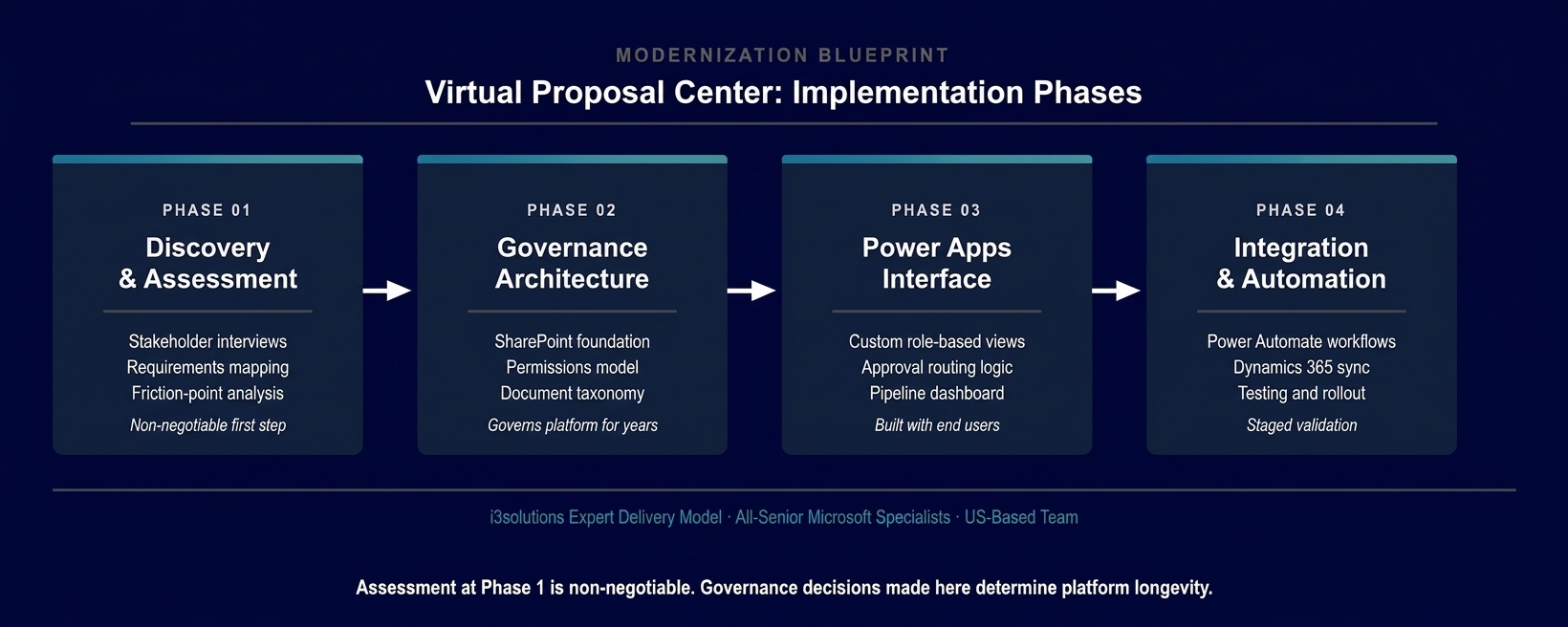
The four-phase implementation approach. Assessment at Phase 1 is non-negotiable and not billable separately at i3solutions.
PHASE 03
Building the application through which proposal team members would manage active opportunities. The custom Power Apps application was built to give each user a role-appropriate view of the pipeline, with task assignments, deadline visibility, and approval routing reflecting the actual workflow of the organization rather than a generic template. This phase required intensive collaboration with end users to confirm the interface reflected how proposal work actually happened.
PHASE 04
Constructing the Power Automate workflows governing movement of information between Dynamics 365, SharePoint Online, Microsoft Teams, Dataverse, and the Power Apps front end. The automation logic handles exceptions, escalations, and routing scenarios varying by opportunity type, customer, and division. Integrations built to be configurable by the proposal operations team without requiring a development sprint for routine process changes. Rollout staged by division.
For a practical breakdown of which enterprise processes benefit most from this type of automation approach, 10 Power Automate Enterprise Processes to Automate in Year One covers the sequencing decisions that determine which workflows to automate first for fastest demonstrable return.
Execution Evidence
Custom Power Apps Interface Across Multiple Product Lines
The Virtual Proposal Center was delivered as a custom Power Apps application providing proposal team members with a unified dashboard for managing the full lifecycle of a bid opportunity. The application surfaced each user’s active tasks, upcoming deadlines, and pending approvals in a single view that required no navigation between disparate systems.
Opportunity records were connected through the application to their associated document libraries in SharePoint Online, their pricing and cost data in Dynamics 365, and their communication threads in Microsoft Teams, without requiring the user to switch context or re-enter data across platforms. A proposal coordinator could move from reviewing a document to routing it for approval to checking the status of an overdue pricing input without leaving the Power Apps environment.
Power Automate workflows managed the routing logic that had previously been handled through manual email follow-up. When a document required a reviewer’s input, the workflow triggered a notification through the appropriate channel, tracked the response against the deadline, and escalated automatically when acknowledgment was not received within the defined window. The escalation paths and timeline triggers were configurable by the proposal operations team without IT intervention. This is the architecture pattern described in detail in SharePoint and Power Platform Integration for Regulated Enterprise Workflows.
The Dataverse environment maintained the structured data supporting the pipeline view: opportunity records, stage definitions, milestone dates, resource assignments, and approval histories. Pre-populated milestone calendars were provisioned automatically when a new opportunity record was created, giving each proposal team a structured timeline from the moment a bid entered the system.
The assessment phase surfaced a migration challenge that had not appeared in initial scoping conversations: years of proposal documentation stored in personal email archives that were inaccessible to IT and had no formal taxonomy. Moving this material into the governed SharePoint environment without disrupting bids already in progress required a staged migration approach that extended Phase 2 by several weeks. This pattern appears consistently in organizations that have managed proposals informally for years. The choice to surface it in Phase 1 and address it as an architecture decision rather than a post-launch problem is exactly what prevents the rework and platform confidence issues that undermine adoption in the first six months of deployment.
Technical Transformation
Integrated Microsoft Stack Replacing Manual Cross-Platform Workarounds
Before the Virtual Proposal Center, the proposal environment consisted of disconnected tools requiring manual coordination to function as a coherent system. Documents lived in shared drives without version control. Pricing data traveled by email in spreadsheet form and accumulated divergent versions. Approval status existed only in conversation threads that could not be audited or systematically reported against.
After the Virtual Proposal Center, the environment was an integrated Microsoft stack where each component communicated with the others through automated workflows and shared data structures. The Microsoft integration services layer governed information flows between Dynamics 365 and SharePoint Online, ensuring that changes to opportunity records propagated automatically to the associated document libraries and pipeline dashboards without human intervention.
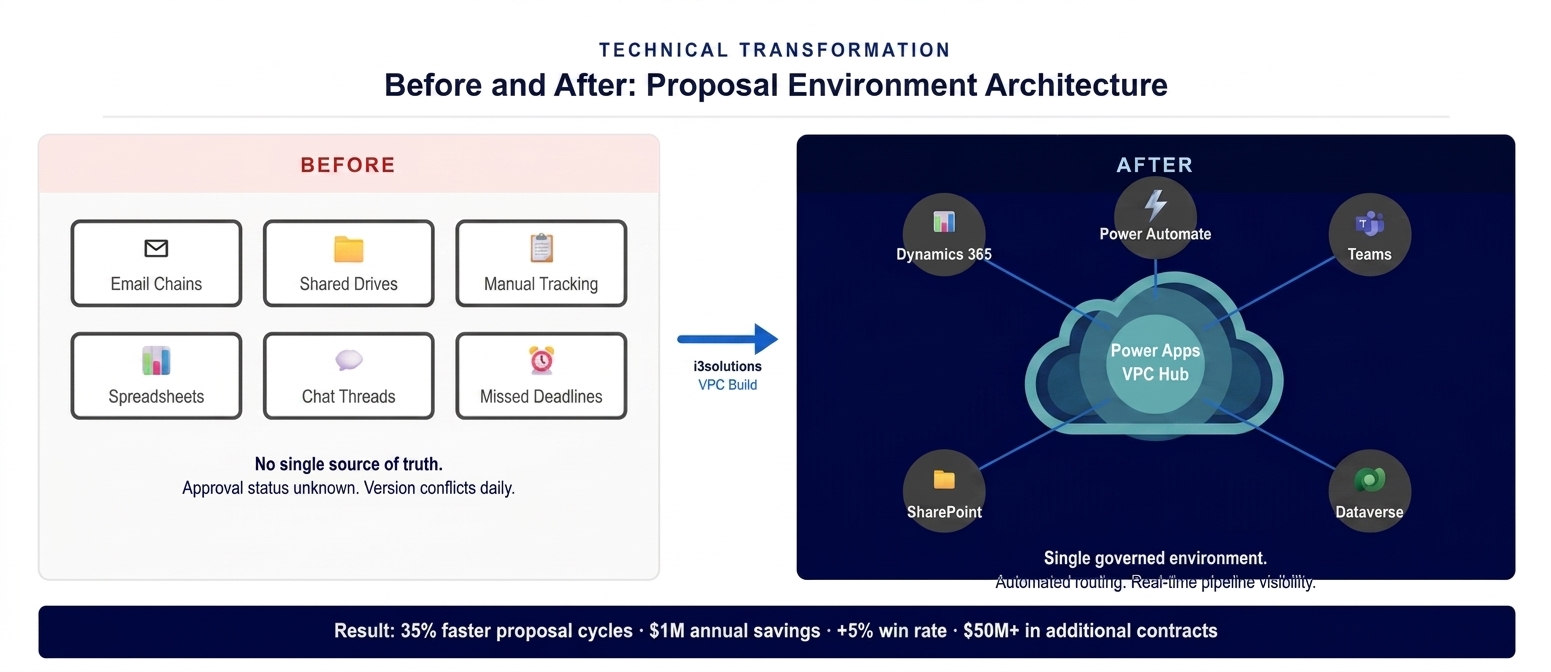
The architecture state before and after the Virtual Proposal Center deployment. Five disconnected tools replaced by one governed integration layer.
The Governance Readiness Ladder that i3solutions applies to Microsoft environment builds was implemented throughout the platform’s design. Permission boundaries were defined at the data model level, not applied as access controls on top of a system built without them. Audit trails for approvals and document access were built into the architecture from the first phase, so compliance documentation for any proposal cycle could be produced from the system without manual reconstruction.
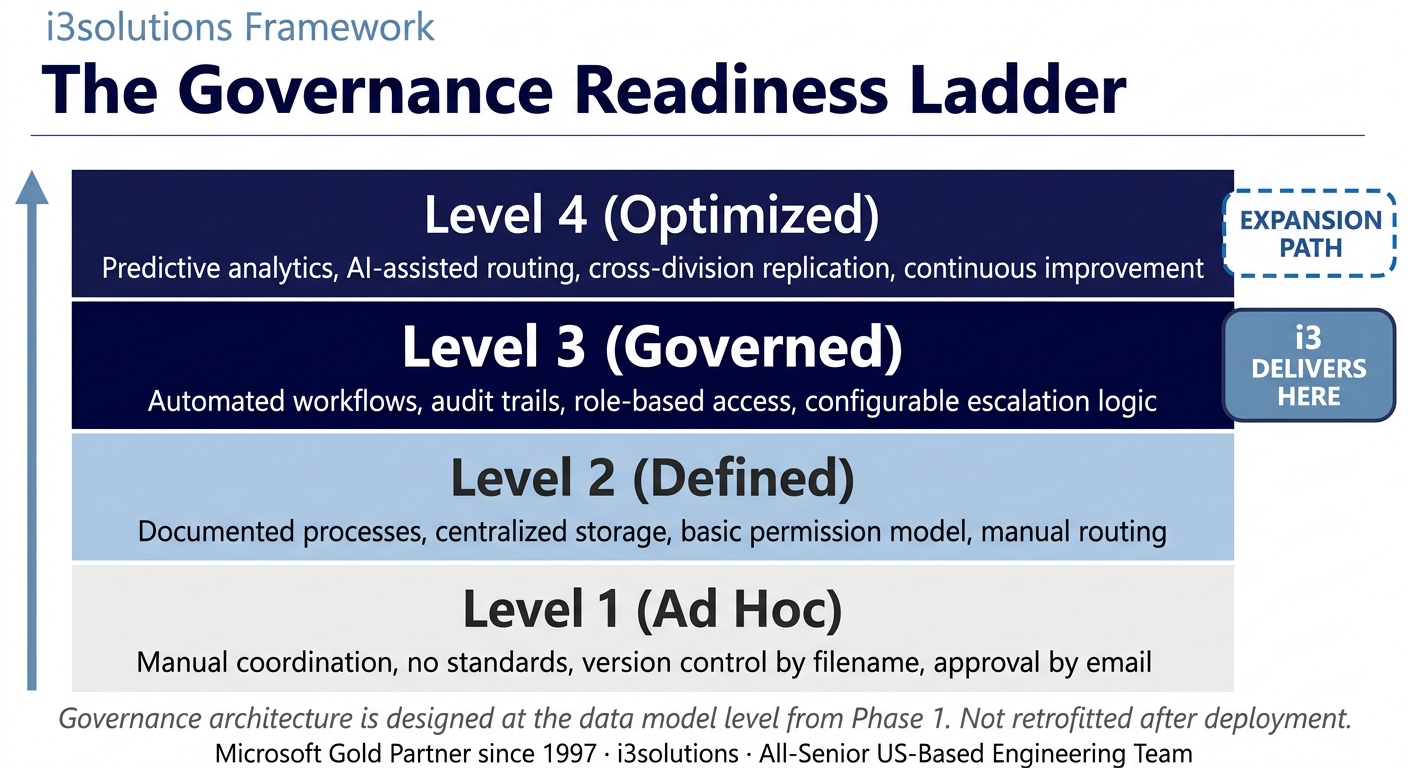
The Governance Readiness Ladder applied to this engagement. The VPC was delivered at Level 3. The governance architecture is in place to reach Level 4 without a structural rebuild.
▶ Related Insight — A 60-second perspective from our channel
Measurable Outcomes
Proposal Cycle Shortened by 35 Percent With Measurable Win Rate Gains
The impact of the Virtual Proposal Center was measured across three dimensions: time recovered, quality improved, and revenue influenced.
| Metric | Before | After |
|---|
| Average proposal preparation time | ~10 days | ~6.5 days (35% reduction) |
| Document access speed | Baseline | 40% faster |
| Proposal win rate | Plateau | +5% improvement |
| Annual staff capacity redeployed | Not measured | ~$800K |
| Annual preparation cost savings | Not measured | ~$1M |
| Additional contracts attributed | Baseline | $50M+ |
[PENDING-CLIENT-QUOTE: insert 1-3 sentence outcome-focused quote in the client’s own language from a role matching the reader’s role.]
[Name or Role], [Organization type]
On time: proposal preparation time decreased by 35 percent. The time recovered came entirely from eliminating administrative friction, not from reducing the rigor of the preparation process. Teams redeployed the equivalent of approximately $800,000 annually in staff capacity toward substantive proposal work. Industry benchmarks for enterprise Power Platform deployments indicate that organizations typically recover 25 to 40 percent of administrative coordination time within the first year of a governed implementation BENCHMARK-ESTIMATE.
On revenue: the organization’s proposal win rate improved by five percent following deployment. For an organization competing on contracts of significant value, a five percent improvement across an active pipeline is a material financial outcome. The organization attributed more than $50 million in additional awarded contracts to improved proposal quality and on-time delivery, with annual preparation savings of approximately $1 million realized within the first year.
All client-specific figures above are sourced directly from the organization’s measurement of platform performance. Industry benchmark range marked BENCHMARK-ESTIMATE is drawn from published Power Platform deployment research and requires human verification before publication.
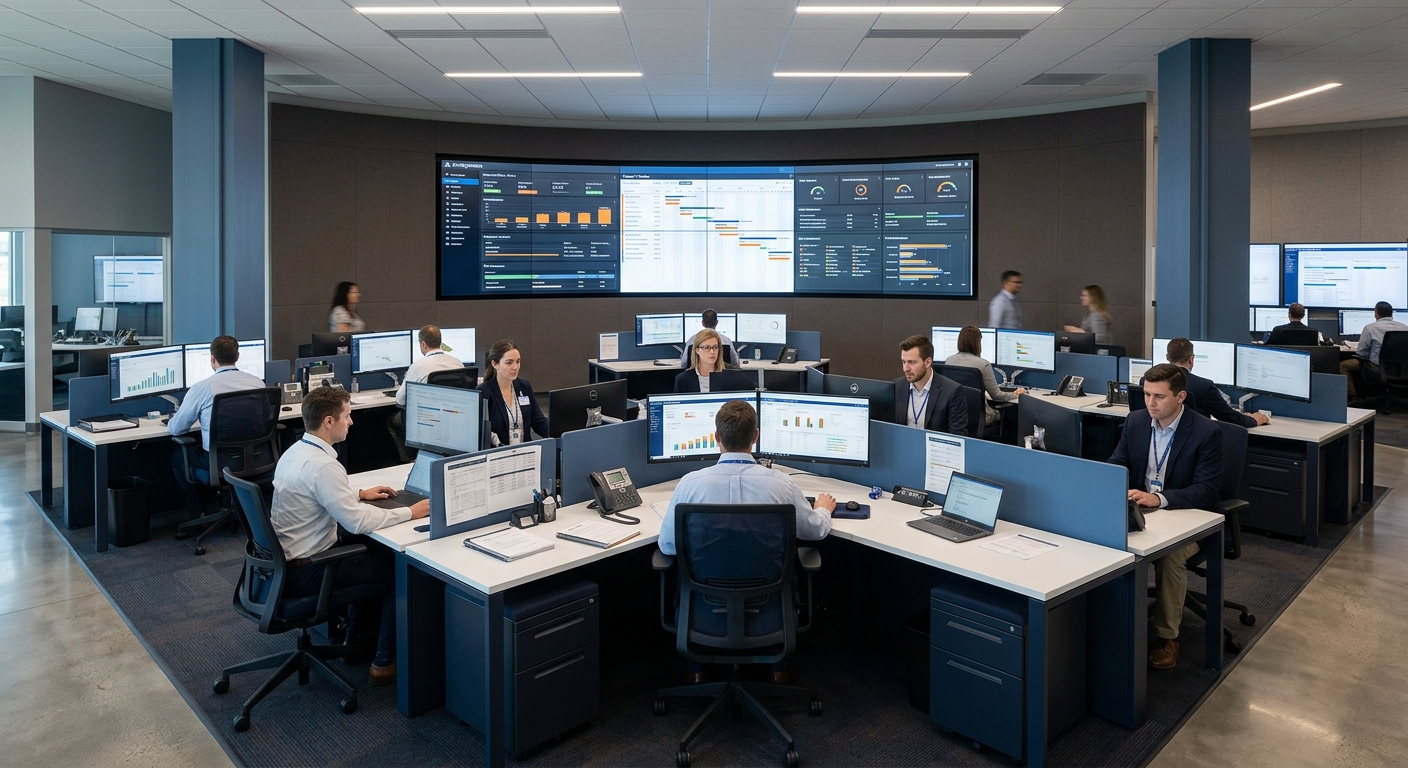
The scale of aerospace manufacturing operations makes proposal coordination a strategic function, not an administrative one. Generated image via Nano Banana 2.
Seen enough to want the numbers for your environment?
The 15-Business-Day Microsoft Assessment maps your specific proposal workflow against a governed Microsoft architecture and produces a realistic implementation scope, timeline, and projected return specific to your pipeline volume and team structure.
Start the conversation
Credibility Anchors
Continued Expansion Across Additional Program Areas
The Virtual Proposal Center was initially deployed to serve the proposal function for one product division. Within the first year of operation, the platform had expanded to cover additional program areas as proposal leadership recognized that the governance architecture and integration framework delivered in the initial engagement could be replicated across divisions without rebuilding from first principles.
Members of the organization’s proposal and product management functions described the platform as essential to sustaining and managing an expanding portfolio of proposal environments. The language used internally reflected a shift from viewing the VPC as a delivered project to viewing it as operational infrastructure maintained through an ongoing relationship with i3solutions.
This expansion pattern characterizes i3solutions’ most durable Microsoft deployments. A disciplined initial build establishes a governance foundation capable of supporting growth. That foundation is then leveraged across adjacent requirements without the rework and technical debt that comes from ungoverned incremental development.
A proposal manager on the team described the shift simply: within the first month, the daily coordination conversations had moved from tracking down document versions and chasing overdue approvals to evaluating competitive positioning. The administrative work had stopped consuming the time that winning bids actually requires.
i3solutions has completed more than 600 Microsoft implementations as a Microsoft Gold Partner since 1997. The depth behind this engagement is not from individual talent alone. It is from institutional pattern recognition built over decades of solving the same class of problem across different industries and scales.
At the conclusion of the engagement, i3solutions established the Rules of the Road: the four-pillar governance operating model the organization’s own team runs under going forward. Ownership and Accountability defines who owns each system, workflow, and integration with documented quarterly reviews. Security and Access governs how permissions are granted, reviewed, and time-limited. Lifecycle and Records defines retention schedules and archival policies implemented at the data layer. Release Discipline requires that all production changes follow a defined process with testing and rollback plans. These rules prevent the most common post-delivery failure mode: a well-built platform that degrades because no one established who owns what after the engagement closed.
iPad Mockup
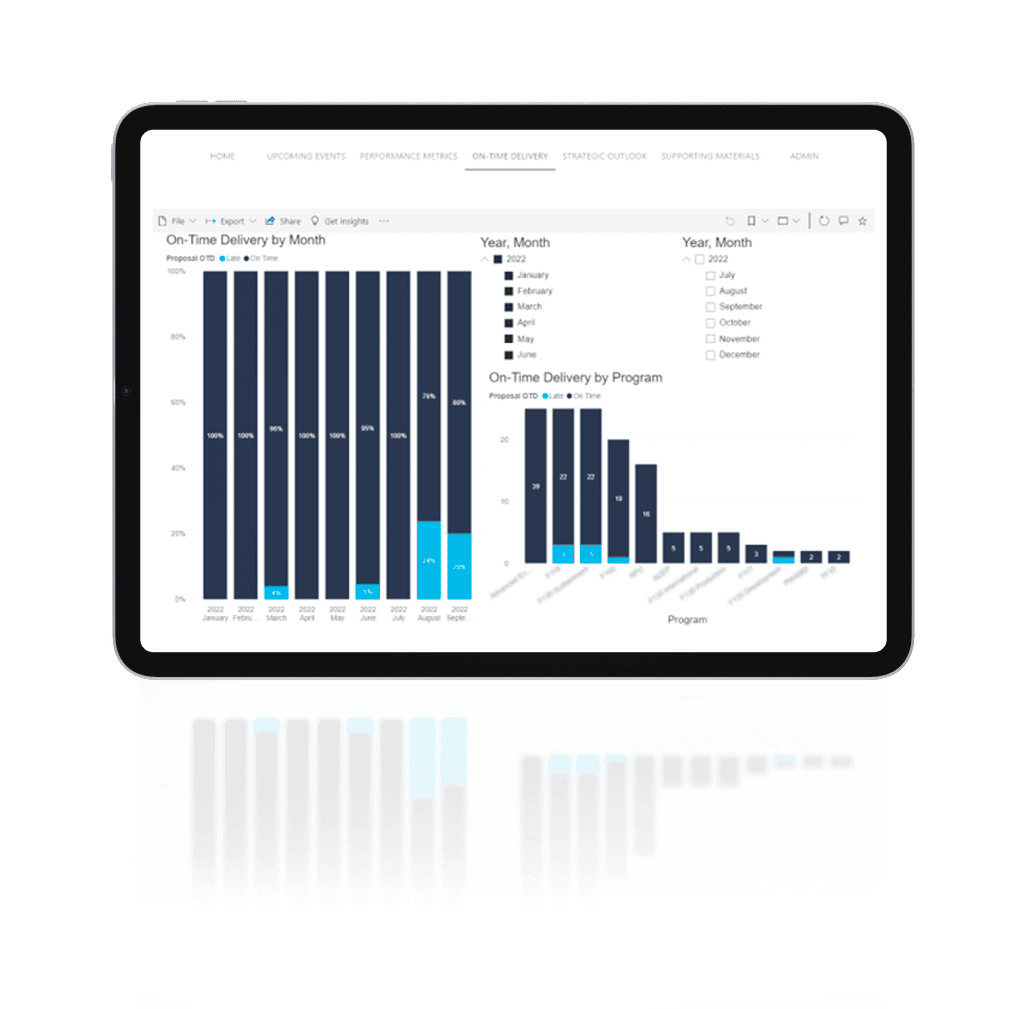
The VPC is accessible across devices, giving field-based capture managers real-time visibility into their active proposals.
Frequently Asked Questions
Power Apps Development Services for Enterprise Proposal Management
What is power apps development services for enterprise proposal management?
Power apps development services for enterprise proposal management involves designing and building custom Microsoft Power Apps applications that centralize proposal workflows, document access, approval routing, and pipeline visibility across distributed teams. For organizations competing on complex contracts, a governed Power Apps environment replaces fragmented manual processes with an integrated platform that reduces preparation time and improves submission quality.
How much can power apps development reduce proposal cycle time?
Organizations implementing custom Power Apps proposal management environments typically report preparation time reductions of 30 to 40 percent according to published Microsoft Power Platform deployment research. In documented i3solutions engagements, a major aerospace manufacturer reduced proposal preparation time by 35 percent, reclaiming approximately $800,000 annually in staff capacity previously consumed by administrative coordination.
Why do aerospace organizations use microsoft power platform for proposal management?
Aerospace organizations use the Microsoft Power Platform for proposal management because it allows custom application development within an already-established Microsoft infrastructure. Power Apps provides the configurable front end, Power Automate manages workflow logic, Dataverse structures the underlying data, and SharePoint Online governs document access, all within a security model that can meet federal data handling requirements where applicable.
What should aerospace defense contractors look for in a power apps development partner?
Aerospace and defense contractors evaluating power apps development partners should assess the vendor’s experience with Microsoft integration architecture, their capacity to work within regulated environments, and their track record deploying custom platforms for organizations with similarly complex coordination requirements. Vendors who deploy only senior Microsoft specialists rather than mixed teams with variable experience levels are better positioned to design governance architecture from first principles.
How does microsoft power automate support proposal approval workflows?
Microsoft Power Automate supports proposal approval workflows by automating the routing, escalation, and notification logic that manual email-based processes handle inconsistently. A well-designed Power Automate implementation captures approval requests, routes them to appropriate reviewers based on configurable business rules, tracks response against defined deadlines, and escalates automatically when the timeline is at risk, removing administrative burden from proposal coordinators.
What governance model is appropriate for an enterprise power apps deployment?
An enterprise Power Apps deployment requires a governance model that addresses permission boundaries at the data architecture level, not through access controls applied after the system is built. This includes a defined approval hierarchy for introducing new application capabilities, a permissions model aligned with the organization’s role structure, and audit trail capabilities that support compliance documentation requirements.
Can power apps development services support GCC High environments?
Power apps development services can be scoped to support GCC High environments when the solution is designed with federal data handling requirements as a foundational constraint rather than an afterthought. This requires specific configuration decisions at the SharePoint Online and Microsoft Entra ID levels, as well as a vendor with experience navigating the access control and compliance documentation requirements that GCC High engagements carry.
What is the typical ROI timeline for a power apps proposal management platform?
Organizations deploying a custom Power Apps proposal management platform typically see measurable return within the first year of operation, based on industry benchmarks for Microsoft Power Platform enterprise deployments. The primary ROI drivers are staff capacity reclaimed from administrative coordination, improved proposal quality leading to higher win rates, and reduced cost per submitted proposal.
Conclusion
A Replicable Model for Complex Proposal Environments
A major aerospace manufacturer transformed its proposal function from a fragmented, manually coordinated process into a governed, integrated Microsoft platform that reduced preparation time by 35 percent and contributed to a measurable improvement in contract win rates. The Virtual Proposal Center now serves as the operational infrastructure through which multiple divisions manage their proposal pipelines, with the governance architecture established in the initial engagement providing the foundation for continued expansion.
For organizations managing proposal workflows through tools that were not built for the purpose, or where a recent near-miss on a proposal deadline has made the current process indefensible, the combination of custom Power Apps development services, Power Automate development integration, and a governed SharePoint Online environment offers a documented path from process friction to operational discipline.
Back to Case Study Library
60 enterprise Microsoft implementations documented
Related Insights
From the i3solutions YouTube Channel
Short-form perspectives on the delivery and technology challenges in this case study.
Who This Engagement Serves
This engagement is relevant if
- An aerospace manufacturer seeking to unify bid processes across multiple commercial and military engine programs.
- A defense contractor requiring better visibility and coordination between disparate functional teams during complex proposal phases.
- A large-scale component supplier needing to replace manual spreadsheets with streamlined digital apps for contract bidding.
Less relevant if
- A small business needing a simple proposal solution without the complexity of an enterprise low-code platform.
- An organization with a centralized, non-aerospace focused procurement process that already functions efficiently without automation.
Ready to build a proposal environment that wins more and wastes less?
The 15-Business-Day Microsoft Assessment is how i3solutions engagements begin. No discovery theater, no vague findings deck. A working assessment of your Microsoft environment, your proposal workflow, and a scoped path to a platform that performs on day one and grows without structural rework.
Microsoft Gold Partner since 1997. 600+ implementations. All senior. All US-based.
Schedule the Assessment