Case Study · Education
No Web Presence, Losing Applicants: How the graduate management admissions council Built a Global MBA Student Portal
Client: the graduate management admissions council (the graduate management admissions council)

The Enterprise Challenge
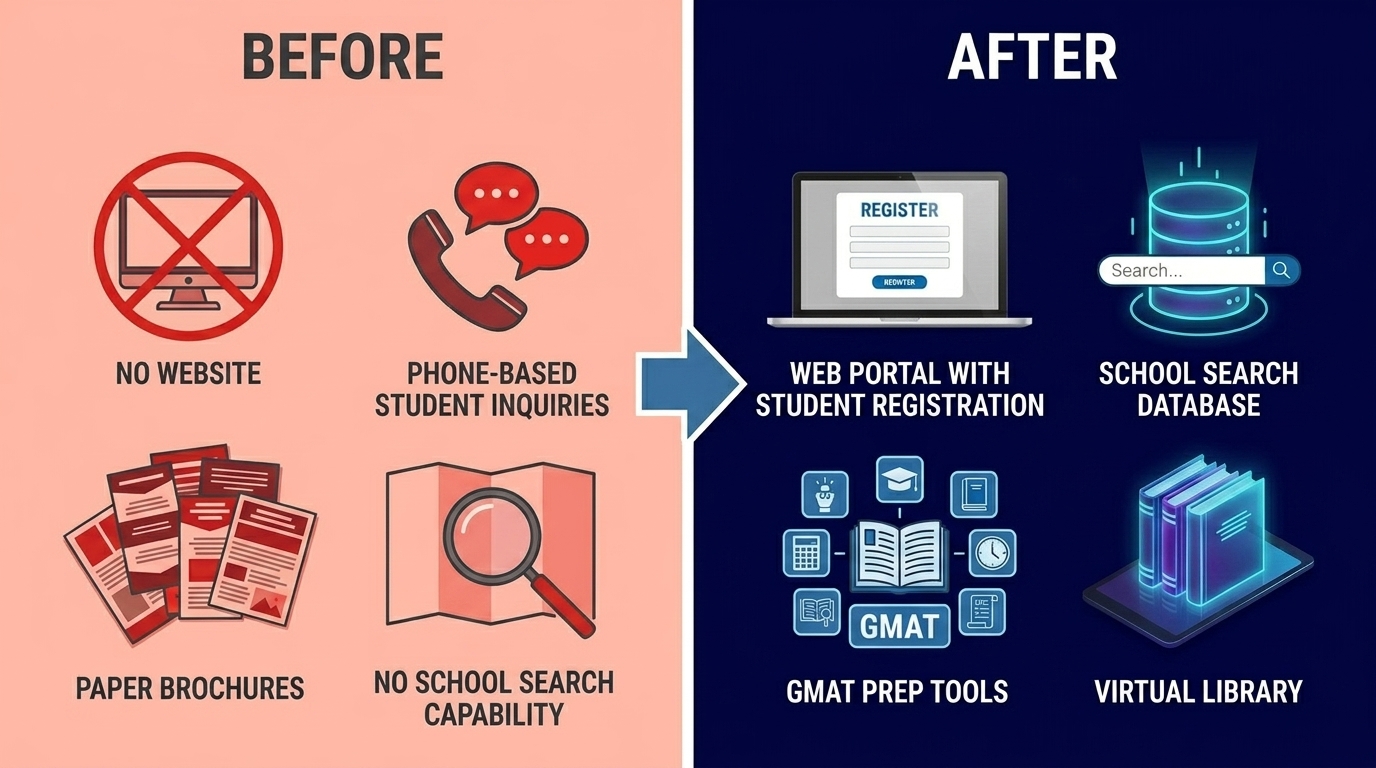
The the graduate management admissions council (the graduate management admissions council), headquartered in Vienna, Virginia, is the creator and owner of the GMAT, the standardized test used by over 7,000 graduate business programs worldwide to evaluate applicants. Despite being the authoritative body behind one of the most recognized admissions tests in higher education, the graduate management admissions council had virtually no digital presence. All student inquiries were handled by phone, program information was distributed as printed brochures, and there was no mechanism for students to search schools, register online, or access preparation resources remotely.
This absence of a web platform was costing the graduate management admissions council prospective students at scale. Competing institutions had already built robust internet-based services, school search tools, online registration, downloadable prep materials, and students were increasingly making program decisions based on digital accessibility alone. the graduate management admissions council’s inability to match that experience meant lost applicants, reduced test registrations, and diminishing institutional reach at exactly the moment when online MBA program discovery was accelerating.
The Strategic Trigger
the graduate management admissions council needed a platform that could serve 3 distinct audiences simultaneously: students looking to find and apply to programs, institutions seeking to attract qualified candidates, and administrators needing to manage content and data without heavy IT dependency. The solution also had to integrate in real time with partner company data systems, no static content, no manual updates. And it had to be built on a foundation robust enough to support future growth as the graduate management admissions council’s digital ambitions expanded.
The Engagement Approach
Strategic Trigger
Paper Registration Processing Crippled Under Record Application Volumes
The absence of a centralized digital portal for MBA candidate registration had reached a critical failure point. the graduate management admissions council was managing peak registration periods using manual, paper-based workflows that depended heavily on data entry personnel and physical mail sorting. This approach was inherently slow, prone to significant transcription errors, and entirely unscalable during high-volume periods. When application rates spiked unexpectedly, the administrative backlog spiraled, creating delays of weeks in processing candidates, delaying test scheduling, and obstructing the critical path for both potential students and member business schools trying to manage admissions. This structural inefficiency threatened core operational integrity.
Faced with escalating complaints from potential test-takers and frustration from member business schools, the graduate management admissions council leadership formally recognized that the manual paradigm was not only inefficient but untenable for sustained global growth. The risk of widespread data inaccuracies and the prohibitive cost of managing a seasonal, paper-based workforce forced a commitment to digital transformation. They acknowledged that continued reliance on physical registration forms fundamentally limited their capability to respond to market demands and committed to modernizing the entire intake infrastructure. Custom development of a secure, accessible web portal became the defined strategic priority for the organization.
Stakes
Losing Top-Tier Business Schools Due to Administrative Chaos
The direct financial and compliance consequences of the manual registration process were substantial. The sheer volume of paper applications created an elevated risk of data loss, privacy breaches, and significant errors in capturing candidate information, which is central to test security and validation. Inefficient processing times led to direct revenue leakage, as the organization could not convert applications into scheduled tests quickly enough during peak enrollment cycles. Furthermore, managing the logistical overhead of physical paper storage, shipping, and manual processing incurred high operational expenditures that were completely unnecessary for a leading, modern professional assessment organization.
Beyond the immediate operational and financial costs, the manual system introduced profound strategic and reputational risks. Global MBA candidates are typically highly digitally proficient; an antiquated, paper-based registration experience was damaging to the graduate management admissions council’s brand image as a sophisticated, global leader in graduate business education metrics. Member business schools also demand real-time data and standardized processes; the inability to provide this compromised the value the graduate management admissions council delivered to its primary stakeholders. Continued reliance on manual methods risked alienating member institutions and inviting competitors to offer a modern alternative, undermining the graduate management admissions council’s market dominance.
Constraints and Complexity
Securely Digitalizing Complex Global Candidate Data Management
The custom-developed portal had to meet rigorous, multifaceted constraints that went far beyond basic form submission. Security was paramount, as the system would handle highly sensitive personal identification, test history, and payment information from a global candidate pool, requiring strict adherence to data privacy regulations such as GDPR and other international standards. Technically, the application needed massive scalability to accommodate extreme traffic spikes during core registration periods without degradation in performance. The backend integration with the graduate management admissions council’s existing, proprietary databases and reporting systems, which were designed for manual entry, added a layer of extreme technical complexity that demanded expert customization and architectural design.
Migrating from a purely manual, paper-reliant workflow to an entirely digital ecosystem presented a colossal data integrity and operational challenge. There were millions of existing physical records that needed, in many cases, manual conversion, cleanup, and validation before ingestion into the new centralized database to maintain historical continuity and candidate record accuracy. Furthermore, organizational adoption required retraining staff whose entire workflows were structured around physical forms, creating a major change management hurdles alongside the technical migration. Ensuring zero data loss and flawless continuity of test-taker processing during the system transition was non-negotiable and technically difficult.
Selection Rationale
Senior Microsoft Specialists with Proven Delivery Depth
the graduate management admissions council thoroughly evaluated several alternatives, ranging from large-scale international consultancies to off-the-shelf software vendors and offshore outsourcing providers. The large, generic consultancies were rejected due to their high reliance on junior, commodity staffing models and often opaque offshore resources, which did not provide the deep, nuanced expertise required for a custom, mission-critical application. Generic offshore vendors were eliminated due to concerns regarding data security, communication delays, and their inability to provide the dedicated, local senior architecture oversight that the graduate management admissions council deemed essential to ensure the success and stability of this core system overhaul.
i3solutions was ultimately selected for this business-critical custom development project because they provided senior Microsoft specialists with proven delivery depth and unparalleled domain expertise. As a Microsoft Gold Partner since 1997 with over 600 successful implementations, i3solutions brought a track record that demonstrated deep proficiency with Microsoft technologies. Their dedication to an all-senior, entirely US-based development team ensured that the graduate management admissions council would benefit from direct access to expert developers who could manage complex integration, rigorous security requirements, and high-performance scalability, offering the exact blend of reliability and sophisticated customization that large, generic firms could not provide.
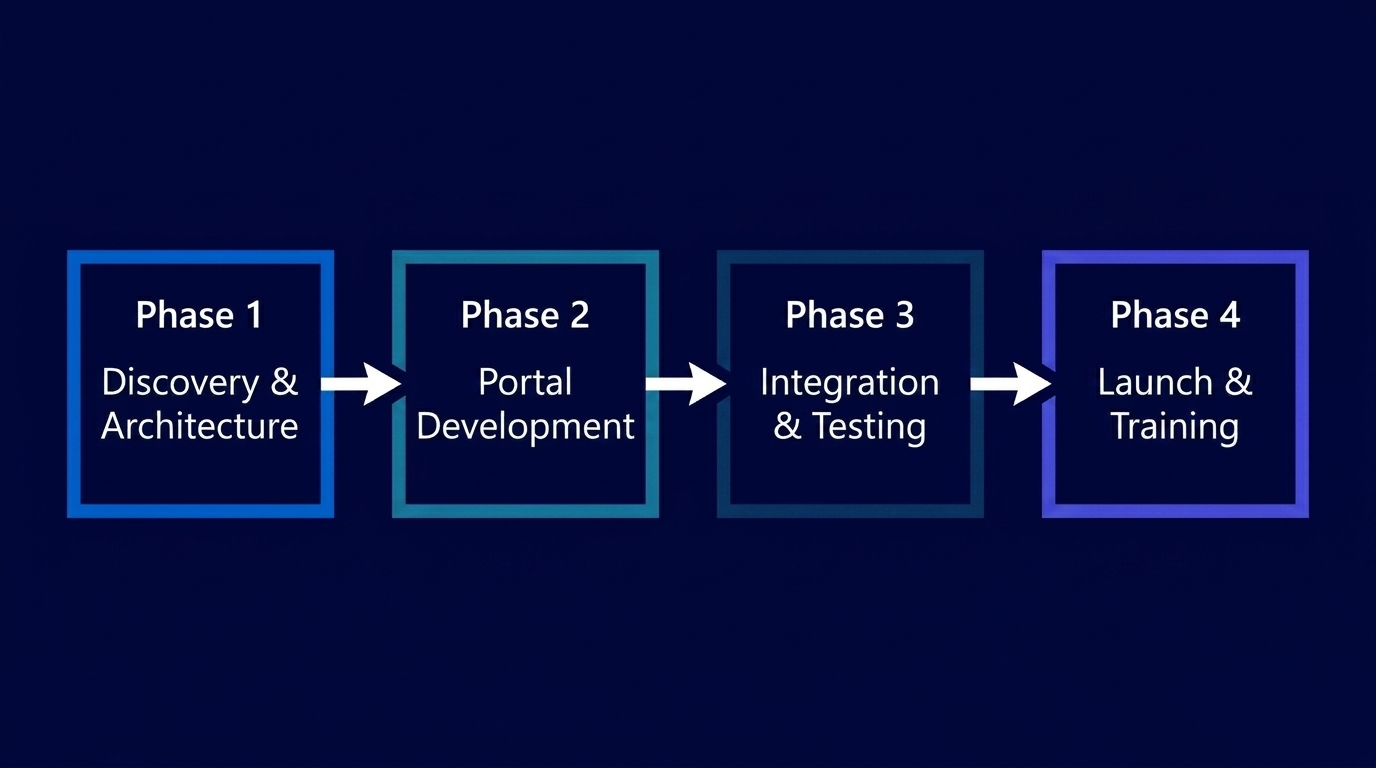
Phase 1
Discovery & Architecture
Assessed the graduate management admissions council’s audience segments, defined portal information architecture, and established integration requirements with GMAT partner systems.
Phase 2
Portal Development
Built the student-facing web portal including registration workflows, the interactive school search database, e-commerce for test registration, and the GMAT POWERPREP download tool.
Phase 3
Data Integration & Testing
Connected the portal to real-time partner data feeds, built the virtual library, and conducted comprehensive QA across all user flows.
Phase 4
Launch & Staff Enablement
Deployed the platform and trained the graduate management admissions council content administrators to manage publications, update program listings, and operate the portal independently.
Technical Transformation
i3solutions migrated the graduate management admissions council from zero digital presence to a fully operational, multi-audience web platform. The student portal consolidated registration, school search, test preparation, distance learning enrollment, and a virtual research library into a single experience. Behind the scenes, the graduate management admissions council administrators gained direct control over published content, no more routing update requests through IT for every change. Real-time data connections with partner organizations ensured that school listings, program details, and institutional information were always current.
Measurable Outcomes
| Metric |
Result |
| Digital Reach |
the graduate management admissions council went from no web presence to serving tens of thousands of prospective MBA students annually |
| Student Self-Service |
Online GMAT POWERPREP registration, school search, and virtual library eliminated the need for phone inquiries |
| Content Control |
Administrators gained direct publish and update access without IT dependency |
| Partner Integration |
Real-time data transfer with partner companies ensured program listings stayed current automatically |
| Foundation for Growth |
The platform architecture was built to scale as the graduate management admissions council’s digital service offerings expanded |
[PENDING-CLIENT-QUOTE: insert 1-3 sentence outcome-focused quote in the client’s own language from a role matching the reader’s role.]
[Name or Role], [Organization type]
Frequently Asked Questions
What is a student portal in the context of MBA admissions?
A student portal is a centralized web platform that allows prospective MBA applicants to search schools, access test preparation resources, register for exams, and enroll in programs, all from a single authenticated experience. For organizations like the graduate management admissions council, a well-built portal replaces fragmented phone-based processes and positions the institution as a modern, accessible service provider.
How does i3solutions approach web portal development for membership and admissions organizations?
i3solutions begins with audience segmentation, identifying who uses the platform, what they need, and how their journeys differ. For the graduate management admissions council, that meant separate functional layers for students, institutions, and administrators. From there, i3solutions designs an information architecture that supports all audiences without creating navigation complexity, then builds each functional module against clear performance and integration requirements.
How does real-time data integration work in a multi-partner portal environment?
Real-time integration connects the portal’s database directly to partner organization data feeds via secure API or data transfer protocols. When a partner institution updates a program listing on their end, that change propagates to the student-facing portal automatically, no manual synchronization, no stale data. i3solutions implements these connections with error handling and fallback states so the portal remains functional even during partner system maintenance windows.
What ROI should education organizations expect from a student-facing web portal?
Organizations that migrate from phone and paper-based student services to a self-serve digital portal typically see registration volume increase as friction decreases. the graduate management admissions council moved from no digital presence to a platform that gave students instant access to prep tools, school search, and online registration. The direct administrative cost reduction from eliminating phone intake and manual information requests is typically measurable within the first year.
Why choose i3solutions for education portal and custom web development?
i3solutions brings 600+ Microsoft platform implementations and 27 years as a Gold Partner to every engagement. Our all-senior, all US-based team has built portals for organizations ranging from federal agencies to global nonprofits, including clients like Pratt & Whitney, General Dynamics, and Deloitte. We deliver on-time, in-scope, in-production. Our 15-Business-Day Microsoft Assessment gives education organizations a clear implementation path before any development begins.
Who This Engagement Serves
This engagement is relevant if
- Academic institutions currently relying on spreadsheets, paper forms, and email to register students for academic programs.
- Professional certification bodies that manage high-volume candidate enrollments manually and need a streamlined digital portal.
- Higher education administrators seeking to integrate disparate student data systems into a single, custom-built web application.
Less relevant if
- Large universities already using comprehensive student information systems like Banner or Workday for all registration needs.
- Small organizations with minimal registration volume that can be managed easily with simple out-of-the-box form tools.
Ready to establish a governed Microsoft environment?
i3solutions delivers enterprise digital transformation on-time, in-scope, in-production. Microsoft Gold Partner since 1997. 600+ implementations. All-senior, all US-based team.
Schedule a 15-Business-Day Microsoft Assessment