Case Study • Federal Government / Treasury • Intranet Consolidation
Thirty Systems to Maintain for One Portal: How the federal treasury agency Consolidated Its Legacy Intranet on SharePoint

The Enterprise Challenge
The the federal treasury agency, the Treasury bureau responsible for designing and producing United States currency, security documents, and other official government products, operated an enterprise intranet called InSite that provided staff with online access to applications, directives and manuals, the telephone directory, and current news and announcements. InSite served a critical operational function for the federal treasury agency’s workforce, accessible from both workstation PCs and strategically located kiosks throughout the Bureau.
The problem was what it cost to keep InSite running. the federal treasury agency was maintaining more than thirty separate legacy systems to support the InSite portal – each application on its own infrastructure, requiring its own maintenance, updates, and IT resources. i3solutions was engaged to consolidate all thirty legacy systems into a single centralized SharePoint platform, eliminating the fragmented maintenance burden while delivering a more functional, discoverable, and stable intranet for the federal treasury agency’s workforce.
Strategic Trigger
The operational cost of maintaining thirty separate systems had reached the point where the maintenance burden was the constraint on everything else the federal treasury agency’s IT team could accomplish. Each of the thirty systems required individual attention for security patches, compatibility updates, and infrastructure maintenance. The cumulative IT overhead of the legacy portfolio was consuming resources that could have been directed toward mission-supporting technology improvement. Consolidation was not a modernization preference – it was a capacity recovery decision.
Is your organization facing a similar challenge?
A 15-Business-Day Microsoft Assessment maps the specific architecture that would address your situation.
Request the Assessment
Stakes
Operational inefficiencies waste resources and compromise regulatory compliance.
The the federal treasury agency faced escalating costs and significant risks due to its dependency on 30 outdated, disparate legacy systems. Inaction meant continued financial strain from maintaining obsolete infrastructure and increased labor hours spent navigating inefficient workflows. Crucially, without a unified platform, data consistency and accessibility were compromised, threatening the agency’s ability to meet stringent federal reporting mandates and auditory standards. Failure to modernize directly resulted in operational logjams and substantial compliance vulnerabilities, making the transition to a consolidated system an urgent financial and regulatory necessity.
The persistence of these siloed systems jeopardized the agency’s long-term strategic positioning and public standing. Continued use of fragmented data sources would have severely hindered accurate decision-making and performance tracking, essential for maintaining public trust and operational transparency. Furthermore, failing to implement a cohesive modern platform could invite significant public scrutiny regarding fiscal management and operational effectiveness. The lack of standardized processes and integrated information flows also presented a risk to national security protocols, as ensuring consistent, secure access to sensitive financial manufacturing data becomes exponentially more difficult across dozens of uncoordinated, aging platforms.
Constraints and Complexity
Securely integrating and migrating massive sensitive financial data.
The the federal treasury agency (the federal treasury agency) required a comprehensive overhaul of its disparate legacy intranet systems within a highly complex operational landscape. Key challenges included stringent federal security requirements (such as FedRAMP and FISMA compliance), ensuring non-disruptive operations during standard manufacturing hours, and strict budget adherence typical of government initiatives. Additionally, the transition demanded a phased rollout to manage institutional resistance to change and accommodate varying technical proficiencies across diverse departments. Ensuring robust disaster recovery protocols and seamless integration with existing mission-critical systems further heightened the implementation difficulty, necessitating a highly tailored and phased strategic approach.
The scope involved migrating vast amounts of sensitive financial and operational data from dozens of disparate systems, many nearing end-of-life support. This presented immense technical challenges regarding data integrity, mapping consistency, and preserving historical accuracy during the ETL (Extract, Transform, Load) process. Achieving widespread adoption required extensive training programs to overcome entrenched workflows and ensure all user levels could effectively leverage the new SharePoint environment. This complexity was amplified by the need to consolidate scattered document repositories into a unified structure, requiring careful planning and execution to ensure minimal operational downtime and maintain productivity throughout the enterprise-wide transition.
Selection Rationale
Senior Microsoft Specialists with Proven Delivery Depth
The the federal treasury agency (the federal treasury agency) meticulously evaluated several alternative platforms, including open-source content management systems and various low-code development suites. However, these options consistently fell short when assessed against the agency’s demanding security protocols and federal compliance mandates. Custom-built solutions, while flexible, were deemed excessively expensive to develop and maintain, introducing substantial long-term technical debt and resource dependencies. Other commercial off-the-shelf alternatives lacked the deep integration capabilities with existing Microsoft infrastructures already in use, threatening fragmented workflows. Ultimately, only SharePoint provided the robust security framework, scalable architecture, and comprehensive regulatory compliance tools essential for consolidating the the federal treasury agency’s disparate legacy systems into a secure, unified digital workplace.
As a distinguished Microsoft Gold Partner since 1997, i3solutions brought an unparalleled depth of expertise in Microsoft technologies. With over 600 successful implementations across numerous federal agencies, i3solutions possessed a deep understanding of complex government compliance standards like FISMA and FedRAMP. The agency particularly valued the team’s composition: exclusively comprised of senior specialists, all based within the United States, eliminating communication barriers and security concerns associated with offshore resources. This concentration of experienced personnel ensured a nuanced implementation strategy capable of managing the Bureau’s legacy migration challenges, guaranteeing a secure, efficient transition while minimizing operational disruption during the consolidation of its critical business systems into the modern SharePoint platform.
The Engagement Approach
PHASE 01
Legacy System Inventory
Complete technical inventory of all thirty legacy systems supporting InSite. Mapping of integration dependencies between systems. Content and data inventory for migration planning. Identification of the SharePoint architecture that would consolidate all thirty applications while maintaining the functionality each provided.
PHASE 02
SharePoint Architecture
Centralized SharePoint architecture designed to host all InSite applications and content in a single governed platform. Information architecture ensuring that content previously distributed across thirty systems was organized for discoverability. Kiosk interface design maintaining the federal treasury agency’s ability to provide portal access at physical kiosk locations throughout the Bureau.
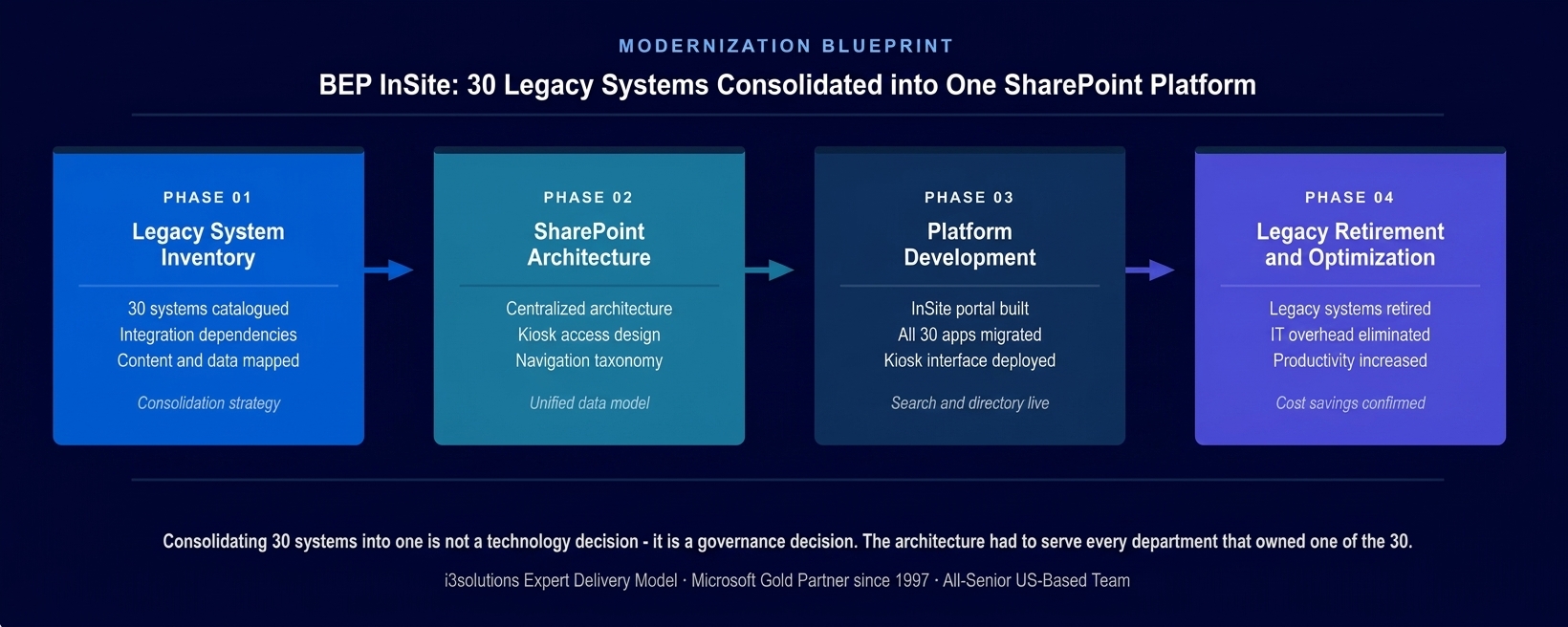
Legacy retirement in Phase 4 was the outcome that justified the entire program – the consolidation only saves money when the thirty systems are actually turned off.
PHASE 03
Platform Development and Migration
SharePoint InSite platform built incorporating all thirty application functions. Content and data migration from each legacy system with validation confirming nothing was lost in the consolidation. Enterprise search configured across all consolidated content. Telephone directory built as a dynamic, searchable application replacing the static directory. Kiosk interface deployed and tested at Bureau locations.
PHASE 04
Legacy Retirement and Optimization
Thirty legacy systems decommissioned after full validation of the consolidated SharePoint platform. IT maintenance overhead eliminated for the thirty retired systems. Performance and stability monitoring confirming the SharePoint platform’s operational reliability. Cost savings from eliminated infrastructure confirmed.
Technical Transformation
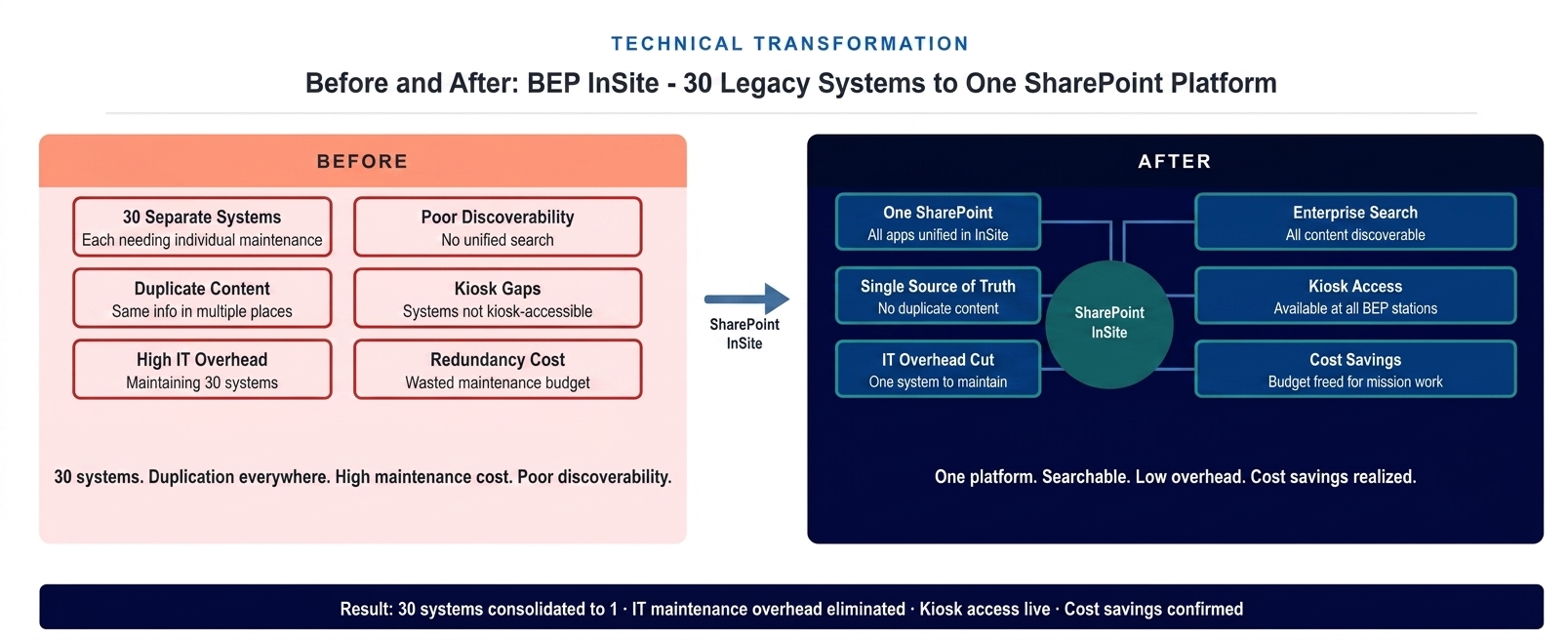
30 separate legacy systems maintaining a single portal replaced by one centralized SharePoint platform. IT maintenance overhead eliminated. Content discoverable through enterprise search. Kiosk access maintained.
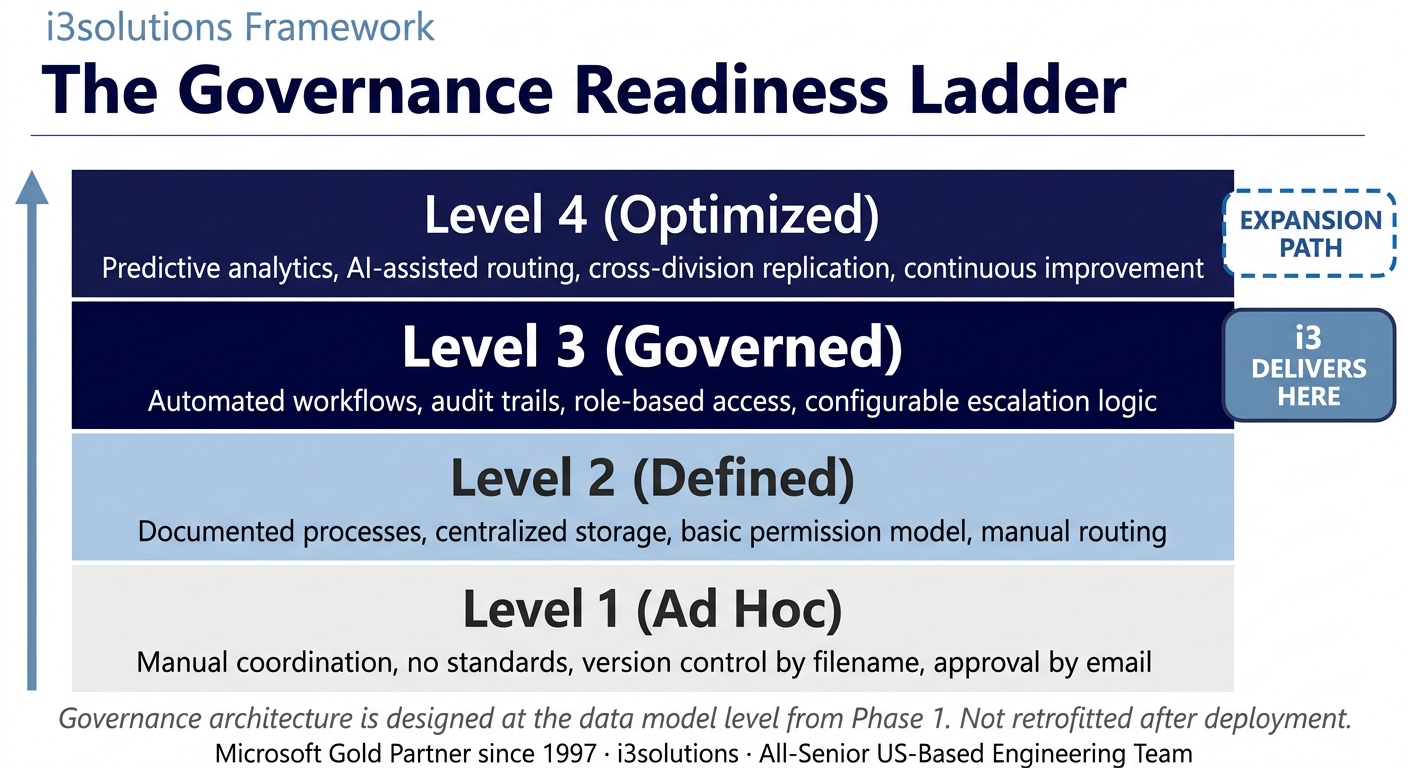
The Governance Readiness Ladder applied. SharePoint InSite consolidation delivered Level 3 intranet governance. The platform supports Level 4 as workflow automation and additional applications are built on the consolidated foundation.
Measurable Outcomes
| Metric | Before | After | Improvement |
|---|
| Legacy system count | 30 separate systems required to run one portal | 1 centralized SharePoint platform serving all functions | 30 systems consolidated to 1 |
| IT maintenance overhead | Significant – 30 systems requiring individual maintenance | Eliminated – one platform, one maintenance cycle | Maintenance overhead eliminated |
| Content discoverability | Poor – content scattered across 30 systems | Enterprise search across all consolidated content | Full content discoverability |
| System stability | At risk – 30 legacy systems on obsolete technology | Stable – SharePoint on current Microsoft platform | System stability achieved |
| Kiosk access | Maintained through legacy systems | Maintained through consolidated SharePoint platform | Continuity preserved |
| IT resource availability | Consumed by legacy maintenance | Freed for mission-supporting technology work | IT capacity recovered |
[PENDING-CLIENT-QUOTE: insert 1-3 sentence outcome-focused quote in the client’s own language from a role matching the reader’s role.]
[Name or Role], [Organization type]
Frequently Asked Questions
SharePoint Legacy System Consolidation for Government Organizations
What is SharePoint legacy system consolidation and why do government agencies undertake it?
SharePoint legacy system consolidation is the process of replacing multiple separate legacy applications and content repositories with a single centralized SharePoint platform that delivers all the functionality the legacy systems provided, plus enterprise search, unified navigation, and a single governance framework. Government agencies undertake it when the cumulative IT maintenance overhead of maintaining many legacy systems individually is consuming resources that should be directed toward mission-supporting work, when the fragmented landscape creates security and compliance risk, or when employees cannot find information because it lives in too many separate places with no unified search.
How does i3solutions manage data integrity when consolidating 30 or more legacy systems?
i3solutions manages data integrity in large-scale consolidations through a wave-based migration approach with validation at each wave before proceeding to the next. Every content item, application record, and document is inventoried before migration begins, and the inventory is used to confirm that nothing was lost or corrupted during migration. For agencies like the federal treasury agency with complex legacy environments including applications built on obsolete technologies with unknown customizations, i3solutions performs pre-migration analysis to identify items that require special handling, content that cannot be automatically migrated, applications that require custom adaptation, and integration dependencies that need to be preserved, before any data moves.
How does i3solutions approach consolidation without disrupting ongoing government operations?
i3solutions sequences consolidations to maintain parallel access to both legacy and new systems throughout the migration period, so that users are never in a state where they cannot access the information they need to do their work. Legacy systems are retired system by system, not all at once, with each retirement preceded by confirmation that all content has been successfully migrated and validated in the consolidated platform. For the federal treasury agency’s 30-system consolidation, this sequencing was the architectural decision that allowed a major technology transformation to proceed without disrupting the Bureau’s daily operations.
What is the IT cost benefit of consolidating legacy systems onto SharePoint?
The IT cost benefit of consolidating legacy systems onto SharePoint comes from two sources: the elimination of per-system maintenance costs for the retired legacy systems, and the shift from multiple maintenance cycles to a single governed platform maintained by Microsoft. Each legacy system requires individual security patches, compatibility updates, and infrastructure maintenance. Multiplied across 30 systems, as in the federal treasury agency’s case, the cumulative maintenance labor and infrastructure cost is significant. Consolidating to SharePoint converts that variable, per-system cost to a single platform cost while gaining Microsoft’s continuous improvement of the underlying platform at no additional charge.
Why choose i3solutions for a SharePoint legacy system consolidation?
i3solutions brings two things that distinguish a consolidation engagement from a standard SharePoint implementation: pattern recognition from 600+ Microsoft platform engagements that identifies consolidation risks before they become problems, and an all-senior delivery model that puts experienced architects on the migration rather than junior developers following a script. Legacy consolidations are technically complex, old systems have undocumented customizations, obsolete integrations, and content in formats that don’t migrate cleanly. Experience recognizing and resolving those issues before they create delays or data loss is the difference between a consolidation that completes on schedule and one that doesn’t. i3solutions has been a Microsoft Gold Partner since 1997 specifically because of that depth of platform experience.
The the federal treasury agency consolidated thirty separate legacy systems into a single centralized SharePoint InSite platform, eliminating the IT maintenance burden of the fragmented legacy portfolio while delivering a more stable, more discoverable, and more governable intranet for the Bureau’s workforce.
Back to Case Study Library
60 enterprise Microsoft implementations documented
Related Insights
From the i3solutions YouTube Channel
Short-form perspectives on the delivery and technology challenges in this case study.
Who This Engagement Serves
This engagement is relevant if
- Government agencies managing numerous disconnected legacy intranets that require consolidation into one modern platform.
- Highly regulated organizations needing a secure, compliant, unified SharePoint environment to replace siloed information systems.
- Large public sector entities seeking to streamline internal communication across multiple departments using M365 tools.
Less relevant if
- Small businesses with minimal internal communication needs that do not require an enterprise-grade SharePoint solution.
- Organizations looking for an open-source intranet platform rather than a Microsoft-based technology stack.
Ready to consolidate a fragmented legacy intranet portfolio into a single governed SharePoint platform?
The 15-Business-Day Microsoft Assessment inventories your legacy systems, maps the consolidation architecture that captures all existing functionality in a single SharePoint platform, and quantifies the IT maintenance cost that consolidation would eliminate.
Microsoft Gold Partner since 1997. 600+ implementations. All senior. All US-based.
Schedule the Assessment