Case Study • Transportation / Enterprise • Compliance Automation
Faxed Reports, Manual Re-Entry, Stale Data: How Amtrak Automated Food Compliance Inspection Reporting
Strategic Trigger
Paper Records Caused Food Safety Compliance Audit Failures
Amtrak’s vast national network of dining cars and cafes relied exclusively on manual, paper-based inspection records to document critical food safety protocols, temperature logs, and sanitation procedures. As inspections were conducted in transit across dozens of routes, the logistical challenge of centralizing, storing, and reviewing thousands of physical documents led to a critical breakdown in visibility. Missing records, illegible entries, and significant data retrieval delays rendered proper oversight impossible. This fragmentation resulted in a concerning increase in audit failures and regulatory findings, as management could not validate the execution of mandated food safety checks in near real-time.
Leadership recognized that the physical disconnect between moving trains and centralized compliance management was untenable, posing an unacceptable risk to operational continuity and passenger safety. They determined that continuing with the status quo was fundamentally incompatible with modernization goals and regulatory requirements. A strategic commitment was made to digitize the entire food safety inspection process, demanding a mobile-first solution capable of capturing verifiable, standardized data directly from the onboard personnel. This transition from reactive paper-chasing to proactive digital reporting was essential to ensure 100% compliance across the entire rolling fleet.
Stakes
Regulatory Fines and Potential Foodborne Illness Outbreaks
The consequences of continued reliance on manual records were extreme, primarily centered on regulatory non-compliance and public health risks. Without verifiable, real-time documentation of temperature logs and sanitation checks, Amtrak faced severe and recurring financial penalties from federal and state health inspectors. Each audit failure not only resulted in immediate fines but also invited increased regulatory scrutiny, complicating future operations. Even more critically, the inability to guarantee the safe storage and handling of perishable food due to inadequate documentation created a statistically significant risk of a foodborne illness outbreak among passengers and crew.
Beyond financial and operational penalties, the reputational and strategic risks posed a threat to the Amtrak brand. In the highly public transportation sector, a single high-profile safety incident or public condemnation regarding unsanitary conditions could irreversibly damage passenger confidence, which had been meticulously built over decades. Media coverage of food safety failures would drive negative public sentiment, directly impacting ridership and future revenue. Such an incident would also jeopardize crucial federal funding, as lawmakers demand rigorous accountability for public safety standards, potentially derailing Amtrak’s long-term modernization efforts and expansion plans.
Constraints and Complexity
Inconsistent Network Connectivity Across Remote National Routes
The defining challenge of implementing a modern solution was Amtrak’s operational environment: a vast geographical footprint spanning thousands of miles of track, much of it in remote areas with non-existent or unreliable cellular coverage. The proposed food safety application absolutely required “offline first” capability. Onboard personnel needed to perform complex digital inspections, capture temperature logs, and document compliance actions seamlessly, regardless of current network availability. The application then needed robust synchronization logic to automatically upload stored data the moment a reliable connection was re-established, all without disrupting the critical workflows of the busy dining car staff.
Further complexity arose from the rigid and detailed nature of food safety compliance standards. The application had to accurately reflect countless regulatory forms and dynamic inspection protocols, tailored not just to different types of food service cars but also potentially differing state regulations along a single route. Transitioning users accustomed to physical paper for decades necessitated an intuitive, streamlined user interface that minimized data entry errors and required minimal training. The digital system also had to integrate with Amtrak’s broader compliance reporting frameworks to ensure the newly captured digital data could be effectively utilized for analysis, oversight, and reporting.
Selection Rationale
Microsoft Power Platform Specialists with Public Sector Experience
Amtrak evaluated several alternatives before committing to a development partner, including internal development with their IT resources and engaging larger, generic consulting firms. Internal development was quickly ruled out due to existing backlogs and the specialized nature of low-code development and offline synchronization logic required for the Power Platform. The larger, general-purpose consulting firms were dismissed as they often utilize junior-level offshore teams and lack the deep, focused expertise necessary to handle the complexity of offline mobile applications within a highly regulated environment. These firms offered broad capabilities but could not guarantee the senior-level, localized focus that Amtrak prioritized.
i3solutions emerged as the premier choice, presenting an unmatched combination of relevant experience and senior-level depth as a Microsoft Gold Partner since 1997. Their track record, spanning over 600 successful implementations across commercial and government sectors, demonstrated a level of reliability and risk mitigation that general consulting firms could not match. Crucially, i3solutions utilizes an all-senior, all-US-based development team, ensuring seamless communication and immediate access to deep technical insight during complex design and integration phases. Their specific expertise in complex Power Apps development and offline data synchronization provided Amtrak with the exact capabilities required for this critical, compliance-driven project.
The Enterprise Challenge
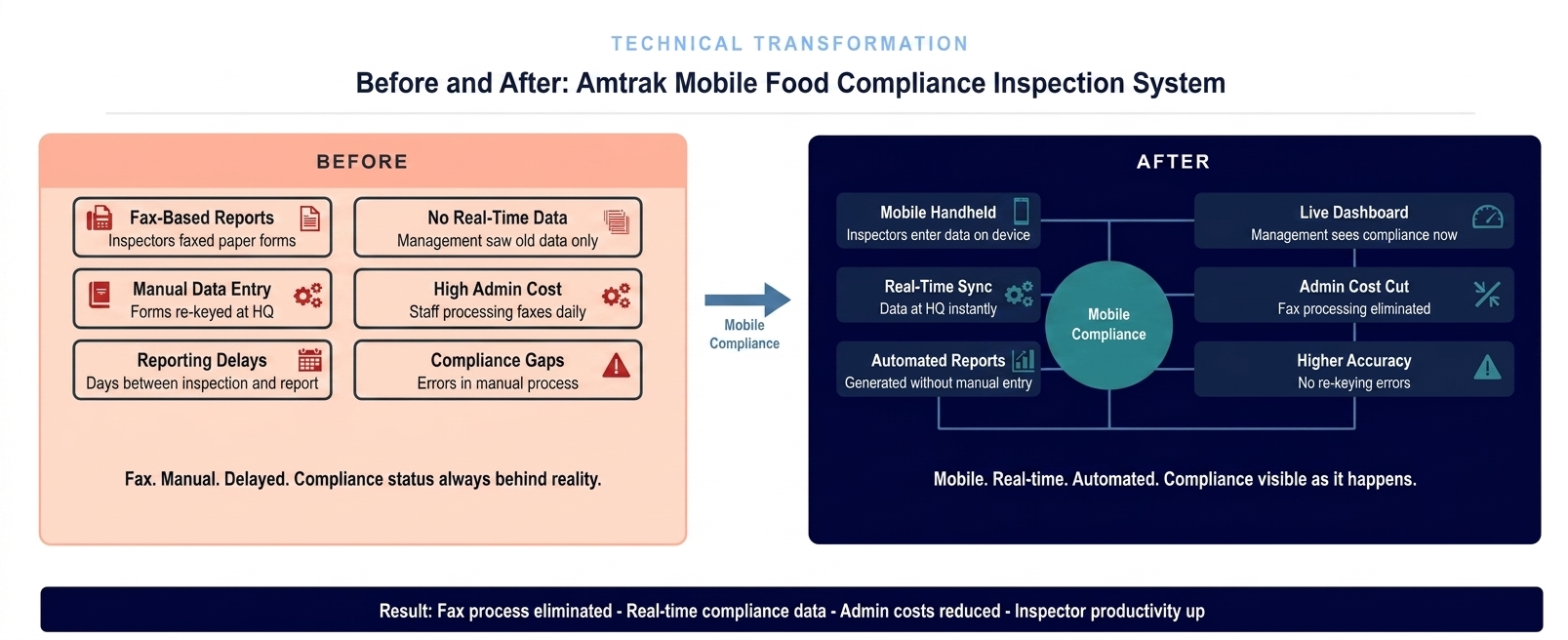
Amtrak provides nationwide rail service to over 500 stations in 46 states, carrying approximately 90,000 guests per day across more than 22,000 route miles. Maintaining food safety standards across that dining operation requires real-time compliance tracking. The system Amtrak was using was a paper form completed by health inspectors on the dining car, faxed to headquarters, manually re-keyed into a computer, and then incorporated into a compliance report. Compliance status measured in days rather than hours.
i3solutions built a wireless mobile inspection system that put a handheld device in each inspector’s hands, transmitted inspection data to headquarters in real time, and generated compliance reports automatically without any manual re-entry.
The Engagement Approach
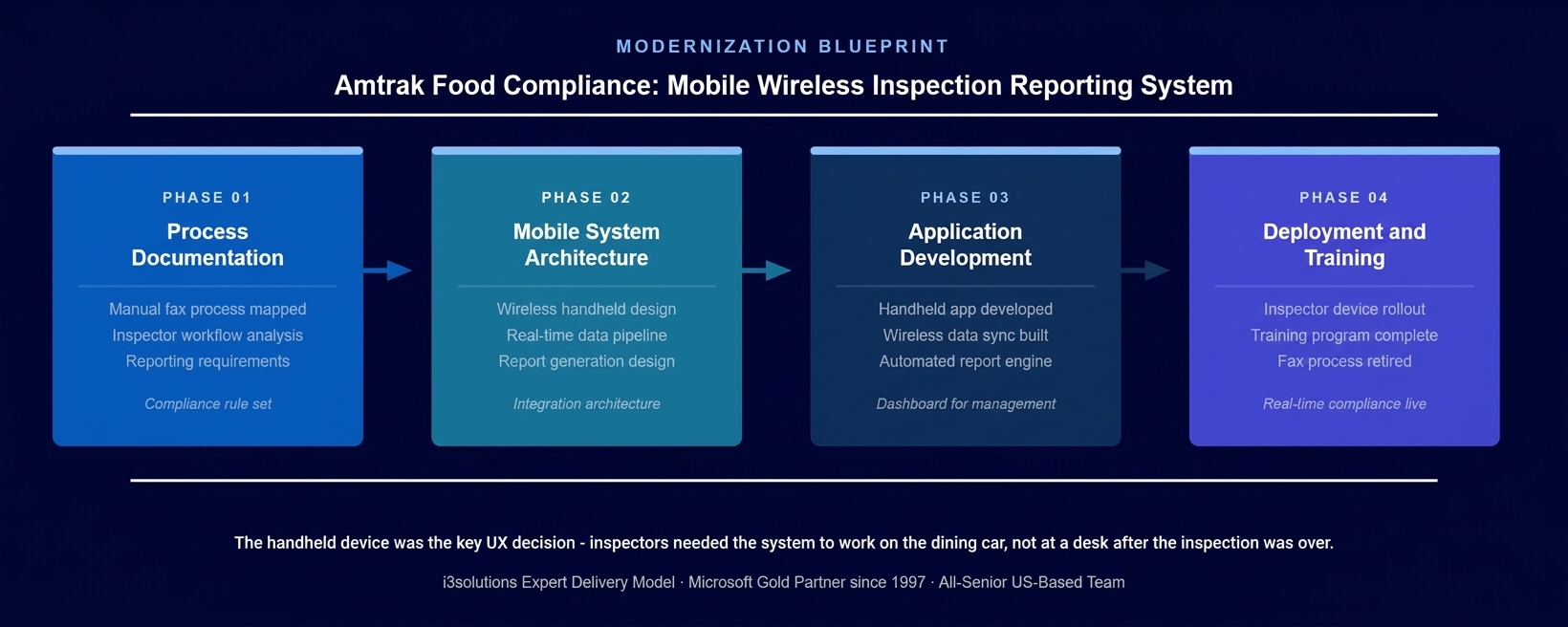
PHASE 01
Process Documentation
Complete mapping of the paper fax process. Inspector workflow analysis. Reporting requirements for management compliance dashboards.
PHASE 02
Mobile System Architecture
Wireless handheld device selection. Real-time data pipeline architecture. Automated report generation design eliminating manual report preparation.
PHASE 03
Application Development
Handheld app with compliance form fields. Wireless data sync in dining car environments. Automated report engine generating management dashboards from live inspection data.
PHASE 04
Deployment and Training
Inspector device rollout with hands-on training. Fax process retired. Paper forms retired. Real-time compliance confirmed at headquarters.
Technical Transformation
Measurable Outcomes
| Metric | Before | After | Improvement |
|---|
| Inspection reporting | Paper fax from dining car to HQ | Mobile handheld capture transmitted in real time | Real-time compliance data |
| Data accuracy | Manual re-entry introduced error risk | Direct handheld to system, no re-entry | Error risk eliminated |
| Report generation | Manual compilation from faxed data | Automated from live inspection data | Reporting automated |
| Administrative cost | Staff processing faxes daily | Fax processing eliminated | Admin overhead cut |
| Management visibility | Compliance status days behind reality | Live dashboard current at inspection time | Real-time visibility |
[PENDING-CLIENT-QUOTE: insert 1-3 sentence outcome-focused quote in the client’s own language from a role matching the reader’s role.]
[Name or Role], [Organization type]
Frequently Asked Questions
Compliance Management Software for Transportation and Field Operations
What is compliance management software for transportation organizations?
Compliance management software for transportation organizations automates the capture, transmission, and reporting of compliance inspection data that was previously managed through paper forms, faxes, and manual re-entry. For rail operators with dining operations across hundreds of routes, automated compliance management means inspectors capture data on mobile devices that transmit directly to headquarters systems in real time, eliminating the lag, error risk, and administrative cost of the paper-to-fax-to-keyboard workflow. The result is compliance status that reflects what inspectors observed today, not what was faxed in yesterday and re-keyed this morning.
How does i3solutions design mobile inspection applications for field operations?
i3solutions designs mobile inspection applications around the physical environment where inspectors actually work, not the office environment where developers work. For Amtrak, that meant a handheld application designed to function in the dining car, on a moving train, with the device held in one hand while the inspector observes with the other. Form fields are sized for finger input, required versus optional fields are clearly distinguished, and data sync is designed to operate reliably on the wireless infrastructure available in that environment. A mobile inspection application that works in a controlled demo but fails in the actual inspection setting is not a compliance solution.
What is the ROI of eliminating paper-based compliance reporting?
The ROI of eliminating paper-based compliance reporting comes from three sources: the administrative cost of processing paper forms is eliminated, the error rate from manual re-entry drops to zero, and management gains real-time visibility into compliance status that was previously available only after a lag. For Amtrak, these three benefits combined to produce immediate cost and time savings from the day of implementation. The administrative staff who previously processed faxes and re-keyed data were able to redirect their capacity to higher-value analysis and response rather than data entry. The value of real-time compliance visibility, catching issues the same day rather than the next, is harder to quantify but operationally significant for a food safety compliance program.
How does i3solutions handle connectivity and reliability requirements for mobile field applications?
i3solutions addresses connectivity requirements during the architecture phase, designing the data synchronization model around the actual connectivity conditions of the field environment rather than assuming reliable internet access. Mobile inspection applications can be designed to capture data locally on the device and sync to headquarters systems when connectivity is available, so that an inspector who moves through an area with poor signal does not lose data or experience application failure. For Amtrak’s dining car environment, the sync architecture was designed and tested against the wireless infrastructure on the train, not just in the development environment.
Why choose i3solutions for a compliance management system implementation?
i3solutions brings deep Microsoft platform expertise combined with an all-senior delivery model to compliance management implementations, meaning the architect who designs the system is the same senior practitioner who builds and tests it, not a junior developer executing a senior consultant’s specification. Compliance management systems have a particular failure mode: they work correctly in the demo, fail in the field, and the failure creates compliance risk rather than eliminating it. i3solutions’ pattern recognition from 600+ implementations means common failure modes, connectivity gaps, device compatibility issues, form design that creates errors rather than preventing them, are identified and addressed in the architecture phase rather than discovered during user acceptance testing.
Back to Case Study Library
60 enterprise Microsoft implementations documented
Related Insights
From the i3solutions YouTube Channel
Short-form perspectives on the delivery and technology challenges in this case study.
Who This Engagement Serves
This engagement is relevant if
- A major airline struggling to track on-board inventory and safety checks across multiple flight operations.
- A national cargo shipping company using paper forms for complex maintenance logs across diverse vessel fleets.
- A multi-state bus line manually compiling daily safety inspections for hundreds of vehicles manually.
Less relevant if
- A city subway system whose standardized food vendors use their own digital reporting tools.
- A single-location, private commuter service with a very small food service footprint.
Ready to replace paper-based compliance inspection with real-time mobile capture?
The 15-Business-Day Microsoft Assessment maps the handheld device architecture, wireless data pipeline, and automated reporting system that would give your compliance managers real-time data from the field.
Microsoft Gold Partner since 1997. 600+ implementations. All senior. All US-based.
Schedule the Assessment