Case Study · Aerospace and Defense
Fragmented Proposals, Declining Win Rates: How the defense systems manufacturer Built a SharePoint Proposal Center
Client: the defense systems manufacturer

The Enterprise Challenge
the defense systems manufacturer is a global leader in defense, aerospace, and security, delivering advanced technologies and systems to governments and militaries worldwide. Winning major defense contracts is central to the company’s revenue and mission, and proposal quality is the determining factor in most competitive bids. With thousands of proposal team members spread across business units, the defense systems manufacturer required a system that could coordinate complex, multi-contributor proposals at speed and with full version control.
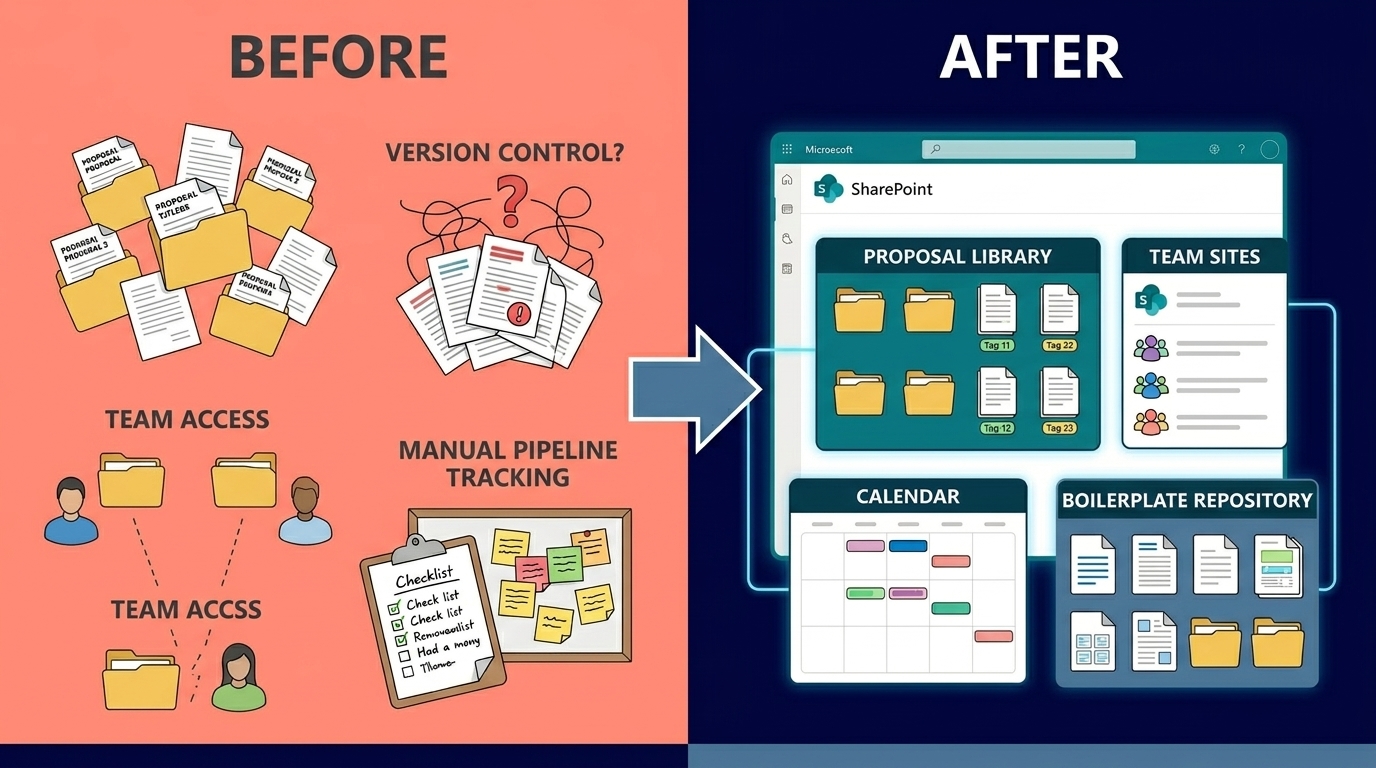
The existing process was running on file shares, email chains, and tribal knowledge. Proposal managers had no single view of the bid pipeline. Contributors were working on documents without knowing whether they had the current version. Security permissions were inconsistent, team members could access materials they shouldn’t, and couldn’t access materials they needed. Past performance documents, boilerplate templates, and capability matrices were scattered across individual hard drives. Every new proposal started from near-zero.
The Strategic Trigger
the defense systems manufacturer needed a platform that could consolidate its entire proposal operation: a central repository for reusable content, a structured workflow for section assignment and deadline tracking, a rollup calendar that gave management a clear pipeline view, and team sites that allowed compartmentalization by contract type and security classification. The solution had to match the pace of defense contracting, where proposal turnaround windows are often 2 to 4 weeks from RFP release.
The Engagement Approach
Strategic Trigger
Global teams using localized drives paralyzed proposal delivery
For a global defense leader like the defense systems manufacturer, the process of assembling complex, multi-billion dollar proposals required seamless collaboration across international teams. Instead, the process was hampered by distributed teams working from localized hard drives, disconnected file shares, and varied data siloes. Proposal managers spent days reconciling versions rather than refining content. The risk of submitting conflicting data or outdated technical specifications in a competitive bidding situation escalated beyond acceptance. In one critical instance, conflicting document versions nearly caused a submission deadline to be missed, highlighting the fundamental operational risk.
This near-miss forced leadership to formally recognize the status quo as untenable. They acknowledged that relying on hard drives and lacking centralized version control was not just inefficient, it was a strategic vulnerability. The company committed to an organization-wide mandate for a single source of truth for all proposal development assets. The objective was clear: create a secure, centralized, and globally accessible repository with robust version control and document management capabilities. This was seen as essential for improving win rates, ensuring consistency, and maintaining competitive agility.
Stakes
Uncontrolled data meant high proposal failure compliance risks
The stakes were exceptionally high, extending beyond efficiency to the core viability of their contracting operations. If the defense systems manufacturer failed to centralize and secure its proposal data, the direct financial and operational consequences would be severe. Preparing a single major proposal costs millions in labor; disjointed efforts increased these costs significantly. More critically, the risk of non-compliance with complex government acquisition regulations (like DFARS or ITAR) was extreme when using unmanaged localized storage. A compliance failure in a proposal could disqualify the firm, leading to billions in lost potential revenue.
Furthermore, the reputational risk was profound. the defense systems manufacturer’ reputation is built on technical precision and mission-critical reliability. Clients, typically national governments, required assurance that the defense systems manufacturer could securely manage sensitive information. Continued failures to maintain version control during the proposal phase signaled an inability to manage information effectively, eroding client trust and placing the strategic future of the organization at risk. In the competitive defense market, demonstrating secure and competent information governance is as important as the proposed technical solution itself.
Constraints and Complexity
Securing complex data across globally federated defense networks
The complexity was driven by both the nature of the data and the scale of the global operations. the defense systems manufacturer operated across multiple distinct business units in the UK, US, and Australia, each with its own IT legacy systems and security domains. The proposal data itself was highly varied, ranging from unclassified engineering data to Controlled Unclassified Information (CUI) and other export-controlled data subject to strict regulations like ITAR. Ensuring data sovereignty and implementing rigorous access controls that could be validated in audits were critical technical and organizational constraints that simple off-the-shelf solutions could not meet.
Additionally, the adoption challenge was enormous. For years, engineers and proposal writers had relied on their local workflows. Moving thousands of users to a centralized SharePoint environment required overcoming significant cultural resistance and ensuring the new system did not add friction to already high-pressure timelines. Data migration was also complex, involving the extraction and clean-up of terabytes of legacy data from fragmented systems while ensuring the preservation of essential metadata and version histories. Simply setting up SharePoint wasn’t enough; it had to be optimized for adoption and performance under intense proposal deadlines.
Selection Rationale
Senior Microsoft Specialists with Proven Delivery Depth
the defense systems manufacturer evaluated several implementation alternatives, including the large, “Big 4” consulting firms and commodity staffing providers. However, these larger firms often proposed complex, multi-year projects staffed heavily with junior, offshore resources. This model was inadequate for the defense systems manufacturer’ needs, which required deep, specialized expertise in high-security SharePoint architecture and migration, not generic IT staffing. The complex regulatory and security requirements demanded specialists who understood how to configure Microsoft technology to meet specific compliance standards (e.g., NIST, ITAR) while ensuring performance for a globally distributed user base.
the defense systems manufacturer chose i3solutions based on their profound Microsoft expertise and proven track record in demanding enterprise environments. As a Microsoft Gold Partner since 1997 with over 600 successful implementations, i3solutions provided the depth and experience the defense systems manufacturer needed. Crucially, i3solutions utilized an all-senior, all-US-based consulting team. This structure ensured that every consultant possessed deep domain knowledge and could operate effectively within the strict security and compliance constraints mandated by the defense systems manufacturer’ defense-related contracts. The direct access to senior leadership and immediate, expert problem-solving capacity was the decisive factor.
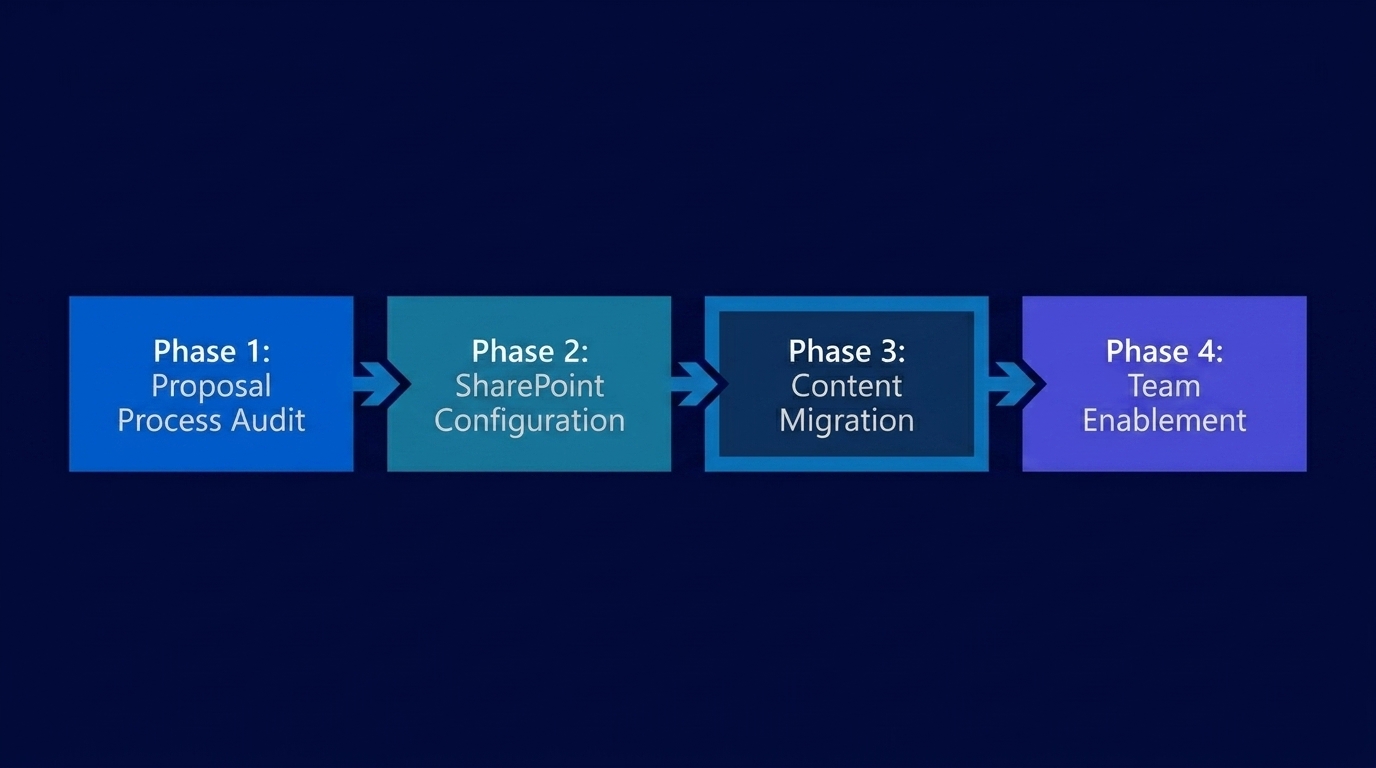
Phase 1
Proposal Process Audit
Mapped existing proposal workflows, identified content reuse patterns, and defined security permission requirements across the defense systems manufacturer’s proposal teams.
Phase 2
SharePoint Configuration
Built the customized Proposal Management Portal with document libraries, version-controlled templates, and role-based access controls.
Phase 3
Content Migration & Structuring
Migrated past performance documents, resumes, capability matrices, and boilerplate into the new repository with consistent tagging and search indexing.
Phase 4
Team Enablement
Trained proposal managers and contributors on section assignment, calendar use, and the rollup pipeline view.
Technical Transformation
i3solutions delivered a fully customized SharePoint Proposal Management Portal that replaced the defense systems manufacturer’s fragmented file-based system with a structured, searchable, and permission-controlled proposal environment. Proposal managers can now assign specific sections to individual contributors, track completion status against deadlines on a shared calendar, and access a rollup pipeline view that shows every active bid simultaneously. Past performance documents, resumes, and boilerplate are findable in seconds. Team sites allow business unit-specific information sharing without cross-contaminating other proposal efforts.
Measurable Outcomes
| Metric |
Result |
| Win Rate |
Higher proposal success rate driven by consistent, approved content and faster turnaround on competitive bids |
| Proposal Speed |
Reduced time spent locating information and assembling proposals from disconnected sources |
| Content Governance |
Version-controlled document library ensures only approved, current content enters final proposals |
| Pipeline Visibility |
Management rollup calendar provides accurate real-time view of all active proposals and upcoming deadlines |
| Resource Efficiency |
Eliminated redundant effort across proposal teams through centralized reusable asset library |
[PENDING-CLIENT-QUOTE: insert 1-3 sentence outcome-focused quote in the client’s own language from a role matching the reader’s role.]
[Name or Role], [Organization type]
Frequently Asked Questions
What is a proposal management portal and how does it differ from a standard file share?
A proposal management portal is a purpose-built system for coordinating the creation, review, and submission of competitive proposals. Unlike a file share, it provides version control, role-based access, structured workflows for section assignment, and calendar integration for deadline tracking. i3solutions built the defense systems manufacturer’ portal on SharePoint, giving the proposal team a single authoritative environment rather than dozens of disconnected drives and email chains.
How does i3solutions approach SharePoint proposal portal implementation for defense contractors?
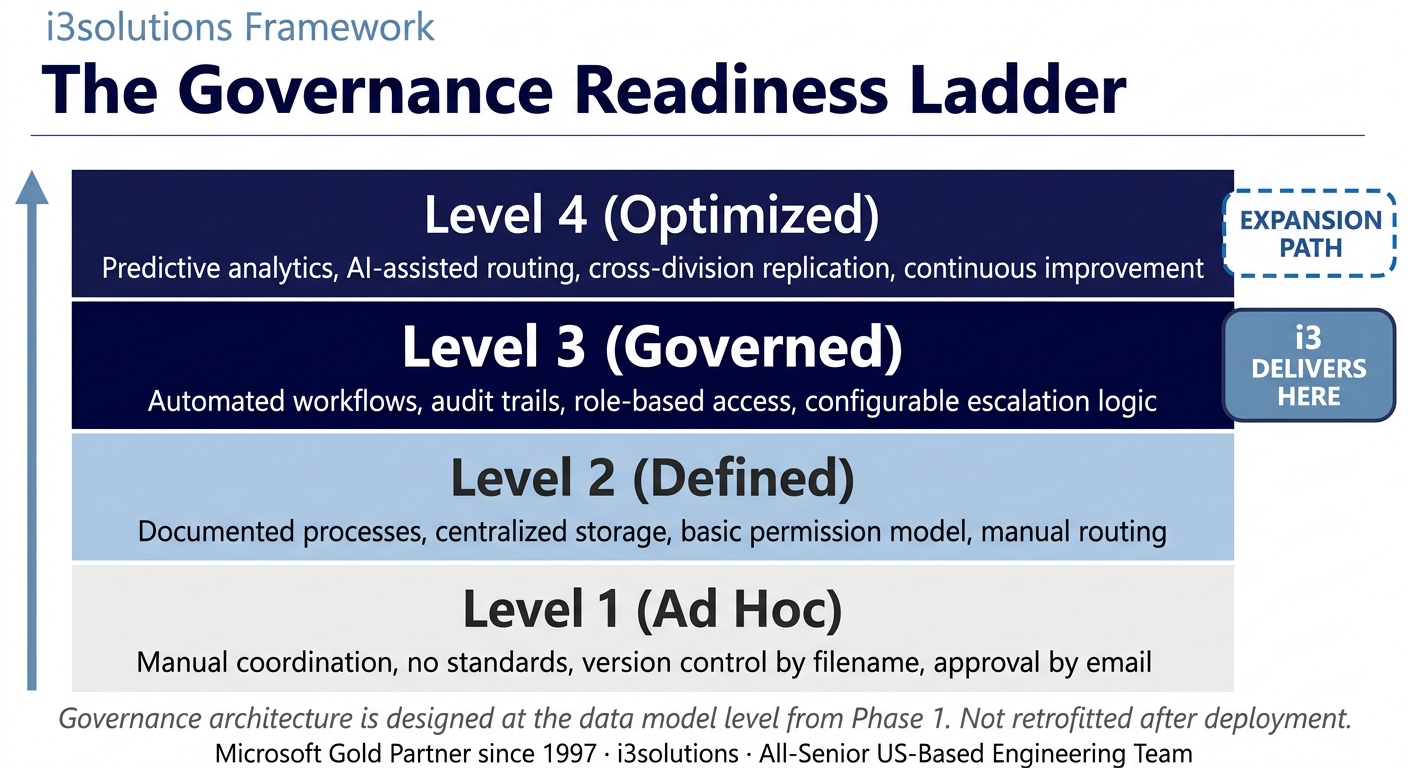
i3solutions starts by mapping the full proposal lifecycle, from RFP receipt through submission, identifying every handoff point, content dependency, and approval gate. For defense clients, security permission architecture is a first-tier requirement, not an afterthought. i3solutions configures SharePoint with compartmentalized team sites, role-based document access, and audit trails that satisfy defense contracting security requirements.
How does version control work in a SharePoint proposal library?
SharePoint’s document versioning maintains a full history of every change to every file, with the ability to restore any prior version. For proposal content, this means contributors can work confidently knowing the system tracks every edit, and proposal managers can confirm that final submissions contain only approved, current-version content. i3solutions configures major and minor versioning with check-in/check-out controls to prevent simultaneous conflicting edits.
What ROI should defense contractors expect from a proposal management portal?
Defense contractors typically see measurable improvement in 3 areas: proposal win rate (higher because submissions use current, approved content), proposal cycle time (shorter because search and assembly are faster), and resource utilization (better because teams stop duplicating effort across bids). the defense systems manufacturer saw all 3: higher win rates, faster turnaround, and more efficient use of proposal team capacity.
Why choose i3solutions for defense SharePoint proposal management?
i3solutions has delivered SharePoint proposal management solutions for defense clients including Pratt & Whitney, KBR, and the defense systems manufacturer, all under the same 600+ implementation, all-senior team framework. We understand defense contracting timelines and security requirements. Our Gold Partner status since 1997 and 15-Business-Day Microsoft Assessment give defense contractors a clear, low-risk path to a better proposal process.
Who This Engagement Serves
This engagement is relevant if
- Defense contractors struggling to maintain secure, centralized proposal repositories across multiple dispersed, air-gapped locations.
- Engineering firms relying on individual drives for critical configuration files instead of using version-controlled platforms.
- Large manufacturing organizations managing complex bid documentation without a standardized collaboration environment for capture teams.
Less relevant if
- Small businesses with limited technology budgets that cannot afford the investment in SharePoint licensing and customization.
- Agile startups requiring extremely low-process document workflows that find SharePoint too rigid and heavyweight for speed.
Ready to establish a governed Microsoft environment?
i3solutions delivers enterprise digital transformation on-time, in-scope, in-production. Microsoft Gold Partner since 1997. 600+ implementations. All-senior, all US-based team.
Schedule a 15-Business-Day Microsoft Assessment