Case Study • State Government • Identity and Access Management
70,000 Users, One System: How a State Government Optimized Its Okta Identity Environment

The Enterprise Challenge
Okta Identity Management for a 70,000-User State Government Enterprise
A state government managing a workforce of more than 70,000 employees dispersed across diverse departments, agencies, and locations had recently implemented Okta as its identity management and authentication platform. The implementation was the right strategic decision – Okta’s centralized identity management capability was the appropriate tool for an organization of this scale and complexity. But the transition had exposed the gap between having an identity management platform and having it configured to operate effectively at the scope and security complexity of a state government enterprise.
The existing Okta integration was struggling to keep pace with the state’s dynamic environment. Account creation and support requests were taking too long – delays that translated directly into productivity loss for employees who could not access the systems they needed and operational bottlenecks for IT staff managing a high volume of provisioning tickets. The platform was not configured to apply differentiated MFA policies appropriate to the state’s diverse departmental risk profiles. Third-party applications had not been fully integrated into the single sign-on environment, requiring employees to maintain separate credentials for systems that should have been unified. And the security hardening measures available in Okta – country-based IP deny lists, performance-optimized architecture, redundant availability configurations – had not been applied.
The state engaged i3solutions to overhaul the Okta environment comprehensively: configuring MFA appropriately for each department’s security requirements, integrating third-party applications into the SSO environment, implementing proactive security measures, optimizing performance and availability, and providing the ongoing help desk support that would make the investment in Okta actually serve the state’s 70,000 users effectively.
Strategic Trigger
A Platform That Existed But Was Not Yet Working at State Scale
The forcing function was the gap between the state’s investment in Okta and the operational value it was actually delivering. The platform was in place. The licenses were active. But long account creation lead times, inconsistent MFA application, disconnected third-party applications, and a high volume of unresolved help desk tickets meant that the state was paying for an enterprise identity management capability it was not yet receiving. For an organization managing 70,000 employees across multiple departments with different security requirements and different application portfolios, this gap had daily operational consequences.
The security dimension was equally compelling. An Okta environment configured with inconsistent MFA policies, without country-based access controls, and without performance optimization is an identity management platform with the right architecture but inadequate hardening. In a state government environment where the identity platform governs access to systems containing sensitive citizen data, employee records, and operational infrastructure, the difference between a configured and a optimized Okta environment is a security risk that the state could not defer indefinitely.
Leadership recognized that the Okta investment would only deliver its potential value through expert configuration and ongoing expert support – not through the state’s existing IT team managing a platform they had not yet developed deep expertise in. Bringing in a team that had configured Okta at enterprise scale, understood the specific optimization levers available in the platform, and could provide ongoing help desk support as a managed service was the fastest path from a deployed but underperforming Okta environment to one that genuinely served the state’s workforce. For context on how integration governance decisions determine whether enterprise identity management investments deliver their intended value, Integration Governance for MicrosoftPENDING-SCHEDULED covers the change control patterns that sustain IAM platform quality over time.
Is a state or government organization’s Okta investment underperforming due to configuration gaps?
If account creation is slow, MFA is applied inconsistently across departments, third-party applications are not in SSO, or help desk ticket volume for identity issues remains high, the platform is not yet configured to serve the organization’s workforce at scale. A 15-Business-Day Microsoft Assessment maps the specific Okta optimization approach that would close those gaps.
Request the Assessment
▶ Related Insight — A 60-second perspective from our channel
Stakes (What Happens If They Fail)
Employee Productivity Loss, Security Exposure, and Citizen Data at Risk
For a state government organization where 70,000 employees depend on access to authorized systems to perform their daily work, an identity management platform that is slow to provision accounts, inconsistent in applying security policies, and incomplete in its SSO coverage is not a technical underperformance issue – it is an operational drag on the state’s ability to serve its citizens. Every employee waiting days or weeks for account provisioning is an employee not yet productive in their role. Every application excluded from the SSO environment is a separate credential set that employees must manage and that IT must support independently.
The security exposure from inconsistent MFA application was the most significant risk dimension. In a state government environment where departments handle sensitive citizen data – healthcare information, financial records, criminal justice data, and social services information – the appropriate authentication requirement varies significantly by department and by data sensitivity. Applying the same MFA policy uniformly across all users either over-restricts low-sensitivity access in ways that create friction and workarounds, or under-protects high-sensitivity access in ways that create genuine security exposure. The group-based, differentiated MFA approach that the Okta platform supports but that had not been configured was the specific capability that would address this risk.
The absence of country-based IP deny lists was a particular vulnerability for a government organization. State government systems are legitimate targets for state-sponsored actors from specific countries. An authentication platform that accepts login attempts from IP addresses associated with known threat actors without any additional scrutiny or blocking is operating below the security baseline that government cybersecurity frameworks expect.
Constraints and Complexity
Diverse Departmental Security Requirements, Third-Party Integration Complexity, and 70,000-User Scale
The most organizationally complex element of the engagement was the differentiated MFA configuration across departments with genuinely different security requirements. A department handling citizen financial records has different authentication risk tolerance than a department managing public parks reservations. Configuring Okta Groups to reflect these differences required structured input from department IT leads and security stakeholders, not a uniform policy applied centrally without understanding departmental operational contexts.
The third-party application integration complexity was technical and varied. Different applications in the state’s portfolio had different authentication capabilities and integration options. Some could be integrated through the Okta Integrated Network using standard SAML or OIDC protocols. Others required manual integration approaches because they used proprietary authentication mechanisms that did not natively support modern identity federation standards. Each integration required a different technical approach while delivering the same operational outcome: a user who authenticates to Okta once and can access the application without a second credential entry.
The 70,000-user scale created performance and availability requirements that smaller Okta deployments do not face. At the start of the business day, when large numbers of state employees authenticate to begin their work sessions, the Okta environment experiences concurrent authentication demand that must be handled without degradation in response time. Performance optimization and redundancy configuration at this scale required architectural decisions specific to the state’s infrastructure context rather than default Okta configuration settings.
▶ Related Insight — A 60-second perspective from our channel
Selection Rationale (Why They Chose i3solutions)
Enterprise Okta Specialists with Government IAM Experience
The state needed a partner who had configured Okta at enterprise scale for organizations with the complexity of a multi-department government enterprise – not a partner who had configured Okta for a commercial organization of similar user count but fundamentally different departmental diversity, security requirement variation, and application portfolio heterogeneity. The combination of enterprise IAM depth and government sector understanding was the specific capability the state required.
i3solutions was selected as a Microsoft Gold Partner since 1997 with demonstrated experience in Okta identity management for large, complex organizations where the platform’s configuration complexity matched the organizational complexity of the environment it served. The Expert Delivery Model that i3solutions operates, staffing every engagement with senior-level IAM specialists, meant that the engineers configuring the MFA policies, building the SSO integrations, and implementing the security hardening measures had encountered and solved the specific configuration challenges of enterprise Okta deployments before.
The ongoing help desk support component of the engagement required a partner who would be operationally embedded in the state’s identity management function rather than completing a project and disengaging. The Microsoft consulting services engagement model that provides sustained support beyond initial implementation was specifically suited to an organization of this scale where identity management requires continuous expert attention rather than periodic project-based intervention.
The Engagement Approach (Our Plan)
From Configured to Optimized: Enterprise Okta for a State Government
PHASE 01
Environment Assessment and Requirements
Comprehensive audit of the existing Okta environment: current MFA policy configuration and gaps, application integration status and SSO coverage, user provisioning workflow performance, help desk ticket patterns identifying recurring pain points, and security configuration against government cybersecurity framework requirements. Structured input sessions with departmental IT leads to understand the security requirements and operational constraints that would govern differentiated MFA policy design.
PHASE 02
MFA Configuration and Security Hardening
Configuring Okta Groups to reflect the state’s departmental structure and applying differentiated MFA policies appropriate to each group’s security requirements: Okta Push for standard users, RSA tokens for high-security departments, voice authentication for users in environments where push notification was not operationally appropriate. Implementing country IP deny lists based on threat intelligence applicable to government organizations. Configuring redundancy and performance optimization to meet the high availability requirements of a 70,000-user authentication platform at peak concurrent load.
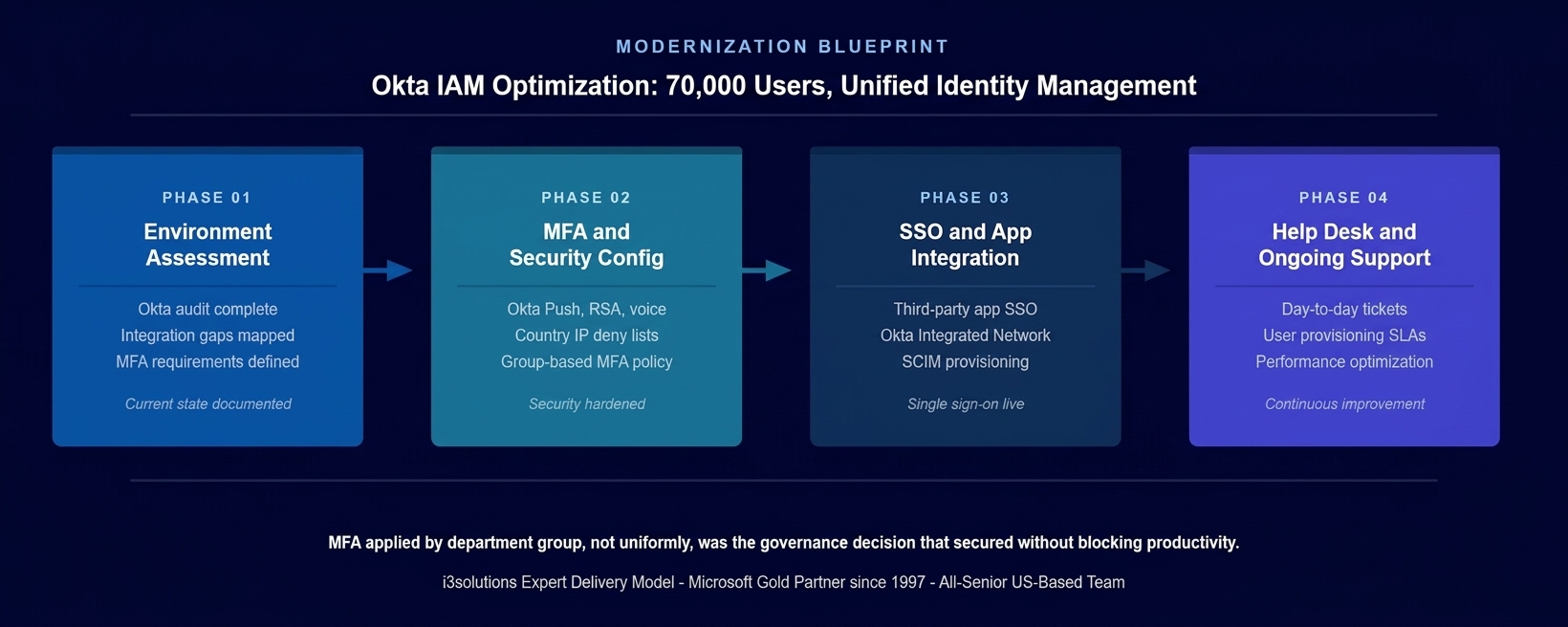
The four-phase optimization approach. Departmental MFA policy design in Phase 2 required structured input from department security stakeholders – applying the same policy uniformly to 70,000 users with diverse security requirements was the failure mode the engagement was designed to prevent.
PHASE 03
SSO Integration and User Provisioning Optimization
Integrating third-party applications into the Okta SSO environment through the Okta Integrated Network and manual integration approaches for applications requiring custom authentication configurations. Automating user provisioning workflows to reduce account creation lead times from weeks to days, with provisioning rules tied to departmental group membership and role-based access control aligned to the state’s organizational structure. SCIM provisioning implemented where supported to maintain account lifecycle synchronization without manual IT intervention.
PHASE 04
Help Desk Support and Continuous Optimization
Providing ongoing day-to-day Okta help desk support for the state’s 70,000-user population: authentication issues, access requests, provisioning exceptions, MFA device management, and application integration support. Continuous monitoring of the Okta environment for performance anomalies, authentication patterns indicating potential security issues, and configuration drift that could affect availability or security posture. Ongoing optimization recommendations based on Okta platform updates and evolving organizational requirements.
Execution Evidence
MFA by Department, SSO Across the Portfolio, Security Hardened at Enterprise Scale
The MFA configuration delivered differentiated authentication policies across the state’s departmental structure in a way that reflected the actual security requirements of each department rather than a compromise policy that served none of them optimally. High-security departments with access to sensitive citizen data were assigned RSA token authentication. Departments with standard operational security requirements used Okta Push. Voice authentication was configured for users in specific operational contexts where push notifications were not practical. The group-based policy approach meant that as the state’s organizational structure evolved, MFA policies could be updated by modifying group membership rather than by reconfiguring individual user accounts.
The third-party application SSO integrations eliminated the separate credential management burden for the applications most heavily used across the state’s workforce. For each integrated application, the user experience changed from maintaining a separate login to accessing the application from the Okta dashboard without any additional authentication step. Help desk ticket volume for password resets and application access issues for the integrated applications declined materially as the SSO coverage expanded.
The country IP deny list implementation immediately began blocking authentication attempts from IP ranges associated with countries identified as elevated threat sources for government organizations. This was not a theoretical security improvement – it was a measurable reduction in the volume of authentication attempts that required evaluation against legitimate user credentials, reducing the noise in authentication logs and improving the signal quality for the security monitoring function.
The honest challenge in this engagement was the third-party application integration scope. The initial assessment had identified the applications most critical for SSO integration, but as the integration program progressed, additional applications surfaced that had not been in the initial inventory because individual departments were managing them locally without central IT visibility. Developing a complete application inventory and integration roadmap required an additional discovery phase that extended the SSO integration timeline but produced a more complete coverage picture than the initial scope had anticipated.
Technical Transformation
From Deployed But Underperforming to Optimized at Enterprise Scale
Before the engagement, the state’s Okta environment was a platform that existed in the architecture but was not delivering the identity management value it was designed to provide. Long provisioning times created productivity delays. Inconsistent MFA exposed high-risk departments to authentication security gaps. Applications outside the SSO environment required separate credential management. Security hardening measures available in the platform were not configured.
After the engagement, the state operated an optimized Okta identity management environment that provisioned accounts significantly faster, applied differentiated MFA appropriate to each department’s security requirements, provided SSO access to the integrated application portfolio, and maintained the security hardening, performance optimization, and redundancy configuration appropriate for a 70,000-user government authentication platform.
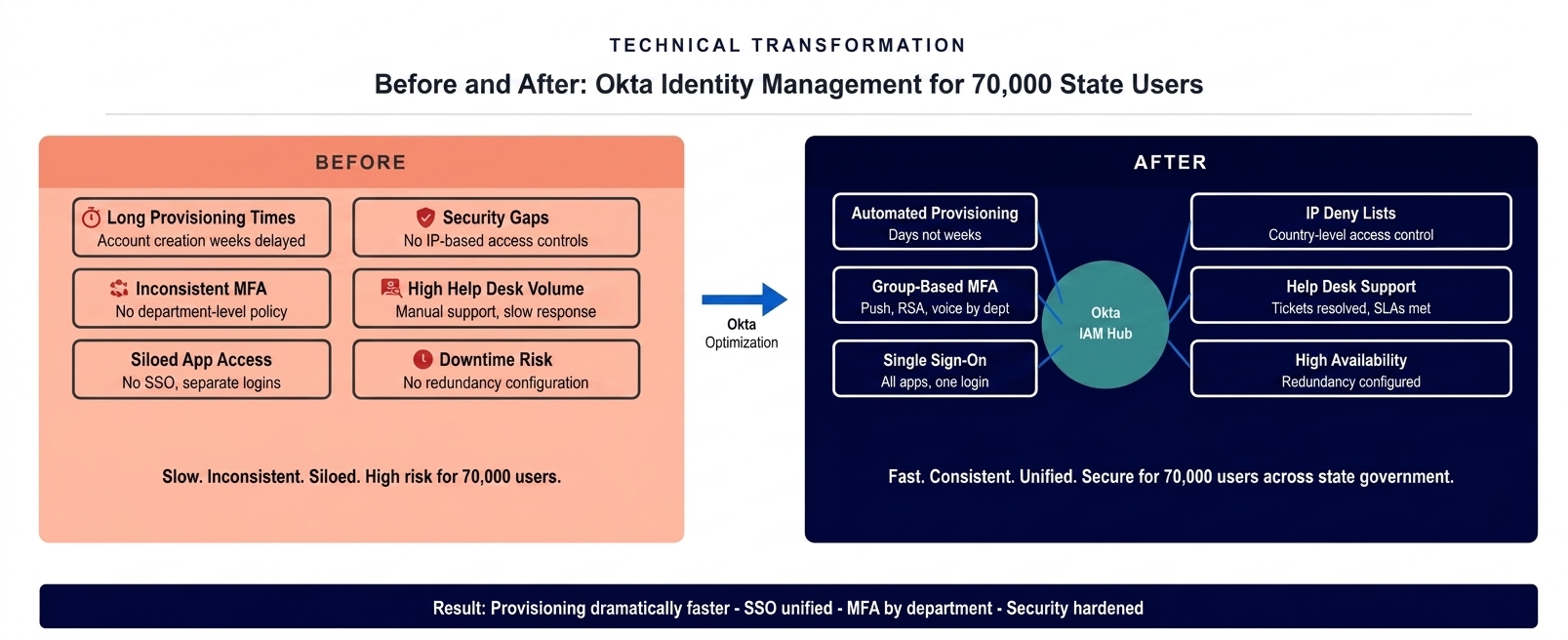
The identity management state before and after the optimization engagement. A deployed but underperforming Okta environment became an optimized enterprise IAM platform with differentiated MFA, SSO coverage, and security hardening appropriate for a 70,000-user state government.
The Governance Readiness Ladder applied to this engagement showed the identity management environment at Level 1 (Ad Hoc) to Level 2 (Defined) at the start: the platform was in place and policies nominally defined, but application was inconsistent, security hardening was absent, and operational support was reactive rather than proactive. The optimized environment delivered Level 3 (Governed): differentiated MFA consistently applied by department group, SSO coverage across the integrated application portfolio, proactive security controls including IP deny lists and redundancy, and sustained expert help desk support maintaining the environment’s quality continuously.
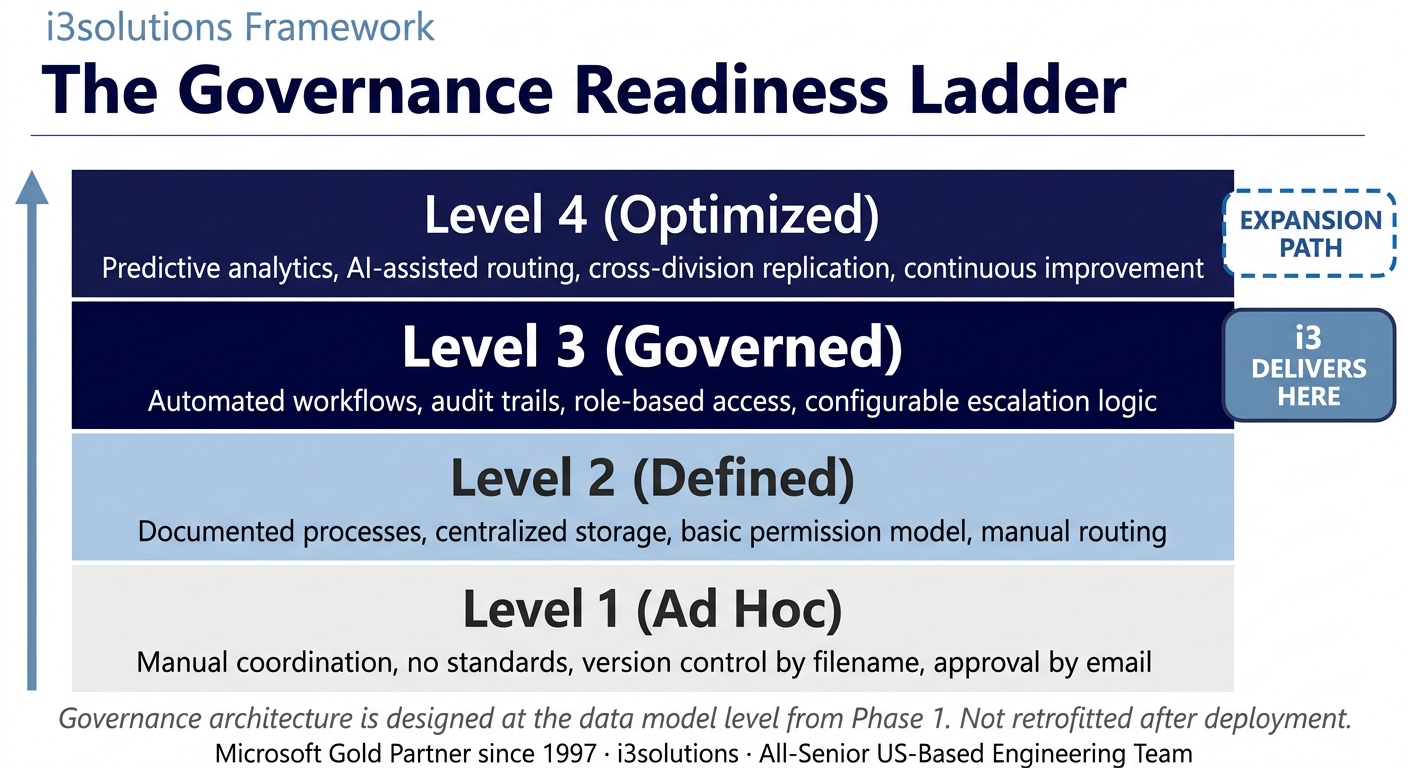
The Governance Readiness Ladder applied to this engagement. The Okta optimization delivered Level 3 IAM governance across 70,000 state employees. The architecture supports Level 4 as adaptive authentication and continuous compliance monitoring capabilities mature.
▶ Related Insight — A 60-second perspective from our channel
Measurable Outcomes
Faster Provisioning, Unified SSO, Consistent MFA, Security Hardened
| Metric | Before | After | Improvement |
|---|
| Account creation lead time | Long – weeks in some cases, creating productivity delays for new employees | Significantly reduced through automated provisioning workflows | Provisioning time substantially reduced |
| MFA policy consistency | Inconsistent – same policy applied regardless of departmental security requirements | Differentiated by Okta Group – Okta Push, RSA, and voice applied by department risk profile | Appropriate MFA for every user role |
| Application SSO coverage | Incomplete – many third-party applications requiring separate credentials | Integrated across portfolio via Okta Integrated Network and manual integration | Single sign-on extended across state application portfolio |
| Security posture | No country IP deny lists; limited hardening beyond basic Okta configuration | Country-based access controls implemented; performance and redundancy optimized | Security hardened at enterprise scale |
| Help desk support quality | Reactive and inconsistent; authentication issues often escalated without resolution | Dedicated Okta help desk support; tickets resolved with SLAs and platform expertise | Sustained expert support operational |
| Platform availability | No redundancy optimization; performance degraded at peak concurrent load | High availability configured; performance optimized for 70,000-user concurrent authentication | High availability and performance confirmed |
| Threat detection signal quality | Authentication logs noisy with global access attempts; legitimate threat signals obscured | Country IP deny lists reduce illegitimate attempt volume; threat signals clearer | Improved security monitoring signal quality |
[PENDING-CLIENT-QUOTE: insert 1-3 sentence outcome-focused quote in the client’s own language from a role matching the reader’s role.]
[Name or Role], [Organization type]
The most significant operational outcome was the combination of faster provisioning and expanded SSO coverage. For a 70,000-user organization, reducing account creation delays from weeks to days or hours at scale represents a material improvement in new employee productivity – and in the IT staff capacity previously consumed by manual provisioning ticket processing. Industry benchmarks for enterprise IAM optimization indicate that automated provisioning typically reduces account creation time by 60 to 80 percent in environments transitioning from manual processing. BENCHMARK-ESTIMATE
The differentiated MFA outcome addressed both security and usability simultaneously. Departments with high-security data access requirements received stronger authentication without imposing those requirements on users in lower-risk operational roles where the friction would have produced workarounds rather than security improvement. This is the specific value of group-based MFA policy in a heterogeneous government environment – it allows appropriate security without uniform friction.
Is your state or government organization’s Okta environment deployed but not yet delivering at scale?
A Risk and Roadmap Assessment maps the specific Okta configuration gaps, SSO integration opportunities, and security hardening measures that would close the gap between your platform investment and the identity management value it is designed to deliver.
Schedule the Assessment
Credibility Anchors
A Platform That Scales With the State’s Workforce and Security Requirements
The optimized Okta environment was designed to accommodate the state’s organizational changes – new departments, new applications, new security requirements – without requiring a new optimization engagement each time the environment evolved. The group-based MFA architecture, the provisioning rule framework, and the help desk support model were all designed for ongoing management rather than one-time configuration.
An IT operations lead described the practical change: before the optimization, every Monday morning started with a queue of provisioning tickets that had accumulated over the weekend. After the automated workflows were configured, those tickets largely stopped accumulating. New employees had access when they needed it rather than when IT got to the ticket.
The ongoing help desk support component created the continuous feedback loop that kept the environment performing. Issues that would previously have accumulated unaddressed were resolved as they surfaced, preventing the accumulation of technical debt in the identity management environment that would eventually require another remediation engagement. The help desk support also provided the organizational intelligence – which departments were experiencing authentication friction, which applications were generating the most access requests – that informed ongoing optimization decisions.
i3solutions has completed more than 600 identity management and Microsoft implementations as a Microsoft Gold Partner since 1997. Okta identity management at the scale of a 70,000-user state government requires the specific combination of platform depth, government sector understanding, and sustained support capability that distinguishes an expert implementation partner from a platform reseller.
Frequently Asked Questions
Okta Identity Management for State and Local Government
What is okta identity management for state government organizations?
Okta identity management for state government organizations involves configuring and optimizing the Okta identity platform to manage authentication, access control, and user provisioning for large public sector workforces. For state governments managing tens of thousands of users across multiple departments with diverse security requirements, Okta identity management delivers centralized access governance, multifactor authentication tuned to departmental risk profiles, single sign-on across all authorized applications, and automated user provisioning workflows that dramatically reduce account creation lead times.
How does Okta MFA work for government departments with different security requirements?
Okta MFA for government departments with different security requirements uses Okta Groups to apply different authentication policies to different user populations. High-security departments can require hardware token or RSA authentication, while operational departments with lower risk profiles use push notification or voice authentication. This group-based MFA policy prevents the dual failure modes of over-restricting low-risk users in ways that impede productivity and under-protecting high-risk users in ways that create security exposure.
What is Okta single sign-on and how does it benefit state government employees?
Okta single sign-on (SSO) allows state government employees to authenticate once and then access all authorized applications without re-entering credentials for each system. For employees who use multiple applications during a typical work session, SSO eliminates repeated login friction, reduces password reset support volume, and creates a single enforced authentication event per session where security controls including MFA can be applied consistently. Third-party applications are integrated into the Okta SSO environment through the Okta Integrated Network or manual integration methods depending on the application’s authentication capabilities.
How does automated user provisioning reduce IT overhead in state government?
Automated user provisioning reduces IT overhead in state government by replacing manual account creation processes with automated workflows triggered by HR system events. When a new employee joins a department, the provisioning workflow automatically creates the Okta account, applies the correct group memberships for the employee’s role, and grants access to the authorized applications for that position without requiring IT staff to manually process each request. This reduces account creation time from weeks to days or hours and eliminates the backlog of provisioning tickets that accumulate in large government IT environments.
What are country IP deny lists in Okta and why do government organizations use them?
Country IP deny lists in Okta are access control rules that block authentication attempts originating from IP addresses associated with specific countries. Government organizations use them as a proactive security measure to prevent unauthorized access attempts from regions that represent elevated threat risk without corresponding legitimate user populations. This is a particularly effective control for government environments where the authorized user population is geographically defined and access attempts from certain countries are almost universally illegitimate.
What should state government organizations look for in an Okta implementation partner?
State government organizations evaluating Okta implementation partners should assess the partner’s experience configuring Okta in large, heterogeneous user environments with multiple departments and diverse application portfolios, their track record integrating third-party government applications into Okta SSO environments, and their approach to ongoing help desk support and user provisioning management. An all-senior team with government IAM experience reduces the risk of configuration errors in MFA policies or SSO integrations that affect thousands of users simultaneously.
How does Okta help desk support differ from standard IT support for government organizations?
Okta help desk support for government organizations requires understanding both the Okta platform’s technical configuration and the organizational context that determines why a specific user’s access request or authentication issue is occurring. Standard IT support that escalates all Okta issues to the Okta configuration team creates bottlenecks that impede the rapid resolution that government employees expect. Integrated Okta help desk support resolves authentication issues, access requests, and provisioning exceptions as part of a unified service function that understands the full identity management architecture.
How does Okta high availability configuration protect state government operations?
Okta high availability configuration protects state government operations by ensuring that the authentication platform remains accessible when individual components experience issues. For an organization where 70,000 employees depend on Okta for access to all their authorized applications, an authentication platform outage is a government operations incident rather than an IT inconvenience. High availability configuration for Okta includes redundant authentication paths, failover mechanisms, and performance optimization that maintains responsiveness under peak concurrent user loads such as the start of the business day when large numbers of employees authenticate simultaneously.
Conclusion
70,000 Users, One Optimized Identity Platform
A state government managing 70,000 employees across diverse departments engaged i3solutions to transform its recently deployed but underperforming Okta environment into an optimized enterprise identity management platform. Through Okta identity management that configured differentiated MFA by department security profile, integrated third-party applications into SSO, implemented proactive security controls including country IP deny lists, optimized performance and availability for peak concurrent authentication load, and provided sustained help desk support, the state moved from long provisioning delays and inconsistent security to a governed identity management platform that served its full workforce effectively.
For state and local government organizations whose Okta investment is not yet delivering at scale, Okta identity management and Microsoft integration services offer a documented path from deployed-but-underperforming to optimized and continuously managed – with the sustained expert support that keeps a 70,000-user identity platform operating at the quality the organization requires.
Back to Case Study Library
60 enterprise Microsoft implementations documented
Related Insights
From the i3solutions YouTube Channel
Short-form perspectives on the delivery and technology challenges in this case study.
Who This Engagement Serves
This engagement is relevant if
- A large, distributed state agency seeking to unify disparate legacy systems onto a single Okta-managed identity framework.
- A state government looking to enhance public-facing security and reduce login friction for various citizen services.
- A county government aiming to implement modern multi-factor authentication across diverse and fragmented internal departments and agencies.
Less relevant if
- A small, centralized local municipality with simple, existing identity needs that are already well-managed in-house.
- A state-level department requiring a purely on-premise, air-gapped identity management solution without any cloud component.
Ready to make your Okta investment deliver its full value for your state’s workforce?
The 15-Business-Day Microsoft Assessment maps your Okta configuration gaps, the MFA policy design appropriate for your departmental security requirements, the SSO integration opportunities in your application portfolio, and the security hardening measures that should be applied to a government identity platform at your scale. Expert configuration. Sustained support. Enterprise results.
Microsoft Gold Partner since 1997. 600+ implementations. All senior. All US-based.
Schedule the Assessment