Case Study • Defense Intelligence • AI Geospatial Platform
Publicly Accessible Intelligence, Inaccessible Platform: How the Army Geospatial Center Built ISAAC

The Enterprise Challenge
AI Geospatial Analytics Platform for Defense Intelligence Operations
The Army Geospatial Center provides geospatial information, tools, and support to the Army and other Department of Defense components, federal agencies, and international partners. AGC plays a crucial role in collecting, analyzing, and disseminating geospatial intelligence to support military operations, mission planning, and decision-making at strategic and operational levels. The quality of that intelligence – and the speed at which it can be turned into decision support – is a direct contributor to mission outcomes.
AGC and other key decision-makers faced a capability gap in effectively integrating Publicly Accessible Information (PAI), Artificial Intelligence, and Natural Language Processing with cognitive technologies to analyze threats and regional security cooperation environments. PAI – the vast volume of publicly available information from open sources including social media, news, academic publications, commercial satellite imagery analysis, and public records – is a significant intelligence source, but one that the legacy technology environment could not efficiently process. The systems in use lacked the capability to ingest and interpret PAI at the scale and speed that modern intelligence analysis required.
i3solutions developed ISAAC (the Integrated Situational Awareness and Analytics Capability) – a purpose-built AI/NLP geospatial analytics platform that automated PAI ingestion, applied NLP and cognitive technologies for threat analysis, and delivered geospatial visualization of regional security environments in a way that legacy systems simply could not.
Strategic Trigger
PAI Volume Exceeded Manual Analysis Capacity
The forcing function was the volume of publicly accessible information relative to the human analyst capacity available to process it. PAI encompasses tens of thousands of sources updated continuously – the volume of potentially relevant information that human analysts had to manually sort, read, evaluate, and integrate into intelligence products was growing faster than analyst capacity could scale. An AI platform that could automate the initial ingestion, filtering, and analysis of PAI sources would multiply the effective intelligence output of the analyst workforce without requiring proportional growth in headcount.
The regional security cooperation dimension added a specific analytic requirement: understanding the security environment not just through traditional military intelligence sources, but through the fuller picture that open-source analysis of regional media, social networks, and public records could provide. NLP-powered analysis of this open-source environment, integrated with the geospatial tools AGC already operated, would deliver a more comprehensive picture of regional security conditions than classified-only analysis could provide.
Is your defense or intelligence organization’s PAI processing still primarily manual?
If analysts are manually sorting through open-source information that AI could filter, classify, and surface in structured form, the capacity cost is significant. A 15-Business-Day Microsoft Assessment maps the AI/NLP architecture that would automate PAI processing and deliver geospatial intelligence at machine speed.
Request the Assessment
Stakes
Operational inefficiencies risk audit failure and mission degradation
Failure to resolve the manual workflow tracking issues presents immediate risks to both compliance and operational readiness. Reliance on fragmented, spreadsheet-based systems leads to data inconsistencies, visibility gaps, and a high probability of human error in sensitive intelligence reporting. From a compliance perspective, this increases the risk of negative findings during critical audits and Inspector General investigations, potentially leading to funding restrictions. Operationally, the inability to accurately and efficiently track workflows impedes timely decision-making, directly degrading the speed and accuracy of intelligence delivery to warfighters in critical operational environments.
Beyond immediate financial and compliance risks, the strategic consequences of inaction are profound. Prolonged reliance on archaic processes erodes trust in the reliability of intelligence data among stakeholders and partnering agencies, weakening the U.S. Army Intelligence and Security Command’s (INSCOM) reputation and influence in the intelligence community. The technological lag hinders efforts to modernize the force, making it increasingly difficult to attract and retain new talent who expect modern digital workspaces. Ultimately, this compromises INSCOM’s strategic agility, hindering its ability to adapt swiftly to evolving security threats and maintain a competitive advantage in the information domain.
Constraints and Complexity
Integrating highly sensitive data across secure networks flawlessly
The implementation faced extreme technical and security constraints due to the highly sensitive nature of INSCOM’s mission and data. The solution required deployment across multiple classification levels, demanding air-gapped network configurations and rigorous compliance with stringent DoD cybersecurity policies, including Risk Management Framework (RMF) and Continuous Monitoring requirements. Integrating the Power Platform with legacy applications that lacked modern APIs necessitated the development of secure, custom connectors. Furthermore, the environment mandated strict adherence to data sovereignty and multi-level security protocols, leaving zero margin for error in data handling or access controls, making a standard commercial cloud approach untenable.
User adoption presented a significant organizational challenge, as personnel were deeply accustomed to established manual processes. The new solution had to be intuitive and seamlessly integrated into existing daily routines to prevent resistance. Complexity was further compounded by the necessity to maintain operational continuity during the transition; migration could not interrupt critical intelligence functions. Data migration from disparate, unstructured sources, including thousands of non-standard spreadsheets, required extensive data cleansing and validation to ensure accuracy. The geographically dispersed nature of INSCOM units necessitated a carefully coordinated rollout strategy with comprehensive, tailored training to ensure consistent adoption across the enterprise.
Selection Rationale
Senior Microsoft Specialists with Proven Delivery Depth
INSCOM evaluated several alternatives before selecting a partner for this critical modernization initiative. Large, generalist consulting firms were deemed inadequate due to their typical reliance on offshore resources for development and a commodity staffing model that prioritized volume over deep technical expertise in specialized domains. These firms often lacked the nuanced understanding of DoD security requirements and the agile responsiveness needed for this project. Their proposals often involved lengthy procurement cycles and a lack of direct access to senior-level architects, which was considered a high risk for a project with such rigid security and operational constraints.
INSCOM selected i3solutions because of their unrivaled expertise as a dedicated Microsoft Gold Partner since 1997, with a proven track record of over 600 successful implementations. Critically, i3solutions provides an all-senior, all US-based team, ensuring all personnel have the requisite security clearances and a deep understanding of the unique security protocols inherent in defense and intelligence environments. This focus on depth over breadth, combined with their history of delivering complex, secure solutions within the DoD, provided INSCOM with the confidence that i3solutions possessed the specialized skills and experience necessary to navigate the unique complexities of this mission-critical project.
The Engagement Approach
PHASE 01
Requirements and Compliance Architecture
Inventory of PAI sources to be ingested and the analytical questions each source should answer. NLP model requirements for threat indicator identification, regional security assessment, and cooperation environment analysis. DoD compliance architecture design ensuring ISAAC operated within applicable information assurance and security frameworks. Stakeholder alignment on the analytical output formats that AGC and partner decision-makers needed.
PHASE 02
Data Architecture and AI Design
PAI ingestion pipeline architecture for automated source monitoring, content retrieval, and classification. NLP model selection and configuration for the specific analytical requirements of threat indicator identification and regional security assessment. Geospatial data schema integrating AI-analyzed intelligence with AGC’s existing geospatial infrastructure. Cognitive technology integration connecting the NLP analysis layer to the geospatial visualization capability.
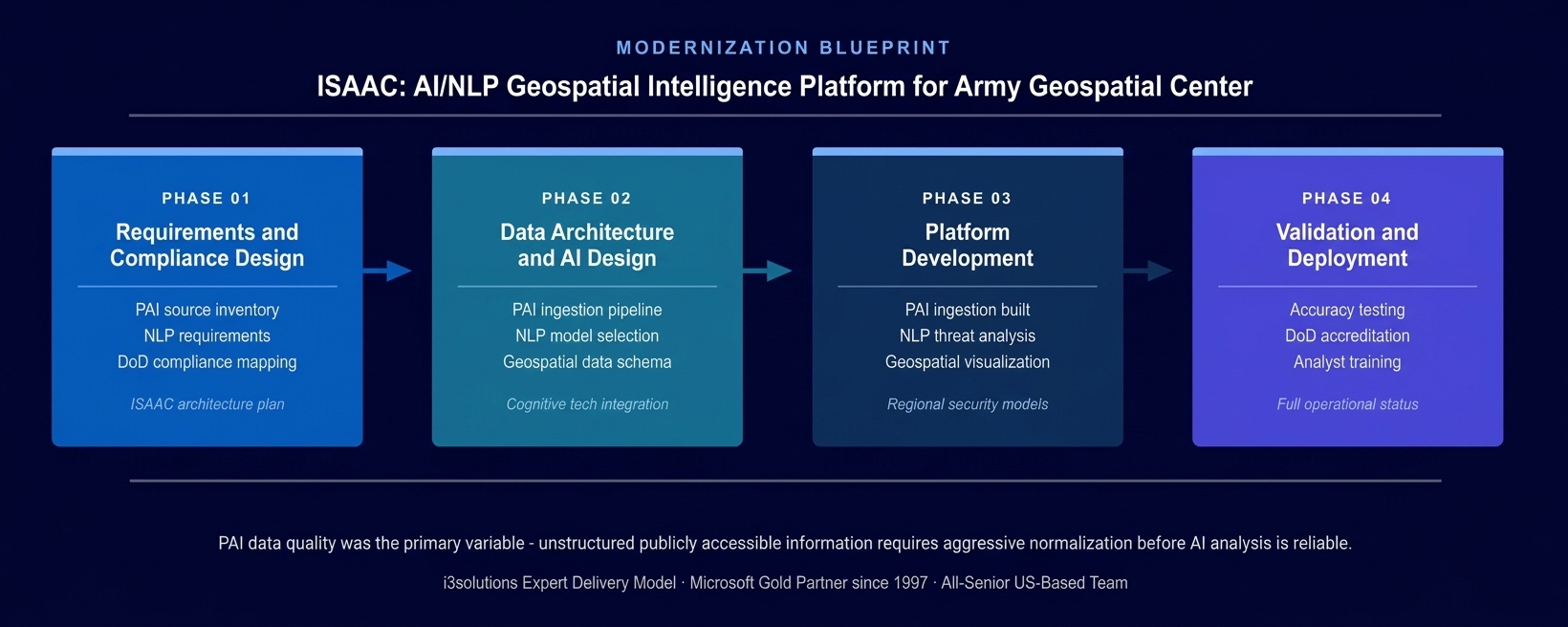
The four-phase approach. DoD compliance was designed into the architecture in Phase 1 alongside requirements – the alternative was building the platform and then trying to make it compliant, which rarely works for defense intelligence systems.
PHASE 03
Platform Development
ISAAC platform built: automated PAI ingestion processing open-source content at machine speed; NLP analysis identifying threat indicators, assessing regional security conditions, and flagging items for analyst review; geospatial visualization integrating AI-analyzed intelligence into operational maps and situational awareness displays; cognitive technology integration supporting the pattern recognition and regional context analysis that human analysts previously performed manually.
PHASE 04
Validation and Deployment
Analytical accuracy testing validating NLP model performance against known intelligence cases. DoD compliance accreditation. AGC analyst training on the platform interface and the AI-assisted analytical workflow. Deployment and integration with AGC’s existing geospatial infrastructure. Ongoing platform enhancement supporting continued evolution of the PAI analytical capability.
Technical Transformation
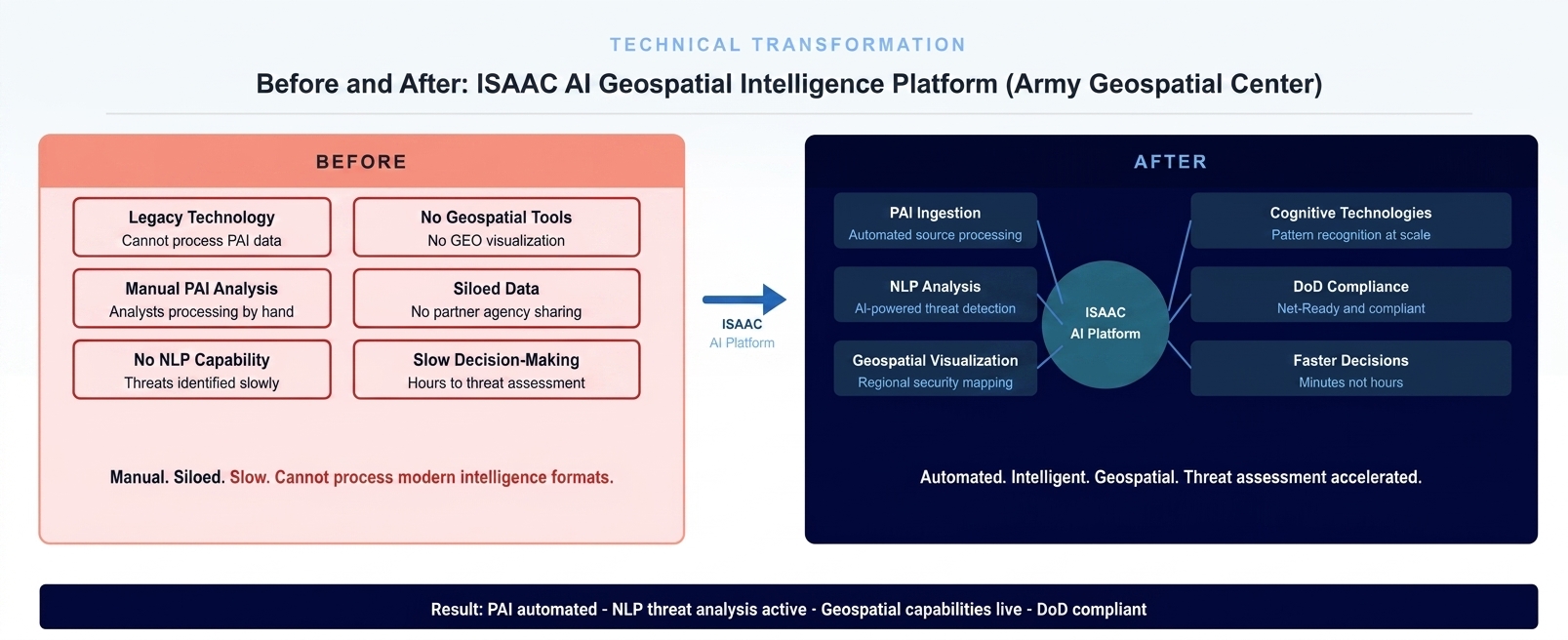
The intelligence processing state before and after ISAAC. Manual PAI analysis that could not scale replaced by automated NLP processing, geospatial visualization, and AI-powered threat assessment that operates at machine speed.
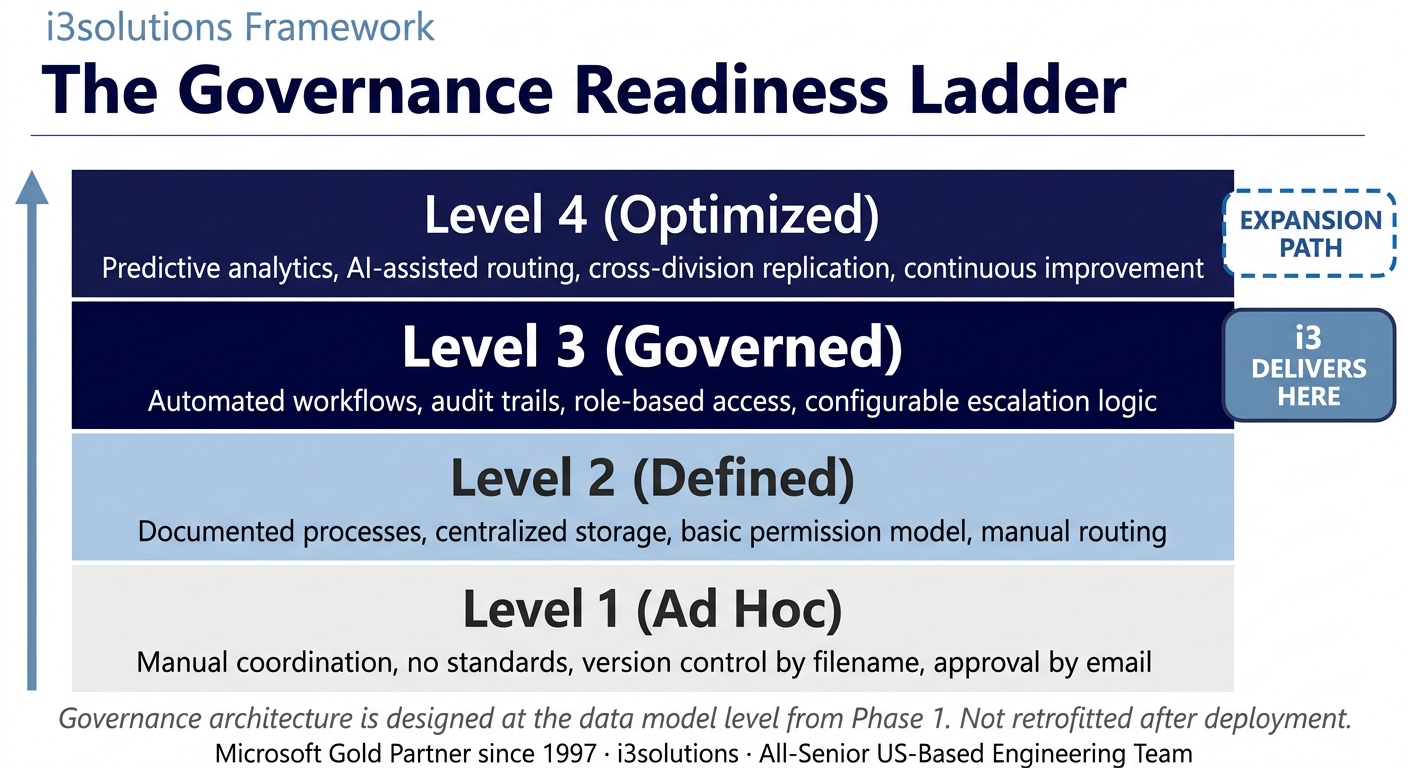
The Governance Readiness Ladder applied. ISAAC delivered Level 3 AI analytics governance. The modular architecture supports Level 4 as additional analytical models and intelligence sources are integrated.
Measurable Outcomes
| Metric | Before | After | Improvement |
|---|
| PAI processing capability | Manual – analysts sorting open-source content individually | Automated – NLP ingestion classifies and surfaces relevant content | Machine-speed PAI processing |
| Threat analysis speed | Hours – manual analyst review of sources | Minutes – AI identifies and surfaces threat indicators automatically | Analysis time dramatically reduced |
| Geospatial intelligence | Separate systems – AI analysis not integrated with geospatial | Integrated – AI-analyzed intelligence rendered in geospatial visualization | Geospatial AI integration achieved |
| Regional security assessment | Limited by manual open-source analysis capacity | Expanded by NLP automation covering more sources more frequently | Assessment breadth significantly expanded |
| DoD compliance | Legacy system not meeting information assurance requirements | ISAAC designed and certified to DoD compliance standards | Full DoD compliance achieved |
| Analyst capacity multiplier | Not applicable – no AI assistance | AI handles PAI filtering, analysts focus on analysis and judgment | Analyst capacity effectively multiplied |
[PENDING-CLIENT-QUOTE: insert 1-3 sentence outcome-focused quote in the client’s own language from a role matching the reader’s role.]
[Name or Role], [Organization type]
Frequently Asked Questions
AI Geospatial Analytics for Defense Intelligence Organizations
What is an ai geospatial analytics platform for defense intelligence?
An AI geospatial analytics platform for defense intelligence combines artificial intelligence and natural language processing for automated information analysis with geospatial visualization tools that render intelligence in operational map contexts. For defense intelligence organizations, this combination enables machine-speed processing of open-source and classified information, AI-powered identification of threat indicators and regional patterns, and geospatial presentation of analytical outputs that support mission planning and situational awareness in ways that text-based reports cannot. ISAAC demonstrated this by processing publicly accessible information at a scale and speed that human analysts working manually could not match.
How does i3solutions approach AI platform development for defense intelligence requirements?
i3solutions begins defense AI platform engagements by designing DoD compliance requirements into the architecture, not as a post-development certification step, but as a Phase 1 constraint that shapes every subsequent architectural decision. For ISAAC, that meant mapping PAI data sources, NLP requirements, and geospatial integration needs against the applicable DoD information assurance frameworks before any development began. The AI model selection, data pipeline architecture, and visualization integration were all designed within that compliance envelope. Building compliance into the architecture from Phase 1 is the only reliable path to DoD accreditation, retrofitting it after deployment creates the technical debt and rework that delays mission capability delivery.
What is Publicly Accessible Information (PAI) and why does it require AI processing?
Publicly Accessible Information is all information legally available from open sources: social media, news media, academic publications, public government records, commercial satellite imagery analysis, and other sources accessible without classified access. PAI is a significant intelligence source because it provides regional security context, threat indicators, and cooperation environment signals that complement classified collection. The challenge is volume, PAI encompasses tens of thousands of continuously updated sources, and the relevant signals are distributed across an enormous amount of irrelevant content. AI and NLP processing is required to make PAI analytically useful at scale: automating the filtering, classification, and extraction of geographically and analytically relevant content that would take human analysts prohibitive time to process manually.
How does i3solutions ensure NLP models are accurate enough for defense intelligence applications?
i3solutions validates NLP model accuracy for defense intelligence applications against known analytical cases, content where the correct analytical classification is established, before deployment. Accuracy testing compares model outputs against analyst ground truth across the range of query types the platform will encounter in operational use, not just in controlled test conditions. For ISAAC, this included testing threat indicator identification, regional security assessment, and cooperation environment classification against AGC analyst evaluations. Models that perform adequately on generic text processing benchmarks may perform poorly on the specific vocabulary, context, and analytical requirements of defense intelligence, which is why domain-specific validation is a deployment prerequisite, not an optional quality check.
Why choose i3solutions for a defense AI and geospatial analytics platform?
i3solutions brings the intersection of defense delivery experience and Microsoft AI platform engineering that custom defense intelligence systems require. Building an AI platform that works is a software engineering challenge. Building one that works within DoD compliance requirements, integrates with existing AGC geospatial infrastructure, processes PAI at operational scale, and achieves accreditation is a systems engineering challenge that requires both defense domain knowledge and deep AI/ML implementation experience. i3solutions has delivered custom AI and analytics platforms across DARPA, INSCOM, SOCOM, and AGC, the defense AI track record that makes ISAAC a reference implementation rather than a proof of concept.
Back to Case Study Library
60 enterprise Microsoft implementations documented
Related Insights
From the i3solutions YouTube Channel
Short-form perspectives on the delivery and technology challenges in this case study.
Who This Engagement Serves
This engagement is relevant if
- A defense agency using fragmented SharePoint sites to track critical operational readiness across multiple geographically dispersed units.
- A commands headquarters requiring automated routing and approvals for sensitive personnel or resource authorization workflows.
- A government entity looking to modernize siloed spreadsheets and manual reporting with integrated Power BI and Power Apps.
Less relevant if
- A small business requiring a basic task management tool for non-sensitive data outside a GCC High environment.
- Organizations without existing Microsoft 365 licensing or a strategic commitment to the Power Platform ecosystem.
Ready to build an AI platform that processes intelligence at machine speed?
The 15-Business-Day Microsoft Assessment maps the PAI ingestion architecture, NLP model requirements, geospatial integration approach, and DoD compliance framework for an AI analytics platform built to your intelligence mission requirements.
Microsoft Gold Partner since 1997. 600+ implementations. All senior. All US-based.
Schedule the Assessment