Case Study • Federal Government / Labor Relations • Expense Management
Paper Invoices by Mail, Checks by Post: How FMCS Automated Its Arbitrator Expense Voucher System

The Enterprise Challenge
Expense Management Automation for a Federal Labor Relations Agency
The Federal Mediation and Conciliation Service promotes labor peace by preventing and resolving labor-management disputes through mediation, conciliation, and arbitration services. Managing expense reimbursements for arbitrators performing services across the country had been a persistent operational burden – a process that ran on paper invoices submitted by mail and reimbursement checks issued and mailed back, creating a slow, error-prone loop with no digital tracking at any stage.
The paper-based expense process created three compounding problems. First, processing time was measured in weeks from invoice submission to check receipt – a timeframe that reflected the postal and manual processing steps at every stage rather than the actual complexity of the underlying transaction. Second, there was no status visibility: arbitrators who submitted paper invoices had no way to know where their reimbursement was in the processing queue without calling FMCS staff, who in turn had to manually search paper records to answer the inquiry. Third, the audit trail was a physical paper trail – accurate only to the extent that paper records were complete, correctly filed, and findable when needed.
i3solutions designed and developed the Electronic Voucher Submission (EVS) system, converting the paper invoice and check reimbursement process into a fully digital workflow: web-based submission, automated routing, electronic payment, and real-time status tracking for every voucher from submission to payment.
Strategic Trigger
Processing Time Was a Service Quality Problem, Not Just an Efficiency Problem
For arbitrators who performed FMCS services and waited weeks for expense reimbursement, the paper process was not an administrative preference – it was a direct statement about the quality of the service relationship. A federal agency that asked professionals to deliver services and then made them wait weeks for routine expense reimbursement while communicating by mail was providing a service experience that was significantly below the standard of any comparable digital process. The reimbursement experience was part of the arbitrator relationship, and the paper process was damaging it.
The internal administrative cost was the second driver. Every paper invoice required FMCS staff time to receive, log, route for approval, calculate the reimbursement amount, process the check issuance request, and mail the check. An electronic system that automated all but the approval step would reclaim staff hours that the paper process was consuming and redirect them to higher-value activities.
Is your agency still processing expense vouchers through paper invoices and mailed checks?
If expense reimbursement takes weeks because it moves through postal mail and manual processing queues, the processing time is a service quality problem, not just an efficiency one. A 15-Business-Day Microsoft Assessment maps the electronic voucher architecture that delivers web submission, automated approval routing, and electronic payment.
Request the Assessment
Stakes
Operational inefficiencies risk audit compliance and financial transparency
The manual processing and tracking of paper expense vouchers create significant operational overhead and introduce high error potential. Without a digitized, centralized system, there is limited visibility into spending, leading to difficulty in budget forecasting and expenditure control. This lack of automated oversight increases the risk of erroneous or fraudulent payments, and complicates auditing procedures, potentially leading to non-compliance with rigorous federal financial regulations. Continued reliance on this fragmented, opaque system means continued high costs, slow reimbursement times, and an inability to make data-driven decisions regarding operational expenses.
Beyond immediate financial risks, the slow reimbursement cycles and administrative burden of a manual system significantly impact employee satisfaction and productivity, detracting from the core mission of the FMCS. If these inefficiencies persist, they can damage the agency’s reputation for modern operational competence, potentially hindering efforts to attract and retain top talent. Strategically, the lack of real-time expense data prevents leadership from accurately assessing resource allocation, inhibiting effective long-term planning and the agility needed to respond effectively to evolving demands and mandates.
Constraints and Complexity
Modernizing legacy processes while ensuring data integration
Implementing the Power Platform solution presented several complex challenges. The primarily paper-based historical process required mapping non-standard data into a digital format suitable for automated workflows, while ensuring stringent federal data security and accessibility compliance. Further, the new application needed to integrate seamlessly with existing legacy financial systems, some of which had limited modern api support, demanding innovative connection strategies. These technical hurdles were complicated by the need to design an efficient user experience for both employees and approvers, while minimizing changes to overall workflow procedures and avoiding extensive user retraining.
The data migration and system adoption presented significant hurdles, requiring careful planning to ensure the integrity and accessibility of historical paper-based information. This required a strategy to accurately digitize and index existing paper vouchers, as well as a phase-in plan for the new system that minimized operational disruptions. Cultural shifts posed a large challenge; overcoming existing reliance on physical documentation required a robust change management strategy. This required extensive training and a gradual implementation approach, ensuring that all users, regardless of technical proficiency, could effectively adopt the new, digitized process.
Selection Rationale
Senior Microsoft Specialists with Proven Delivery Depth
Large firms often rely on a one-size-fits-all, low-cost approach, sacrificing deep technical expertise in critical areas like security, compliance, and integration. Their commodity staffing models prioritize volume over quality, leading to a lack of specialized knowledge and personalized attention that is essential for a successful implementation of a complex Power Platform solution. Furthermore, the reliance on offshore teams can introduce unexpected communication and coordination challenges, ultimately delaying project timelines and compromising the quality of the final product. These firms are less equipped to tailor the solution to the unique requirements of a federal agency like the FMCS.
i3solutions stands apart with a proven track record as a Microsoft Gold Partner since 1997 and over 600 successful implementations. Their all-senior, all US-based team possesses a level of expertise and dedication that is unmatched in the industry. They take a collaborative and tailored approach, ensuring that the final Power Platform solution meets the unique needs and regulatory compliance requirements of the FMCS. This deep level of specialized knowledge, coupled with a focus on long-term client success, makes them the ideal partner for complex implementations that demand meticulous attention to detail and unwavering quality.
The Engagement Approach
PHASE 01
Process Documentation
Complete mapping of the paper-based voucher process: every step from invoice submission through mail receipt, manual logging, approval routing, check calculation, check issuance, and mailing. Identification of every manual handoff that introduced processing delay. Federal financial compliance requirements for the electronic payment system. Output: the complete process specification and the digital architecture requirements for end-to-end electronic processing.
PHASE 02
EVS Architecture
Web portal architecture for arbitrator voucher submission. Automated approval routing design replacing the manual routing process. Electronic payment integration connecting to federal payment processing systems with the compliance requirements that Treasury payment integration requires. Audit trail architecture maintaining the complete transaction record from submission to payment. Status tracking design providing arbitrators real-time voucher status without requiring FMCS staff involvement.
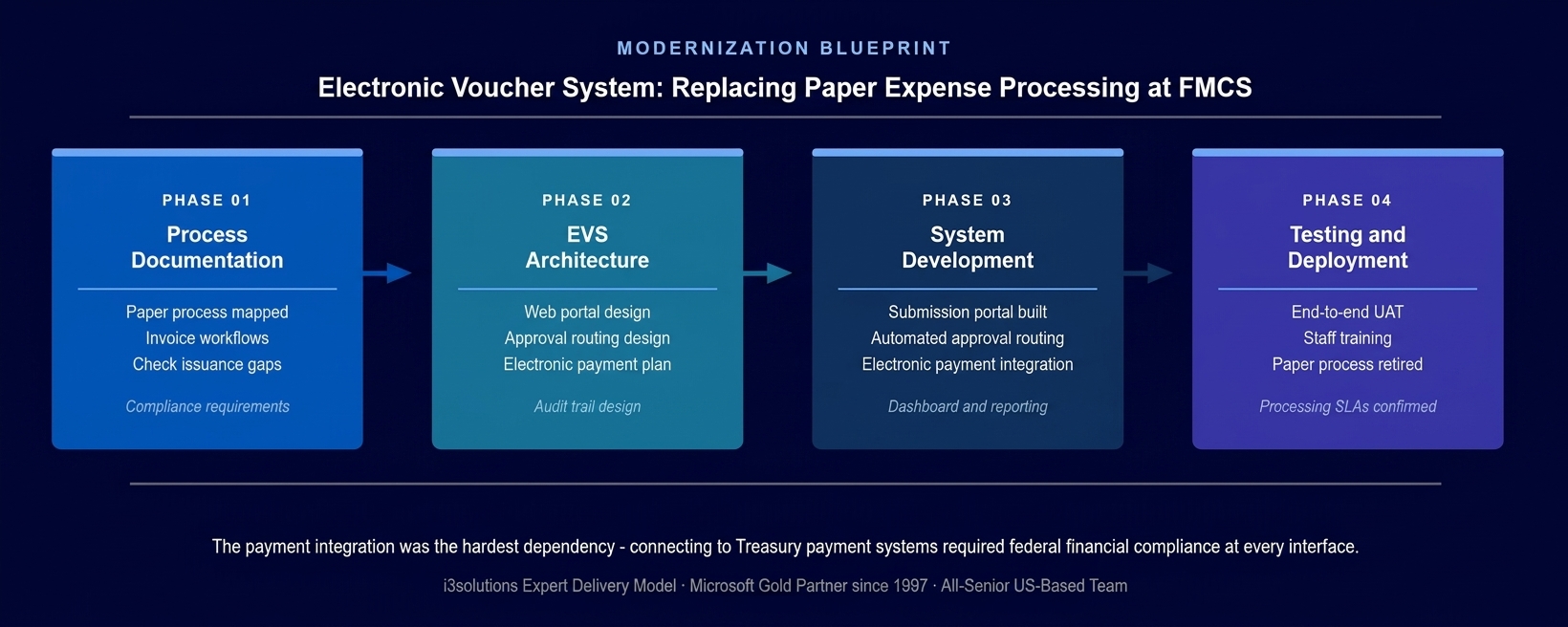
The four-phase approach. Federal payment compliance in Phase 2 was the constraint that governed the entire payment integration design – Treasury payment system interfaces have non-negotiable requirements that the EVS architecture had to satisfy before any development began.
PHASE 03
System Development
Web-based voucher submission portal enabling arbitrators to submit expense invoices electronically, attach documentation, and receive immediate confirmation. Automated approval routing eliminating the manual routing steps. Electronic payment processing integrated with federal payment systems for direct payment rather than check issuance. Real-time status dashboard providing arbitrators current status from submission through payment. Administrative dashboard providing FMCS staff complete voucher portfolio visibility and exception management.
PHASE 04
Testing and Deployment
End-to-end testing across the complete voucher lifecycle: submission, routing, approval, payment processing, and status update. Staff training on the administrative interface and exception handling procedures. Paper process retired. Post-deployment monitoring confirming processing time improvements and payment accuracy.
Technical Transformation
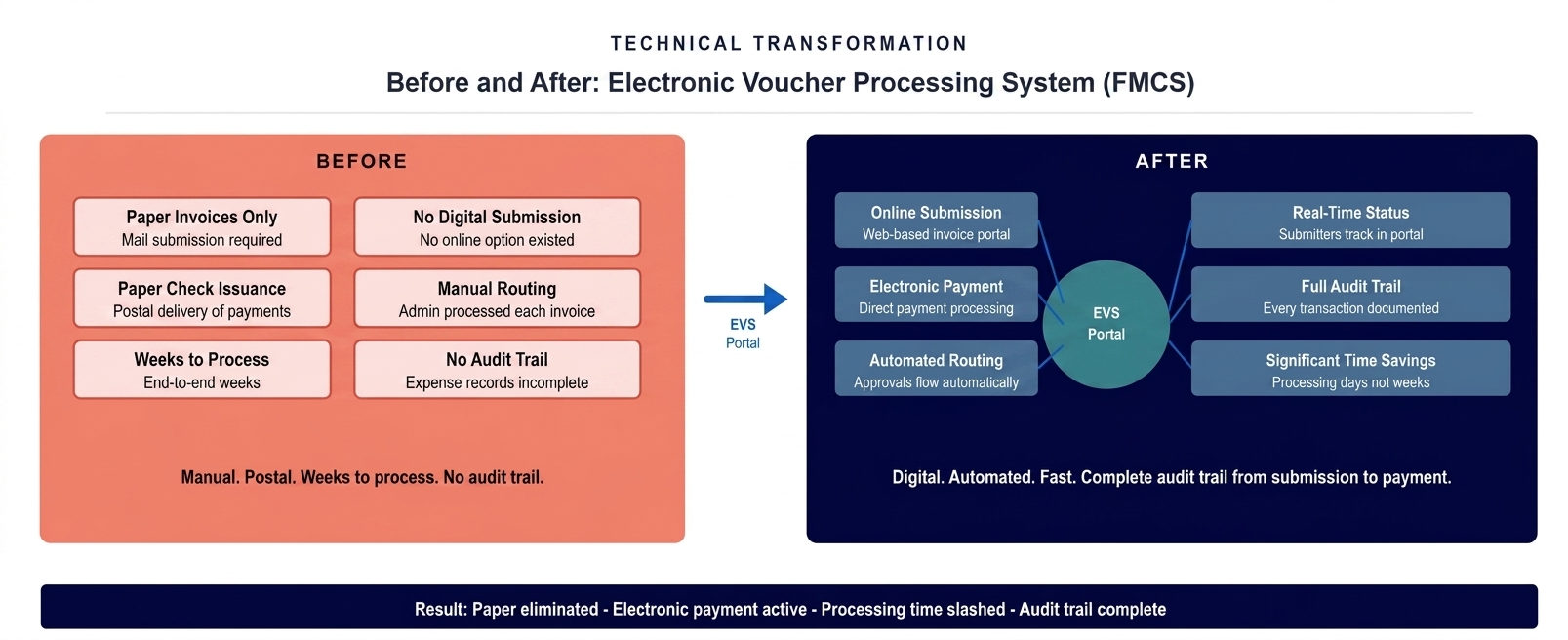
The expense processing state before and after EVS. Paper invoices by mail and reimbursement checks replaced by web submission, automated routing, electronic payment, and real-time status tracking.
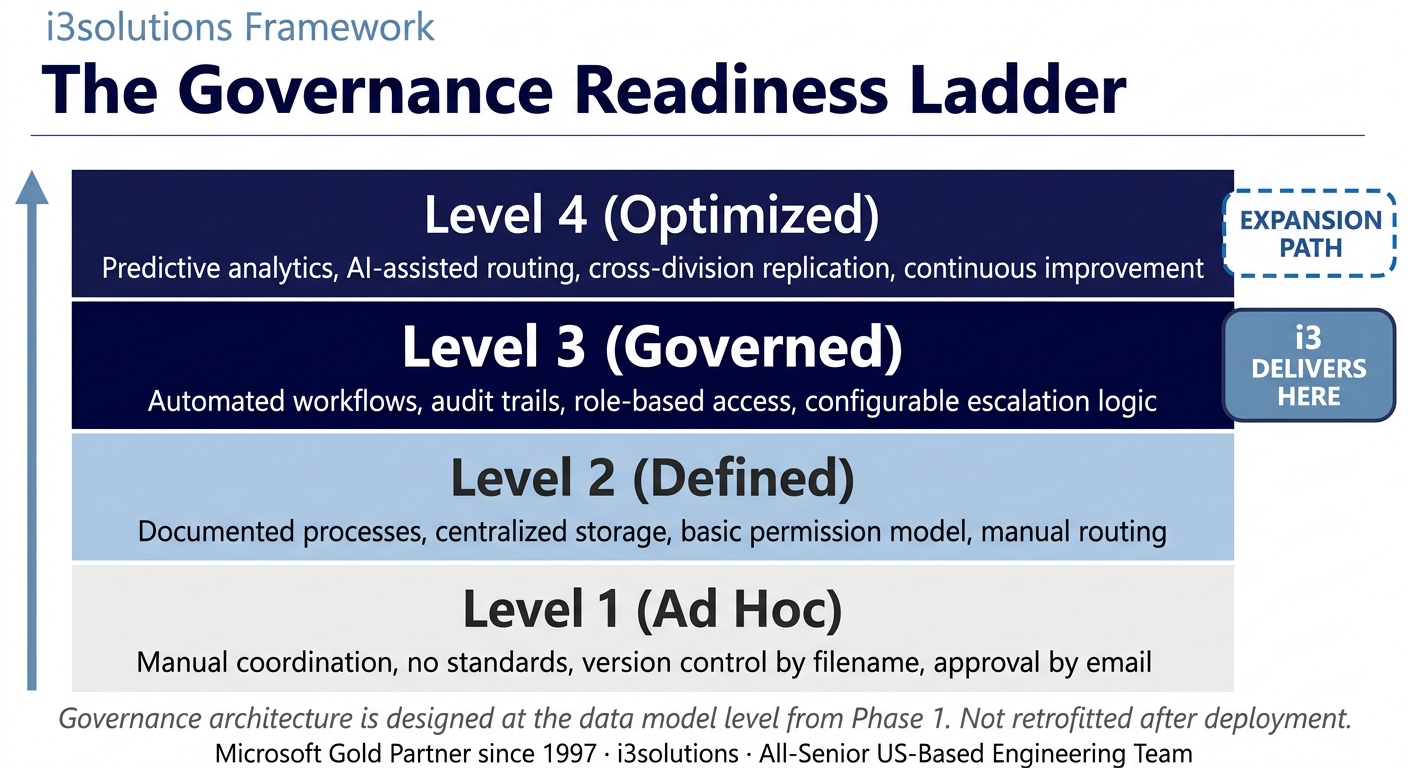
The Governance Readiness Ladder applied. EVS delivered Level 3 expense management governance. The electronic audit trail and payment integration architecture supports Level 4 as analytics and automated compliance reporting mature.
Measurable Outcomes
| Metric | Before | After | Improvement |
|---|
| Submission method | Paper invoices by postal mail | Web portal – electronic submission with instant confirmation | Postal submission eliminated |
| Processing time | Weeks – postal, manual routing, check issuance, postal return | Days – electronic routing, automated approval, direct payment | Processing time significantly reduced |
| Payment method | Paper checks by postal mail | Electronic payment – direct to arbitrator | Paper check eliminated |
| Status visibility | None – arbitrators called FMCS staff to inquire | Real-time portal status – arbitrators self-serve current status | Real-time visibility delivered |
| Audit trail | Physical paper records – incomplete and difficult to search | Complete digital record – every transaction documented electronically | Full audit trail active |
| Staff administrative overhead | Significant – manual processing at every voucher stage | Reduced – automated routing, staff handles exceptions only | Routine overhead eliminated |
[PENDING-CLIENT-QUOTE: insert 1-3 sentence outcome-focused quote in the client’s own language from a role matching the reader’s role.]
[Name or Role], [Organization type]
Frequently Asked Questions
Expense Management Automation for Federal Agencies
What is expense management automation for federal agencies?
Expense management automation for federal agencies involves replacing paper-based expense submission, approval routing, and payment processes with electronic systems that accept submissions through web portals, route them through configured approval workflows automatically, integrate with federal payment systems for electronic reimbursement, and provide real-time status visibility to submitters and administrators without requiring manual staff involvement in routine processing. For FMCS, this eliminated a paper-and-postal process that measured reimbursement time in weeks and replaced it with electronic processing measurable in days.
How does i3solutions approach federal expense system development with Treasury payment integration?
i3solutions treats federal payment integration as a Phase 1 architecture constraint, not a Phase 3 implementation task. Treasury payment system interfaces have specific compliance requirements, authentication standards, audit trail specifications, data format requirements, that must be designed into the electronic voucher system from the start rather than added after the application is built. For FMCS’s EVS engagement, the payment integration architecture was designed and validated against Treasury requirements before any portal development began, ensuring the system could achieve federal payment compliance rather than discovering integration blockers late in the engagement when reverting the architecture is expensive.
What does automated approval routing deliver for federal voucher processing?
Automated approval routing converts the manual voucher processing sequence, receive, log, route to approver, track, follow up, process payment, into a configured workflow that executes each step automatically when triggered by the preceding one. When a voucher is submitted, the workflow routes it to the correct approver based on the configured rules, sends the approver a notification, escalates if the approval deadline passes without action, and initiates payment processing once all required approvals are confirmed. The FMCS administrative staff who previously processed each voucher manually now handle only exceptions, approvals that require manual judgment outside the standard workflow. Routine processing is fully automated.
What security and compliance requirements apply to federal electronic payment systems?
Federal electronic payment systems must comply with Treasury Department requirements including authentication controls for payment authorization, audit trail requirements that document every payment action with timestamp and actor identity, data encryption standards for payment information in transit and at rest, and the specific interface standards required for connection to Treasury payment infrastructure. These requirements are non-negotiable, a federal electronic payment system that does not satisfy them cannot be deployed regardless of how well the rest of the application functions. i3solutions confirms compliance requirements in full before architecture decisions are made, so that the system is designed for compliance from the first phase rather than being validated against requirements it was never designed to meet.
Why choose i3solutions for a federal expense management system implementation?
i3solutions brings specific federal government delivery experience to expense management implementations, including prior FMCS engagements for both the arbitration system and EVS, combined with the custom application development depth that federal workflow and payment integration requirements demand. Federal expense systems have a particular failure risk: a system that processes reimbursements incorrectly or fails a Treasury compliance audit creates consequences for the agency and the individuals awaiting reimbursement. i3solutions’ all-senior delivery model and 600+ implementation track record reflect the standard of care that federal program delivery requires. Microsoft Gold Partner since 1997.
Back to Case Study Library
60 enterprise Microsoft implementations documented
Related Insights
From the i3solutions YouTube Channel
Short-form perspectives on the delivery and technology challenges in this case study.
Who This Engagement Serves
This engagement is relevant if
- Large federal agencies still using manual paper forms and spreadsheets to process employee travel reimbursements.
- Organizations requiring audit trails and real-time visibility into the approval status of financial documents.
- Public sector entities looking to digitize workflows using their existing Microsoft 365 and Power Platform licenses.
Less relevant if
- Small businesses with very few monthly expense reports that do not require complex approval routing.
- Companies already utilizing a modern, automated third-party expense management system like Concur or Expensify.
Ready to replace paper voucher processing with an electronic system that pays in days?
The 15-Business-Day Microsoft Assessment maps the web submission portal, automated approval routing, federal payment integration, and audit trail architecture that would convert your paper expense process to electronic processing from submission to payment.
Microsoft Gold Partner since 1997. 600+ implementations. All senior. All US-based.
Schedule the Assessment