Case Study • Federal Nonprofit Consulting • Microsoft 365 Migration
Logging in Three Times to Do One Job: How a Federal Consulting Firm Fixed Its Microsoft 365 and Okta Environment

The Enterprise Challenge
Microsoft 365 Migration Services for a Federal Management Consulting Nonprofit
LMI, a nonprofit consulting firm founded in 1961 and dedicated to improving the management of government, serves federal civilian agencies, the Department of Defense, and state and local governments with expertise in logistics, supply chain management, and information management. The organization that advised federal agencies on operational efficiency was experiencing a significant efficiency problem of its own: employees were logging in multiple times across various platforms because Okta and Office 365 were not properly integrated, creating authentication friction that consumed productivity and frustrated staff at every session.
The integration gap between Okta and Office 365 was the root cause. LMI had both platforms deployed, but the SSO configuration that should have made them operate as a unified authentication experience was not working correctly. The result was an environment where accessing different applications required separate login steps rather than a single authenticated session. For a consulting firm whose workforce moved frequently between multiple client-facing and internal tools, the cumulative login friction across a workday was a measurable productivity tax.
Concurrent with the SSO integration problem, LMI needed to migrate from its legacy platform to Microsoft 365 – modernizing its collaboration infrastructure while addressing the identity management gap that was undermining the value of both platforms. The engagement combined Microsoft 365 migration services and Okta SSO integration as a unified program to address both the migration and the authentication architecture simultaneously.
Strategic Trigger
Authentication Friction Was a Daily Productivity Cost Across the Entire Organization
For a consulting firm whose billable productivity depends on staff being able to move quickly between tools, systems, and client environments, the cost of repeated authentication steps was not a minor inconvenience. It was a friction that compounded across every session, every tool transition, and every new login required by an Okta/O365 integration that was not delivering the SSO it was designed to provide. Quantifying the per-employee, per-day cost of authentication friction and multiplying it across the full workforce produced a productivity loss that justified immediate investment in a correct integration.
The legacy platform migration was the second driver. LMI’s existing collaboration infrastructure was approaching the point where its limitations would begin affecting the quality of internal operations and, by extension, the quality of the work delivered to federal clients. Microsoft 365 offered the modern collaboration capability – Teams, SharePoint Online, the full M365 suite – that LMI needed to operate at the standard a leading federal consulting firm required of its own technology infrastructure.
Is Okta/O365 authentication friction costing your organization productivity every day?
If users are logging in multiple times per session because Okta and Office 365 are not properly integrated, the daily productivity cost is measurable. A 15-Business-Day Microsoft Assessment maps the specific SSO integration architecture that eliminates the friction and the M365 migration approach that modernizes the platform simultaneously.
Request the Assessment
▶ Related Insight — A 60-second perspective from our channel
Stakes
Operational collapse and severe regulatory non-compliance risks.
Failure to migrate from the aging SharePoint farm directly threatened LMI’s primary revenue streams. The technical debt accrued on the legacy architecture introduced unacceptable application latency, leading to significant drops in employee productivity and operational capacity during peak requirements. Inaction was not an option, as the on-premises hardware neared end-of-support; any failure would cause extended service blackouts. This infrastructure fragility jeopardized strict service level agreements (SLAs) with government and commercial partners, directly risking significant financial penalties, contract terminations, and the immediate erosion of client trust. Furthermore, the absence of robust Single Sign-On (SSO) integration created an expanded attack surface, violating security baselines and compounding audit and non-compliance exposures.
Beyond immediate technical risks, the outdated collaborative environment hampered LMI’s strategic agility and competitive advantage. Modern government contracting increasingly demands rapid, secure, and integrated information sharing, capability LMI desperately lacked. The inability to recruit or retain top talent accustomed to modern, cloud-native tools inhibited organizational growth. Strategically, the technological stagnation broadcast an image of an outdated organization, damaging the company’s reputation for innovation and reliability. The fragmented and inefficient workflows imposed by the old system stifled cross-functional innovation, preventing LMI from pursuing larger, more complex contracts that require seamless, digitally optimized collaboration. The downstream effect of continued inaction was a shrinking market share and a weakened position in the industry.
Constraints and Complexity
Complex data restructuring combined with zero-downtime authentication migration.
The existing SharePoint farm was extremely complex, with deeply nested custom applications, critical integrations with proprietary LMI databases, and fragmented governance. The primary constraint was the complete lack of architectural documentation for decades of accumulated modifications. This was compounded by strict DoD security requirements (IL4/IL5 data) which heavily restricted modern, cloud-native migration tools. Every process, application, and workflow needed a exhaustive security assessment and approval before migration. Additionally, the existing authentication mechanism was highly proprietary, making its transition to Okta for all cloud services particularly delicate. The organizational change management was similarly constrained; hundreds of critical business workflows had to be reinvented while thousands of users required comprehensive retraining, all while maintaining complete operational continuity and ensuring all business functions continued without any interruption.
The data migration itself presented immense complexity, encompassing over a decade of loosely organized documentation containing significant amounts of sensitive and proprietary data across vast storage repositories. This data required extensive purification, classification, and mapping to the new, streamlined Microsoft 365 environment, rather than a simple ‘lift-and-shift’ approach. Additionally, hundreds of critical custom-built applications, essential for everyday business operations, had to be painstakingly refactored or completely re-developed to work within the entirely new cloud paradigm, as their underlying codebases were fundamentally incompatible with the cloud environment. Ensuring that these critical business processes continued completely uninterrupted while transitioning millions of complex and varied files to Microsoft 365 presented an intricate logistical and technical challenge that required careful orchestration and flawless execution.
Selection Rationale
Senior Microsoft Specialists with Proven Delivery Depth
LMI’s evaluation of potential partners was rigorous, recognizing that this complex migration was a zero-fail mission. The organization thoroughly vetted several large, global systems integrators but found their proposal models lacking the necessary depth. These large firms typically leveraged heavy offshore delivery models, raising significant concerns regarding security compliance for LMI’s sensitive data and the immediate responsiveness required for a complex migration. Other mid-sized firms were also considered but ultimately disqualified due to their reliance on commodity staffing; their proposals often included junior-level developers with limited real-world experience. LMI required a strategic partner, not just a staffing agency, capable of providing senior leadership and deep, specialized expertise in both modernizing Microsoft ecosystems and implementing complex Okta integrations.
i3solutions emerged as the clear choice due to their unique combination of senior-level expertise, security commitment, and unmatched Microsoft ecosystem depth. LMI prioritized the certainty of delivery that comes with a partner holding uninterrupted Microsoft Gold Partner status since 1997. i3solutions’ track record of over 600 successful SharePoint implementations provided the verifiable evidence LMI needed of their capability to handle projects of extreme complexity. Crucially, i3solutions’ methodology of utilizing an all-senior, all US-based team addressed LMI’s stringent security constraints and ensured the necessary responsiveness for real-time collaboration. This eliminated the risks associated with time-zone delays and communication gaps inherent in other models. Choosing i3solutions gave LMI direct access to a deep pool of domestic, veteran architects and engineers committed to their project’s success.
The Engagement Approach
Migration and SSO Integration as a Unified Program
PHASE 01
Environment Assessment
Complete audit of the legacy platform and existing Okta/O365 configuration. Microsoft 365 tenant readiness assessment. Identification of the specific SSO integration gaps causing repeated authentication. Migration risk assessment for content, customizations, and workflow dependencies. Output: a migration and integration plan addressing both programs in a coordinated timeline.
PHASE 02
Migration Architecture and Okta/O365 Design
M365 tenant architecture for the new environment. Okta/O365 SAML SSO configuration design eliminating the repeated login steps through correct identity federation. User transition plan managing the authentication model change without disrupting access for LMI’s staff. Data mapping and migration sequencing for the content migration.
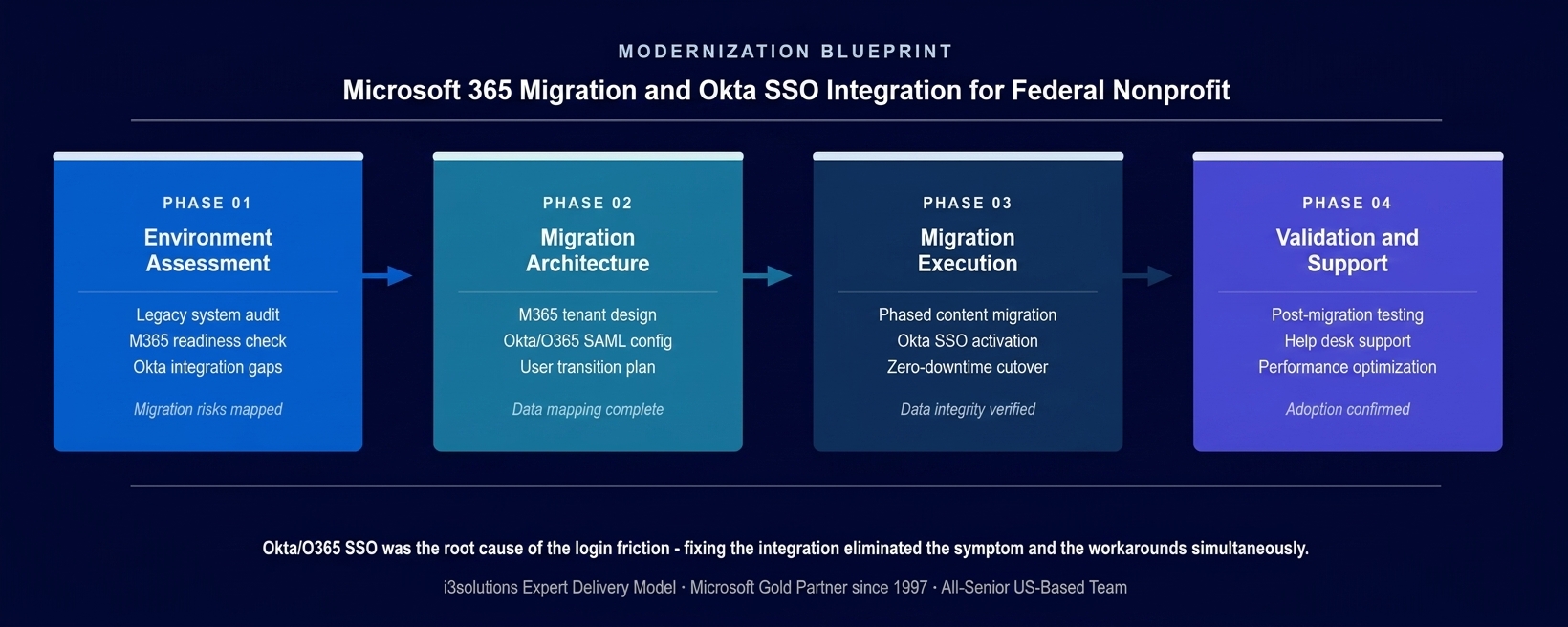
The four-phase approach. Getting the Okta/O365 SAML configuration right in Phase 2 was the root cause fix – the repeated logins were a symptom of an incorrect federation configuration, not a platform limitation.
PHASE 03
Migration Execution and SSO Activation
Phased content migration from the legacy platform to M365 SharePoint Online with data integrity validation at each phase. Okta SSO activation on the corrected SAML configuration, eliminating the repeated authentication steps. Zero-downtime cutover approach ensuring that staff access was maintained throughout the migration. Post-activation testing confirming single-sign-on function across all integrated applications.
PHASE 04
Validation and Optimization
Post-migration validation confirming content integrity across all migrated content. Help desk support for the user transition period. Performance optimization for the M365 environment. Adoption support for the M365 applications – Teams, SharePoint Online, and the full suite – that were now available on the modernized platform.
Technical Transformation
From Fragmented Authentication and Legacy Platform to Unified M365
Before the engagement, LMI operated a legacy collaboration platform alongside an Okta/O365 environment with a broken SSO integration that required users to authenticate separately to different applications rather than experiencing the single-login session the platforms were designed to provide.
After the engagement, LMI operated a unified Microsoft 365 environment with a correctly configured Okta SSO integration, providing the single-authenticated-session experience across all integrated applications that the platform investment was supposed to deliver from the start.
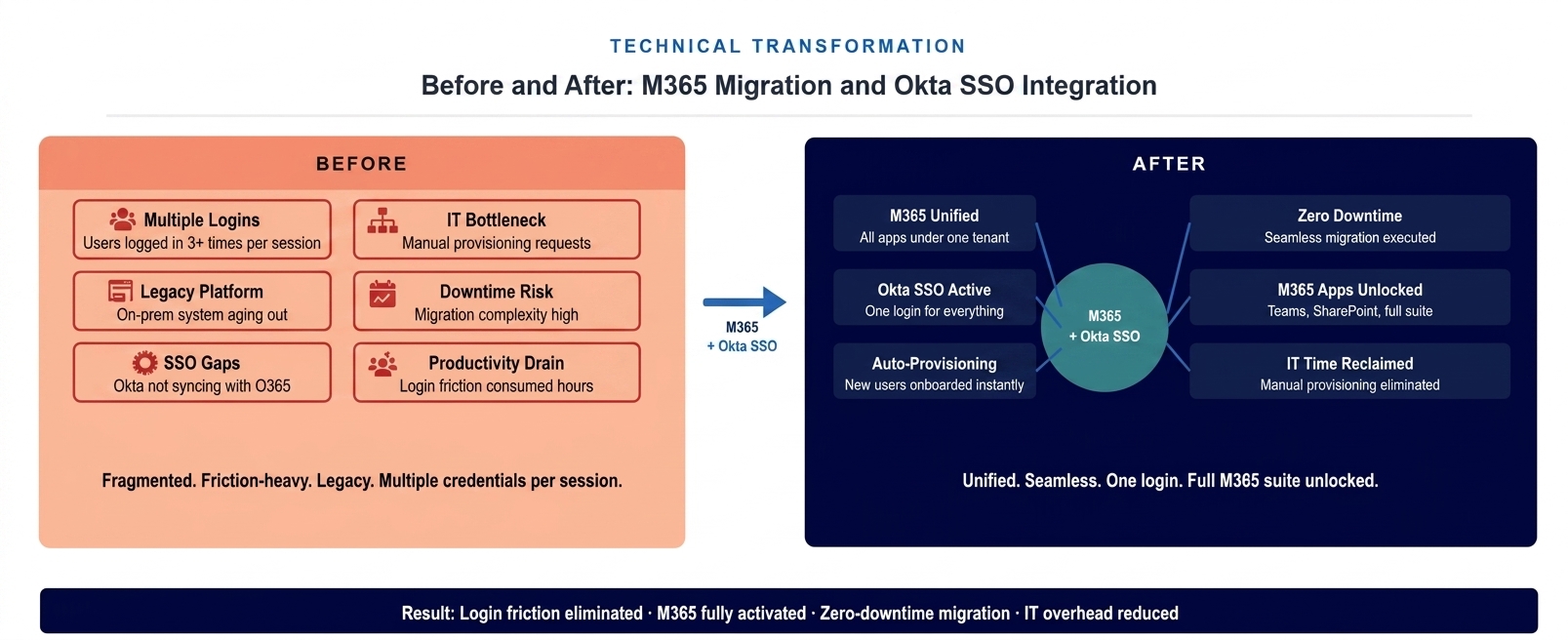
The authentication and platform state before and after. Multiple required logins and legacy platform replaced by unified M365 with Okta SSO delivering one login for everything.
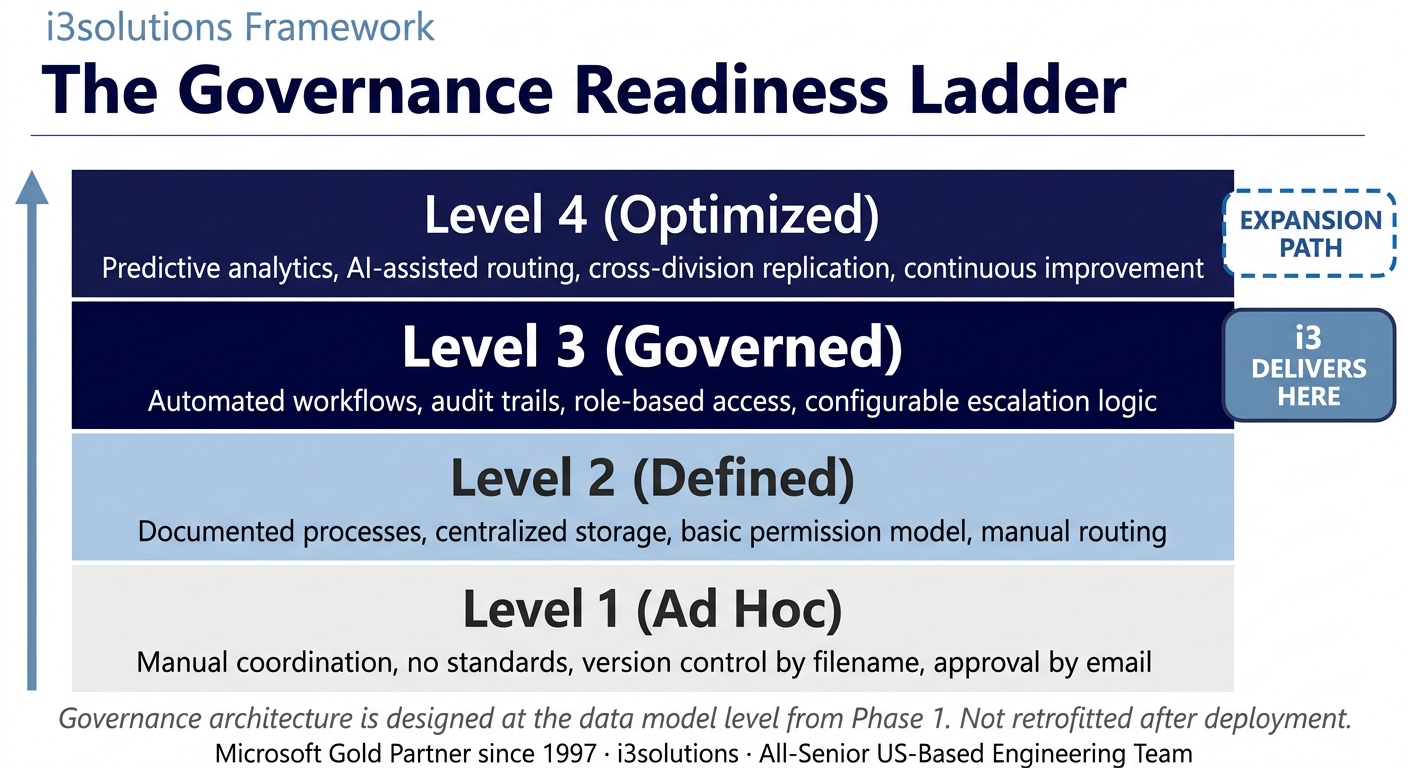
The Governance Readiness Ladder applied. The M365 migration and SSO integration delivered Level 3. The M365 foundation supports Level 4 as Power Platform and advanced collaboration capabilities mature.
▶ Related Insight — A 60-second perspective from our channel
Measurable Outcomes
| Metric | Before | After | Improvement |
|---|
| Authentication friction | Multiple logins per session – Okta/O365 SSO not functioning correctly | Single login – correct SAML configuration delivers unified session | Authentication friction eliminated |
| Platform currency | Legacy platform approaching limits of modern collaboration requirements | Microsoft 365 – Teams, SharePoint Online, full M365 suite active | Modern collaboration platform live |
| Migration downtime | Not applicable – concern was minimizing disruption during transition | Zero downtime – phased approach maintained access throughout | Zero-downtime migration achieved |
| M365 productivity tools | Unavailable on legacy platform | Full M365 suite accessible to all staff | M365 suite unlocked |
[PENDING-CLIENT-QUOTE: insert 1-3 sentence outcome-focused quote in the client’s own language from a role matching the reader’s role.]
[Name or Role], [Organization type]
Frequently Asked Questions
Microsoft 365 Migration Services for Federal Consulting Organizations
What is microsoft 365 migration services for nonprofits and consulting firms?
Microsoft 365 migration services involve planning and executing the transition from legacy collaboration platforms to the Microsoft 365 suite, SharePoint Online, Teams, Exchange Online, and the full M365 application stack, including identity management configuration to deliver single sign-on across all M365 applications. For federal consulting firms, migration also includes configuring Okta or Azure AD integration to eliminate per-application login friction, ensuring the modern platform delivers the seamless authentication experience the investment is designed to provide.
How does i3solutions approach a Microsoft 365 migration for a federal consulting firm?
i3solutions begins M365 migrations with an environment assessment that identifies the specific gaps causing current pain, for LMI, that was the Okta/O365 SAML configuration failure causing repeated logins, and sequences the migration to address those gaps first. Migration architecture is designed to maintain parallel access to both legacy and new environments throughout the transition, so users are never in a state where they cannot access their content. i3solutions confirms the platform is functioning correctly against the business requirements, single sign-on working, content integrity validated, productivity tools available, before retiring the legacy environment.
Why does Okta and Office 365 SSO sometimes require multiple logins, and how is it fixed?
Okta and Office 365 SSO requires multiple logins when the SAML federation configuration between the two platforms is incorrect or incomplete, typically a misconfigured assertion consumer service URL, incorrect entity ID, or session policy conflict that causes O365 to treat an already-authenticated Okta session as requiring separate authentication. Fixing it requires examining the SAML assertion exchange between the platforms to identify the exact configuration gap, then correcting the federation settings on both sides. This is a root cause fix, not a workaround, once the federation is correctly configured, the repeated login friction is permanently eliminated.
What is the ROI of Microsoft 365 migration for a federal consulting organization?
The ROI of M365 migration for a federal consulting organization comes from unlocking the collaboration productivity that the M365 investment is designed to deliver: Teams for integrated video and chat, SharePoint Online for modern document management, Power Platform for workflow automation, and the full suite of continuously updated Microsoft productivity applications. For organizations that had M365 licenses but were not realizing full value because of legacy infrastructure or broken SSO configurations, migration converts a sunk cost into an active productivity multiplier. The elimination of manual authentication steps alone has measurable impact at scale, across hundreds of staff making multiple daily tool transitions.
Why choose i3solutions for a Microsoft 365 migration with Okta integration?
i3solutions brings specific depth in both Microsoft 365 migration architecture and Okta identity integration, the combination required to fix a broken M365/Okta environment rather than just completing a migration that leaves the SSO problem in place. Our all-senior delivery model means the engineers who diagnose the SAML configuration gap are the same engineers who design the migration architecture, ensuring that the integration fix and the migration are coordinated rather than sequenced as separate projects that create a window where neither is working correctly. With 600+ Microsoft platform implementations and Microsoft Gold Partner status since 1997, i3solutions has handled the specific failure modes that federal consulting migrations encounter.
Conclusion
One Login, One Platform, Full M365 Suite
LMI replaced a legacy collaboration platform and a broken Okta/O365 SSO integration with a unified Microsoft 365 environment configured with correct Okta SAML federation, eliminating the repeated authentication steps that were taxing staff productivity, and unlocking the full M365 collaboration suite through a zero-downtime phased migration. Through Microsoft 365 migration services and Okta identity management delivered as a coordinated program, LMI moved from a fragmented authentication environment to a modern, unified collaboration platform that matched the operational standard the organization set for the federal agencies it advised.
Back to Case Study Library
60 enterprise Microsoft implementations documented
Related Insights
From the i3solutions YouTube Channel
Short-form perspectives on the delivery and technology challenges in this case study.
Who This Engagement Serves
This engagement is relevant if
- Organizations currently maintaining complex on-premise SharePoint farms that are nearing their official end-of-support dates.
- Companies requiring a modernized document management system integrated with robust cloud-based identity and access management.
- Enterprises seeking to migrate legacy data to Microsoft 365 while leveraging Okta for secure authentication.
Less relevant if
- Organizations that are fully cloud-native and have no existing on-premise legacy infrastructure to decommission.
- Companies with strict regulatory requirements mandating all data remain on-premise, prohibiting any cloud migration projects.
Ready to fix the Okta/O365 integration and migrate to Microsoft 365?
The 15-Business-Day Microsoft Assessment maps the SAML configuration root cause behind your authentication friction, the M365 migration approach that minimizes disruption, and the full platform activation plan that delivers the collaboration capability your investment is designed to provide.
Microsoft Gold Partner since 1997. 600+ implementations. All senior. All US-based.
Schedule the Assessment