Case Study • Climate Technology • Okta Provisioning Automation
Accounts That Lingered: How a Climate Analytics Firm Automated Okta Onboarding and Offboarding

The Enterprise Challenge
Okta Provisioning Automation for a Climate Risk Analytics Leader
Jupiter Intelligence, a trusted leader in climate risk analytics serving organizations that need to understand and manage their exposure to physical climate risk, operates in an environment where the quality of its data science and the speed of its team operations both matter. The firm’s ability to onboard new employees quickly, provision them with the correct access to systems and tools from day one, and revoke that access immediately and completely when they depart – these are not administrative preferences, they are operational and security requirements for an organization handling proprietary climate models and client risk data.
Jupiter faced a specific challenge in streamlining its employee lifecycle management within Okta. New hire onboarding required manual IT ticket processing before employees had access to the tools they needed. JIRA, central to Jupiter’s engineering and project workflows, was not synchronized with Okta, meaning that role changes in the organizational structure were not automatically reflected in JIRA permissions. And offboarding – the higher-security risk of the two – left departed employees’ accounts in states that required manual verification rather than automated deprovisioning.
i3solutions was engaged to implement Okta provisioning automation with JIRA integration that would replace manual lifecycle management with automated workflows: accounts created and provisioned on hire, role changes synchronized between Okta and JIRA, and access fully revoked on departure without requiring IT staff to manually process each action.
Strategic Trigger
Offboarding Risk Made the Business Case; Onboarding Friction Made It Urgent
The offboarding risk was the higher-stakes driver. At a firm handling proprietary climate analytics and client risk data, a departed employee whose access has not been completely and immediately revoked represents a security exposure that is both a data protection liability and a client confidence risk. Manual offboarding processes that depend on IT ticket processing introduce a time gap between departure and access revocation that automated deprovisioning eliminates entirely. The question was not whether to automate offboarding – it was why it had not already been automated.
The onboarding friction had a productivity consequence that compounded with every new hire. A climate analytics firm hiring scientists, data engineers, and client-facing staff needed those employees operational quickly. Days of waiting for IT provisioning tickets before having access to development environments, JIRA project spaces, and collaboration tools was a direct tax on the velocity that a growth-stage analytics firm needed.
Are departed employees’ accounts still active in your systems?
If offboarding requires manual IT processing rather than automated deprovisioning, the time between departure and access revocation is a security exposure. A 15-Business-Day Microsoft Assessment maps the specific Okta automation architecture that closes the gap.
Request the Assessment
Stakes
Operational inefficiencies risk significant financial losses
The ongoing problem of fragmented research document management presents substantial operational risks. If this issue remains unaddressed, the company could face significant financial penalties for failing to meet regulatory compliance standards in data handling. Inefficient document retrieval not only slows down time-to-market for critical research but also wastes valuable employee resources, translating directly into increased operational costs and decreased overall profitability.
From a strategic perspective, the inability to effectively leverage existing research assets hinders innovation. This failure can result in reputational damage, as delays in delivering research outcomes erode client trust and market position. Furthermore, lack of transparency and collaboration across divisions limits the company’s ability to compete in a rapidly evolving market, potentially leading to missed opportunities for growth and partnerships.
Constraints and Complexity
Integrating heterogeneous data sources poses major architectural challenge
One of the primary challenges lies in the diverse nature of existing data storage systems, with each division utilizing different formats and repositories. The technical constraint of integrating these disparate sources into a cohesive SharePoint environment is complex. Furthermore, stringent security protocols and compliance requirements add another layer of difficulty, ensuring that sensitive data is accessible only to authorized personnel while maintaining compliance across all divisions.
Migrating large volumes of legacy research data from old systems is another major hurdle. The complexity of mapping and transferring this data without loss or corruption, while minimizing downtime and business disruption, is critical. Additionally, driving user adoption for the new system across various divisions with differing workflows and technical proficiencies will require comprehensive training and change management strategies.
Selection Rationale
Senior Microsoft Specialists with Proven Delivery Depth
While evaluating alternatives, it became evident that generic solutions and offshoring models would not meet the company’s complex requirements. Large firms often rely on junior, offshore staffing, which can lead to communication barriers, slower turnaround times, and a lack of deeply specialized expertise necessary for a seamless SharePoint implementation and integration. These options lacked the depth and localized understanding required for a project of this magnitude.
The decision to choose i3solutions was driven by their impressive credentials as a Microsoft Gold Partner since 1997, backed by over 600 successful implementations. Their all-senior, US-based team provided the required depth of expertise and direct communication, ensuring a higher level of responsiveness and accountability. This strategic choice was crucial for achieving a reliable and high-performance SharePoint solution tailored to the specific needs of the business.
The Engagement Approach
PHASE 01
Requirements and Gap Analysis
Audit of the existing onboarding process documenting each manual IT step and its typical duration. Review of the JIRA/Okta integration gap identifying which role changes were not synchronizing and what access was persisting after offboarding. Compliance gap assessment. Output: complete lifecycle automation requirements covering all user states – new hire, role change, and departure.
PHASE 02
Okta/JIRA Architecture
SCIM provisioning design for automated account creation on hire. JIRA attribute mapping connecting Okta group membership to JIRA project permissions. Offboarding lifecycle rule design specifying the complete deprovisioning sequence. MFA policy configuration for consistent authentication across all applications.
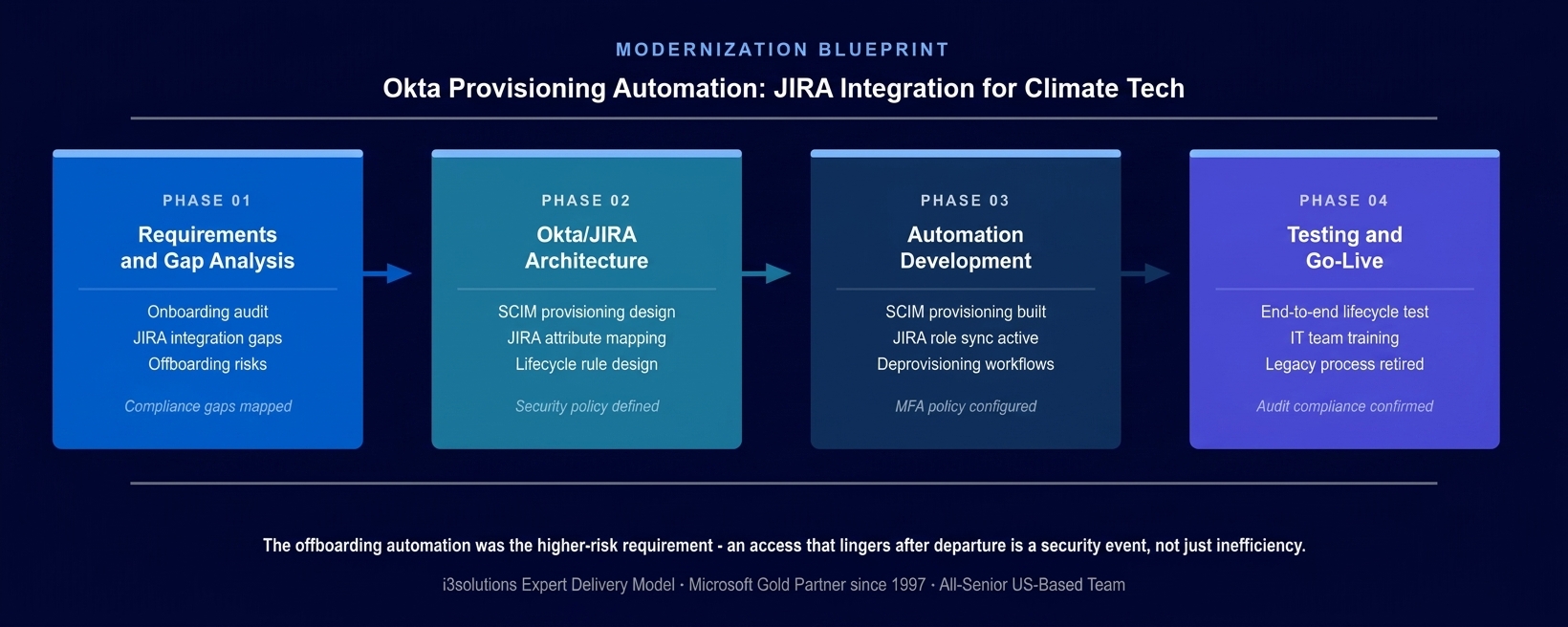
The four-phase approach. The offboarding deprovisioning sequence was designed in Phase 2 with input from security, HR, and IT – all three had different requirements for what “fully offboarded” meant.
PHASE 03
Automation Development
SCIM provisioning configured for automatic account creation and role assignment on new hire. JIRA role synchronization activated through the Okta/JIRA integration. Automated offboarding workflows configured to revoke all access on departure trigger without requiring manual IT action. MFA policy applied consistently across the integrated application environment.
PHASE 04
Testing and Go-Live
End-to-end lifecycle testing covering all user states: new hire provisioning, role change synchronization, and full offboarding deprovisioning. IT team training on the automated system and exception handling procedures. Legacy manual process retired. Audit compliance review confirming full access trail from onboarding through offboarding.
Technical Transformation
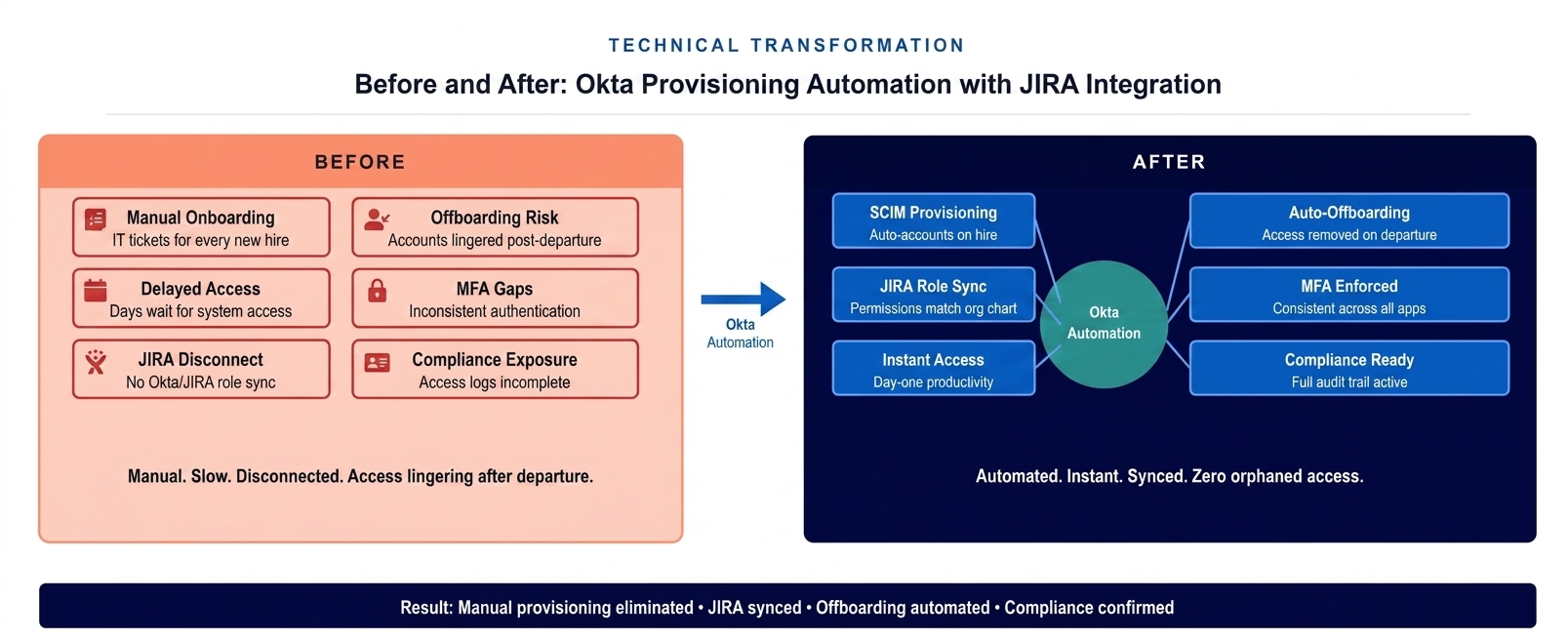
The identity lifecycle state before and after. Manual IT ticket processing and lingering access replaced by automated SCIM provisioning, JIRA synchronization, and instant deprovisioning on departure.
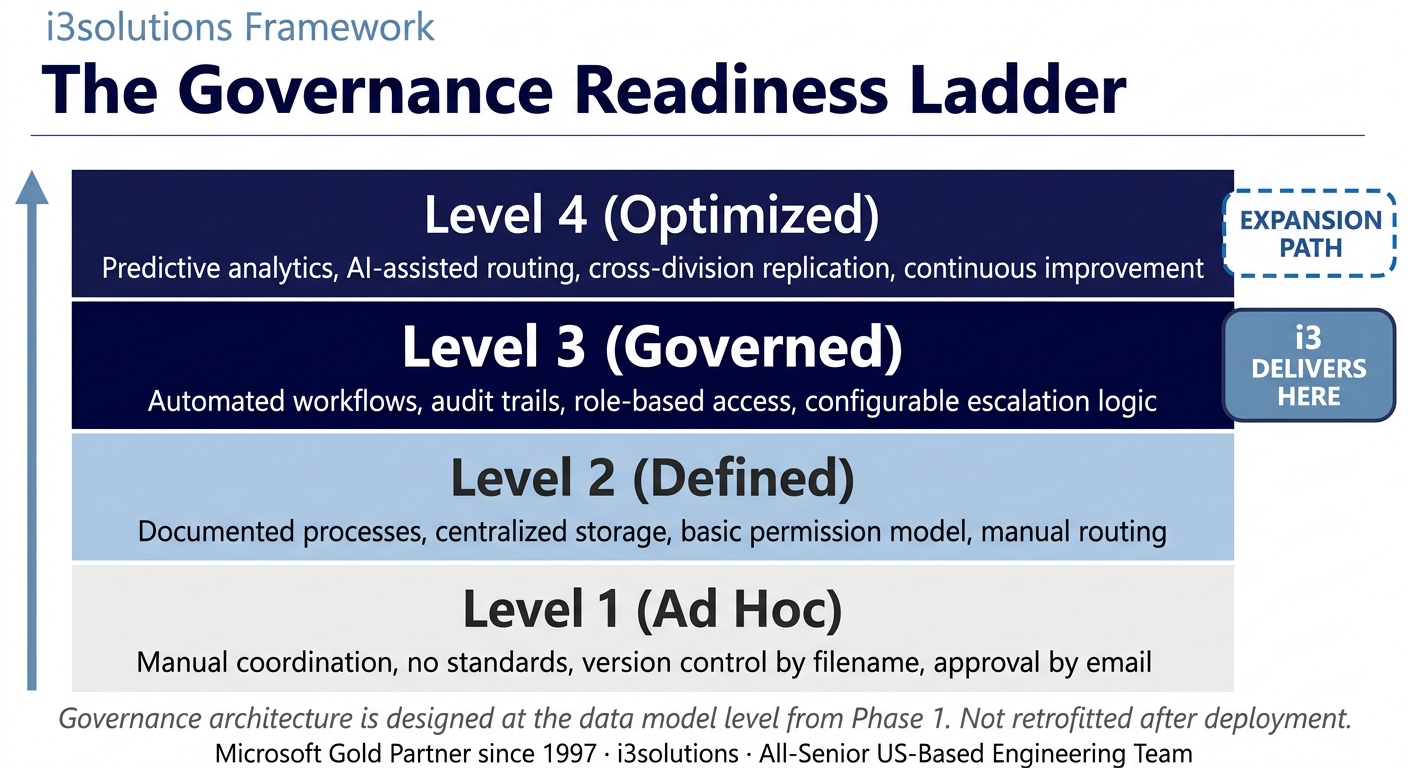
The Governance Readiness Ladder applied. Automated Okta lifecycle management delivered Level 3. The architecture supports Level 4 as adaptive access policies and continuous compliance monitoring mature.
Measurable Outcomes
| Metric | Before | After | Improvement |
|---|
| New hire access provisioning | Manual IT tickets – days to access | SCIM automation – day-one access on hire | Instant provisioning on hire |
| JIRA/Okta synchronization | Manual – role changes not reflected | Automated – JIRA permissions match Okta groups | Continuous synchronization active |
| Offboarding security | Manual – time gap between departure and revocation | Automated – access revoked on departure trigger | Zero-delay deprovisioning |
| MFA consistency | Inconsistent across applications | Enforced consistently across all integrated apps | Uniform MFA enforced |
| IT lifecycle overhead | Significant – manual processing for every lifecycle event | Eliminated for routine events – IT handles exceptions only | Routine IT overhead eliminated |
[PENDING-CLIENT-QUOTE: insert 1-3 sentence outcome-focused quote in the client’s own language from a role matching the reader’s role.]
[Name or Role], [Organization type]
Frequently Asked Questions
Okta Provisioning Automation for Technology and SaaS Organizations
What is okta provisioning automation and how does it work?
Okta provisioning automation uses SCIM (System for Cross-domain Identity Management) to automatically create, update, and deactivate user accounts in connected applications when lifecycle events occur in Okta. When a new user is added with the appropriate group membership, SCIM automatically creates accounts in all connected applications with the correct permissions. When a user is deactivated, SCIM automatically revokes access across all connected applications simultaneously, without requiring IT staff to manually process each application. The result is an identity lifecycle that operates at machine speed rather than ticket processing speed.
How does i3solutions implement Okta provisioning with JIRA integration?
i3solutions begins Okta provisioning engagements with a requirements and gap analysis that maps the current onboarding and offboarding processes in detail, every manual IT step, every system where access is granted or revoked, and every point where the current process creates delay, error, or security exposure. The JIRA integration is designed at the attribute mapping level, connecting Okta group membership to JIRA project permissions so that organizational changes propagate automatically to both systems. For Jupiter Intelligence, the offboarding automation was designed first because it addressed the higher security risk, access that lingers after departure is a security event, not just an inefficiency.
Why is automated offboarding more secure than manual offboarding processes?
Automated offboarding is more secure than manual offboarding because it eliminates the time gap between an employee’s departure and the revocation of their access. Manual offboarding requires IT staff to receive departure notice, process a ticket, identify all systems the employee had access to, and revoke access in each one, a sequence that can take hours or days and may miss systems not in the original provisioning record. Automated offboarding triggered by an Okta deactivation revokes access across all connected applications simultaneously and immediately, with no time gap and no system-by-system manual process. For a climate analytics firm handling proprietary models and client risk data, eliminating that window is a meaningful security improvement.
What should technology companies look for when selecting an Okta implementation partner?
Technology companies should look for an Okta implementation partner with specific depth in SCIM provisioning and JIRA integration, not just general Okta configuration experience. The difference between a provisioning implementation that works correctly at scale and one that creates duplicate accounts, missed deprovisioning, or JIRA permission gaps is architectural, it is in the SCIM attribute mapping, the provisioning rule design, and the offboarding trigger configuration. i3solutions has implemented Okta provisioning automation across defense, technology, and federal clients, developing the pattern recognition to identify provisioning edge cases, role changes, contractor accounts, shared service accounts, before they create compliance issues.
How does Okta provisioning automation impact IT team capacity?
Okta provisioning automation converts IT’s identity management workload from routine transaction processing to exception handling. Before automation, IT staff process every onboarding, role change, and offboarding request as a discrete ticket, receiving the request, identifying the correct systems, creating or modifying accounts in each, and confirming completion. After automation, those routine events are handled by the system. IT staff handle only the exceptions, accounts that require manual intervention, access requests outside the standard provisioning model, or compliance investigations that require account history review. For a growth-stage technology company like Jupiter Intelligence hiring rapidly, this capacity difference is significant: onboarding speed scales with the hire rate, not with IT headcount.
Back to Case Study Library
60 enterprise Microsoft implementations documented
Related Insights
From the i3solutions YouTube Channel
Short-form perspectives on the delivery and technology challenges in this case study.
Who This Engagement Serves
This engagement is relevant if
- Multi-divisional organizations with disparate content management practices across R&D and engineering teams
- Large global firms seeking to centralize access to intellectual property and collaborative research
- Entities with complex data access requirements that must harmonize information governance across several subsidiaries
Less relevant if
- Small single-location businesses with simple, un-fragmented document management needs and minimal growth
- Organizations already highly integrated within the Microsoft 365 and SharePoint Online ecosystem
Ready to eliminate manual provisioning and automate offboarding?
The 15-Business-Day Microsoft Assessment maps the SCIM provisioning architecture, JIRA integration, and offboarding automation that would replace your manual lifecycle management with automated workflows that secure departure access on the day it happens.
Microsoft Gold Partner since 1997. 600+ implementations. All senior. All US-based.
Schedule the Assessment